Zhejiang · Quzhou
Root Palace, Buddha Kingdom: The 5A One Man Carved
China's highest scenic-area rating usually goes to a mountain, a walled city or a lake with two thousand years of poetry attached to it. In a forested county in western Zhejiang it went to the collected works of a living sculptor, made almost entirely out of dead tree stumps.
5A View location, maps and nearby scenic areasAlmost every place holding China’s top tourist rating is old. The rating is called 5A, it is the ceiling of a five-step national scale, and the roughly 370 sites carrying it are overwhelmingly mountains with a thousand years of poetry stuck to them, imperial complexes, walled towns, gorges, lakes and grottoes. The newest thing at most of them is the car park.
In one county in western Zhejiang this is inverted.
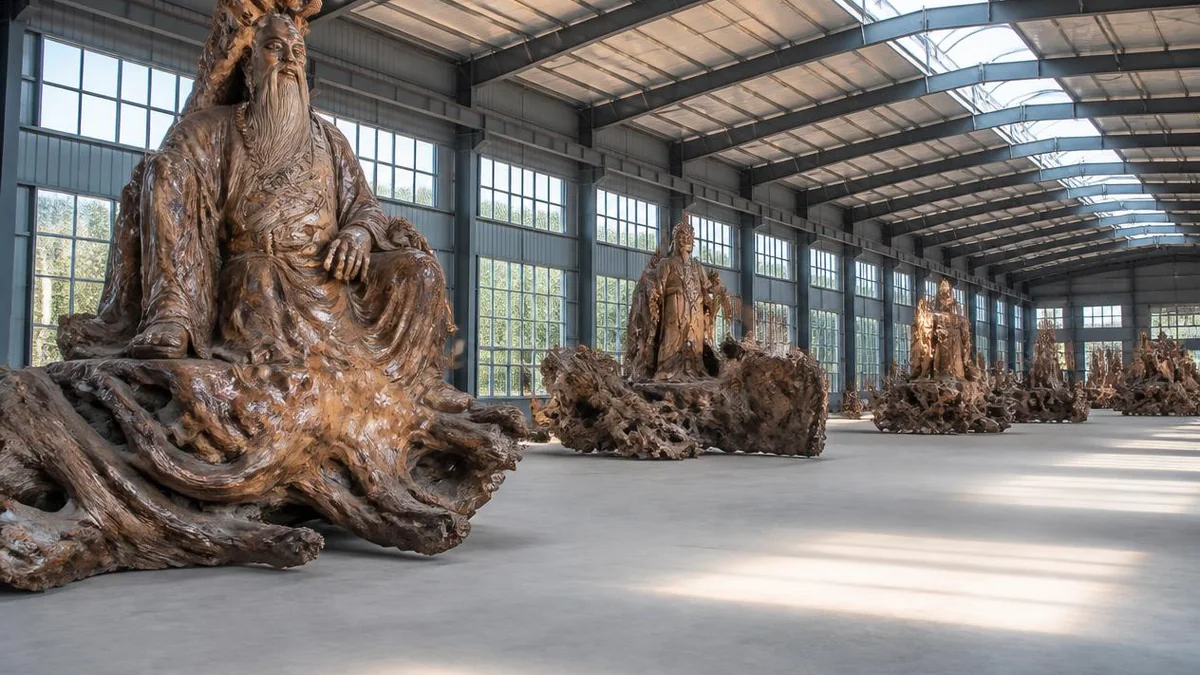
At Kaihua Root Palace Buddha Kingdom — the name is literal, and it is two halves — the oldest things on site are the raw materials and the newest are the sculptures. The material can be centuries dead before anyone touches it. The sculpture is contemporary. And almost all of it is the work of one living artist, Xu Guqing, born in this county and still producing.
A national tourist rating usually certifies a place. This one certifies a body of work.
The rating is not what you think it is
Start with the rating, because misreading it is the single most common mistake foreign visitors make about Chinese travel, and this park is the cleanest possible demonstration of the point.
The A-grades come out of a national standard for classifying tourist areas. A site is scored on two schedules. One covers landscape and resource quality — how good the thing itself is. The other, much longer, covers service and environment, and it does most of the work: transport access, parking, signage in more than one language, toilets, guiding, interpretation, safety, sanitation, complaint handling, staffing ratios. Visitor opinion is surveyed separately. A 5A site clears very high thresholds on all of it.
What none of it measures is age.
There is no clause anywhere awarding points for a Tang foundation date. A 5A rating says a place has been assessed as outstanding in what it offers and competently run in how it offers it. It is not a heritage listing — China has a separate national system for that, and the two overlap without matching.
Once you see this, several baffling entries on the 5A list make sense at once. Hengdian World Studios, a working film backlot east of here with a full-scale replica Forbidden City in it, is 5A. And a museum of root carving in a forest county can be 5A, because it can have excellent parking, excellent toilets and a first-rate collection of a thing found nowhere else at that concentration.
A county at the top of a river
Kaihua County sits in the far west of Zhejiang province, in Quzhou prefecture, up against the borders of both Anhui to the north and Jiangxi to the west. It is hill country: narrow valleys, terraced tea, bamboo, and forest cover reported at over eighty per cent, which is high even by the standards of a province that is mostly hills.
Its geographical claim is a headwater. The Qiantang River, which runs out past Hangzhou and produces the most famous tidal bore in China, gathers from streams in this district, and the county has built an identity on being its source. A national park pilot for the Qiantang headwaters was established in these mountains in the 2010s, protecting a block of subtropical evergreen broadleaf forest unusual for how little of it was cut.
That detail is not decoration. It is the reason there is a root carving industry here at all.
A root carver needs stumps, and stumps come from forests that have been worked — logged, coppiced, cleared for terraces, flooded by reservoirs, scoured by streams. A county with a lot of trees, a long history of small-scale timber cutting, and rivers that dig things out of banks is a county with a supply. Kaihua has been associated with the craft for long enough to promote itself as a home of root carving art in China, and the park is the industrial-scale expression of a local trade that existed before it. Think of the way Carrara has a marble sculpture culture. The rock is why.
What a root carving actually is
For a reader with no background, this is the part worth slowing down on, because root carving is not what the words suggest and it is not a subset of wood carving.
A wood carver works with timber: felled, sawn, squared, dried. It arrives as a block, more or less neutral, and the carver decides what shape comes out of it. Authority runs from the artist into the material.
A root carver works with a stump, a root ball, a burl, or wood that has spent decades in a riverbed. None of it is neutral. Its shape was decided by drought, rot, fungus, insect galleries, a rock the root had to grow around, a flood that stripped the softwood and left the hard. The carver’s job is to look at several hundred such objects, find the one that already contains something — a shoulder, a beard, a wave, a coiled animal — and then remove as little as possible to make other people see it too.
The maxim the trade repeats is seven parts nature, three parts human hand. It is a claim about proportion and also a claim about authority. The related principle, work according to the material, means the same thing from the other direction: you do not impose the subject, you accept the one you are offered.
This produces an art form with peculiar properties. It is almost entirely subtractive. It cannot be repeated — there is no second stump like the first, so there are no editions and no copies. Its best pieces are the ones where the intervention is least visible, which means the craft’s highest achievement looks, to an untrained eye, like the artist did nothing. And the failure mode is obvious: the moment a carver forces a subject onto the wood the piece dies, and you can see it die without knowing why.
Walk a large root carving collection and you are watching one person’s judgement, several thousand times over, about when to stop.
Mr Wood the Recluse
The premise of this park is far older than the park.
Han Yu (768–824) was a Tang dynasty essayist and official, the figure conventionally credited with turning classical Chinese prose back towards plainness after centuries of ornament — roughly the position Samuel Johnson occupies in English, an argumentative moralist who became a standard. Among his poems is a short one written about a piece of wood.
The object, as the poem describes it, was a water-worn root or trunk — burned by fire, holed by waves, so old the years were past counting — whose knot happened to look like a head and whose shaft like a body. Someone named it Mr Wood the Recluse, as though it were a retired scholar. Having been named, it began to attract an endless queue of people asking it for blessings.
Han Yu’s tone is dry. He is noting how little it takes: a shape, a label, and the human appetite for somewhere to direct a request. Whether he meant it as a joke about superstition or a remark about how sacredness gets made, the poem sits at the centre of what a root carving park is doing. A stump becomes a figure. A figure becomes a Buddha. People come.
The practice is usually traced further back than the Tang. The claim most often repeated in Chinese writing on the craft is that carved root objects have been excavated from Warring States tombs in the middle Yangtze, which would put the technique before the unification of China in 221 BC. I have not been able to check that against the excavation reports, and would treat it as the craft’s founding story rather than settled archaeology.
The useless tree
There is a second and deeper text under this park, and it is one of the foundational works of Chinese thought.
The Zhuangzi, compiled around the fourth to third centuries BC and named for the philosopher Zhuang Zhou, is the funniest of the Chinese classics and the one most preoccupied with the uses of uselessness. It returns to trees. In one passage a man complains about an enormous tree too gnarled for a chalk line and too crooked for a square — no carpenter will look at it. The reply is that this is exactly why it is still standing. In another, a giant oak beside a village shrine is examined by a master carpenter who walks straight past: the wood would rot as a boat and split as a coffin. Being worthless as timber is the tree’s whole technique for reaching an enormous age.
The Zhuangzi also supplies the phrase that Chinese writing about root carving reaches for almost every time: to transform the rotten into the miraculous. The line it descends from is about the reversibility of the two — what is foul becomes marvellous, what is marvellous becomes foul, and the distinction is a matter of where you are standing.
Put those together and you have the intellectual case for this park stated two thousand years before it existed. The wood that survives is the wood nobody wanted. The stump is what is left after the useful part of the tree has been taken away and sold. What root carving does is come back for the remainder — the part the timber trade rejected, the part that is by definition waste — and turn it into the object of highest value in the room.
The Buddhist half of the site pushes the same logic one step further. A discarded stump becomes an arhat, a being who has completed the path. The material ethic and the doctrine line up neatly enough that it barely needs explaining on the signage, and mostly is not.
Where the material comes from, and the problem with that
The waste-into-treasure story is true, and it is not the whole story, and any honest account of contemporary root carving has to hold both.
The benign supply is real and substantial. Stumps left after legal felling, which otherwise rot or get grubbed out and burned. Roots exposed by river scour. Trees killed by storms. Old orchard and tea stock cleared at the end of its productive life. Timber recovered from reservoir beds where valleys were flooded for hydropower, of which Zhejiang has a great deal. And buried wood, known by trade names that translate as sunken wood or dark wood: trunks that went into anaerobic mud in a flood, sometimes thousands of years ago, and came out semi-mineralised, dense and stable. That material is authentically ancient and authentically waste, and turning it into a sculpture is an unambiguous gain.
The problematic supply is also real. Once spectacular roots acquired high prices — and they did, in the Chinese collecting boom of the last two decades — a market appeared for going and getting them. The most-cited case is the high-altitude cliff cypress prized for its dense, resinous, contorted deadwood, where demand drove digging on exposed slopes in the northwest that stripped stands and destabilised ground. Nobody serious in the craft defends it. But it means that root carving uses only what would have been thrown away describes the craft’s ideal rather than any particular object.
Most of what is in these halls is camphor and other southern hardwood from a heavily worked forest region, which is the benign end of the trade. It is still worth knowing that the claim printed on the tin has a live counter-argument, and that Chinese conservation press has been running it for years.
Xu Guqing
The park exists because of one person, and this is unusual enough in the Chinese scenic-area system to be the most interesting administrative fact about it.
Xu Guqing was born in Kaihua in the 1960s, took up root carving locally, and built the practice into an enterprise — a workshop, then a company, then a collection, then a museum, then a landscaped park around it, then a national rating. His studio name translates roughly as drunk on roots and appears on the branding throughout the site. The trajectory is a founder’s, not a curator’s.
The correct Western comparison is not a museum. It is Vigeland Park in Oslo, where more than two hundred sculptures by Gustav Vigeland (1869–1943) occupy a public park that is one of Norway’s most-visited attractions, all by one hand, all under one commission, arranged as a single continuous statement. Nobody visits Frognerparken to see the history of Norwegian sculpture. They visit to see what one man did, at length, in one place, in one material.
Kaihua works the same way, with three differences. The artist is alive. The material fights back — Vigeland could make granite do what he wanted, and no root carver can. And the collection sits inside a rating system designed for landscapes, which is why a body of contemporary sculpture ends up sharing a grade with Huangshan.
One fair criticism should be said plainly: a very large collection by a single living artist, seen in one afternoon, produces a fatigue that a mixed collection does not. The strongest twenty pieces are extraordinary. The next two hundred are the same sensibility again.
Five hundred faces that have to be different
The Buddha Kingdom half is the reason most Chinese visitors come, and the set piece is a hall of five hundred arhats.
For readers with no background: an arhat — luohan in Chinese — is a person who has completed the Buddhist path and will not be reborn. In Indian Buddhism they are disciples and elders. In China they became considerably more entertaining. The iconography licenses extremes that ordinary Buddhist figures do not permit: enormous eyebrows, grotesque foreheads, absurdly long arms, animals, comedy, decrepitude, drunkenness, one man scratching, another asleep. Big halls of them are an established temple type, and the good ones are portrait galleries of eccentrics.
The five hundred is a conventional number rather than a fixed roster, and the one rule everybody observes is that no two may be alike. Five hundred distinct faces, five hundred distinct postures, no repeats.
That convention is why form and material fit together so well. A carver in stone or bronze who must produce five hundred non-identical figures faces an exhausting design problem: the variation has to be invented five hundred times, and invented variation goes stale. A root carver has the opposite problem. Variation is forced on him. Every stump is asymmetrical in a way no other stump is, and the discipline is not to flatten it. The differentiation does itself, and the artist’s contribution is restraint plus the decision about which stump is which saint.
It also means the figures are read differently from temple statuary. At a working temple such as Lingyin in Hangzhou you look at an arhat and see an attribute — the tiger, the alms bowl, the staff. Here you see the wood first: a burl that became a shoulder, a root fork that became crossed legs, a rotted hollow that became a mouth. The devotional reading and the material reading compete, and most visitors end up doing the material one, which is arguably the point.
The palace half
The Root Palace side holds everything that is not a deity, and it is where the range of the craft is easier to see.
The secular repertoire is broad and fairly stable: dragons and mythical beasts, which suit sinuous root systems almost too well; eagles, cranes and horses; literati subjects — a scholar, a fisherman, a monk on a rock; landscape pieces, where a root is read as a mountain range rather than a figure; furniture, especially tea tables, root chairs and screens; and unaltered specimens presented as objects in their own right, with nothing done to them but cleaning, stabilising and a base.
That last category is the one to look for and the one most visitors walk past. A root displayed as a root, with a title and a stand, is the craft’s purest statement — a claim that the finding was the art and the carving would have been interference. It is roughly the argument Duchamp made about a bottle rack, arrived at from a completely different direction and without any of the irony.
The furniture is worth a look for a duller reason. It shows you the economics: the tea-table trade is what pays for a workshop large enough to attempt five hundred arhats.
Numbers I am not going to repeat
Every write-up of this park carries a set of figures: hectares, number of works, tonnes of timber, visitor counts, the year the plaque arrived. They vary, sometimes by a lot, between the park’s own material, the county’s, the province’s and the aggregators that copy from all three.
This is normal for Chinese scenic areas and it has a mundane cause. The assessment date, the announcement date, the gazette date and the plaque ceremony are four separate events reported interchangeably as the date. Areas get quoted variously as planned, developed, open to visitors, or the administrative unit around them. Collection counts drift because the collection is still growing.
What can be said with confidence is that the 5A designation was made in 2013, that it was the first in Quzhou prefecture, and that the park was assembled through the 2000s and reached roughly its present form around the time of the award. Anything more precise I would want to see in a gazette first. The alternative — taking one number from one press release and stating it as fact — is what most English-language write-ups of this place do.
Zhejiang carves
The park does not come out of nowhere, and the provincial context is the strongest argument that it belongs where it is.
Chinese decorative woodcarving is conventionally reckoned in four regional schools, and two are in this province: the architectural carving of Dongyang, which supplied beams, brackets, screens and lattice to Jiangnan houses for centuries and whose craftsmen remain the default choice for restoration work; and the boxwood figure carving of Yueqing on the coast, a small-scale, dense-grained, hand-held tradition. The other two are usually given as the gilt-lacquer carving of Chaozhou and the longan-wood carving of Fujian.
Dongyang matters here for a second reason: it is the same district that contains Hengdian, the film backlot mentioned earlier. Within a few hours of Kaihua you have an old carving tradition and China’s largest studio complex sharing a county, both selling to visitors.
Root carving sits slightly outside the four-school scheme. It is not architectural and not a figurine tradition; it is closer to a collecting practice that grew a workshop. Fujian and Zhejiang are both strongly associated with it, and the boom of the last thirty years has been driven as much by the antiques and tea-culture markets as by any craft lineage.
What the rating actually bought you
For a visitor, the practical content of a 5A rating is worth spelling out, because it is mostly invisible until it is missing.
It means the road in is signposted and the car park works. It means interpretation exists at the object level rather than as one board at the gate, in Chinese and usually in at least one other language. It means the toilets are maintained to a standard the assessors physically check, and that there is shuttle transport, wheelchair provision, first aid and a complaints procedure. It also means the grade can be taken away if the site stops delivering any of it — demotions happen, and they are reported nationally when they do.
For a foreign visitor with no Chinese, that bundle is the difference between a manageable day and a lost one.
What it does not tell you is whether you will find several thousand carved tree roots interesting, and people split hard on that. Visitors who like objects and craft process stay longer than they planned. Visitors who came to Zhejiang for landscape and got a large indoor sculpture collection in a small county find it a long way to go. Knowing which you are, before you commit the day, is the most useful thing this article can tell you.
Kaihua outside the gate
The county rewards a little attention on its own account, and pairs well with the park precisely because it is the opposite kind of experience.
Kaihua Longding is the local tea — a green tea from these hills with a real reputation in Zhejiang, which in a province that also produces Longjing is not a trivial thing to have. Spring is when to buy it and the hillsides above the villages are worth the drive in April for their own sake.
The local food is distinctive enough to plan around. Kaihua is known for a light aerated steamed cake made from fermented rice batter and eaten hot, and — more divisively — for small pointed freshwater river snails cooked hard with chilli and sucked from the shell.
The forest is the real landscape attraction. The headwater country north of the county town is protected, walkable, and about as good as low-altitude evergreen broadleaf forest gets in eastern China. If you come this far west in Zhejiang and only see the inside of a museum, you have missed what the county is.
Mount Jianglang — same prefecture, three enormous freestanding rock towers, World Heritage-listed as part of the Danxia serial site — is the other 5A in Quzhou and the natural pairing. Qiandao Lake, the reservoir in the neighbouring county northeast, is the other obvious extension, and a good illustration of where a lot of southern Chinese carving timber came from: a valley system flooded in the twentieth century, with a great deal of wood left under it.
Visiting
Treat it as a half day, and as an indoor half day.
That framing helps more than it sounds. Zhejiang gets a long wet season — plum rains through June, typhoon tails in late summer — and a large share of this park works in the rain, which is not true of any of the province’s mountains. If you are in western Zhejiang and the forecast collapses, this is the day to move here.
Access is via Quzhou, on the main east–west rail corridor across the province and reachable from Hangzhou in well under two hours; Kaihua is a further road trip northwest. Confirm current opening hours, ticket prices and shuttle arrangements on arrival rather than from any article, including this one.
Give the arhat hall more time than you think you need, and walk it twice: once looking for the saints, once for the stumps. Then find the section where uncarved material is displayed as material, which is quieter and where the argument of the whole place is made.
Carry one question through the halls, because it is the one this park exists to provoke and it has no settled answer. Every object here was once dead wood a timber cutter walked away from. Somebody looked at it long enough to see a figure, and removed everything else. The question is whether the figure was there before he looked.
Han Yu asked more or less the same thing about a river-worn log twelve hundred years ago, and did not answer it either.
The LoreLens app can identify the individual arhats and the timber species at Kaihua, and explain what a burl, a root ball and a piece of buried wood each bring to a carving, in your own language, offline.
Location profile
Where it is

Frequently asked questions
What is actually inside the Kaihua 5A area?
Essentially one very large collection of root carvings, split across indoor galleries and landscaped outdoor grounds. The Buddha Kingdom side holds the religious figures, including the hall of five hundred arhats that most people come for. The Root Palace side holds the secular work: literati pieces, animals, furniture, screens, dragons, and raw material displayed as material. It is closer to a sculpture park with a museum attached than to a scenic area in the landscape sense. Plan on a half day, longer if you look at things properly.
Is this an ancient site?
No, and it is important not to arrive expecting one. The park took shape through the 2000s and reached roughly its present form around the time of the 5A award in 2013. The individual objects are old in one sense only: the wood inside them is often centuries or millennia dead. The carving is contemporary, and most of it is by one artist, Xu Guqing, who is still alive and still working.
How is a root carving different from a wood carving?
A wood carver starts with timber that has been squared off, and the shape is decided by the carver. A root carver starts with a stump, a root ball or a burl whose shape was decided by seventy years of drought, rot, insects and rock. The craft maxim is seven parts nature, three parts human hand. Most of the work is looking, choosing and removing, not modelling. It is a subtractive art in which the artist has very little authority over the composition.
What season is best?
It matters less here than at almost any other 5A area, because a large share of the collection is indoors. That makes Kaihua a genuinely good rainy-day option in a province where the plum rains soak most of June. Outside the gate, spring is tea season in Kaihua and the county is at its greenest between April and October. Winter is cold, quiet and cheap.
Are the five hundred arhats real Buddhist figures or a tourist set piece?
Both, in the sense that Chinese arhat halls have always been both. The five hundred arhats are a genuine and old convention in Chinese Buddhism, and famous halls of them exist at working temples. The convention requires every face to be different, which is precisely why it suits root carving: the material forces variation on the artist whether or not he wants it. What is at Kaihua is a contemporary sculptor working inside a traditional iconographic form, in a building that is a gallery rather than a functioning temple.