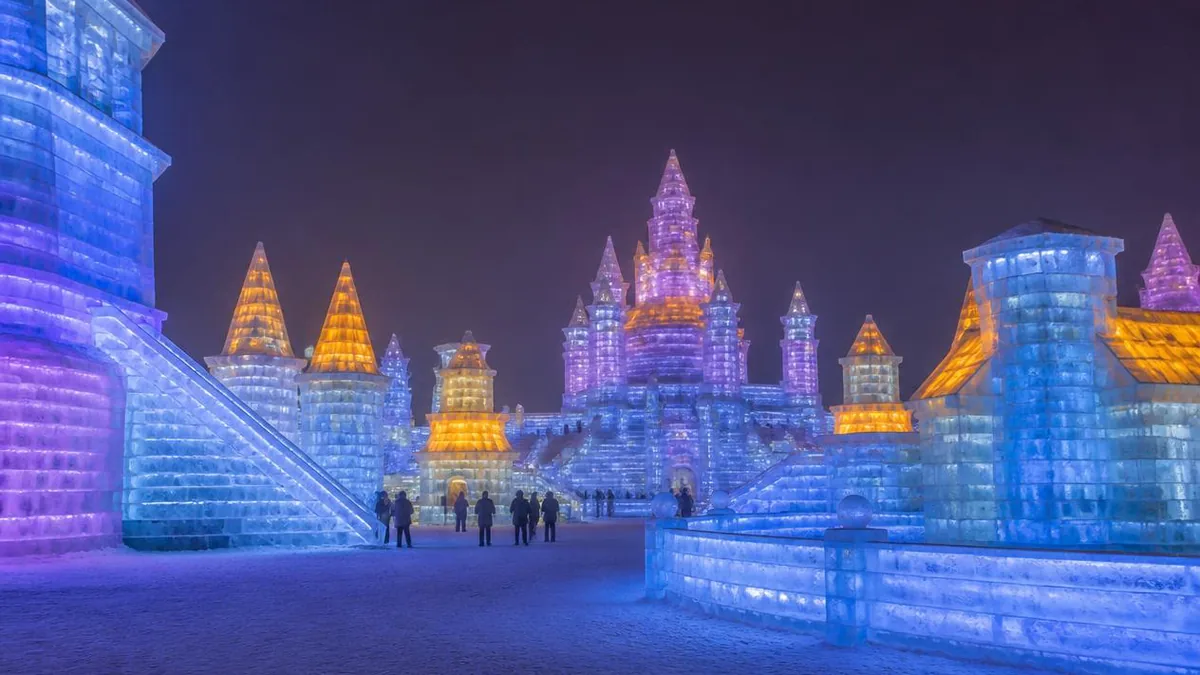
Heilongjiang · Harbin
Harbin Ice and Snow World: A City Built to Melt
A park the size of a district is cut out of the Songhua River each December, assembled in about fifteen days by roughly ten thousand people, and abandoned to the thaw. That schedule is also why it holds no national scenic rating.
Most attractions are places. Harbin Ice and Snow World is a construction schedule.
Every December a park is cut out of the frozen Songhua River, hauled to the north bank, and assembled into towers, walls and slides by a workforce that numbers in the thousands. It opens around the turn of the year. By March the weather takes it apart. Nothing is stored except surplus blocks; nothing is restored; there is no original fabric, because the fabric was river water eighteen months ago and will be river water again.
Hold that in mind and the rest of the place explains itself—including the odd fact that China’s most photographed winter attraction does not appear on the country’s official list of rated scenic areas.
The material arrives by river
The season starts on the ice, not at the gate. Harvesting begins when the river has frozen to about 30 centimetres, which in recent years has been signalled by a staged opening ceremony: the sixth Harbin ice-harvesting festival was held on 7 December 2025, timed to the Daxue solar term. The ritual has an ice foreman reading a blessing, a drum, a departure toast, the lifting of the season’s first block, and a work chant sung by the cutting crews. Ice has been taken from this river for as long as people have needed to keep fish cold; the festival around it dates from 2020.
The work underneath is ordinary industrial labour. A crew runs to about thirty people. Chainsaws score the surface into a grid; where volume matters, a circular saw a metre across and weighing some fifteen kilograms does the cutting. An ice spud breaks each block free, a hooked pike pole pushes the floating slab to the edge, and a forklift or crane loads it.
Block sizes are quoted in a way that does not quite add up, and it is worth knowing why. A veteran carver interviewed in January 2024 gave two plan formats and a weight range of 700 to 1,200 jin, roughly 350 to 600 kilograms. The weights fit blocks of about 0.8 by 1.6 metres and 0.9 by 1.8 metres at winter thickness; the centimetre figures as printed are ten times larger and would give multi-tonne slabs. Take the weights as the reliable half.
Colour is the harvester’s own quality grade. Near the bank the current is slow and waterweed grows, so the ice comes out green—usable, since lighting goes inside it anyway. Later, when the freeze reaches mid-channel, the blocks come out faintly blue, and that is the clear ice.
The list it is not on
China rates its attractions from 1A to 5A. Harbin’s entries include Sun Island at 5A and about thirty sites at 4A—Central Street, Saint Sophia, the Siberian Tiger Park, the Yabuli ski resort. Ice and Snow World is not among them.
The plainest explanation is structural rather than qualitative. A-level assessment is built for permanent scenic areas: fixed boundaries, standing facilities, signage, sanitation, parking, a resource base that can be inspected in any season. This park has none of that for nine months of the year. Its footprint, entrances, internal roads and buildings are redesigned and rebuilt annually, and the whole thing is scheduled to fail structurally by spring.
The absence is not a verdict on scale. The twenty-fifth edition, covering 810,000 square metres, was announced on 5 January 2024 as a Guinness record holder for the world’s largest ice and snow theme park; the park was a sub-venue of the 2025 Asian Winter Games and held the main cauldron. What it does not have is a rating designed for things that stay put.
Three ice attractions, and only one of them is this
Visitors merge them constantly, so separate them once.
The oldest is the ice lantern garden party at Zhaolin Park, on the south bank in Daoli District. Its origin is unusually well documented. In November 1962 Ren Zhongyi, then first secretary of the Harbin party committee, saw a flower market in Guangzhou and began thinking about a winter equivalent. On 1 February 1963 he noticed a homemade lamp outside a house near a market in Xiangfang District—a hollowed block of ice with a candle inside—and tested the idea at home that evening with a bucket and a washbasin. Thirteen departments and more than 800 staff froze tap water into moulds over four days and nights. The first garden party opened on 7 February 1963; admission was five fen for adults and three for children; nearly 50,000 people came the first night, the planned three days were extended to six, and roughly 250,000 attended in total—about a tenth of the city’s population.
The second edition, in 1964, was the first lit entirely by electricity and the first to use natural Songhua ice rather than moulds. Late that year a journalist’s report called the event a waste of labour and money, and a provincial supervision team investigated before withdrawing. In 1966 it was denounced as a bourgeois-feudal hotchpotch; the 1967 edition was cancelled. It resumed in 1979, was folded into the first city-wide festival in 1985, added an international carving competition in 1987, and has been free to enter since December 2018.
The second attraction is the Sun Island snow sculpture expo—snow, not ice, read by daylight and shadow. The third is Ice and Snow World: coloured light through cut ice, read after dark.
Since 1985 all three have sat under one umbrella festival, merged in 2001 with a provincial ski festival. That umbrella is the reason a single name sells four different tickets.
1999, on a sandbar in the river
Ice and Snow World is the youngest of the three, and it was a millennium project. The municipal government decided to build at a scale the parks could not hold, and the first site was a sandbar in the middle of the Songhua.
The first edition’s numbers are specific: nearly 200,000 square metres, 60,000 cubic metres of ice, 130,000 of snow, more than 500 individual works, over 30 million yuan invested, and more than 5,000 construction workers. Preparation began on 22 November 1999, construction on 4 December, and the site passed inspection 33 days later, on 25 December.
It then moved twice. The second edition, in 2000, dropped “Songhua River” from the name. The third moved to the upper wharf area of Sun Island, and by the fourth it had settled on the west side of Sun Island, on the north bank, where it has stayed. Chinese accounts date both the third and fourth relocations to 2001, which cannot both be right; the sequence is reliable, the years are not.
Every number here needs a year attached
Area and volume figures for this park circulate without dates, which makes them useless. Attached to their editions, they show a place that grows and shrinks:
- 2015–16, seventeenth edition: 800,000 square metres, more than 330,000 cubic metres of ice and snow combined; over a million visitors by 20 February.
- 2017–18, nineteenth: 800,000 square metres, 180,000 cubic metres of ice and 150,000 of snow, more than 2,000 features; trial opening 18 December, closing 10 March; a single-day record of 58,000 visitors.
- 2018–19, twentieth: 600,000 square metres, 110,000 cubic metres of ice, 120,000 of snow.
- 2023–24, twenty-fifth: 810,000 square metres, about 6,000 cubic metres of ice delivered daily from 7 December, fourteen large ice slides, a main tower given as 43 metres.
One warning about the English-language summaries. A widely copied entry attaches 3.56 million visitors and a revenue figure in the hundreds of billions of yuan to the 2025 festival. The visitor count is plausible for the park; the revenue figure is the order of magnitude of a province’s entire winter tourism economy, not one park’s takings, and no park statement supports it. Where a source gives no year and no definition, it is not a measurement.
Fifteen days, three shifts, ten thousand people
The build is the least visible and most impressive part.
Main structures go up in roughly fifteen days. A longer programme would cost more and push back opening, so the site runs three eight-hour shifts—starting at 06:00, 14:00 and 22:00—around the clock, with something close to ten thousand people on the ground at peak: carvers, chainsaw operators, haulage crews, riggers, supervisors.
The masonry has rules. Rough blocks can be stacked as they come, or dressed and laid tight like brick. Each course must be level; light channels are cut into the inner face and fitted with strip lighting before the next course goes on; joints are sealed by pouring water into them and letting it freeze; a chalk line keeps the runs straight. Vertical joints must be offset between courses by at least 15 centimetres, or the wall splits. Waste runs at roughly a quarter to a third of the ice handled—dropped blocks, saw damage, offcuts—some of it backfilled into the structures.
The labour force exists because of the same cold that supplies the material. In this region cement freezes and ordinary construction stops for the winter, so external-works, welding and fit-out crews move to the river for the season.
Ice kept through a Harbin summer
Here is the detail that most surprises visitors: the building season does not end when the park opens. Once the exhibition is standing, crews go back onto the river and keep cutting, this time for storage.
Surplus blocks are stacked into large mounds on high ground, wrapped in at least four layers of plastic sheeting and straw matting, and sealed around the base so that summer rain cannot get underneath. The pile is meant to survive about a year, and is opened the following autumn so that the next edition can start work before the river has refrozen. Carvers describe the calculation as chronically tight: the stored ice always runs out early, and the site bridges the gap until the new freeze catches up.
It is a strange piece of infrastructure—an ice bank, held against the weather, so that a temporary city can start building a few weeks sooner.
The winter the queue became the story
The 2023–24 season is worth writing about carefully, because it was a genuine demand shock rather than a marketing line.
Over the 2024 New Year holiday alone the city received 3.0479 million visitors, up 441.4 per cent year on year, with tourism revenue of 5.914 billion yuan, up 791.92 per cent—both records, reported by state media at the time. Those percentages are large partly because the comparison year was depressed, and they should be read as a rebound plus a surge rather than a steady trend.
The consequences were operational rather than aesthetic. An attraction rebuilt annually can add area quickly—the twenty-fifth edition was the largest to that date—but it cannot add throughput at the same speed. The number of slides, gates, warm rooms, toilets and shuttle bays is fixed on the day the ice is laid, months before anyone knows how many people are coming. Queue length at the large slides became the season’s dominant complaint, and no amount of extra ice could answer it.
That is the useful lesson for anyone planning a visit in a strong season. Area figures in the publicity tell you how much ice was cut. They tell you nothing about how long you will stand in a line at −25 °C, which is a function of gate count and slide count, and those are much slower to grow.
Cold as an operating condition
Harbin’s winter mean sits near −16.8 °C, and annual lows around −25 °C are unremarkable. The park’s best hours are after dark, when the lighting works and the temperature is at its lowest. Plan for standing still, not for walking.
Three practical points matter more here than at most cold-weather sites. First, batteries: lithium cells lose capacity fast below freezing, so carry spares in an inside pocket against your body and expect a phone to shut down without warning at what it reports as 40 per cent. Second, condensation: a cold camera or phone taken into a warm room fogs internally, so seal it in a bag before you go inside and let it warm slowly. Third, extremities—gloves you can shoot through, covered ears, insulated boots rated well below the forecast, and warming breaks scheduled before you feel you need them rather than after.
Opening dates, closing dates, ticket tiers, indoor halls and shuttle arrangements all change from year to year and sometimes within a season. Confirm them against the current official notice on the day.
What March takes back
At the end of the season the park is not dismantled. It is left.
Walls soften, edges round off, colour goes out of the lighting channels, and by late spring the site is wet ground on the north bank with nothing standing on it. The blocks that made a forty-three-metre tower return to the river they were cut from, a few kilometres downstream of where they started.
That cycle is the real subject here, and it is worth resisting the temptation to read it as a metaphor. It is a supply chain: a river that freezes reliably enough to quarry, a construction workforce idled by the same cold, a rating system that cannot describe the result, and a city that has been making light out of frozen water since a party official copied a candle in a block of ice in 1963.
The buildings are gone by summer. The reason they can be built at all is still there, running north-west out of the mountains and freezing on schedule.
For the same river bank in its other seasons, see Sun Island; for the city that the railway built on the south bank, see Central Street.
The LoreLens app can identify ice-construction techniques, lighting methods and river-ice conditions on site, and explain what you are looking at while you are still standing in front of it.
Location profile
Where it is

Frequently asked questions
Is Harbin Ice and Snow World the same thing as the ice lantern show and the snow expo?
No, and the three are routinely merged in travel writing. The ice lantern garden party at Zhaolin Park, in Daoli District on the south bank, is the oldest: it began on 7 February 1963, was suspended in 1967, resumed in 1979, and has been free to enter since its forty-fifth edition in December 2018. The Sun Island International Snow Sculpture Art Expo is a snow-carving exhibition inside Sun Island Scenic Area. Ice and Snow World is a separately ticketed park of illuminated ice buildings on the north bank, first built for the 1999–2000 winter. Since 1985 all of them have sat under one umbrella event, the Harbin ice and snow festival, which is why one city name ends up attached to four different gates. Buy tickets by the specific venue name, not by the festival name.
When is it open, and what does it cost?
The season is roughly late December to late February, but no two years match, because the opening date depends on when the river ice is thick enough to cut and the closing date depends on when it starts to soften. The nineteenth edition opened for trial visits on 18 December 2017 and closed on 10 March 2018; other editions have finished in February. Ticket prices have moved a long way too—330 yuan for an adult in the 2017–18 season—and there are separate charges for some rides and indoor halls. Treat every date and figure you read, including these, as history rather than as a plan, and confirm against the current official notice before you book flights around it.
Is the ice really cut from the river?
Yes, and the park is unusual in that respect. Most large ice-sculpture exhibitions elsewhere use manufactured ice from cold stores; Ice and Snow World harvests natural ice from the frozen Songhua. Cutting begins once the ice reaches about 30 centimetres, usually in early December, and continues as it thickens through 50 to 60 centimetres, with a seasonal maximum around 80 to 90. Crews of about thirty score the surface with chainsaws or a metre-wide circular saw, break the blocks free with an ice spud, and pole them to the bank for a forklift. Ice cut near the bank, where the current is slow and waterweed grows, comes out greenish; mid-channel ice cut later is faintly blue and the clearest of the season.
Why is it not a 5A scenic area?
Because the national A-level system rates permanent scenic areas, and this one is demolished by weather every spring. Harbin's list has Sun Island at 5A and roughly thirty sites at 4A, including Central Street and Saint Sophia; Ice and Snow World is not on it. That absence says nothing about the park's scale—it has held a Guinness entry as the world's largest ice and snow theme park, announced on 5 January 2024 for an 810,000-square-metre edition, and served as a sub-venue of the 2025 Asian Winter Games. It says that a site with no fixed buildings, whose footprint, layout and entrances are redrawn from scratch each December, does not fit a rating framework built around durable facilities.
Sources and further reading
Background references for the history and place names in this guide. Opening hours, ticketing and access change often — always confirm with official local information before travelling.