Heilongjiang · Harbin
Siberian Tiger Park: The Gene Bank That Sells Tickets
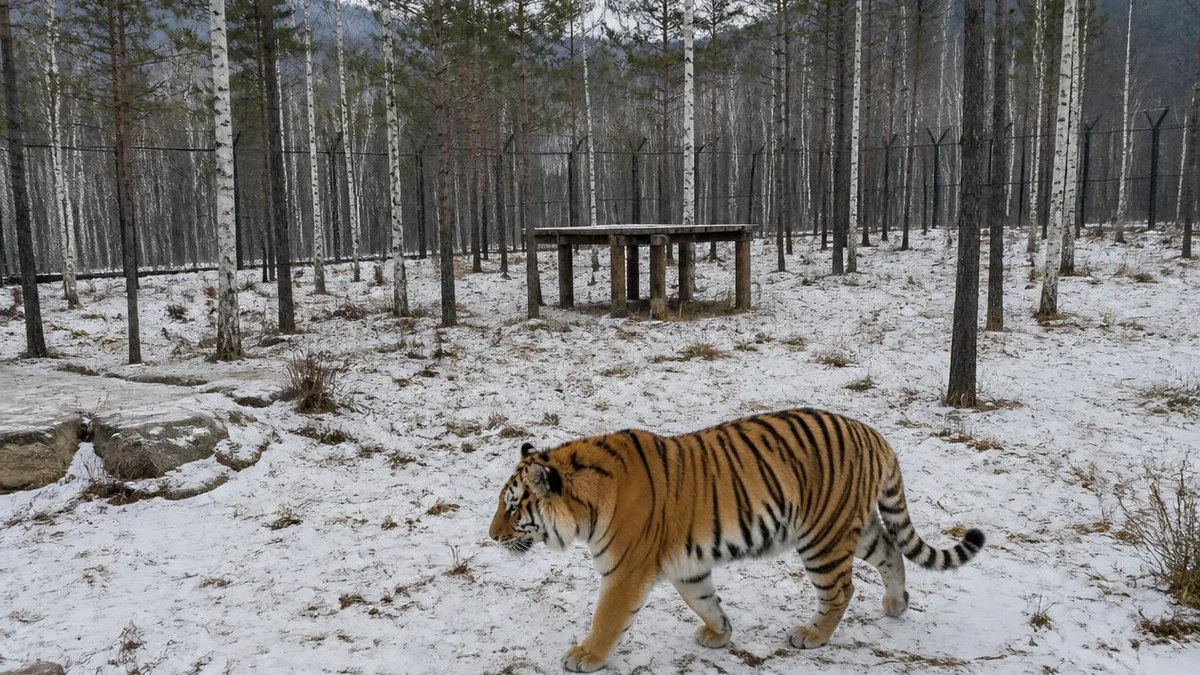
Harbin's tiger park is two institutions in one body: a forty-year captive breeding programme that calls itself a source-stock reserve, and a paid attraction where visitors feed predators through a port in a caged bus. The gap between them is the subject.
Two descriptions of this place are both accurate and almost impossible to hold at the same time.
The first: a forty-year-old captive breeding programme for a critically depleted subspecies, holding the largest managed Amur tiger population in the world and describing itself as a source-stock reserve for a national park. The second: a rated tourist attraction on the edge of Harbin whose central paid experience is feeding a predator from a caged bus.
They are not two institutions. They are the same institution, and the second one pays for the first.
A fasting rota, posted for visitors
In February 2026 the most informative document here was not an interpretation panel. It was a schedule listing which of the park’s free-range enclosures would be fasting that day.
The reason was straightforward. Spring Festival crowds were feeding the tigers so often—reports put it at thousands of individual feeds a day—that the animals were being overfed. So the park set up a rota: from 1 February to 31 March 2026, thirteen enclosures took turns, one fasting each day, with visitor feeding suspended in whichever enclosure was resting. Staff told reporters that this would not spoil anyone’s visit, because drivers would take passengers to an enclosure where feeding was still allowed. The park’s live-stream desk gave the same answer: the thrill bus passes five or six enclosures, and only one is resting.
That is an unusually candid piece of operational writing, and it settles several arguments before they start. The feeding is not incidental or occasional; it is frequent enough to constitute a nutritional problem. The park knows this, has measured it, and has managed it—by rationing the animals rather than the customers.
Eight tigers, 1986
Start with why the place exists, because the founding conditions were genuinely desperate.
By the mid-1980s the wild Amur tiger in China was down to something like ten animals. The subspecies survived mainly in the Russian Far East; the Chinese side of the range had been logged, farmed, hunted and fragmented. In 1986 the China Hengdaohezi Feline Breeding Centre was established in Hengdaohezi, a small railway town in Hailin, Mudanjiang, with eight pure-bred Amur tigers gathered from wherever they could be found. It was China’s first ex-situ breeding base for the species.
The early work was improvised. Staff built tiger houses in the forest, mixed their own feed, and learned husbandry by observation; the first generation’s slogan, quoted by the centre’s own veterans, was that people could go without before the tigers did. By 1995 the population had passed 100.
Feeding was the constraint that changed everything. An adult Amur tiger eats 4 to 5 kilograms of meat a day in summer and 6 to 8 in winter. Multiply that by a growing population and the centre had a problem no research grant was going to solve.
Three parks, one licence, and numbers that disagree
The solution was tourism. In 1996 the centre opened the Heilongjiang Siberian Tiger Park on the north bank of the Songhua River in Harbin, near Sun Island. A second visitor park followed at the original Hengdaohezi site in 1998, and a third at Guaipo in Shenyang in 2011.
Now the numbers, which do not agree with each other and are worth laying out rather than averaging.
The Harbin park’s own 2025 visitor guide gives its area as 800,000 square metres and claims nearly a thousand pure-bred tigers on site, marketing itself as a park of a thousand tigers. Chinese Wikipedia gives the area as 1.44 million square metres and the tiger count as more than 800. A 2022 provincial feature gives the three parks a combined area of about 2.16 million square metres and a combined captive population of close to a thousand. Xinhua’s reporting from 2024 and 2026 consistently puts the Harbin site at more than 300 tigers, of which 100-odd are in the free-range enclosures, and the whole centre at around 700 in 2026—down from the figure of over a thousand that Xinhua itself used in 2019.
The direction of travel is the interesting part, and the centre explains it openly. Since about 2019 the breeding policy has shifted from expansion to selection: whole-genome sequencing of more than 500 animals, deliberate management of inbreeding coefficients, and fewer but better-documented litters. A population that stops growing is not a programme in trouble here; it is a programme that has changed objective.
Raising tigers on tigers
The funding model is not concealed. The centre’s phrase for it, repeated in state media, translates as raising tigers on tigers: ticket income from the visitor parks pays for the feed, the veterinary work, the enclosures and the research.
The scale is now substantial. Xinhua’s fortieth-anniversary piece in July 2026 put the Harbin park’s annual attendance at about 1.8 million, against a few tens of thousands a year in its early period; a 2024 report described more than 10,000 visitors a day in July and projected annual ticket revenue above 100 million yuan. During the 2026 Spring Festival the park again averaged over ten thousand a day.
This is worth stating plainly rather than framing as hypocrisy. A captive population of several hundred obligate carnivores in a climate with a five-month winter is expensive, and no one is subsidising it out of pure science budgets. The consequence, though, is real: the more the breeding programme grows, the more visitors it needs, and the visitor experience that reliably fills buses is proximity to a feeding predator.
What the thrill bus actually is
Two vehicles run the free-range circuit. The standard sightseeing bus is a windowed coach. The thrill bus is caged and fitted with small ports, and the ports exist so that visitors can pass food out.
In recent seasons what is passed out is strips of meat, sold inside the park. The historical record includes more. A price board photographed at the entrance in 2009 listed live animals by species and price—chickens and ducks in the tens of yuan, sheep and cattle in the hundreds to well over a thousand—and the park’s promotional text of that period advertised the resulting scenes directly, as did municipal tourism material. Whether live prey is offered on any given day now varies, and the honest instruction is to ask at the gate rather than to repeat either an old price list or a reassurance.
Set the two accounts side by side without adjudicating. The institution’s position is that feeding maintains hunting response, that the tigers are captive animals whose diet is managed regardless, and that visitor income sustains the breeding work. The position taken by international zoo and aquarium welfare codes is that feeding large carnivores from vehicles as a paid entertainment is not acceptable practice, because it habituates animals to vehicles and people, converts feeding into a performance, and teaches the public a relationship with a predator that conservation work is trying to prevent in the wild.
What is not in dispute is that the park itself has started asking. In late 2025 it circulated a questionnaire to visitors that included the questions of whether captive tigers need feeding by the public at all, and whether the public supports the feeding programme continuing. Institutions do not usually survey their customers about a profitable attraction unless the argument is live internally.
What rewilding training means here
One of the enclosures you drive through is labelled a rewilding-training zone, and the training is real in a limited sense. Staff release live pheasants—in recent years flown in by drone, which both raises the difficulty and makes a better video—so that tigers chase and catch moving prey rather than collecting a delivered carcass. Enclosures have been planted and watered to give more varied ground. Handlers report improvements in running, hunting response and cold tolerance.
Be precise about what that can and cannot supply. Catching a pheasant in a fenced field is a motor skill. Surviving as a wild Amur tiger requires holding a home range that in this landscape runs to hundreds of square kilometres, killing wild boar and deer that fight back, avoiding people and snares, and raising cubs through a Manchurian winter—none of which can be rehearsed in an enclosure, and the last of which is learned from a wild mother over roughly two years.
That is why the institution’s public language about release has stayed in the future tense for four decades. Its own formulation is that captive breeding is not the end point and that returning good individuals to the mountains is the ultimate goal; a provincial forestry official marking the fortieth anniversary spoke of deepening rewilding training so the tigers can return to the forest sooner. Sooner, not yet.
The one tiger that went back, and the exact wording
There is a release in this park’s record, and it is genuinely significant—but its wording is the whole point.
On 23 April 2021 a wild adult Amur tiger walked into a village in Heilongjiang and injured a resident. The animal, later known as Wandashan No. 1, was found hiding behind a house. The tiger park’s chief engineer and two veterinarians drove more than six hours to the scene; the team carried out the capture and the veterinary care; after a period of isolation and assessment the tiger was released back into the forest. Xinhua describes it as China’s first successful rescue and release of a wild Amur tiger, and monitoring has since recorded the animal alive and sharing range with a female.
Every word of that is an achievement of veterinary and field capability built by the breeding centre. None of it is a captive-bred release. Wandashan No. 1 was a wild tiger that had a bad week.
Why the captive-to-wild step is the hard one
The genetic argument runs in both directions, and the park’s version of it is not wrong.
Wild Amur tigers carry strikingly little maternal genetic variation—a single mitochondrial haplotype dominates the wild population—while captive animals show more, apparently because the founders were taken when wild diversity was higher. Genetic work on wild and captive Amur tigers has found variants persisting in captivity that have been lost in the wild, and has explicitly described the captive population as a potential reservoir. When the centre’s chief engineer says the managed population’s diversity exceeds that of some isolated wild groups inside China, he is on defensible ground.
The problem is that genetic material is not the binding constraint. The same body of work identifies the constraint as connectivity: wild Amur tigers are split into subpopulations separated by developed corridors, and what the wild population needs is joined-up habitat, prey and safe passage, not more animals delivered into it. A released tiger that cannot find a range, or that walks into a village, subtracts from the recovery rather than adding to it.
The comparison cases make the point without anyone having to editorialise. The rehabilitated tigers that have succeeded in this landscape were wild-born orphans, not captive-bred animals: a Russian female released in 2013 after rehabilitation gave birth in a nature reserve in 2015, the first rehabilitated Amur tiger recorded breeding in the wild. And the most ambitious introduction project currently running, in Kazakhstan, was deliberately designed around this limitation—two captive tigers were moved from a European sanctuary in September 2024 into a semi-wild enclosure so that their offspring, not the adults themselves, might eventually be released.
Where the recovery actually came from
Meanwhile, the wild population in China has recovered, and it is worth being clear about the mechanism, because it was not restocking.
In a joint Chinese, Russian and American survey in 1998–99, researchers could find evidence of only 12 to 16 wild tigers and 7 to 12 Amur leopards in China. A decade of camera-trap work by a Beijing Normal University team raised the count to 27 tigers and 42 leopards for 2012–14. The Northeast China Tiger and Leopard National Park followed: pilot status from 2016, an administration established in August 2017, formal designation on 12 October 2021, covering roughly 14,100 to 14,600 square kilometres depending on the source, about seventy per cent of it in Jilin.
The 2026 figures released for Global Tiger Day report wild tigers inside the park at 72 and Amur leopards at 115, against 27 and 42 in 2017. The instruments of that change are unglamorous: mining and industry removed from the area, fences and livestock cleared, snare sweeps, more than eight thousand ranger posts filled annually from local communities, prey abundance more than doubled, five wildlife corridors reopened, large-scale under-canopy replanting, an integrated monitoring network, and a standing cooperation agreement with Russia’s adjoining protected areas, across which twenty-one tigers and twenty-seven leopards are recorded moving regularly.
Not one of those measures involved releasing a captive-bred tiger.
How to visit, and what to look at
The park sits on the north bank of the Songhua, close to Sun Island, and is easily combined with it. Visitors buy an entry ticket and then choose the vehicle: in the 2025 season the tiers were quoted at 90 yuan for entry alone, 110 with the standard bus and 130 with the thrill bus, with first departure at 08:30 and last at 16:00—figures that change and should be confirmed on the day. Beyond the drive there is a walking corridor, viewing platforms, an education hall and a cub area. From July 2026 a self-driving sightseeing vehicle carrying four lidar units has been running the free-range circuit.
Winter is the better season for the animals themselves: Amur tigers are built for it, their winter coats are at their densest, and activity is higher than in Harbin’s humid summer. If you go in the deep cold, the same rules apply as anywhere else in this city—layered insulation, spare batteries kept warm, and a plan for warming breaks.
The most useful thing to do here is to keep both frames open at once. Watch the animals, and also watch the arrangement: the ports in the bus wall, the fasting schedule, the education hall, the merchandise counter, the sign describing a national park two provinces’ width away where the wild tigers actually live. This place is neither a fraud nor a sanctuary. It is a forty-year-old gene bank that pays for itself by selling proximity, and it has not yet solved the problem it was founded to solve.
For a longer look at how a Chinese city zoo carries its own history of display and conservation, see Beijing Zoo; for the riverbank immediately next door, see Sun Island.
The LoreLens app can explain enclosure design, individual identification methods and the conservation status of the species you are looking at, while you are still in front of the fence.
Location profile
Where it is

Frequently asked questions
Is this a conservation centre or a zoo?
Legally and administratively it is both, and the two roles are held by different bodies at the same address. The Heilongjiang Siberian Tiger Park in Harbin, opened in 1996, is a rated 4A tourist attraction. It belongs to the China Hengdaohezi Feline Breeding Centre, founded in 1986, which describes itself as a source-stock reserve unit for the Northeast China Tiger and Leopard National Park and holds what state media call the world's largest and most genetically complete captive Amur tiger gene bank. The park was opened specifically to pay for the breeding work—the centre's own phrase is raising tigers on tigers—so the ticket counter is not incidental to the conservation programme, it funds it. Whether a visitor-feeding attraction is an acceptable way to fund a gene bank is exactly the question the institution has begun asking its own visitors.
Can you really feed the tigers, and is it live animals?
The park runs two vehicle types through the free-range enclosures: a standard sightseeing bus and a caged thrill bus fitted with small ports through which visitors can pass food. What is passed through them in recent seasons is strips of meat, bought inside the park. Live poultry and livestock were openly on sale in the past: a price board photographed in 2009 listed live chickens, ducks, sheep and cattle, and the park's own promotional text at the time advertised the resulting scenes. Whether live prey is still offered varies by season and enclosure and should be checked at the gate rather than assumed from an old blog post. Feeding captive carnivores from a vehicle for entertainment is not accepted practice under international zoo welfare codes, and the park itself circulated a questionnaire in late 2025 asking visitors whether captive tigers need feeding by the public at all.
Have any of these tigers been released into the wild?
No captive-bred tiger from this programme has been documented as released and surviving in the wild, and the institution's own language is consistently future-tense: release of good individuals is described as the ultimate goal, and officials speak of deepening rewilding training so that tigers can return to the forest sooner. One release does belong to the park's record, and the wording matters. In April 2021 a wild adult tiger known as Wandashan No. 1 wandered into a village in Heilongjiang and injured a resident; the park's team carried out the capture and veterinary care, and after isolation and assessment the animal was returned to the forest. Xinhua describes this as China's first successful rescue and release of a wild Amur tiger. It was a wild animal going home, not a captive-bred animal going out.
Where are China's wild Amur tigers, and can I see them?
Not here, and realistically not at all. The wild population lives in the Northeast China Tiger and Leopard National Park, on the Jilin–Heilongjiang border adjoining Russia, together with animals that move across that border. Official monitoring reported by Xinhua in July 2026 put wild tigers inside the park at 72, up from 27 in 2017, with Amur leopards at 115, up from 42; twenty-one tigers and twenty-seven leopards are described as crossing the border regularly. Those are camera-trap counts across more than eleven thousand square kilometres of forest. The park is a working conservation landscape with ranger patrols and restricted access rather than a wildlife-viewing destination, and the animals are famously hard to see even for the people employed to monitor them.
Sources and further reading
Background references for the history and place names in this guide. Opening hours, ticketing and access change often — always confirm with official local information before travelling.