Beijing
Beijing Zoo: A Farm That Kept Its Animals
China's oldest public zoo did not begin as a zoo. It began in 1906 as an agricultural experiment station set up under the late Qing reforms, with a menagerie attached, and the ground you walk on is still that reform project — gate, palace, halls and all.
Nearly everyone who comes here comes for the pandas, walks a loop, and leaves. That is a reasonable visit. It also means walking straight past the reason this place exists.
Beijing Zoo is not an old zoo that acquired some buildings. It is an old agricultural reform project that acquired a zoo. The institution founded on this land in 1906 was the Agricultural Experiment Station, established by the Qing Ministry of Agriculture, Industry and Commerce in the last decade of the dynasty, when the court was building modern ministries, schools and industries at speed. A menagerie was attached to it. The menagerie is what survived.
Read the site that way and the odd things about it — a Baroque palace behind the giraffes, a Chinese hall with a memorial obelisk, a French-funded botany building on the street outside — stop being odd.
A farm first, a menagerie second
The land was assembled from what Chinese accounts call the two gardens and two temples: Leshan Garden, granted by the Kangxi emperor and later an imperial travelling lodge; Ji Garden to the northwest, also known as the Third Prince’s Garden; and the temples of Guangshan and Hui’an at the southeast corner, of which only the Guangshan site remains.
On that ground, in 1906, the ministry laid out an experiment station of roughly 71 hectares organised into five research divisions: grain, sericulture, vegetables, fruit trees and flowers. There was a botanical garden. And there was a menagerie of about 1.5 hectares.
That ordering is the argument of this article. The purpose was to demonstrate improved agriculture to a public that the reformers wanted to persuade. The animals were the draw that got the public through the gate.
Where the first animals came from, and what it cost to look
The founding collection was bought abroad. Duanfang, then viceroy of Liangjiang and commissioner for southern trade, purchased animals in Germany; provincial governors sent others as tribute. Chinese accounts put the founding stock at a few dozen species and a hundred-odd animals.
It worked immediately. The station opened to ticket-holders in 1908 — one account dates the opening to 16 June and puts admission at eight copper coins, half price for children — and drew crowds from the start, helped by a location just outside Xizhimen with easy access from the city. The Empress Dowager Cixi and the Guangxu Emperor each visited twice.
The commercial instinct was there early. Later, under the Republic, management recruited two men over 220 centimetres tall to work as ticket inspectors, one of them recorded as Zhang Yingwu, on the reasoning that people would come to see the ticket-taker. The zoo has been selling a spectacle to fund an institution for as long as it has existed.
Changguanlou, 1908: built for a stop that was never made
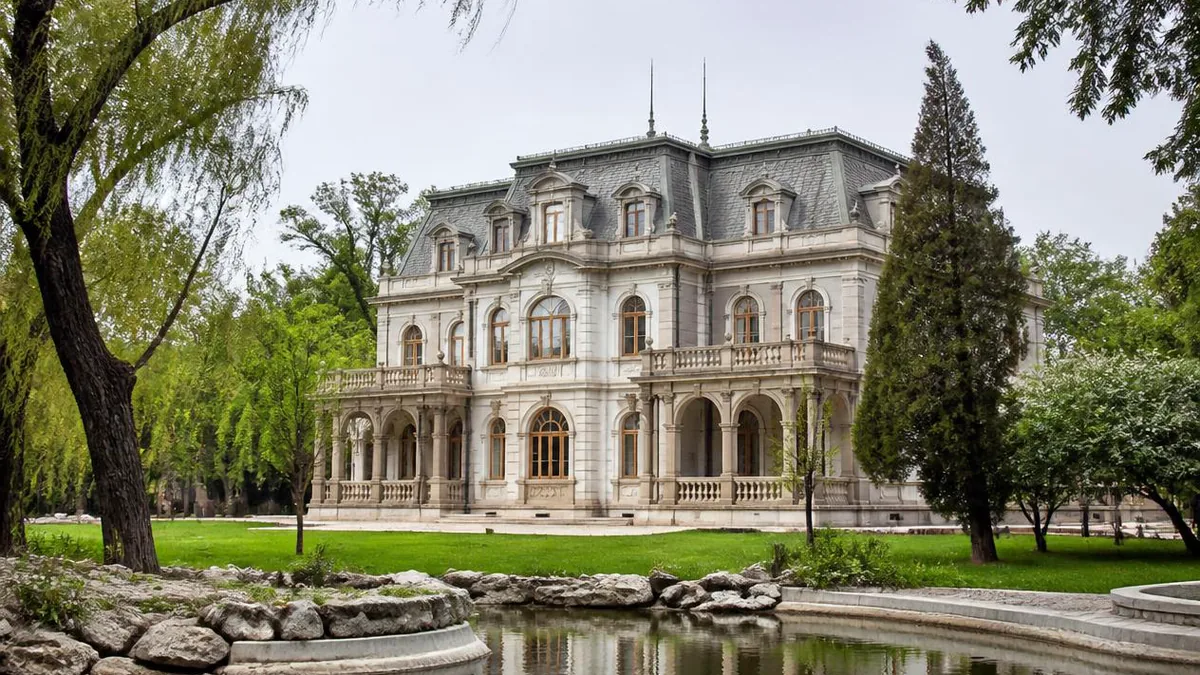
Behind the western half of the grounds stands a two-storey Baroque building with deep verandas, red brick with plaster mouldings and brick-carved ornament, Ionic columns, curved gables tipped with spheres, and octagonal corner turrets under arched metal roofs.
Changguanlou was completed in 1908, and its purpose was specific: a resting place for Cixi on the boat journey up the Changhe canal towards the Summer Palace. It was never used for that. Cixi and the Guangxu Emperor both died within months of its completion.
Its afterlife is a compressed twentieth century. Sun Yat-sen came here three times in the space of four days in 1912 — 29 and 31 August and 1 September — for receptions held by a Guangdong association, the national railway association and the postal association, by the provisional parliament, and by the military and police. Beijing’s first post-1949 city plan was drafted in this building and is known by its name. In the 1990s it was converted into a private club and closed to visitors, which it has remained.
A palace built for an empress who never arrived, now shut to the public that owns it. Look at it over the water from the bridge and that is the whole story of the building.
The rest of the reform-era fabric
Changguanlou is not alone, and this is the walk most visitors miss.
- Changchuntang, 1908, a Chinese hall whose roof is three linked ridges, glazed on all four walls. Song Jiaoren, the Nationalist politician assassinated in 1913, lived here while serving as minister of agriculture and forestry. A memorial obelisk was raised behind it in June 1916, destroyed in 1966, and marked again with a stele on its surviving base in November 2009. The original hall burned in a fire in the early 1990s and was rebuilt.
- Binfengtang, 1907, built as the station’s display room for farm produce and tools; it is now a restaurant and staff canteen.
- The Four Martyrs’ Tomb, built in 1912 for four men killed in assassination attempts on Qing officials, smashed in 1966, now marked by a stele. Like the Song Jiaoren base, it is a district-level registered relic.
- Lamarck Hall, on the street outside at 141 Xizhimenwai Dajie, built in 1934 with returned Boxer Indemnity funds by a Sino-French education foundation and two research bodies. It was China’s earliest purpose-built botany research building.
Several are gone. A Japanese-style teahouse of 1906 stood on an island; a European building with a Western restaurant and a photographic studio stood by the river; a two-storey pavilion laid out on a swastika plan burned down in 1935. What you are walking through is a partial ruin of an exhibition ground.
Six names, and two decades that emptied the cages
The name history is the institutional history. Agricultural Experiment Station from 1906; Central Agricultural Experiment Station in the early Republic; National Peiping Natural History Museum from 1929; back to Central Agricultural Experiment Station in 1934; a horticultural experiment station from 1941; under the Japanese occupation, an agricultural experiment station of the special municipality, open to the public as Leshan Park. It became Xijiao Park on 1 September 1949, opened under that name on 1 March 1950, and was renamed Beijing Zoo in 1955.
Between those names the collection was destroyed twice over. The single Asian elephant starved during the war. In 1943 the Japanese army ordered the lions, tigers and leopards poisoned, on stated air-defence grounds. Accounts of what was left in early 1949 differ in detail — one says 13 macaques and a one-eyed emu, another adds three parrots — but agree on the scale.
Even the sign is a document. Guo Moruo wrote the calligraphy for the zoo’s name in 1955; during the Cultural Revolution it was taken down and replaced with five characters assembled from Mao Zedong’s handwriting in three of his poems. That patchwork sign is still in use. The carved dragon ornament on the 1906 gate arch, smashed in the same period, was restored in 1987. Since October 2020 the brick gate has not been the everyday entrance; a new gate opened beside it.
What is actually protected here, stated exactly
This is worth getting right, because it is often overstated.
The Qing-era remains on this site were listed in the third batch of Beijing municipal cultural relics protection units, promulgated on 24 May 1984, under the name Leshan Garden Architectural Remains, entry 3-65. That is a municipal designation, not a State Council one, and I could not verify any national-level listing for Changguanlou or the other buildings here.
Two of the twentieth-century monuments — the base of the Song Jiaoren memorial and the Four Martyrs’ Tomb — sit lower still, as registered relics of Xicheng district.
So the accurate sentence is: a nationally significant reform site, protected at city level, inside a working zoo. If a guide tells you Changguanlou is a national key protected unit, ask which batch.
Pandas, and what a city zoo is for
Giant pandas were first displayed here in 1955, and the zoo recorded its first captive birth in 1963. Two buildings hold them now: the house built as a project for the 1990 Asian Games, and a second built around the 2008 Olympics at about 2,500 square metres, its enclosure landscaped with planted slopes, pools, climbing frames and a rock-tower motif.
The 1990 building is a useful corrective to zoo publicity. It was voted one of Beijing’s ten best new buildings of its year; the same Chinese account notes it was leaking within a decade and describes its construction quality as ordinary. Award and performance are not the same measurement.
Practically: pandas are most active early and around feeding, and largely asleep in the middle of the day. Panda admission has generally been priced separately or bundled at the gate, so ask when you buy.
What this place is for is a different question from what the breeding institutions in Sichuan are for. If you want the science of panda reproduction, that belongs to the Chengdu base. What Beijing Zoo does is the older, more ordinary job: it is where a metropolitan population, roughly five million visits a year, meets non-domestic animals at all.
Enclosures, decade by decade
The zoo covers about 89 hectares, including some 5.6 hectares of lakes and ponds, and the buildings can be dated by looking at them.
Monkey Hill, built in 1946, was the last surviving pre-1949 enclosure, a sunken pit of about 1,000 square metres with artificial rockwork; it was demolished in 2007 for road construction. Bear Hill followed in 1952, about 4,275 square metres, also sunken and open-topped. Lion-Tiger Hill, 1956, was the zoo’s signature building for a generation, its interior styled as caves, a design that also kept winter wind out of the indoor dens; it was the standard backdrop for family photographs when cameras were still a luxury.
The Amphibian and Reptile House of 1979 was among the most advanced buildings of its kind in China: over 90 display rooms of wildly different sizes, a two-storey python hall around a cast concrete tree, climate and humidity control. Between 2004 and 2007 its indoor displays were rebuilt in three phases under a research programme on improving amphibian and reptile survival, and Chinese accounts credit the rebuild with enabling captive breeding of several species.
Newer work has come from outside as well. The otter enclosure was built as a demonstration project in enclosure enrichment with funding from the British and Australian embassies in Beijing.
Welfare, as an argued question
This is a contested subject and the useful thing to do is set the record side by side rather than pick a side.
What the institution can show. A breeding programme that in 2013 produced 1,104 surviving offspring across 92 species, including northern white-cheeked gibbon and Guizhou snub-nosed monkey. The reptile house rebuild. The otter enrichment project. An off-site breeding centre north of the city, on land granted in 1965 in compensation when stadium construction took four hectares from the zoo.
What the criticism says. Chinese-language accounts of the zoo’s own enclosures describe severe visitor feeding at Monkey Hill and Bear Hill, and a rat problem at the former. They describe the penguin house as holding a South American species in a set dressed as an Antarctic snowscape, without outdoor space, and record that the fruit bats displayed in its basement died off and the display was discontinued.
What is on record as an incident. On 21 August 2019 a member of the public filmed a keeper striking a tapir with a stick and prodding its head while driving it indoors. The zoo responded the next day, saying construction odours in the tapir house had made the animal refuse to enter, that the keeper’s conduct had been excessive, and that management would be tightened.
What was decided politically. In 2004 a proposal to move the zoo out to merge with a wildlife park in Daxing, and to sell this land commercially, was shelved after public, expert and media opposition. In the 1990s the zoo had already sold western and southern edges of its land for development; a science education hall opened in 2003 was presented as returning the benefit to the public.
Old enclosures, a working refurbishment programme and documented criticism can all be true at once. A comparable tension, framed round a different question, runs through Harbin’s Siberian tiger park, where the argument is about whether captive breeding leads anywhere in the wild.
Getting there, and the two tickets
The zoo has its own metro station on Line 4, at 137 Xizhimenwai Dajie, just west of the northwest corner of the Second Ring Road, with a large bus interchange outside. The Beijing Planetarium is diagonally across the street, Purple Bamboo Park is to the west, and the Beijing Exhibition Centre with its Soviet-style tower is to the east.
Two ticket points matter. The panda area has generally been priced separately from base admission or offered as a combined ticket. The Beijing Aquarium, opened in 1999 on the north side of the grounds, is inside the zoo but is an entirely separate operation with its own, much higher, admission. Neither arrangement is fixed; check at the gate.
Collection figures differ by what is counted: Chinese accounts give upwards of 490 species and close to 5,000 animals for the zoo, while English accounts give 450-plus land species and 500-plus marine species totalling around 14,500 animals — the difference is mostly the aquarium.
Walk in at opening, do the pandas while they are awake, and then spend twenty minutes on the western side of the grounds where almost nobody goes. There is a Baroque palace there, finished in 1908 for a journey that was never taken, standing in what was laid out as a demonstration farm for a dynasty with three years left to run. The animals were the marketing. The farm was the plan. The farm is gone, and the marketing became the institution.
The LoreLens app can identify late-Qing Western-style buildings, Republican memorial structures and mid-century zoo architecture, and explain what each was built for.
Location profile
Where it is

Frequently asked questions
Is Beijing Zoo really the oldest zoo in China?
It is the oldest public one, with a caveat about what is being counted. Chinese and English sources agree that the menagerie attached to the Agricultural Experiment Station, set up in 1906 by the Qing Ministry of Agriculture, Industry and Commerce outside Xizhimen, was the earliest modern public zoo in China, and that the site is the oldest public park in northern China. It first sold tickets to the public in 1908; one account puts the opening on 16 June 1908 at eight copper coins, half price for children. What it was not is the first collection of animals in China, which is a much older story of imperial and princely menageries, including on part of this same land. The distinction that matters is the word public: the 1906 institution was open to anyone who paid at the gate.
Are the pandas worth it, and when are they awake?
They are the reason most overseas visitors come, and the honest planning advice is to go first thing. Giant pandas are most reliably active in the early morning and around feeding, and sleep through a large part of the middle of the day, so an arrival timed to opening will get you more than an afternoon visit. The panda houses are two buildings: one built for the 1990 Asian Games and one built around the 2008 Olympics, at about 2,500 square metres. Admission to the panda area has generally been charged separately from the base zoo ticket, or bundled into a combined ticket sold at the gate, and that arrangement can change, so ask when you buy. If your interest is in how pandas are bred rather than in seeing them in a city zoo, that is a different institution and a different article: see our guide to the Chengdu panda base.
Is the Beijing Aquarium included in the zoo ticket?
No. This is the most common and most expensive misunderstanding here. The Beijing Aquarium opened in 1999 and sits inside the zoo grounds, on the north side, but it is a separate operation with its own admission that costs several times the zoo's base ticket. You pass through the zoo to reach it, so it feels like part of the same visit; it is not. Decide in advance whether you are doing both, because the aquarium alone is a two-to-three hour commitment and the zoo is large enough to fill a day on its own. Prices and combined-ticket arrangements change, so confirm at the gate rather than budgeting from an old figure.
How do I get there, and how long should I allow?
The zoo has its own metro station: Beijing Zoo on Line 4, at 137 Xizhimenwai Dajie, just west of the northwest corner of the Second Ring Road, with a major bus interchange outside. That location is part of the point — this is a city park that people use on ordinary weekdays, not a destination on the edge of town. Allow three hours for a walk that takes in the pandas, the historic buildings and one or two of the animal houses; allow a full day if you are adding the aquarium. The historic buildings are unevenly accessible, and Changguanlou in particular has been closed to visitors since the 1990s, so treat the built heritage as something you look at from outside.
Sources and further reading
Background references for the history and place names in this guide. Opening hours, ticketing and access change often — always confirm with official local information before travelling.