Guangdong · Guangzhou
Canton Tower: The Tower That Got Named Last
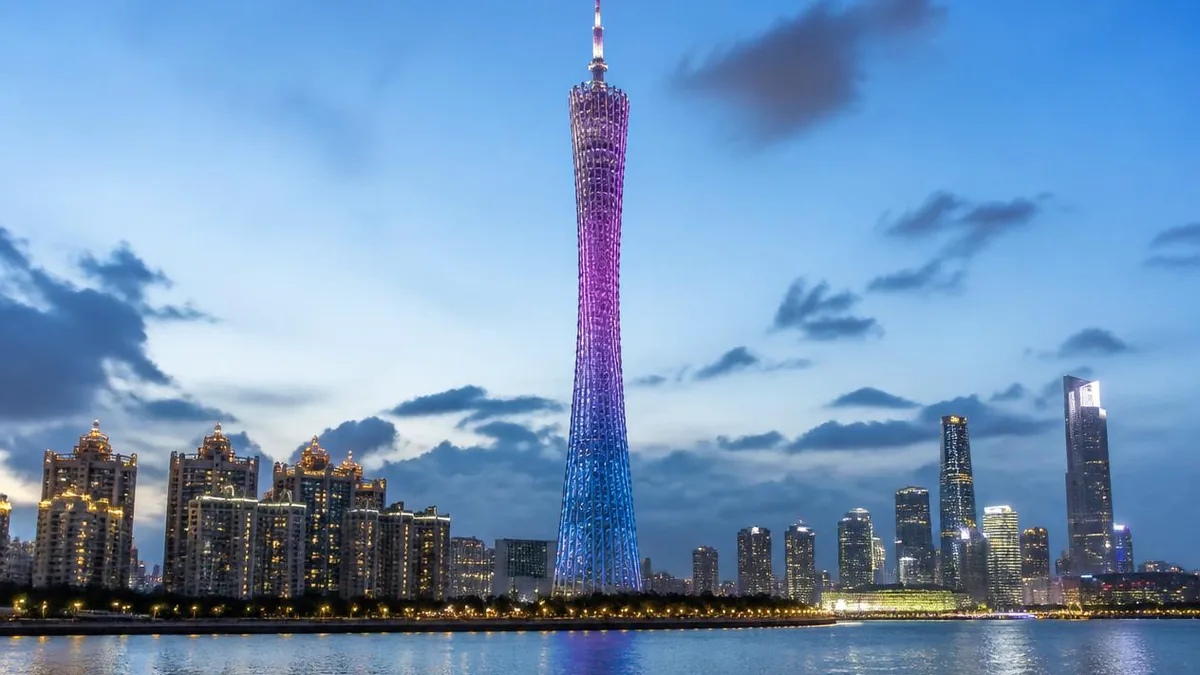
The shape was picked in 2004 and finished in 2009. The official name arrived on 28 September 2010, three days before the doors opened — by which time the city had already named it after the one part of the structure doing the most work.
Most towers are named before they are built. This one was finished first.
The shape was chosen in the summer of 2004, ground was broken in November 2005, the main body topped out in August 2008 and the antenna reached its full height in May 2009. Through all of that the project was officially the Guangzhou TV and Sightseeing Tower, which is a description rather than a name. The name Canton Tower was announced at a press conference on 28 September 2010. The tower opened on 1 October.
Three days. In the meantime Guangzhou had done the job itself, and the name it chose — Xiao Man Yao, the slender waist — happens to point at the exact part of the structure where the engineering is concentrated.
Named three days before it opened
The naming went badly enough to be worth the detail.
In 2009 an open online call for names was run. The winner was Haixin Ta, Haixin Tower, justified on the grounds that the building faces Haixinsha, the island in the river where the Asian Games opening ceremony would be held. The objection was immediate and geographical: the tower is not on Haixinsha. It stands across the water in Chigang, in Haizhu district. The name was dropped and officials said the final choice remained under discussion.
The English half of the argument was separate and more interesting. The working translation had been Guangzhou TV and Sightseeing Tower. In 2009 a municipal political consultative conference member, Geng Shusen, argued for Canton Tower on the grounds that Canton was an internationally recognised name for the city and worth using. The tower is publicly owned but is not a government body, so the naming rules that bind state organs did not apply to it, and Canton won.
Meanwhile the city had produced its own vocabulary and kept it. Xiao Man Yao, slender waist, is the one the operator now uses in promotion. Nau man chai, twisted firewood, is Cantonese for stubborn. There is a homophone joke about the Ram City, and there is “the syringe.” None of these was ever adopted; all of them predate the official name.
One correction to make in passing, because the error is in circulation. English-language reference material dates the naming contest to September 2020, credits it with over 180,000 valid entries, and then states that the name was reconsidered in 2010. That sequence is impossible. The Chinese sources place the contest in 2009.
An axis drawn in 1999, and a deadline that arrived later
The standard assumption is that Guangzhou built this for the Asian Games. The dates say otherwise.
A tower on this bank was first proposed in a 1999 urban design document for the Zhujiang New Town section of Guangzhou’s new central axis, on the site of a former shipyard. The project was formally launched when the municipal executive meeting passed a policy on accelerating cultural infrastructure on 15 December 2003, with the construction commission leading and Guangzhou TV supporting.
Guangzhou was awarded the 2010 Asian Games on 1 July 2004, and it was awarded them as the sole remaining bidder after Kuala Lumpur withdrew. Groundbreaking followed on 25 November 2005.
So the Games did not commission the tower. They gave it a deadline, which is a different and in some ways more demanding thing.
The site has one detail worth walking round for. Immediately beside the tower stands the Chigang Pagoda, a Ming brick pagoda begun in 1619 under the official Wang Mingxuan, stalled halfway for want of funds, and completed in the Tianqi era with backing from the minister Li Daiwen. It is octagonal, nine storeys outside and seventeen within, and 48.9 metres tall — and the strongman figures carved at the corners of its red sandstone base are Westerners. Two towers, four centuries apart, on the same low sandstone rise. The metro station is named after the older one.
Thirteen schemes, and the thousand-metre tower that lost
The competition was public in a way that competitions usually are not.
From July 2004 the entries were shown simultaneously on the construction commission’s website and in Hall 9 of the Canton Fair complex, with the public invited to vote. Thirteen institutions or consortia submitted. After technical review, expert assessment and three rounds of voting, the winner was Scheme No. 4, by the Dutch practice Information Based Architecture — Mark Hemel and Barbara Kuit — with Arup, whose structural team was led by Joop Paul. The local design institute was Guangzhou Design Institute; the owner is Guangzhou City Construction Investment Group with Guangzhou’s broadcaster.
The scheme that had drawn the loudest public support was Scheme No. 1, a 1,000-metre tower. It was rejected.
The winning geometry is not new, and the tower’s own documentation says so. A hyperboloid lattice of straight members corresponds to a Russian patent, No. 1896 of 12 March 1899, held by the engineer Vladimir Shukhov; the closest built ancestor usually cited is Shukhov’s Adziogol lighthouse of 1910. What is new is the scale and the parametric method used to make thousands of near-unique joints buildable.
Two ellipses, rotated against each other
This is the sentence that explains the nickname, so it is worth getting exactly right.
The form is generated by two ellipses: one at foundation level, one on a notional horizontal plane at 450 metres. The two are rotated relative to one another. Straight members running between them therefore cross, and the crossing tightens where the rotation has the most effect — at mid-height.
The consequences run all the way through the building. Low down the lattice is porous and open. At the waist the material densifies and the grid pulls tight, described in the design documentation as behaving like a twisted rope; transparency drops there and views out are restricted. Above the waist it opens again, helped by the tapering of the tubular columns.
That is the whole design. The waist is not a stylistic flourish applied to a straight tower; it is what happens when you rotate one ellipse against another and connect them with straight steel. When Guangzhou looked at the finished thing and called it a slender waist, it was, without meaning to, naming the structural diagram.
Twenty-four columns, forty-six rings, and a thousand tonnes of water
The complexity is in the geometry, not the parts list, which is short.
Three elements do the work: 24 tapered steel columns forming the outer tube, 46 rings, and diagonal braces, all wrapped around an inner reinforced concrete core. The colour scheme is graded to make that legible from the ground — light grey for the outer steel, mid grey for the rings, dark grey for the core, so the tower reads as lighter on the outside and denser within.
Wind is handled twice. The open lattice lets air through, cutting both the wind load and the apparent bulk. Then, near the top of the core, sit two iron water tanks of 500 tonnes each, mounted on rails; sensors slide them against the sway, and the reduction in displacement is stated at about 40 per cent.
The published design values are worth quoting with their source attached, because they are design values rather than test results: seismic design to a special first grade, stated resistance to a magnitude 7.8 earthquake and to force-12 typhoon winds above 149 kilometres per hour, and a design life of over a hundred years.
Six hundred metres, or six hundred and four, or six hundred and ten
The height has a paper trail, and reading it in order removes the confusion.
The design was 610 metres: a body of about 450 and a mast of 160. At tender stage the designers revised it — body up 4 metres to 454, mast down to 156, total unchanged. That revision also raised the top observation platform by four metres, which is the reason the deck figures in circulation are sometimes 450 and sometimes 454.
Then the sequence: 27 August 2008, the 454-metre body tops out and passes CITIC Plaza as the tallest thing in Guangzhou. 5 May 2009, the mast is hoisted to 610. Mid-2010, the site is found to lie under an approach path for Guangzhou Baiyun International Airport, and the civil aviation authority requires the tip to come down.
Here the record splits. Chinese accounts of the works give the cut as about 10 metres, producing the 600 metres used today. Chinese accounts of the later municipal audit dispute give it as 14.2 metres, with an additional cost of over 16.66 million yuan met from the city budget and no one held responsible. The two are not reconcilable from the available material. Separately, English-language reference material states a 450-metre body plus a 150-metre antenna for 604 metres, which matches neither.
Use 600 and treat the rest as history. It was China’s tallest structure until the Shanghai Tower topped out on 3 August 2013, and it lost the title of world’s tallest tower to the Tokyo Skytree, at 634 metres, on 1 March 2012.
The rides pay for the antenna
The attractions are the business, and they are unusually specific objects.
The Bubble Tram, opened on 1 September 2011, is often called a Ferris wheel and is not quite one. Sixteen transparent pods, each 3.2 metres across and taking four to six people, run on a track around the edge of the roof between roughly 450 and 454 metres. The pods are not suspended from a rim, they stay level rather than rotating, and the track follows the roof’s incline, so it is closer to horizontal than vertical. A circuit takes 20 to 40 minutes.
The Spider Walk is the staircase. It runs from about 168 metres to 334.4 metres, 1,088 steps spiralling around the core through the waist, roughly a kilometre of stair, with glass laid into parts of the floor. It is promoted as the world’s longest open-air sky staircase, which is an operator claim rather than an independently defined record. English material describes the same feature as starting at 170 metres and rising nearly 170 metres, and elsewhere as a 180-metre skywalk; the figures are loose.
Drop seats sit at the very top, and whether they run depends on the wind on the day. The revolving restaurant is two storeys, quoted at 407.2 to 422.8 metres in one Chinese list and at 424 in another, seating around 400.
Four loss-making years, in public
The economics are documented, which is rarer than it should be, and for a while they were bad. Total investment was about 2.948 billion yuan. A municipal audit reported for 2013 gave actual investment of 2.94 billion by May 2014, an overspend of 444 million, annual bank interest of 135 million, and four consecutive loss-making years, with attendance running at about 3,900 a day against the 6,000 the operator had said were needed to break even at a top ticket of 150 yuan. It improved: the operator reported nearly 15.57 million cumulative visitors by December 2019 and revenue rising from 485 million yuan in 2015 to 691 million in 2019, with tickets and rides about half of it, before the pandemic years produced heavy losses.
Every price, bundle and opening time in that paragraph has since moved. Confirm at the gate.
What the tower still broadcasts
The day job is in the tower’s formal description — a broadcasting tower with sightseeing, cultural and city-window functions — and it carried the transmission task for the 2010 Asian Games.
Whether it is still the city’s working transmitter is a separate question, and the answer in Chinese reference material is blunt. As of 2022, that material states, Guangzhou’s television signal was still being transmitted from the older Yuexiu Hill and Huaguoshan towers, and Canton Tower’s television transmission function remained idle. The explanation given is that cable displaced rooftop aerials across Guangzhou through the 1990s and 2000s, and that the city has few free-to-air terrestrial channels for a new transmitter to carry. This is reference material rather than an operator statement and should be read as such — but it sits comfortably beside the revenue mix the operating company itself reports, which is tickets, catering, cruises and retail.
What the tower does emit, without dispute, is light, and the lighting is the most carefully designed thing about it after the structure. 1,080 individually controllable LED nodes are mounted on the structure itself so that the tower glows rather than being floodlit from below — a scheme by Rogier van der Heide, then heading Arup’s lighting practice, stated to consume about 15 per cent of the permitted maximum for facade lighting. Three lasers at the top, with a throw of over a kilometre, are aimed at the towers of Zhujiang New Town and at CITIC Plaza. The antenna mast runs on a timer that locks a different colour each day, so that, in the original description, a resident can tell the day of the week from the tip.
Lighting hours, holiday programmes and whether any particular scheme is still running all change. Check the day’s notice rather than a guidebook.
The axis it anchors, and the emblem it became
Stand at the base and look north across the water, because the tower is the south anchor of a line that was drawn before it.
Haixinsha, the olive-shaped island directly opposite, covers about 175,000 square metres and has had an eventful century. It was a tidal flat belonging to Liede village, dry only at low water; land reform put it under a horticultural farm in 1952; the village traded 700 mu of riverside land to get it back in 1958; the port authority requisitioned it in 1976, after which it served as a military logistics depot; a shoe factory occupied the west end from 1988 until 2000. Silting and reclamation roughly doubled it. The city took it back in 2006, rebuilt it from October 2009, and held the Asian Games opening ceremony there on 12 November 2010. The retained grandstand seats 54,445.
Behind it runs Huacheng Square, 56 hectares, opened to the public in October 2010 and host to the Guangzhou International Light Festival each November since 2011. On its flanks are the Guangdong Museum, won in a 2003 invited competition by a Hong Kong practice with a scheme called the treasure container, built from December 2004 and opened on 18 May 2010, its galleries column-free because the exhibition floors hang from a mega-structure; and the Guangzhou Opera House, Zaha Hadid’s two-pebbles scheme, begun in January 2005, with an 1,800-seat main hall and a 400-seat studio, and a budget that rose from an estimated 850 million yuan to 1.38 billion, which brought accusations of a vanity project.
The last move in the sequence is the one that closes the argument about names. In 2017, ahead of the Fortune Global Forum, Guangzhou adopted a city logo that draws the two characters of its name as the tower’s silhouette. It displaced the Five Rams, the emblem the city had used for generations, and a good many residents said so.
An object that had no agreed name in 2009 was the city’s own name eight years later. The name people actually say is still the one about the waist — which is, as it happens, the only one that describes what the building is doing.
The LoreLens app can identify the towers along Guangzhou’s new axis from the observation decks and explain when each arrived and what it replaced.
Location profile
Where it is
Frequently asked questions
How tall is Canton Tower, and why do sources give 600, 604 and 610 metres?
Because all three numbers were true at different moments and one of them is a translation artefact. The design height was 610 metres: a main body of about 450 metres plus a 160-metre antenna mast. During construction tendering the designers raised the body by 4 metres to 454 and shortened the mast to 156, keeping 610. The body topped out at 454 metres on 27 August 2008 and the mast reached 610 on 5 May 2009. Then the site was found to sit under an approach path for Guangzhou Baiyun International Airport, and in mid-2010 the civil aviation authority required the tip to come down. Chinese accounts give the cut as about 10 metres, producing the 600 metres quoted today; a municipal audit dispute over the same episode gives the reduction as 14.2 metres and the extra cost as over 16.66 million yuan borne by the city budget. Those two figures do not reconcile and both are in print. English-language reference material states a 450-metre body plus a 150-metre antenna for 604 metres, which matches neither Chinese sequence. Take 600 as the current operating figure.
Is it really called Xiao Man Yao, and what is the official name?
The nickname is not official and it came first. Through construction the working name was the Guangzhou TV and Sightseeing Tower. In 2009 an open online naming call was run; the winning entry was Haixin Ta, Haixin Tower, on the grounds that the tower faces Haixinsha island. That drew immediate objection — the tower does not stand on Haixinsha, it stands across the water in Chigang, in Haizhu district — and the name was dropped, with officials saying the final choice was still under discussion. The name Guangzhou Ta, in English Canton Tower, was announced at a press conference on 28 September 2010; the tower opened on 1 October. Meanwhile the city had settled on its own names. Xiao Man Yao, roughly slender waist, is the one used in promotion; nau man chai, twisted firewood, is Cantonese for stubborn; there are others. One caution: English-language reference material dates the naming contest to September 2020 and credits it with over 180,000 entries, then says the name was reconsidered in 2010 — internally impossible. Chinese sources put the contest in 2009.
Which levels can you go to, and what are the rides?
The tower sells by level and by bundle, and the bundles change, so read the current options at the counter. In outline, from Chinese descriptions of the functional zones: a special-effects cinema and games hall between roughly 84 and 116 metres; viewing and rest areas around 147 to 168 metres; a high-altitude tea house around 334 to 355 metres; a two-storey revolving restaurant given variously as 407.2 to 422.8 metres or 424 metres, seating around 400; an indoor observation hall around 428 to 433 metres; and the open-air rooftop deck, given as 450 metres and about 54 by 40 metres. English material puts an indoor observatory at 449 metres and the rooftop at 488 metres, which the Chinese figures do not support. The rides are the Bubble Tram, sixteen transparent pods circling the sloping roof, opened 1 September 2011; the Spider Walk staircase up through the waist; and drop seats at the top. Prices, opening hours and which attractions are running on a given day all change — confirm at the gate.
Does it still work as a broadcasting tower?
It was commissioned as one and it carried the transmission task for the 2010 Asian Games, so the function is real. Whether it is still the city's main transmitter is a different question. Chinese reference material states that as of 2022 Guangzhou's television signal was still going out from the older Yuexiu Hill and Huaguoshan transmitting towers and that Canton Tower's television transmission role remained idle, the reason given being that cable displaced rooftop aerials through the 1990s and 2000s and Guangzhou has few free-to-air terrestrial channels. That is a claim from reference material rather than an operator statement, and should be treated as such. What is not in doubt is the revenue mix the operating company reports: tickets and rides, catering, cruises and retail. The one signal the tower reliably emits is light — a facade scheme of 1,080 individually controllable LED nodes mounted on the structure itself, plus three lasers at the top.
Sources and further reading
Background references for the history and place names in this guide. Opening hours, ticketing and access change often — always confirm with official local information before travelling.