Liaoning · Dalian
Xinghai Square: A Hundred Hectares of Made Ground
Dalian's great civic space was a bay until the 1990s. It was filled with construction spoil, laid out as a circle whose diameters are dates, and paved with a thousand bronze footprints taken from a thousand real residents. Its subject is its own size, and the size claim needs checking.
Most guides describe Xinghai Square by listing what stands on it. That is the wrong instrument, because the things standing on it are not the point. The point is the ground.
Until the 1990s this was water. Xinghai Bay, on the southern coast of Dalian’s Shahekou district, held an abandoned salt works and the tail end of the city’s waste stream. What is now a kilometre of lawn, pavement and radial road is fill—construction spoil, tipped into a bay and levelled.
Everything else here follows from that. The scale is possible because the ground was manufactured. The geometry is legible because nothing older was in the way. And the square’s central claim about itself, that it is the largest of its kind, is a claim about a number rather than about a place. Start with the number.
The site, in plain terms
Xinghai Square sits about 4.5 kilometres south-west of the old city centre at Qingniwa, with Zhongshan Road—Dalian’s main east–west artery—running through it. Roughly a kilometre to the east is Baiyun Mountain; roughly a kilometre west, Xinghai Park; roughly a kilometre south, out over the water, the Xinghai Bay bridge.
It is free. There is no gate, no ticket window and no scenic-area listing, because it is not an attraction in the administrative sense: it is a public square that happens to be enormous. Metro Line 1 has a station named for it, with three exits.
This matters more than it sounds. Almost everything written about Xinghai Square borrows the vocabulary of sightseeing—“must-see,” “highlight”—for a place that is really infrastructure with a design on it. Approach it as a piece of city and it becomes legible. Approach it as an attraction and you will walk a long way looking for something that is not there.
What was here, and what it was filled with
The dates are specific and worth having.
The Xinghai Bay renovation project is dated to 16 July 1993. The municipal government reclaimed land using construction waste—an important detail that often gets garbled into “built on a rubbish dump.” The pre-existing site was an abandoned salt-evaporation works on the bay; the material used to make new ground out of the water was construction spoil. Reported figures give 114 hectares reclaimed and 62 hectares developed.
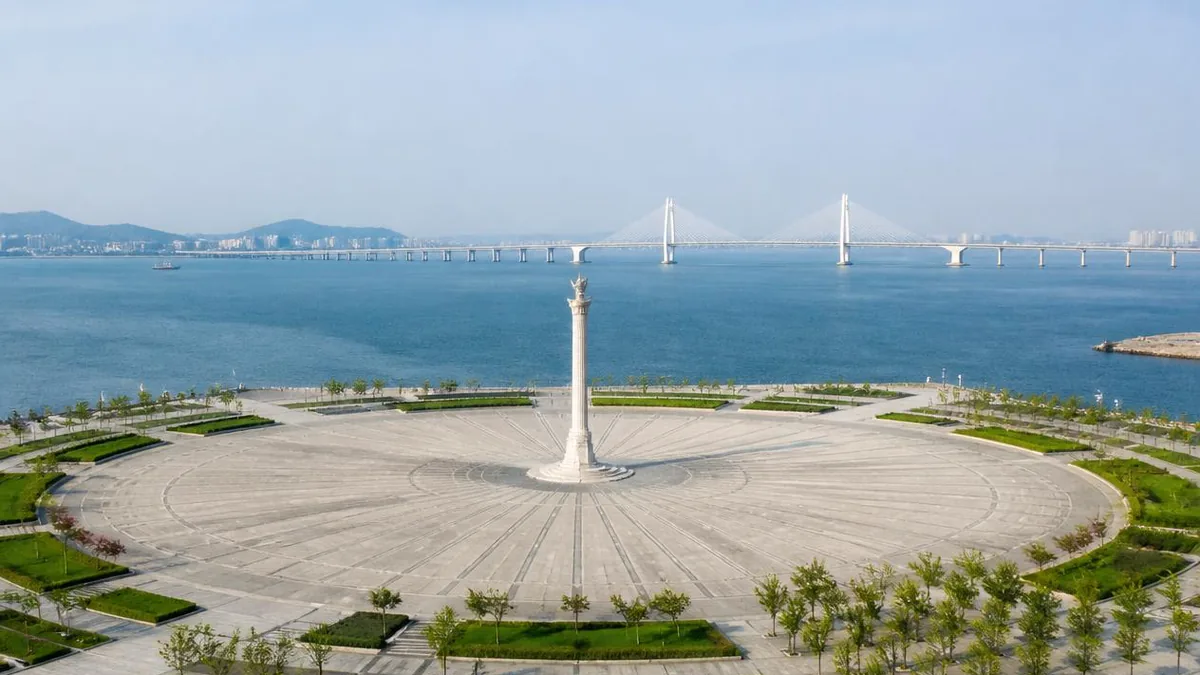
The square was completed on 30 June 1997 and opened free to the public. The timing was not incidental: the following day, 1 July 1997, was the handover of Hong Kong, and the square’s original centrepiece was raised to commemorate it.
So the whole thing is younger than a great many of the people walking on it. That is unusual enough to say plainly, and it is the honest frame for everything that follows.
The size claim, taken apart
Here is where the sources stop agreeing, and where the honest version is more useful than the superlative.
Chinese-language accounts generally call it the largest public city square in Asia. English-language accounts generally call it the largest city square in the world. Neither states a criterion—paved area? total site? does a lawn count?—and superlatives without criteria are advertising.
The areas do not agree either. One figure in wide circulation is 110 hectares, that is 1.1 million square metres. Another, given in Chinese sources and repeated in English, is 1.76 million square metres of total occupied area including lawns, fountains and carriageways. Both are quoted as “the area of Xinghai Square.”
There is a tell. The same English account that gives 1.76 million square metres also reports the lawn as 850,000 square metres, “77.3 percent of the total area.” Do the arithmetic: 850,000 is 77.3 percent of 1.1 million, not of 1.76 million. The percentage was calculated against the smaller figure and then printed beside the larger one. This is what happens when numbers are copied rather than checked, and it is a good reason to hold all of them loosely.
What is not in doubt: the layout gives a north–south axis of about 1,010 metres and a north-east axis of about 630 metres. Whatever the accounting, you are looking at something around a kilometre across, and you will feel every metre of it.
The geometry is a calendar
The plan is not decorative. It encodes dates, and once you know the code the circle stops being an abstraction.
The central paved circle has an inner diameter of 199.9 metres, for 1899—the year Dalian was founded as a city, under Russian administration. The outer circle has a diameter of 239.9 metres, for 2399, the city’s five-hundredth anniversary. A civic space that references a date four centuries in the future is either confident or absurd, and it is at least specific.
The centre draws on the circular mound altar of Beijing’s Temple of Heaven. It is paved with 999 slabs of Sichuan red marble, carved with the heavenly stems and earthly branches, the twenty-four solar terms and the zodiac animals. Nine bronze ding tripods stand around it, each carrying one character; read together the nine characters form a single sentence about the unity of the Chinese nation.
Around the outer edge stand 30 groups of sculpture representing thirty sports, made in hollow white stainless-steel mesh for the 2008 Beijing Olympics. They are the most dated element on the site and, unlike the circle, they encode nothing.
A thousand feet, in order of birth
The best thing on this square is the thing you can most easily walk over without seeing.
Leading south from the centre toward the Centennial City Sculpture is a ground-level bronze relief of 1,000 footprints, pressed by 1,000 Dalian residents of different ages. They run north to south in order of age, oldest first. The first line belongs to people born in 1899; the last line to people born in 1999, the year the work was installed for the city’s centenary.
Consider what that required: finding a resident born in each year of a century, in a city that had been Russian, then Japanese, then Soviet-garrisoned, then Chinese, and getting each of them to stand in soft material. The result is a hundred-year census rendered as shoe sizes.
At the end of the line stands the Centennial City Sculpture, also from 1999: a stone form shaped like an opened book, carved with relief and line work, turned to face the sea. The intended reading is a city turning a page after its first hundred years. Whether you find that moving or bureaucratic, it is at least a legible idea, and the walk toward it—reading dates off the ground—is the one route across this square that has a narrative.
The column that is no longer there
If you have seen photographs of Xinghai Square, you have probably seen a tall white column at its centre. Do not go looking for it.
It was a huabiao, the traditional ornamental column form, in white marble, erected in 1997 to mark the return of Hong Kong. It was described as the tallest in China: 19.97 metres high and 1.997 metres in diameter, the digits chosen to echo the year. For nearly two decades it was one of the city’s emblems.
It was taken down at midnight on 5 August 2016.
The explanation you will find in English-language accounts is political: that the removal was connected to the downfall of Bo Xilai, who was mayor of Dalian when the square and the column were built, and that local media stayed silent while mainland reports were deleted. That is a widely repeated attribution, not a documented reason, and no official account of the decision is available. We report it as what it is—an inference in circulation—and leave it there.
What replaced it is a matter of record. A musical fountain opened at the centre on 26 November 2017, described as the largest in north-east China, with a diameter of about 140 metres and jets reaching up to about 88 metres. It is the third such fountain in the central city.
Why Dalian is a city of circles
Xinghai Square looks like an invention of the 1990s. Its form is not.
Dalian was founded as a planned city under a Russian lease taken from the Qing government in 1898. The new town, Dalny, was laid out from 1899 on an explicitly Parisian model: circular squares with roads radiating from them, and government, postal and banking institutions arranged around the circles. The surviving demonstration is Zhongshan Square, 213 metres across, with ten streets radiating from it.
The Russian plan was never completed. The Russo-Japanese War of 1904–05 stopped construction with only the area north of that square built, and under the Treaty of Portsmouth the territory passed to Japan, which renamed the city Dairen and continued building to the existing plan. The ten landmark buildings around Zhongshan Square went up between roughly 1908 and 1936; the group was listed for national protection in 2001 and now houses banks, a post office and a cultural club.
None of this needs a verdict attached to it to be worth knowing. It is planning history, and it explains why a Chinese city has a road network that behaves like a European one—and why, when Dalian wanted a grand civic gesture in the 1990s, it reached for a circle with radiating axes. Xinghai Square is that tradition continued on ground that did not previously exist. Readers who like this sort of layered urban record will find a comparable case on Shanghai’s Bund.
The bay had a leisure industry before it had a square
One kilometre west, Xinghai Park carries the older layer, and its dates are surprising.
In May 1909 the South Manchuria Railway Company established a pleasure park here, together with a hotel, explicitly to attract Western visitors. By the 1930s it had grown from around 820,000 square metres to roughly 4.78 million. A 1932 architectural-association survey describes its zones: a public area at the east gate, a hotel-and-villa promenade at the main gate, a bronze-statue area at the west gate, a bathing beach and a golf course.
After 1945 the park was renamed Xinghai Park, and most of its area was absorbed by housing, hospitals, research institutes and military land. What survives is small by comparison: about 190,000 square metres after renovations in 1995 and 1996 that extended the sea wall, enlarged the beach and cleared buildings. It has been free to enter since 2005. The shoreline runs about 800 metres; the beach is mixed sand, gravel and cobble rather than soft sand.
The point is not nostalgia. It is that this bay has been a leisure coast for well over a century, under three administrations, and Xinghai Square is the most recent expression of that rather than the first.
What else is on the water
Four things worth a sentence each.
The Xinghai Bay bridge opened on 30 October 2015 after construction from 2011. It runs about 6.8 kilometres with a main bridge of 820 metres and a clearance of about 30 metres, and it is double-decked, each deck carrying four lanes in one direction, with a pedestrian walkway. It was deliberately aligned so that its centre faces the square’s axis, which is why it appears in nearly every photograph taken looking south. It has also had a legal afterlife: in March 2024 the project company was fined 27.26 million yuan for having begun work without sea-area use rights, and the authorities stated the bridge would not be removed.
The shell museum on the square is a building shaped like a lying shell, holding a very large collection. Its dates diverge: English accounts say it opened on Xinghai Square in 2015, while Chinese accounts date the institution to 2003 with a new building completed in 2010. Those may describe the same museum at different addresses; no source reconciles them.
North of the square is the Xinghai CBD, with the city’s convention and exhibition centres and the headquarters of the Dalian Commodity Exchange—the reason the skyline behind the lawn looks like a financial district rather than a seafront.
West along the bay, beside Xinghai Park, is a ticketed aquarium complex operating since the mid-1990s. If you are weighing up marine-animal displays, our guide to Laohutan Ocean Park covers the considerations at length.
How to walk it without regretting it
Now the practical part, which for this square is unusually important.
The distances are real. A crossing on the long axis is around a kilometre, and the perimeter walk is considerably more. There is almost no shade: the design is lawn, paving and low sculpture, and the tree cover is at the edges. Dalian is one of the windier parts of north-east China, with mean wind speeds of 3 to 6 metres per second, and on the seaward side of an open square that wind has nothing to break it. In summer, most of the year’s rain falls between June and August; August is the hottest month.
So: sun protection, water, and a route rather than a wander. A workable one runs from the metro to the centre, then south along the footprints—reading the years as you go—to the Centennial Sculpture and the sea wall, then west along the shore toward Xinghai Park, and out. That is about an hour and a half at a normal pace and covers everything with a reason behind it.
Late afternoon into dusk is the best light and the busiest hour. The square hosts large events—the beer festival moved here from Beijing in 2002, and an international walking event has used the third weekend in May since 2003—during which layout, access and the fountain schedule all change. Nothing here runs to a timetable you can rely on from a distance. Check on the day.
And then, at some point, stop walking and look down. You are standing on a bay. Someone decided, in 1993, that the most useful thing to do with a hundred hectares of water and a city’s construction rubble was to make a floor out of it and write a hundred years of birthdays into the paving. Whether that is the largest square in the world is a question about definitions. That it exists at all is a question about ambition, and the answer is under your feet.
The LoreLens app can identify civic monuments, sculpture and architectural styles like those around Xinghai Square and explain the history behind them.
Location profile
Where it is
Frequently asked questions
Is Xinghai Square really the largest city square in the world?
Treat that as a marketing line, not a measurement. Chinese-language sources typically claim the largest public city square in Asia; English-language sources typically claim the largest in the world. Neither states the criterion, and the two most-quoted areas are not the same number: 110 hectares in some accounts, 1.76 million square metres in others. You can even watch a single English source contradict itself, giving 1.76 million square metres as the total and then reporting the lawn as 850,000 square metres or 77.3 percent of the whole—a percentage that only works against 1.1 million. What is not in dispute is that it is very large by the standards of Chinese civic squares, and that the entire surface is made ground. That is a more interesting fact than any superlative.
Is there an admission fee, and is it a scenic area?
No, and no. Xinghai Square is a free, ungated public space—a piece of city, not a ticketed attraction. It does not appear in national scenic-area listings and there is no gate to buy anything at. Individual things around it are separate and may charge: the shell museum on the square, the aquarium and amusement operators along the bay, boat and ride concessions. Those come and go with tenancies and seasons, so check on the day rather than from any published list.
What are the thousand footprints?
A ground-level bronze relief leading toward the Centennial City Sculpture, made of 1,000 footprints pressed by 1,000 Dalian residents of different ages. They are laid out in order of birth from north to south, oldest first: the first line belongs to people born in 1899, the year the city was founded under Russian administration, and the last line to people born in 1999, the year the work was made for the centenary. It is easy to walk past without noticing—it is underfoot, not on a plinth—and it is the one element here that is about individuals rather than dimensions.
Where has the big white column gone?
It was removed. A white marble huabiao, a traditional ornamental column, stood at the centre of the square from 1997, put up to mark the return of Hong Kong. It was described as the tallest in China at 19.97 metres, with a diameter of 1.997 metres—the digits deliberately echoing the year. It was taken down at midnight on 5 August 2016. English-language accounts state that the removal is believed to have been political, connected to the fall of Bo Xilai, who was mayor of Dalian when the square and the column were built, and note that local media did not report it and that mainland reports were deleted. That explanation is widely repeated but is an attribution rather than a documented reason, and no official account of the decision is available. A musical fountain opened in the centre in November 2017 in its place.
Sources and further reading
Background references for the history and place names in this guide. Opening hours, ticketing and access change often — always confirm with official local information before travelling.