Liaoning · Dalian
Laohutan Ocean Park: Read the Coast Before the Aquarium
A practical, clear-eyed guide to Dalian's bay-sized marine park: start with the real coast, understand its separate halls, read the tiger legend carefully and make informed choices about animal displays.
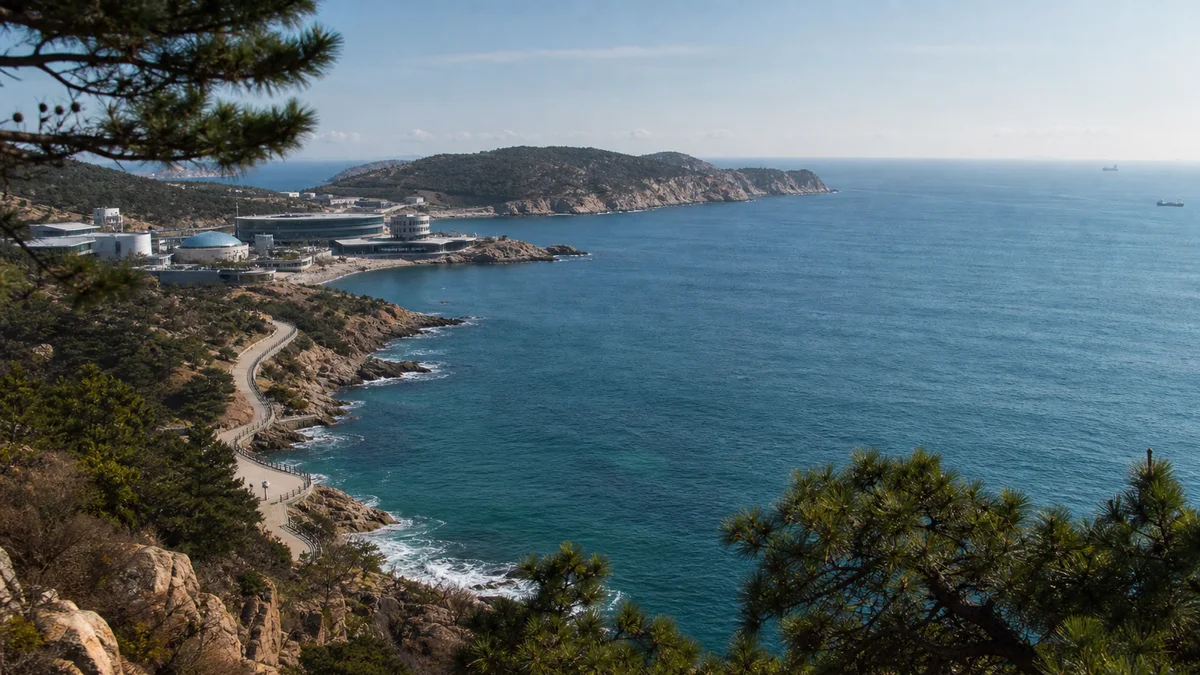
5A View location, maps and nearby scenic areasStand where the paved park meets Tiger Beach Bay and look in two directions. Inland are themed façades, signs and queues. Seaward are headlands, exposed rock, gulls and water moving through a real Dalian cove. The second view should come first: Laohutan Ocean Park was built into a coast, not sealed away from it.
That distinction keeps the day legible. The park mixes a natural shoreline with constructed aquariums, managed animal habitats, performance spaces, rides and public art. They share one ticketed destination, but they are not the same kind of experience and should not be judged by the same rules.
Orient yourself before joining a queue: find the bay on the map, mark the Coral Hall and Polar Hall in the main park, locate the Marine Mammal Hall and any performance venue, then identify Birds Singing Forest on the far side of the water. Check which connections are actually operating today. Only then decide what deserves your time.
One park, several separated experiences
The operator describes a site of about 1.18 million square metres with more than 4 kilometres of winding shoreline. Those figures explain why a list of five halls can be misleading. Laohutan is closer to a coastal district than to a single aquarium: substantial walks, outdoor exposure and repeated decisions sit between the exhibits.
Its commonly advertised core comprises the Polar Hall, Coral Hall, Marine Mammal Hall, Happy Theatre and Birds Singing Forest. Other features can include Tiger Sculpture Square, hillside and bay views, paid rides, a cross-sea cableway, sightseeing boats and immersive entertainment. This is an inventory, not a promise that every component will operate on your date.
The park and the Polar Hall are paired in the official 5A scenic-area name. The 5A scenic-area profile gives the mapped location. Once inside, use the day’s park map: older online diagrams may not reflect maintenance, seasonal closures or changed one-way routes.
Dalian’s maritime identity outside the glass
Dalian occupies the end of the Liaodong Peninsula, where maritime routes connect the Bohai region with the Yellow Sea. Its modern growth was shaped by port construction, railways, naval strategy, migration and periods of Russian and Japanese imperial control before the city became one of northeast China’s major ports. The sea here has never been only scenery; it has been a route, workplace, border and source of food.
Laohutan lies on the city’s southern coast. The indented shore, steep green slopes and offshore rocks explain why Dalian markets itself as a bincheng, a “coastal city.” Yet the bay you see is neither untouched wilderness nor a decorative backdrop. Roads, sea walls, buildings and tourism infrastructure have altered it, while wind, tide and salt continue to set physical limits.
Pause at an open view between halls. Fishing and cargo may be out of sight, but the same maritime city supports aquariums, seafood restaurants, beaches and waterfront leisure. That connection is more revealing than any generic claim that Dalian simply “loves the ocean”: the city’s economy and identity have long depended on managing access to it.
Five venues, five ways of looking
Each major area asks you to look at marine life differently. Keep the categories separate.
- The Coral Hall presents coral-reef communities and jellyfish in controlled tanks. Lighting and windows make detail visible, but the colour, current and species combination are designed rather than a slice of nearby sea.
- The Polar Hall uses immersive scenery and large viewing windows to present animals associated with polar or cold-water environments. The operator advertises animals such as belugas, penguins, seals, walruses and polar bears, but individuals, access and activity vary.
- The ship-like Marine Mammal Hall offers above- and below-water views of pinnipeds such as seals and sea lions. Watch swimming, breathing and resting as much as feeding or trained behaviour.
- Happy Theatre is a performance venue, not a natural-history display. Its programme and opening can be seasonal, and the presence of a listed venue does not guarantee a show.
- Birds Singing Forest, in the hills across the bay, is a large managed aviary landscape. It feels greener and more open than an aquarium hall, but it remains a human-designed enclosure with its own entry, route and husbandry rules.
The most honest comparison is therefore not “which hall has the best animals?” Ask instead what each setting reveals, what it hides, and how much of the behaviour you see is spontaneous, conditioned or prompted by a presentation.
From a scenic shore to a modern marine attraction
Laohutan is sometimes narrated as though coastline, aquarium and entertainment complex had always formed one attraction. They did not. The older asset is the southern Dalian shore; the large-scale marine park is a modern way of organizing and selling access to it.
China’s urban aquariums expanded rapidly as domestic tourism, marine science communication and themed leisure grew. Laohutan brought these strands together: landscape viewing, animal exhibition, popular education, staged entertainment and paid recreation. It was included among the first group of National 5A Tourist Attractions in 2007, a tourism-quality classification rather than a declaration that every component is historic or ecologically exemplary.
Look at the architecture and route design as evidence of that modern history. Simulated ice, a pirate-ship silhouette, theatrical lighting and a giant aviary convert distant habitats into scenes a city visitor can enter. They can spark curiosity, but they also compress complex ecosystems into a manageable afternoon. The real coast outside restores some scale: no tank or stage contains “the ocean.”
Why “Tiger Beach”? A legend, not a place-name record
Near Tiger Sculpture Square, the monumental group of granite tigers turns the name Laohutan—literally “Tiger Beach”—into a visible emblem. It is tempting to read sculpture, name and coastline as one documented event. The park itself presents something different: a local legend.
In that story, a young man named Shicao rescues a daughter of the Dragon King from a tiger. She returns to the dragon palace to borrow the only sword capable of defeating the supernatural beast, but the tiger attacks again before she comes back. Shicao fights anyway. Pieces of the tiger become named reefs, hills and shores; Shicao dies from the struggle, and the returning dragon daughter becomes another rock beside him.
The tale works like a verbal map. It gives memorable bodies and moral actions to irregular landforms—teeth, tail, head, beach and reef. It also carries a familiar folk pattern: a brave ordinary person protects the community, while love arrives too late to reverse the cost.
Treat it as landscape storytelling, not verified etymology or geology. The rocks were not made by a tiger, and the story alone does not prove when the name arose. Its modern echo is easier to verify: tiger imagery still organizes the park’s identity, from the square to souvenirs and photography.
Animal care, education and the price of spectacle
A modern marine park can make animals visible to people who may never reach polar seas or a coral reef. Labels, keeper talks and close observation can support learning. Managed care may also involve veterinary work and professional husbandry. None of those general possibilities proves that every display, programme or conservation claim is equally strong.
Captive marine mammals, polar species and birds raise hard welfare questions: space, social grouping, climate, noise, repetitive behaviour, transport and the purpose of training all matter. A performance may demonstrate coordination between carers and animals, yet theatrical music and applause can shift attention from biology to spectacle. “Education” should therefore be evaluated by what visitors actually learn and what evidence the institution provides, not accepted as a blanket justification.
You do not need to resolve the global aquarium debate at the gate. Practise attentive viewing instead. Read the species and habitat panels. Notice whether animals can withdraw from view, whether enrichment is visible and whether conservation messaging names specific partners or outcomes. Do not tap glass, shout, use flash or encourage a child to provoke movement. An animal resting out of sight has not failed to entertain you.
A route that survives queues and schedule changes
The operator’s published sequence has commonly been Coral Hall → Polar Hall → Happy Theatre → Marine Mammal Hall → Birds Singing Forest. It is useful because it moves through the main park before finishing across the bay. It is not a timetable.
Start with the Coral Hall if the entrance queue is manageable, then give the Polar Hall the largest protected block of indoor time. After that, make a decision rather than following arrows automatically:
- For exhibits and coast: skip schedule-chasing, continue to the Marine Mammal Hall, take a bay-view pause, then cross to Birds Singing Forest only if the route, energy and weather suit your group.
- For a listed presentation: confirm the day’s time and admission method first, then work backwards. Arriving early does not guarantee a seat, and a notice can change.
- For limited mobility or young children: choose two priority halls in the main park and treat the far-side bird area and paid rides as optional extensions.
Do not assume the cableway or sightseeing boat is the required connection. Both may be paid separately and may pause for season, wind, storms, inspection or maintenance. Ask staff what pedestrian or vehicle alternative is open. Keep your ticket or digital code available because checks can occur at individual venues.
Photograph the relationships, not just the animals
The strongest exterior composition often places the granite tigers against the bay, or frames a themed building with rock and open water. That contrast tells the truth of Laohutan: made attraction and maritime landscape occupy the same frame. A moderate telephoto lens can compress the headlands; a wide lens is better when coastline and architecture need to remain connected.
Inside, obey posted restrictions. Turn off flash and any focus-assist lamp. Stand back after taking a few frames so children and wheelchair users can reach the glass. Dark tanks tempt visitors to press a phone against the window; if permitted, shade reflections with a hand without touching or blocking the panel. Never knock to obtain eye contact.
At performances, photographing continuously can become a wall for everyone behind you. Keep the screen low, avoid bright displays and do not lean over barriers. In the aviary, give birds space, especially around feeding or resting points, and never use food to manufacture a close-up.
Families, access, weather and the working edge of the sea
The operator lists an information desk, first-aid help, baby-care facilities, luggage storage, and wheelchair or stroller services. Availability, deposit rules and exact locations can change, so confirm them when you enter. A provided wheelchair does not make every slope, threshold or crowded viewing tier step-free; ask for the current accessible route between your chosen halls.
For families, agree on a meeting point and put a contact number in a child’s pocket. Crowds bunch at show entrances and large windows. Bring water, a light layer and hearing protection if a child is sensitive to loud music or animal calls. Do not promise a particular animal will swim, feed or approach the glass.
Dalian’s coast can change character quickly. Sea wind can feel much colder than the city forecast, summer sun reflects off paving and water, and fog or rain can erase the far headland. Thunderstorms, strong wind and rough water can stop outdoor venues, cableway or boat operations. Wear shoes with grip, stay behind railings, keep off wet rocks and do not treat a sheltered-looking cove as safe for unsupervised water access.
Leave by looking back at the bay
After tanks, stages and themed façades, return to a place where the water is visible without glass. The day may have shown you animals from climates far from Liaoning, but the most important habitat lesson is close at hand: every marine story begins with a coastline shaped by weather, work and human choices.
Laohutan is neither simply a natural scenic area nor simply an aquarium. Its value—and its tension—comes from the join. The real bay gives the park meaning; the park turns the sea into curated images; the animals make distant ecosystems emotionally near; captivity makes that closeness ethically complicated.
Let the final photograph include some empty water. It leaves room for what no performance schedule can guarantee: the sense that the sea continues beyond the visitor route, indifferent to the story the park has arranged around it.
The LoreLens app can help distinguish the natural bay, themed halls, Tiger Sculpture Square and the landscape legend while you explore.
Location profile
Where it is

Frequently asked questions
Is Laohutan Ocean Park one aquarium building?
No. It is a large coastal park with separate indoor halls, outdoor areas and a bird area across the bay. Entry checks, walking and possible queues occur between parts, so study the current map instead of treating it as one continuous exhibition.
How much time should I allow for Laohutan Ocean Park?
Most visitors should protect at least half a day, while a slower visit with children, rest stops or several presentations can take longer. Queueing, weather and the day's venue schedule can change the pace, so do not plan a tight onward connection.
Are the shows, cableway and sightseeing boats guaranteed?
No. Presentations and outdoor or paid attractions can change with season, weather, maintenance, animal welfare and operations. Check the operator's current notice and the information desk after arrival before building your route around any one activity.
Is Laohutan Ocean Park suitable for children and wheelchair users?
Many main areas are family-oriented, and the operator lists services such as baby-care facilities, stroller and wheelchair support, but the park is extensive and includes slopes, thresholds and outdoor transfers. Ask staff about the step-free route and current assistance before setting out.