Liaoning · Shenyang
Shenyang Botanical Garden: Reading the Expo Garden After 2006
Walk from a phoenix-shaped gateway into a living garden where northern plants, international display gardens and the built legacy of Shenyang’s 2006 horticultural exposition continue to grow together.
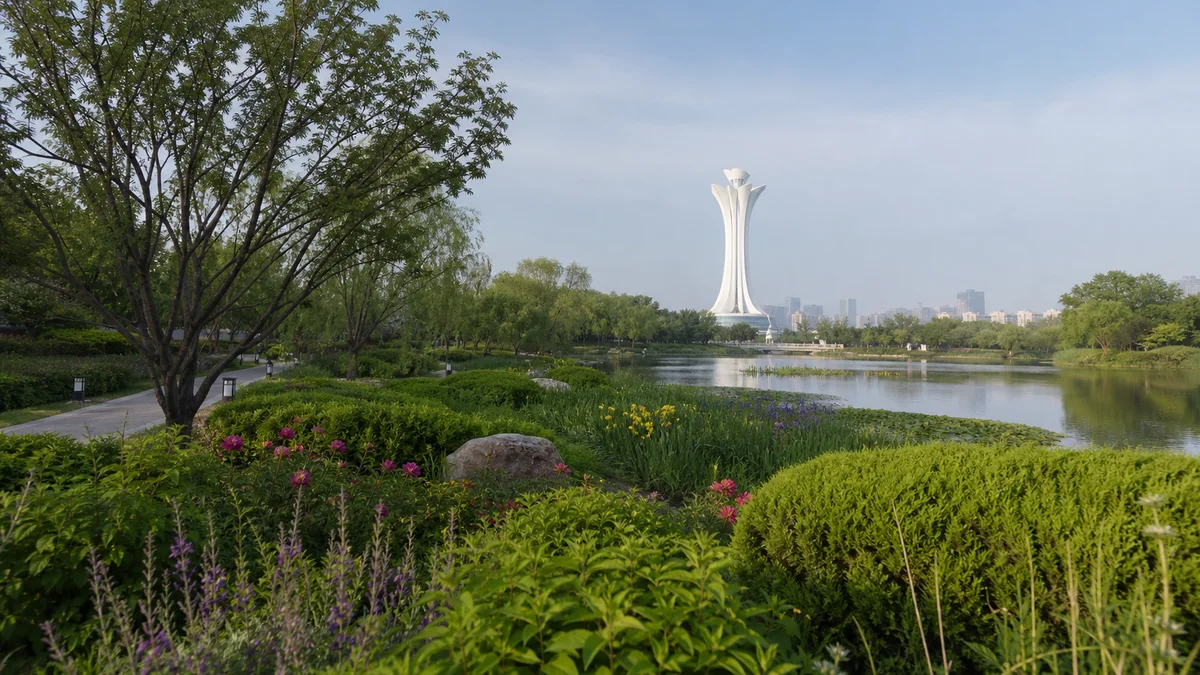
5A View location, maps and nearby scenic areasPass beneath the long steel sweep of Phoenix Wing and pause before choosing a path. Straight lines, clipped beds and the distant white form of Lily Tower belong to an international exposition. Mature trees, water, plant labels and the uneven shade beneath them belong to a botanical garden. At Shenyang, both readings are correct.
The place is officially called Shenyang Botanical Garden, while Shenyang Expo Garden remains an equally common public name. That is not two attractions sharing a neighbourhood. It is one landscape with two institutional memories: a garden founded in the twentieth century, and the site remade to host a major horticultural exposition in 2006.
Read the garden in layers: begin with Phoenix Wing and the main exposition axis, use Lily Tower as a visual compass, choose either the domestic and international display gardens or the specialist plant collections, then finish among woodland, water and bridges. Trying to collect every garden name usually reveals less than comparing a few spaces carefully.
A 2.46-square-kilometre garden, not one flowerbed
The current attraction covers 2.46 square kilometres—246 hectares, or a little under one square mile—on the eastern side of Shenyang in the Qipanshan tourism area. That figure describes the whole visitor landscape, not a single formal botanical collection. It contains specialist gardens, woods, lakes and paths as well as exposition plots, large structures, family attractions and service areas.
Three measurements make the built scale easier to grasp:
- Phoenix Wing, the principal gateway, has a 72-metre main tower and a wing-like span officially described as 210 metres long.
- Lily Tower rises to 125 metres and works as the garden’s dominant vertical marker.
- The garden’s official history dates its creation to October 1959 and public opening to 1993.
The Shenyang Botanical Garden 5A profile gives the map location and coordinates. Inside, use a current official map: gates, internal transport, activity zones and temporarily closed structures can change, while the sheer distance between points remains.
Do not confuse height with access. Lily Tower may be visible across much of the park even when its viewing facilities are not open. Likewise, a route that looks short on a stylised map may curve around water or cross bridges. The garden’s scale is experienced in walking time, not only hectares.
From a 1959 botanical institution to a public garden
The botanical garden began in 1959, at a time when Chinese cities were establishing institutions for plant introduction, research, display and public education. Its later official opening to general visitors in 1993 marks a second phase: collections that served horticultural and scientific work also became part of the city’s leisure landscape.
A living collection does not survive through a founding date alone. Gardeners propagate material, replace losses after hard winters, prune for health rather than a single photograph, update labels and decide which plants can thrive in Shenyang’s continental climate. Those workers are easy to overlook because their best work resembles ordinary growth.
Look closely at the specialist gardens. A woody collection teaches through bark, branching and seasonal change; a perennial border teaches through sequences of emergence, flower and dormancy; shade and rock gardens are lessons in habitat as much as decoration. Exact collection totals change as accessions, taxonomy and planting records change, so the most useful question is not “how many species?” but “why has this plant been placed here, beside these neighbours, in this exposure?”
That approach also separates a botanical garden from a flower show. A show is arranged for a moment of impact. A collection must remain intelligible across years, including the weeks when nothing is at peak bloom.
2006: when the garden became an exposition city
The decisive turn came when the site hosted the 2006 China Shenyang International Horticultural Exposition. Official provincial and garden sources identify the botanical garden as the exposition venue; the structures and display gardens that visitors now call “the Expo Garden” are its most visible inheritance.
This distinction matters. “Shenyang Botanical Garden” names the continuing institution and present scenic area. “Shenyang Expo Garden” foregrounds the 2006 event and its surviving landscape. It was a horticultural exposition, not a claim that every pavilion is an ancient national garden or that the site is a separate universal-exposition district.
The exposition turned planting into a language of civic presentation. Chinese cities and international participants offered compact gardens intended to communicate a place through paving, walls, water, plants and recognisable forms. Phoenix Wing announced arrival; Lily Tower made a distant skyline; the rose-themed building referenced Shenyang’s municipal flower. Together they gave a temporary event a durable public image.
After the crowds and ceremonies ended, a harder form of design began: keeping the site useful. Temporary landscapes often decline when funding, plant care and visitor purpose disappear. Shenyang instead retained the exposition plan inside an operating botanical and recreational garden. What you see today is therefore neither a frozen 2006 exhibit nor a return to the pre-exposition garden. It is an adapted legacy.
How to read the national and international gardens
Treat each exposition garden as a designed argument, not a complete portrait of a culture. Designers worked with small plots, deadlines, climate limits and the expectation that a visitor would understand an idea quickly. A gate, roofline, stone arrangement or miniature watercourse may therefore carry more symbolic weight than it would in an everyday landscape.
Start by asking three questions. Which elements are structural and which are living? Which features seem to cite a regional garden tradition? Which plants are responding to Shenyang rather than the place named on the sign? The last question is especially revealing. A garden can represent another latitude, but every surviving plant must negotiate local winters, rainfall and maintenance.
Avoid turning the plots into a checklist of nations. Some will be better preserved than others; renovation can replace materials or planting; a sign may describe the original concept while the present view tells a later story. That gap is not necessarily failure. It shows that cultural display outdoors is never stable.
There is also an ethical limit to the shorthand. No small exhibit can contain a whole country or city. Read architectural motifs as curatorial choices made for a 2006 audience, not as timeless definitions of the people represented. The human story includes the designers who compressed ideas, the construction teams who built them, and the gardeners who have translated those ideas through two decades of growth and repair.
Plants first: watching a northern garden change
It is easy to let the towers dominate, but the garden becomes more rewarding when you slow down at plant scale. In specialist areas, compare sun and shade, dry rockwork and damp edges, evergreen structure and deciduous change. Labels, when current, let you connect a name to leaf arrangement, bark, fruit or habit rather than to one spectacular flower.
Shenyang’s seasons make the same path behave like four different exhibits. Spring may favour emerging foliage and woody blossom; summer generally gives perennials and dense canopy more visual weight; autumn can shift attention to colour, seed and fruit; winter strips the plan back to conifers, trunks, landform and architecture. These are viewing patterns, not bloom guarantees.
Flowering calendars move with accumulated warmth, rain, storms and garden work. A named festival does not mean every cultivar will be at its best throughout the advertised period. Check dated photographs and the garden’s current notices shortly before visiting, then keep a second subject—architecture, bark, foliage or garden design—in reserve.
Do not pick flowers, collect seed or step into beds for a close view. A botanical collection is not only scenery; trampling compacts soil, and removing a labelled specimen takes information from later visitors. Observe pollinators without handling them and leave fallen material where staff have not designated it for collection.
Choose a route by question, not by attraction count
A short visit of roughly 90 minutes should accept incompleteness. Read Phoenix Wing, follow the main sightline towards Lily Tower, then choose one coherent cluster: either exposition gardens for design history or a nearby specialist collection for plants. Return before distance turns the visit into a rush. This is an orientation, not “doing” the whole garden.
For three to four hours, combine the entrance landmarks with several contrasting display gardens, then cross into a quieter planted or waterside zone. The contrast between ceremonial axis and mature shade is the central story. Schedule a rest before the return walk rather than after fatigue has already narrowed your attention.
A fuller day can connect domestic, international and specialist gardens with woodland and family areas. It also involves trade-offs: more breadth means less time reading labels and design details. Internal sightseeing vehicles can reduce distance when operating, but routes, stops, capacity and extra charges may change. Confirm them at the entrance rather than building an essential connection around them.
Approach from central Shenyang also requires planning. The attraction lies east of the urban core, and advertised bus routes, transfers, driving times and gate access can become outdated. Verify the current journey with the operator and a live map on the day; note the exact gate for your return vehicle.
Lily Tower, Phoenix Wing and the modern echo
The exposition’s architectural language is unapologetically optimistic. Phoenix Wing uses the image of a bird opening its wings, a civic metaphor of revival and forward motion. Lily Tower enlarges a flower into a white vertical landmark. These are not subtle woodland follies. They were built to make Shenyang legible to a mass audience.
That ambition belongs to the early twenty-first-century city as much as the planting does. An industrial metropolis presented itself through horticulture, international exchange and a greener public image. The garden still stages that argument whenever residents use the grounds for family outings, study plants, take wedding photographs or return to see seasonal change.
Yet the phrase commonly used in official promotion—“an expo garden in the forest”—is best treated as a question rather than a verdict. Where does the forest actually soften the exposition? Where do paved plazas, entertainment or commercial services push back? Which mature trees may predate the event, and which spaces still feel like exhibition scenery?
The modern echo is not that architecture and nature achieved permanent harmony in 2006. It is that staff and visitors renegotiate their relationship every season: through pruning, repair, habitat, crowd management, education and the decision to keep some areas quiet while others carry new uses.
Photography: show the layers, not only the landmark
Phoenix Wing rewards a centred composition, but take one frame with people crossing beneath it; the human scale explains the 210-metre sweep. Lily Tower works as a distant anchor across planting or water. A moderate telephoto lens can compress tower, trees and garden structures, while a wide lens helps show how an exposition plot sits beside its neighbours.
For plants, overcast light often preserves colour and texture better than hard midday sun. Photograph a label after a specimen if you want to identify it later, but do not assume an old or displaced label is infallible. In autumn, look beyond the broad colour view to fruit, seed heads and the contrast between evergreen and bare branches.
The most truthful sequence contains both polish and time: a repaired wall, a tree exceeding its original design envelope, shade falling across a once-open plaza, gardeners at work where photography is permitted. These details show what it means for a six-month event landscape to live on for decades.
Tripods, commercial portrait sessions, drones and access to towers or indoor spaces may be regulated separately. Check current rules and never move barriers or enter a bed for symmetry. Around children and private events, compose with the same consent and restraint you would expect at home.
Distance, weather and access deserve a plan
Many major paths appear broad and relatively even, but 2.46 square kilometres creates an accessibility challenge of distance. Bridges, slopes, thresholds, crowded plazas and long gaps between rest points can matter more than a single staircase. Visitors with limited mobility should ask which gate offers the best step-free approach, which toilets and indoor spaces are accessible, and whether wheelchairs or internal vehicles are currently available.
Shenyang’s continental weather adds another layer. Summer heat and thunderstorms can make exposed plazas tiring; rain makes painted surfaces, stone and bridges slippery. In cold periods, ice, wind and shortened daylight can change a route quickly. Bring water and sun protection in warm weather, insulation in cold weather, and shoes suited to wet paths. Follow closures around water, construction and amusement facilities.
Opening hours, last entry, admission, transport, night programmes, tower access, rides and seasonal exhibitions all change more quickly than the garden’s history. Consult the garden’s dated official notice on the day of travel. If one facility is essential, confirm it directly rather than assuming that admission to the park includes or guarantees it.
Leave with two names in mind
Near the end of the walk, look back from shade towards one of the white exposition landmarks. The composition reverses the entrance: architecture that once commanded the view is partly held by branches, weather and accumulated growth.
Calling the place only “Expo Garden” can hide the decades of botanical work before 2006. Calling it only “Botanical Garden” can hide the event that reorganised its space and public identity. The two names remain useful because the landscape has not resolved the tension between collection and spectacle, patient cultivation and civic display.
Its most persuasive legacy is not that an exposition was preserved unchanged. It is that living material refused to stand still. Trees widened, beds were renewed, structures aged, and new generations inherited choices made for a different moment. Walk out under Phoenix Wing again and the gesture looks less like a finished symbol than an open question: what should a city keep growing after the celebration is over?
The LoreLens app can help distinguish exposition landmarks, specialist collections and later adaptations while you move through the garden.
Location profile
Where it is

Frequently asked questions
Are Shenyang Botanical Garden and Shenyang Expo Garden the same place?
Yes. Official sources use both Shenyang Botanical Garden and Shenyang Expo Garden for the present attraction. The botanical garden was founded in 1959, opened to the public in 1993 and later became the site of the 2006 China Shenyang International Horticultural Exposition.
How much time should I allow for Shenyang Botanical Garden?
Allow at least three to four hours for a coherent route through the landmark buildings, one group of exposition gardens and a quieter planted area. The site covers 2.46 square kilometres, so a short visit requires firm priorities and a broad visit can occupy most of a day.
What is the best season to visit Shenyang Botanical Garden?
There is no single guaranteed best season. Spring can bring woody blossoms and fresh growth, summer offers fuller perennial planting, autumn often shifts attention to foliage and fruit, and winter makes the architecture and evergreens more legible. Flowering dates and displays vary with weather and maintenance, so check the garden’s current notices.
Is Shenyang Botanical Garden suitable for visitors with limited mobility?
Many principal routes are broad and surfaced, but the garden is very large and includes long distances, bridges, slopes and facilities whose lifts or vehicles may not always operate. Ask the operator about the most accessible entrance, current step-free route and mobility services before travelling.