Liaoning · Benxi
Benxi Water Cave: Reading a River Beneath the Mountain
Board a low boat, let your eyes adjust to reflected light, and follow an underground river through limestone chambers shaped by water, time and the choices of modern show-cave tourism.
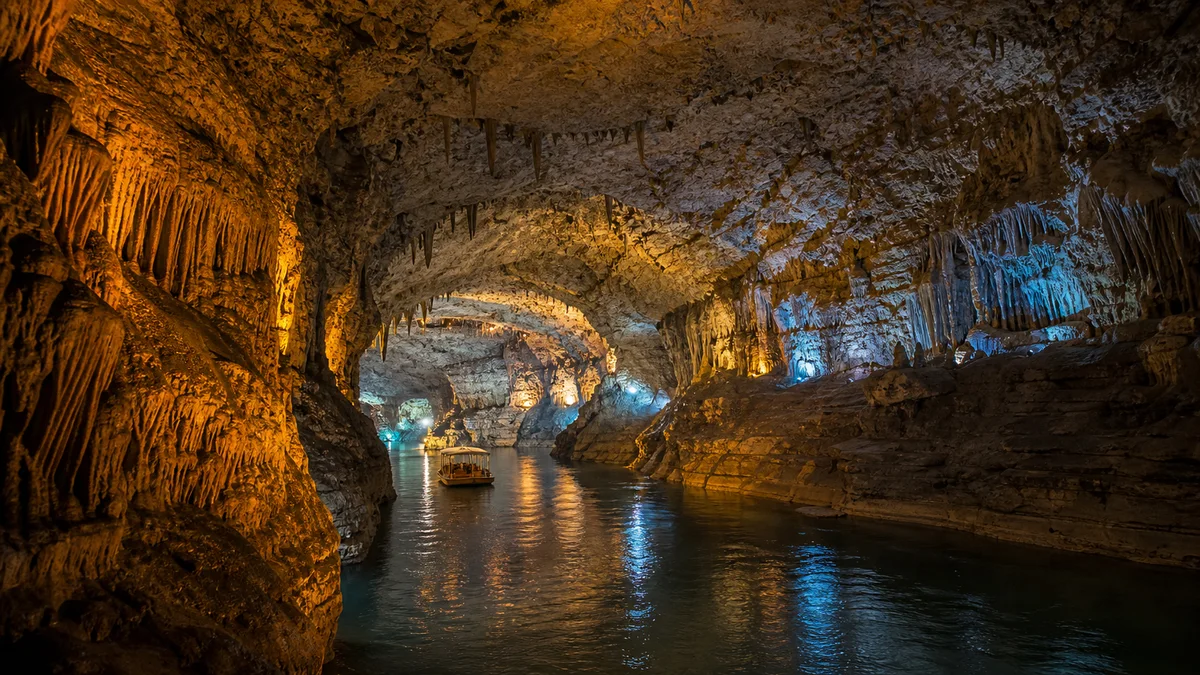
5A View location, maps and nearby scenic areasOnce the boat leaves the landing, the first thing to watch is not a named “palace” of stone. Watch the light break on the black water. A coloured beam finds a wet fold in the wall, the boat’s wake doubles it, and an echo arrives a moment after someone speaks. The air feels cooler; the limestone ceiling seems to move as the boat does.
This is the useful starting point for Benxi Water Cave. The attraction is a lit boat journey, but the underlying subject is an active karst cave and underground river. Water helped open the passage, still occupies it, and determines what visitors can safely enter. The lights reveal the cave, yet they also edit it.
Look in this order: notice the waterline and current, trace joints in the limestone, separate stalactites and flowstone from ordinary fractured rock, then ask what the fixed lights leave invisible. Save the fantasy names for later; shape, water and darkness explain more.
One entrance, several different measurements
Benxi Water Cave lies in Benxi Manchu Autonomous County, east of central Benxi. At the entrance, dry and water-filled branches belong to a larger cave system. A modern visitor does not freely explore that system: the experience is a controlled sequence of queuing, walking, boarding and travelling through the section that operations and water conditions permit.
Current Liaoning cultural-tourism material gives two figures:
- 5,800 metres for the cave’s stated total length;
- 2,800 metres described as developed.
Neither number should be silently converted into “the boat ride is 5.8 kilometres” or even “every visitor always travels 2.8 kilometres.” A surveyed cave length, a developed corridor, a navigable underground river and a route open today are different measurements. Turning points, maintenance areas and branches also affect how length is counted.
The same caution applies to “world’s longest.” Provincial promotion cites a 2018 certification in a category translated as the world’s longest underground-river scenic area available for continuous boat touring. That is a specific record claim tied to a certifying body and category—not an unconditional scientific ranking of every known flooded cave. Benxi is remarkable without flattening survey methods into a slogan.
The Benxi Water Cave 5A profile provides the map location and coordinates. For the actual visit, use the operator’s dated notice: accessible length, boat operation and companion venues can change.
How slightly acidic water makes a cave
The rock came first. Limestone is largely calcium carbonate, commonly deposited as marine sediment and later raised, fractured and exposed. The bedrock is therefore far older than the open passage visitors see. Saying “the cave is millions of years old” can be a useful scale, but it is not a precise birthday for every chamber.
Rainwater absorbs carbon dioxide from air and especially soil, becoming weakly acidic. As it moves through fractures, it dissolves small amounts of limestone. Repeated over long periods, joints widen into conduits; underground drainage captures more flow; collapse and erosion can enlarge chambers. Changing regional water levels may leave some passages dry while others remain flooded.
The mineral decorations tell the other half of the process. When calcium-rich water reaches an air-filled space and loses carbon dioxide, calcite can precipitate. Deposits hanging from the ceiling are stalactites; those growing upward from the floor are stalagmites; sheets coating a wall are flowstone. Their rates vary with water chemistry, drip supply, temperature and airflow. Rules such as “one centimetre per century” are not reliable clocks here.
From the boat, look for the relationship between a formation and its water source. A bright wet stripe may still be active; a muddy or broken surface may record flood, sediment or old damage. Some shapes celebrated by guides are dissolutional rock rather than deposited calcite. Both are genuine cave geology, even if only one resembles a dragon.
Discovery is not one date; public tourism is
A large entrance does not suddenly begin existing when a ticket office opens. Local people could know an entrance or dry chamber long before surveyors mapped deeper water passages. For that reason, a single modern “discovery year” often confuses local knowledge, formal exploration and tourism development.
The secure official milestone is 1983, when Benxi Water Cave opened to the public. Making a flooded cave visitable required more than finding it: teams surveyed routes, built landings and paths, installed lighting, organised boats and trained operators to move large numbers of people through a constrained environment. That work created the experience visitors now recognise.
In 2015, the scenic area received national 5A status. By then the cave had become a major image of Benxi, a city otherwise closely associated with mountains, rivers, forests and heavy industry. The underground journey gave the region a different public face: not a skyline or monument, but a landscape whose main room cannot be seen from outside.
The people who sustain that image remain present. Boat operators read clearance and water, guides coordinate movement, electricians maintain a damp lighting system, and conservation and engineering staff watch rock, paths and visitor infrastructure. Their decisions determine which part of “nature” the public can safely encounter.
Coloured light is a guide—and an editor
Without installed lighting, most of the route would be darkness beyond the boat’s immediate lamp. Illumination makes ceiling height, stone texture and water reflection legible. It also produces the theatrical experience for which Chinese show caves are known: colour isolates a formation, and a guide’s name turns ambiguity into a story.
Enjoy that layer, but test it. When red or blue light hits calcite, the colour belongs mostly to the lamp, not the mineral. A low side light exaggerates relief; reflection can make a chamber seem twice as tall; darkness hides the boundary beyond the beam. Take a moment to look at an uncoloured edge, the natural cream or grey of the rock, and the true waterline.
Formation names—animals, curtains, palaces or immortals—are acts of collective imagination, not geological classifications. They help a moving audience remember a passage and connect natural form to cultural storytelling. Different guides or generations may prefer different resemblances. There is no need to prove one image correct.
Light also changes the cave physically. In show caves worldwide, illuminated wet surfaces can support algae, mosses or microbes known collectively as lampenflora. Good management limits duration and intensity and removes growth carefully. This is a known conservation issue, not proof that every green patch in Benxi is neglect. It reminds us that revealing a cave always creates a new condition inside it.
A living environment, not an empty stone stage
Caves may look barren because their energy supply is small. Yet water carries organic matter and microbes; cracks and sediment can shelter invertebrates; entrance zones exchange air, insects and sometimes larger animals with the surface. Tourist passages are not pristine laboratories, but neither are they biologically empty.
Visitors add heat, carbon dioxide, lint, skin particles and noise. One boat makes little difference by itself; repeated traffic is the management problem. Infrastructure can alter airflow and water contact, while cleaning methods must avoid damaging calcite. Conservation therefore involves thresholds, monitoring and maintenance rather than the impossible promise that tourism leaves no trace.
The simplest visitor rules matter. Do not touch formations: oils and dirt can mark a wet surface, and thin calcite can break. Do not throw coins into the river, even when a story invites wishes; metal and litter do not belong in the water. Keep food packed away, and never aim a powerful light or flash at animals if any are visible.
Listen, too. The echo that makes the journey dramatic also multiplies shouting. A few quiet seconds can reveal dripping water, the motor or pole of the boat, and the different acoustic size of each chamber. Silence is both a better instrument and a courtesy to the next boat.
Boarding well is part of seeing well
Expect a queue before the boat, especially when groups arrive together, but do not plan around a fixed waiting time or departure interval. Boat dispatch depends on capacity, water conditions, staffing and crowd control. Use the wait to put on a warm layer, secure loose items and listen to boarding instructions.
Wear the provided life jacket as directed. Step down only when staff signal, keep your weight low and use the handhold offered. Once seated, do not change places, stand for a photograph or trail a hand in the water. Keep head and arms inside the boat profile: a passage can narrow or lower, and another boat or landing may be closer than it appears in theatrical light.
Put backpacks and umbrellas where they cannot shift. A phone should have a wrist strap; a camera strap should remain around your body without dangling over the side. If a child cannot remain seated or a visitor cannot transfer safely, discuss it before joining the final queue, when alternative arrangements are easier.
The cave commonly feels cool and damp even when the outside is hot. Layers work better than one heavy item because the waiting area, boat and outdoor grounds can feel completely different. Secure footwear matters on wet landings. Official publicity may quote a characteristic cave temperature, but local airflow, season, crowding and personal comfort mean it should not be treated as a clothing guarantee.
Build the day around the water cave
If time is limited, make the Water Cave boat route the anchor and regard other venues as optional. Arrive with enough margin for ticketing, queueing and a change in dispatch. A short dry walking section can help you compare air-filled and flooded passage, but it does not substitute for the underground river.
With more time, operator materials list a geological museum, a silicified-wood display area and other garden or recreation zones within the broader scenic area. These can place the cave in a wider earth-history story, especially if weather or mobility makes a long outdoor programme unattractive. Their opening, ticket inclusion, internal transport and exhibition status should be confirmed on the day.
There is a real trade-off between adding venues and allowing the cave to settle in memory. Rushing directly from coloured chambers to several unrelated attractions can reduce geology to one spectacle among many. A pause after the boat—looking at the surface river, hillside and exposed rock—helps reconnect underground drainage to the landscape above.
Transport from Benxi or beyond is also variable. Do not rely on an old bus number, travel time or last departure. Check live transport information and the scenic area’s current guidance, especially outside peak season or in poor weather.
Photography, condensation and the limits of a moving boat
Set the camera before boarding. Use a fast lens or a modern phone’s low-light mode, brace elbows against your body and accept some motion. Long exposures are rarely practical on a moving boat, while flash tends to flatten wet stone and illuminate the heads in front of you rather than the distant chamber.
Photograph relationships: the edge of a boat against a large wall, a reflection broken by wake, a life jacket beneath a towering ceiling. These scale references are more honest than isolated coloured formations. Do not lean, stand or block another passenger’s view for a composition. Follow any current no-photography or no-flash instruction.
Humidity creates a second problem. Moving a cold camera into warm outdoor air can fog the lens and may cause condensation inside equipment. Keep the camera in a closed bag for part of the temperature transition, carry a clean lens cloth and avoid changing lenses in spray or heavy humidity. Protect the device without using loose covers that could fall into the river.
Sound and memory can sometimes outperform an image. Notice where the echo lengthens, where the boat wake touches both walls, or where the ceiling vanishes above the lamps. The route controls speed and viewpoint, so missing one shot is not a reason to disobey the operator.
Access, enclosed space and water always set the rules
The boat journey may require walking on damp surfaces, waiting upright, stepping down across a height difference and sitting in a confined row for a sustained period. Broad entrance halls do not mean every passage feels open. Darkness, coloured light, echoes, low ceilings and the inability to leave immediately can be difficult for people with claustrophobia, sensory sensitivity or motion concerns.
Visitors with limited mobility should ask specific questions: Is there a step-free route to the landing? How large is the boat transfer? Can a wheelchair be stored? Is physical assistance available, and which companion venues are accessible? A general “accessible scenic area” label cannot answer the critical transfer into a small craft.
Rain outside can affect an underground river after water travels through the karst system, sometimes with a delay. High water, debris, inspection, maintenance or other safety concerns may shorten or suspend boat operation. Do not treat heavy rain as irrelevant simply because the attraction is underground. Follow closures and never enter an unlit or unmanaged branch.
Opening hours, admission, boat frequency, route length, temperature, crowd level and access to the Dry Cave or museums are all operational facts. Confirm them on the date of travel. A safe reduction in route is not a failed visit; it is evidence that the cave remains a water system rather than a fixed ride.
When the last reflection disappears
Near the return, the named formations may blur together. What remains is often simpler: black water, a pale seam, the pressure of cool air and the sound of several people becoming quiet at once.
Benxi Water Cave is sometimes introduced through records, and its scale deserves attention. But the better measure is the relationship it makes visible. Marine carbonate became rock; fractures guided water; water dissolved a route; calcite rebuilt delicate surfaces; explorers, engineers and boat crews opened a portion to the public; lighting turned that portion into a story.
None of those layers cancels the others. The coloured show is not the untouched cave, but it is how most people gain access to it. Conservation cannot remove every human effect, but it can decide whether access remains disciplined and reversible. When daylight returns, resist calling the darkness conquered. The river continues beyond the visitor’s beam, keeping most of its work outside the performance.
The LoreLens app can help distinguish dissolved limestone, calcite deposits and the visual effects of show-cave lighting during the visit.
Location profile
Where it is

Frequently asked questions
How long is Benxi Water Cave, and how much is open to visitors?
Current Liaoning tourism material describes a 5,800-metre cave and 2,800 metres as developed. Those figures are not automatically the same as the distance travelled by your boat: surveys, developed infrastructure and the route open on a particular day have different boundaries. Confirm the current visitor route with the operator.
Do I have to take a boat inside Benxi Water Cave?
The defining Water Cave experience is a managed boat journey on the underground river. Walking areas and the adjacent Dry Cave or other scenic-area venues do not provide the same view of the flooded passage. Boat service can be affected by water, maintenance and crowd management, so verify operation before travelling.
What should I wear in Benxi Water Cave?
Bring a warm layer even in summer and wear footwear with secure grip. The cave commonly feels cool and damp, while queues and outdoor areas may be much warmer. Exact temperature, spray and waiting conditions vary, so use layers rather than relying on one advertised cave temperature.
Is Benxi Water Cave suitable for limited mobility or claustrophobia?
The visit can involve queues, damp walking surfaces, stepping down into a low boat and remaining seated in darkness with echoes and no immediate exit. Ask the operator about current transfer assistance and accessible routes. Visitors sensitive to enclosed spaces should review the sequence in advance and decide with their own health needs in mind.