Zhejiang · Lishui
Xiandu: The Rock Column, the Emperor's Compliment and Nine Reopened Quarries
A rhyolite column stands free of every hill around it in a river valley in southern Zhejiang, and the height given for it changes with the document. In 748 an emperor renamed the whole mountain on the strength of one official's report of coloured cloud and music. Twelve centuries later a county with three thousand abandoned quarries hired an architect to turn nine of them into rooms.
5A View location, maps and nearby scenic areasThe first thing to understand about Xiandu is that nobody can tell you how tall it is.
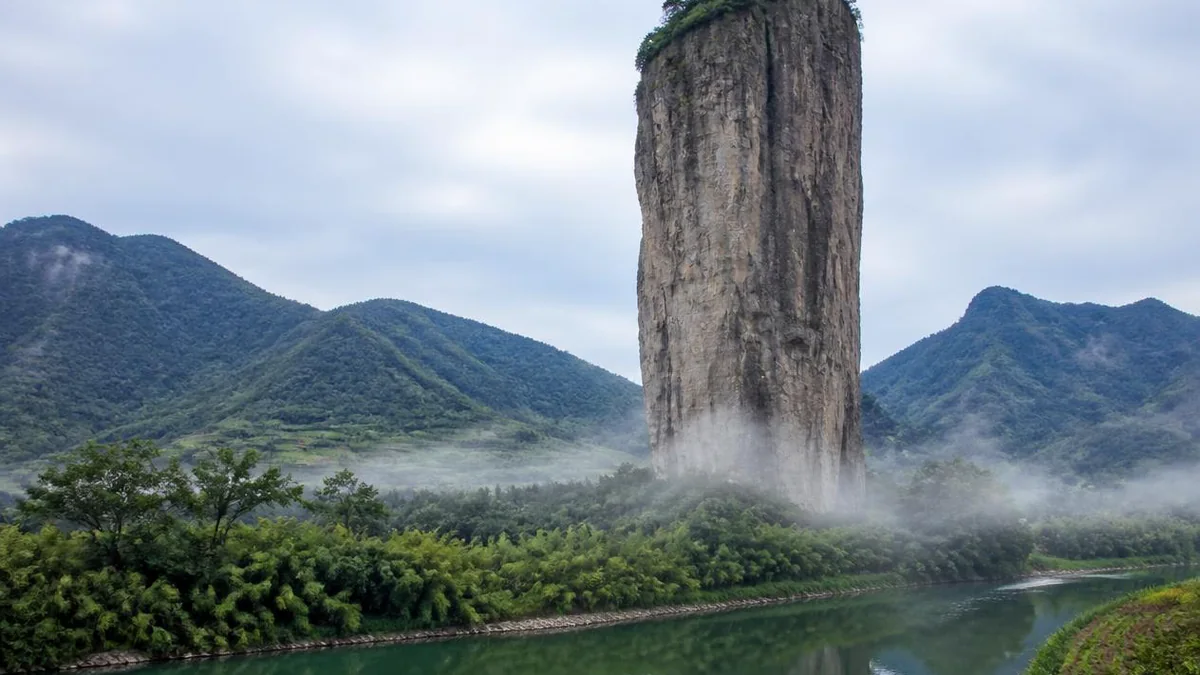
The Dinghu column — Dinghu Feng, the peak that is the reason this place exists as a destination — stands in the valley of a creek in southern Zhejiang, unattached on every side, a single shaft of rhyolite going straight up out of farmland and water. The number almost every Chinese source gives for it is 170.8 metres. Others round it to 170, or say it rises a hundred and seventy-odd metres from the valley floor, or quietly switch to the summit’s height above sea level, which is 364 metres and describes something else entirely. The top is given as about 710 square metres of surface. The base is given as between 2,468 and 2,787 square metres, which is not a measurement of a rock so much as an admission that where a column stops and its hillside begins is a matter of opinion.
The superlative attached to it drifts in the same way. It is China’s tallest single stone column. It is the world’s tallest freestanding rhyolite column. It is the world’s tallest stone bamboo shoot — because it looks like one, and the first bamboo shoot under heaven is the phrase the county has settled on. Each version of the claim narrows the category slightly, which is what claims do when they are being defended rather than tested.
What is not in dispute is that you can walk around it.
The column, and what made it
Rhyolite is granite that got out. Same chemistry, roughly 63 per cent silica or more, but erupted instead of cooled underground, and so viscous that it piles up near the vent rather than flowing away. Southern Zhejiang is built out of the stuff: thick plateaux of rhyolite interbedded with volcanic tuff, laid down by eruptions and then taken apart, over tens of millions of years, by water working along the joints.
Xiandu is a late stage of that process. The plateau has been cut back until only fins, stacks and single columns remain, and the Dinghu column is the last piece of a wall.
You can see the evidence directly. Buxu Hill stands immediately behind the column and was once continuous with it; weathering and running water separated the mass into stacks of different sizes, and the column happens to be the one that survived tallest and most complete. Where the interbedded tuff is softer than the lava above and below it, the cliffs come out pocked with honeycomb hollows and shallow niches — the texture that gives the ridges along the creek their particular look, and the reason so many of the caves here are shelters rather than tunnels.
On the date the sources part company again. The figure that circulates locally is 160 million years, which puts the volcanism in the Jurassic. The geopark literature for Jinyun describes Cretaceous rhyolite volcanism, which is tens of millions of years later and is the age usually given for the comparable formations elsewhere in the province. Both appear in official material. Neither is footnoted.
There is a pool on top of the column, fed by springs, described as never running dry. It is the reason for the name: ding is a bronze ritual cauldron, hu is a lake, and the story is that the depression was left by a cauldron. Whose cauldron is the subject of the rest of this article.
What the ticket covers, and where the scenic area stops
This is the practical thing to get straight before you book anything, because Xiandu is sold under two boundaries that differ by a factor of thirty.
The 5A scenic area — the rating the Ministry of Culture and Tourism awarded — is given as about 5.23 square kilometres and consists of five blocks: Dinghu Peak with the Yellow Emperor temple at its foot, Zhutanshan, Niweng Cave, Xiaochibi, and the Xiandu Daoist temple. They are strung along roughly ten kilometres of creek, east to west, and the combined ticket sold by the scenic area covers those five and no more.
The national scenic area is a different animal: 166.2 square kilometres, divided into four zones — Xiandu, Huanglong Hill, Yanmen and Dayang — and credited with three hundred-odd named sights. This is the figure the county uses in promotional copy, and it is the one that produces the impression of a vast park. It is a planning boundary, administered under a master plan submitted to the State Council for the period 2023 to 2035. It is not a ticket.
The named-feature counts inside it do not agree either. One standard description gives 106 remarkable peaks and 27 unusual caves. Another, equally standard, gives 72 peaks and 18 historic sites. These are not competing surveys; they are competing formulae, both old, both still in circulation.
Practically: Furong Gorge and the Zhao Marquis shrine appear on package itineraries for Xiandu and are generally sold separately from the five-block pass. Guifu Rock — the mother-in-law and daughter-in-law, two stones one above the other on Zimu Hill, recorded in a Ming provincial gazetteer of the Jiajing era and visible from outside the railway station — is a landmark rather than a gated site. And the quarry rooms described below are close to the scenic area but were never part of its original inventory at all.
A creek that used to be called Evil Creek
The water everything is arranged along is the Hao Creek — Good Creek — which rises on Dapan Mountain, runs down past the Xiandu hills, and eventually joins the Ou River, the river that drains most of southern Zhejiang. Through the scenic area the same water is called the Lian Creek, and the stock phrase for the reach is nine bends of Lian Creek, ten miles of painted gallery.
Its older name was E Creek — Evil Creek. Southern China had several waterways with that name; this was among the best known.
The rename is credited to a Tang prefect who dredged the shoals, built weirs, took the danger out of the channel and turned a hazard into an irrigation asset, after which local people changed the character out of gratitude. The prefect usually named is Duan Chengshi (c. 803–863), who held the prefecture in 855 and left a surviving temple inscription from his time there — and who is better known outside China as the compiler of a great Tang miscellany of the strange, one of whose stories is an early cousin of Cinderella.
The attribution is not secure. Popular versions credit the rename to Li Yangbing, who appears again below and who held the county post about a century earlier. And at least one local account states flatly that the county gazetteer dates the change to the end of the Northern and Southern Dynasties — that is, before either man. Three answers, no reconciliation, and the pattern will be familiar by the end of this article: at Xiandu the story is usually older than the earliest document that mentions it.
748: an emperor renames a mountain
Until the middle of the eighth century this place was called Jinyun Mountain. The name it has now was, according to the standard account, a compliment.
In 748 — the seventh year of the Tianbao reign — a prefect named Miao Fengqian reported to the court that coloured cloud and immortals’ music had appeared over Jinyun Mountain. Emperor Xuanzong (685–762), the ruler whose long reign contains both the high point of Tang culture and the rebellion that broke it, is said to have exclaimed that the place must be a gathering-capital of immortals, and to have written the two characters Xiandu — immortals’ capital — in his own hand. The name has been in use ever since.
Read that paragraph again with the mechanics in view. A provincial official files an auspicious-omen report. The emperor, then in his sixties and increasingly absorbed in Daoist practice, responds with an autograph. A mountain acquires a new name and a county acquires a permanent tourism asset. Omen reporting was a functioning channel of Tang provincial politics, and this is what a successful one looked like.
As evidence it is thin in exactly the way you would expect. The story comes down through local records rather than through a court document quoted in the histories, the omen itself is unfalsifiable, and the wording of the emperor’s exclamation varies slightly between retellings — a sign of a phrase transmitted as a story rather than copied from a text. Whether Xuanzong ever said it, the naming is the hinge of the place’s identity: everything marketed here, including the immortals, dates its self-description from 748.
The only county in China named after a god
The county underneath all this is Jinyun, and it is a very deliberate piece of naming.
It was created in 696, in the sole reign of Wu Zetian — the only woman to rule China in her own name — by combining the northeastern part of one county with the southern part of another to get a governable unit in the mountains of southwest Zhejiang. The new county took its name from Jinyun Mountain, which it contained.
And Jinyun is an appellation of the Yellow Emperor. Chinese tradition assigns the culture-founding sovereign several clan names, of which Jinyunshi is one; the county’s standing claim, repeated in every official description, is that it is the only county in China named after a name of the Yellow Emperor. For a Western reader the closest analogy is a district named not for a saint but for one of the epithets of a founding deity — and then keeping the name for thirteen centuries.
There is a footnote that the tourist material leaves out. The clan name has a bad reputation in the classics: the Zuo Zhuan, the great chronicle of the Spring and Autumn period, gives Jinyunshi a descendant so greedy he is counted among the four monsters, and lends his name to the gluttonous taotie mask that stares out of Chinese bronzes. Nobody at Xiandu mentions him. It is, in fairness, a long time ago.
Riding a dragon off the top
The legend the whole site rests on is short and, in every telling, explicitly a legend.
According to tradition, the Yellow Emperor set his cauldron on the summit of this column, refined an elixir, and then ascended to heaven on the back of a red dragon. The pool on top is the cauldron’s mark. The name Dinghu records it. And Xiandu — the immortals’ capital — describes the company he was joining.
The related tradition puts this valley among the Yellow Emperor’s three residences, the Three Sons of Heaven capital, which is a phrase from early geographical literature that has been claimed by more than one mountain. The honest framing is the one the sources themselves use when they are being careful: the Yellow Emperor is a figure of tradition rather than a documented ruler, the ascension is a story, and what is historical here is the cult — the fact that people have been making offerings at the foot of this rock for something like sixteen hundred years, which is a verifiable social practice regardless of what happened on the summit.
A poem about the solitary rock and the departed banners of the Yellow Emperor circulates under the name of Bai Juyi (772–846), the Tang poet with the largest surviving body of work and the plainest style. The attribution is traditional and repeated locally; I have not been able to confirm it against a critical edition, and it should be read as part of the site’s literature rather than as evidence about the ninth century.
A temple with five names
At the foot of the column stands the Huangdi Ciyu, the Yellow Emperor’s shrine-hall, and its institutional history is the most concrete thing on the site.
It began as the Jinyun Tang, founded in the Xianhe years of the Eastern Jin — the 320s and 330s, sources giving either 326–334 or 326–342 — and it was a centre of organised Daoist activity, not a folk shrine. In 748, the same year as the renaming, Xuanzong ordered it renamed Huangdi Ciyu, and the plaque inscription was written by Li Yangbing, the seal-script master who was then the county magistrate. Under the Northern Song, in the Zhiping reign of the 1060s, it was renamed again, to Yuxu Gong. It reached its greatest extent under the Song and Yuan, with a reported twenty-four buildings. It was destroyed by fighting in the Shunzhi reign, in the middle of the seventeenth century, and the site lay in ruins for roughly three hundred years.
The present buildings are a reconstruction in High Tang style, with a gate, the Xuanyuan Hall, a rebuilt Jinyun Tang, an ancestral hall and two towers. The rebuild date is given as 1994 in some accounts and 1998 in others, both official, and the discrepancy is unresolved — plausibly the difference between a design decision and a completion, but nobody says so.
Five names, one continuous site, one three-century gap. That is a more interesting object than a temple that was simply always there.
Twice a year, at Qingming and the Double Ninth
The rites resumed with the rebuilding, and they now run on a fixed double calendar.
The Jinyun Xuanyuan rite divides into a spring observance at Qingming, the tomb-sweeping festival in early April, and an autumn observance at the Double Ninth, the ninth day of the ninth lunar month. The spring one is the folk version: worship in the main hall, in clan halls around the county, or at home in the courtyard of a family house. The autumn one is the state version, hosted by the Zhejiang provincial government at the temple, with several hundred participants — the 2025 ceremony, held on 29 October, was reported as drawing more than four hundred.
In May 2011 the State Council added the Jinyun Xuanyuan rite to the third batch of the national intangible cultural heritage list. The county has held the public ceremony annually for more than two decades.
The framing you will meet in Chinese coverage is that China now has two Yellow Emperor ceremonial centres, Jinyun in the south and the Yellow Emperor’s mausoleum in Shaanxi in the north. That is a formulation used by the county and by provincial publicity rather than a designation anybody awarded, and it is worth reading as positioning. What it is positioning, though, is real: a provincial government does turn up here every autumn.
Li Bai’s uncle wrote three characters on a cave wall
The best cultural reason to come to Xiandu is not the column. It is a cave mouth on Chuyang Hill with writing all over it.
Niweng Cave is where the inscriptions concentrate — reported as more than sixty in that one area — and the most important of them is three characters spelling the cave’s own name, cut in 759 by Li Yangbing.
For a reader with no Chinese background, the chain of associations here is unusually rich. Li Yangbing was the pre-eminent practitioner of seal script in the Tang: the oldest of the standard Chinese scripts, formalised under the first emperor in the third century BC, and by the eighth century about as current as blackletter is to us — an antiquarian hand used for seals, plaques and inscriptions, chosen precisely because it looked ancient. He was also Li Bai’s clan uncle. Li Bai (701–762) is the poet Chinese schoolchildren memorise first and the one most widely translated into English, and it was Li Yangbing who collected his work after his death and wrote the preface to the collection — which means the survival of the most famous body of poetry in the language runs through the man who carved these three characters.
He held the Jinyun magistracy before his later posting downriver. Local accounts add that a City God Temple stele he composed and wrote during that tenure is now in the stele corridor of the county museum, and that the Niweng Cave inscription is one of only two well-preserved Li Yangbing stones recorded anywhere — a claim that comes from the site and that I could not check against an independent catalogue.
The cave’s name, incidentally, points at another figure entirely: an old man Ni, whom local tradition identifies with a retired official of the state of Yue in the fifth century BC. That one is legend without hedging required.
A hundred and twenty inscriptions, Tang to the Republic
The inscriptions are protected as a single national monument, and the paperwork is unusually clean for once.
Xiandu Moya Tiji — the Xiandu cliff inscriptions — was listed in the fifth batch of nationally protected sites, published by the State Council on 25 June 2001, in the stone-carving category. The listing covers five separate locations inside the scenic area: Chuyang Hill (where Niweng Cave is), Dinghu Peak, Xianshui Cave, Tiecheng and Xiaochibi. The recorded total is more than 120 surviving carvings and inscriptions, and the date range given is Tang to the modern period — with the Xiaochibi group specifically running from the Southern Song to the Republican era.
That range is the point. This is not a monument; it is twelve centuries of visitors signing the wall, at a site whose fame was official from 748 onward. Chinese cliff-inscription clusters are the closest thing the tradition has to a guest book kept in stone, and the entries are prefects, monks, exiles, poets and eventually county officials of the 1930s.
Xiaochibi — little red cliff, named after the Red Cliff of the Three Kingdoms battle far up the Yangtze — is also where the strangest walk at Xiandu is. A natural ledge runs along the cliff face for somewhere around sixty to seventy metres, produced by differential weathering of a softer bed, and it is called the Dragon Plough Road on the theory that a dragon cut it. You walk it with the rock above your head and the creek below.
Zhu Xi’s academy, and the ox at dawn
Two more layers, one very old and one very new, both at the eastern end.
Dufeng Academy stands at the foot of Hao Hill in the Niweng Cave block, facing the creek, and commemorates the teaching visits of Zhu Xi (1130–1200) — the Southern Song philosopher whose synthesis of Confucian thought became the official curriculum of imperial China for six hundred years and the intellectual framework of Korea and Japan besides. He is the nearest thing the tradition has to an Aquinas. An academy on the spot where he lectured is a normal way for a Chinese locality to record that he came.
Downstream at Zhutanshan — named because the same Zhu Xi is said to have boated and taught there, under his style name Huiweng — the attractions are a cobbled dyke called the Immortal Causeway planted with willows, a pavilion named for him, a nine-dragon wall and a viewing pavilion. Zhutanshan is the postcard: the causeway in the foreground, mist on the water, the column behind.
It is also the place to be honest about what photographs of Xiandu are. The most reproduced image of this landscape — an old farmer leading a water buffalo along the causeway in dawn mist — is a scheduled performance. Photography guides discuss its timing. The man and the ox are hired, the mist is sometimes assisted, and thousands of visitors have the same photograph. This is not a scandal; it is a service, and the shot is beautiful. But it is staged, and being told so in advance is better than working it out afterwards from other people’s identical pictures.
Nine quarries and an architect
The newest thing at Xiandu has nothing to do with immortals.
Jinyun is a stone county — the local boast is the first stone city of Jiangnan — and the by-product of that is more than three thousand small abandoned quarries, known in the local dialect as shidang or yandang: pits and chambers cut into hillsides by hand, some of them cathedral-shaped, all of them useless once the stone trade moved on.
In 2021 the county commissioned the Beijing architect Xu Tiantian and her practice DnA_Design and Architecture to find new uses for nine representative examples. Xu had spent years doing small, cheap, surgical rural buildings in Songyang, the next county over, and had built an international reputation on the approach; she has since been reported as a laureate of the Wolf Prize in architecture, which if accurate makes this one of the more decorated rural commissions in China.
Three opened first, identified by their quarry numbers: 8, 9 and 10, converted into a library, a concert chamber and a performance space. The interventions are minimal — a stair, a floor, a rail, glass where the pit was open — because the room already existed, cut by quarrymen who were not designing anything.
The library, Yandang Shufang, is the one most visitors reach. It sits near the Niweng Cave end of the scenic area, keeps daytime hours, and is reported as free. Standing in it is the only moment at Xiandu when the landscape reads as something people worked rather than something people worshipped, and it is worth planning for rather than stumbling into.
The set that stayed up
Xiandu is, by some distance, one of China’s most-filmed landscapes. Local accounts put the total in the hundreds of productions, which is credible if you count everything shot along the creek since the 1980s.
The titles that travel are the costume fantasies. The Legend of Shen Li (2024) is the current one, and its effect was measurable: one online travel platform reported Xiandu bookings up 572.2 per cent between the series’ opening on 18 March 2024 and the end of that month, and Xingyun Xiaoyuan, a courtyard set built inside the scenic area for the production, went from an obscure corner to the busiest photo queue on site. Before it there were The Journey of Flower, the film Monk Comes Down the Mountain, Nirvana in Fire, the Chinese Paladin adaptations and a long tail of martial-arts serials.
The instructive comparison is with Hengdian World Studios, two hours north, which is the largest purpose-built backlot on earth and where the palaces are plywood and plaster. Hengdian builds what a story needs. Xiandu rents what is already there — a two-hundred-metre rock, a mist-filled valley, a cliff with a ledge along it — and the production leaves the odd courtyard behind. Both are film infrastructure. Only one of them was made 160 million years ago, or possibly rather less.
Visiting
Xiandu is in Jinyun County, in Lishui prefecture, in the mountainous middle-south of Zhejiang, and it is one of the easier 5A sites in the province to reach: the county has its own high-speed station, and the scenic area is a short ride from it.
The shape of a visit is a walk along one creek. The five ticketed blocks are laid out over about ten kilometres, connected by greenway paths, and doing them all properly is a full day; doing Dinghu Peak, the temple and Zhutanshan is a comfortable half. Zhutanshan wants dawn, for the mist and the causeway. Niweng Cave wants time and, ideally, someone who can read the inscriptions to you. Xiaochibi wants dry weather, because the Dragon Plough Road is a ledge.
Tickets are sold both singly and as a five-block pass, with the usual Chinese age concessions, and both structure and price move — check at the gate rather than from any article, this one included. Furong Gorge and the Zhao Marquis shrine are separate. The quarry library is separate and free. If your dates are flexible and the Yellow Emperor is why you are coming, the Double Ninth ceremony in autumn is the one with the provincial government at it; the Qingming rite in spring is the one where people are worshipping rather than representing.
And two facts to hold at once, as usual.
The first is that the emperor’s compliment survives only as a local story, the ascension on the dragon is a myth about a legendary figure, the ceremonies now performed here were rebuilt from nothing in the 1990s after a three-hundred-year gap, the height of the rock and the age of the rock both change with the document, and the most famous photograph taken here is a paid performance repeated every morning.
The second is that a 170-metre column of volcanic rock stands free in a river valley in southern Zhejiang; that people have been leaving carved writing on the cliffs around it continuously from the Tang dynasty to the Republic, more than a hundred and twenty pieces of it; that one of those carvings was cut by the man who saved Li Bai’s poems; and that a county with three thousand dead quarries decided the right thing to do with nine of them was to put books and music inside.
Neither of those lists cancels the other. They are what happens when a landscape has been famous for one thousand two hundred and seventy-eight years.
The LoreLens app can identify the cliff inscriptions at Niweng Cave and Xiaochibi, the halls of the Yellow Emperor temple and the rock formations along the creek at Xiandu, and explain what each of them is for, in your own language, offline.
Location profile
Where it is

Frequently asked questions
What does the Xiandu combined ticket actually cover?
Five blocks strung along one creek: Dinghu Peak with the Yellow Emperor temple, Zhutanshan, Niweng Cave, Xiaochibi and the Xiandu Daoist temple. Together they are given as about 5.23 square kilometres, and the whole run is roughly ten kilometres end to end along the water. The much larger figure you will see quoted - 166.2 square kilometres, four zones, three hundred-odd named sights - belongs to the national scenic area, not to the ticket. Furong Gorge and the Zhao Marquis shrine turn up on tour itineraries but sit outside the five-block pass, so confirm at the gate rather than assuming.
How tall is the Dinghu column?
The figure repeated almost everywhere is 170.8 metres for the column itself, with the summit at 364 metres above sea level. Other accounts round it to 170 or simply say it rises 170-odd metres from the valley floor. Chinese sources give the top a surface of about 710 square metres and the base somewhere between 2,468 and 2,787 square metres - a range, not a measurement. It is routinely billed as the tallest single stone column in China or in the world, and the qualifier drifts between sources, so treat the superlative as a domestic claim and the 170.8 as the one number everyone agrees on.
Is the Yellow Emperor ceremony a real tradition or a modern event?
Both, and the sources are open about the join. A cult building stood on this site from the Eastern Jin, in the Xianhe years of the 320s and 330s, and rites here are described as running from that period onward. The temple was destroyed in the Shunzhi reign of the early Qing and the ceremonies lapsed. Jinyun County rebuilt the hall in High Tang style and restarted the public rite in the late 1990s - accounts give 1994 and 1998 and do not reconcile. Since then there have been two a year: a folk rite at Qingming and a state-level ceremony at the Double Ninth, hosted by the Zhejiang provincial government. The Jinyun Xuanyuan rite entered the national intangible cultural heritage list in the third batch in May 2011.
Which films and series were shot here?
A great many, and the local claim of several hundred productions is plausible if you count everything. The ones foreign viewers are most likely to know are the costume fantasy series - The Legend of Shen Li in 2024, The Journey of Flower, Nirvana in Fire and the Chinese Paladin adaptations - plus the film Monk Comes Down the Mountain. The 2024 series had a measurable effect: one booking platform reported Xiandu reservations up 572.2 per cent between the broadcast opening on 18 March and the end of that month, and the courtyard set built for it inside the scenic area became a queue.
What are the quarry rooms, and do they cost anything?
Jinyun is a stone county with more than three thousand small abandoned quarries, known locally as shidang or yandang. In 2021 the county commissioned the Beijing architect Xu Tiantian and her practice DnA to give nine representative ones a new use. Three opened first, numbered 8, 9 and 10, as a library, a concert chamber and a performance space. The library, Yandang Shufang, sits close to the Niweng Cave end of the scenic area, keeps daytime hours and is reported as free to enter. It is the newest thing at Xiandu by twelve centuries and the one visitors talk about most on the way home.