Shanghai
Shanghai Disneyland: What Disney Gave Up to Get In
A Disney park with no Main Street, no perimeter railroad and no earthen berm, run by a company that owns 43 percent of it. On this map the concessions are the most interesting thing to read.
Every Disney park outside the United States is the residue of a negotiation. Tokyo’s terms were licensing. Paris’s were land and finance. Hong Kong’s were a government cheque and a very small site.
Shanghai’s terms are readable from the pavement, which is what makes the place worth an afternoon of attention beyond the queues. This is the park where Disney conceded the most, and the concessions are structural rather than decorative. They show up in the ownership documents, in the shape of the entrance, and in what the map does not contain.
The park opened on 16 June 2016, seventeen years after the first survey trips. It is now the most visited theme park in China.
Three companies, and who signs what
The corporate structure is public, and it is the foundation of everything else.
The park itself is held by Shanghai International Theme Park Company Limited, 57 percent owned by Shanghai Shendi Group and 43 percent by the Walt Disney Company. Day-to-day operation sits in a second entity, Shanghai International Theme Park and Resort Management Company Limited, split 70 percent to Disney’s parks division and 30 percent to Shendi. Shendi is itself three Shanghai state enterprises: Shanghai Lujiazui, Shanghai Radio, Film and Television Development, and Jin Jiang International.
Set that against the rest of the portfolio. Anaheim, Orlando and, since 2017, Paris are Disney-controlled. Hong Kong is 52 percent Hong Kong government to 48 percent Disney. Tokyo is not a Disney asset at all—the Oriental Land Company owns and operates it under licence, making it the only Disney resort worldwide that Disney’s parks division neither owns nor runs.
So Shanghai is not the park where Disney owns least. It is the park with the smallest Disney equity stake that Disney actually manages, and the arrangement was signed before a single foundation was poured.
Seventeen years between the first survey and the first ticket
Location scouting in Pudong began in 1999, with Bob Iger involved. Negotiations ran from around 2001. Then they stopped, deliberately.
The national government slowed Shanghai down to let Hong Kong Disneyland establish itself. That park opened in 2005, two years after SARS had gutted Hong Kong’s tourism economy, and it was expected to help the recovery. By early 2016, with Shanghai imminent, Hong Kong reported its first loss in four years and a 9.3 percent attendance drop.
Approval came on 4 November 2009, with an estimated investment of 24.4 billion yuan. The agreement with Shendi was signed in November 2010; major construction started on 8 April 2011, aimed at spring 2016. The opening slid from late 2015 to early 2016 to a fixed date announced that January. In April 2014 Iger added 800 million dollars to open with more attractions, taking the total to roughly 5.5 billion dollars.
The published cost breakdown splits roughly 24.5 billion yuan for the theme park and a further 4.5 billion for the rest of the resort, about 34 billion yuan in total. The build figures are the kind that get quoted on opening day and are worth keeping: more than 100,000 workers over five years, 72,000 tonnes of structural steel, 130 kilometres of utility piping.
One smaller concession is easy to miss and hard to explain any other way. In February 2014 the resort signed a strategic partnership with PepsiCo, making it the first Disney property in twenty-five years to pour Pepsi rather than Coca-Cola. Global beverage exclusivity is one of the most jealously guarded arrangements in the parks business. Here it was traded away too.
Read the park by what is missing
The fastest way to understand this park is to inventory the absences, because each one is a decision someone had to authorise.
There is no Main Street, U.S.A. The entrance corridor is Mickey Avenue, themed to the personalities of Disney characters rather than to a small American town. There is no railroad circling the perimeter—reporting at the time attributed this to Chinese visitors being thoroughly familiar with train travel, so a train ride is not a novelty. There is no earthen berm, the raised embankment that at every other Disney park hides the outside world from view.
Frontierland is absent entirely. Adventureland became Adventure Isle. Several fixtures that Disney fans treat as compulsory—Space Mountain, the Jungle Cruise, It’s a Small World, the Haunted Mansion—were left out, with contemporary reporting linking the omissions to Disney’s wish to avoid accusations of cultural imperialism.
The layout is also mirrored relative to other Magic Kingdom parks: Adventure Isle sits right of the hub instead of left, Tomorrowland left instead of right.
What is present, in order of arrival, is six lands at opening—Mickey Avenue, Gardens of Imagination, Fantasyland, Treasure Cove, Adventure Isle and Tomorrowland—plus Toy Story Land from 2018 and Zootopia from 2023.
Main Street and the berm are the two most doctrinaire elements of the Disneyland template—one supplies the nostalgia, the other supplies the seal. Giving up both in the same park is not set dressing.
Eleven acres where the hub should be
In place of the traditional spoked hub, the centre of the park is an 11-acre collection of gardens called the Gardens of Imagination. Dumbo and the carousel sit in front of the castle rather than behind it, which had not been done at a Disney park before.
Inside it is the Garden of the Twelve Friends, announced in December 2013 alongside the resort’s first corporate alliance partner, the Industrial and Commercial Bank of China. The conceit is a set of mosaic murals pairing each of the twelve Chinese zodiac animals with a Disney or Pixar character, set among a grove of peach trees with sightlines to the castle.
It is easy to be cynical about this and worth resisting the impulse. The zodiac is the one Chinese cultural system that every visitor, of any age or education, already carries in their head—you know your own animal. Building the park’s hub around it means the first thing a first-time visitor encounters is a system they already own, populated by characters they may not know yet. That is the localisation strategy in one garden.
The daytime parade that runs through here is described as using the longest parade route at any Disney park.
A castle assigned to nobody in particular
The Enchanted Storybook Castle is 197 feet, about 60 metres, and is the tallest at any Disney park, displacing Cinderella Castle in Florida.
Its more unusual property is that it belongs to no one. Anaheim’s castle is Sleeping Beauty’s; Florida’s is Cinderella’s. Shanghai’s represents the Disney princesses collectively—Chinese-language accounts note that every princess predating Moana appears somewhere in it. Hong Kong later did something similar when it rebuilt its own castle. At the top of the tallest tower sits a peony, the flower associated with Shanghai.
It is also the most heavily used castle in the portfolio: a walkthrough attraction, a character dining hall, a boutique, and a boat ride that passes beneath it through scenes from Tangled, Aladdin, Mulan, Fantasia, The Little Mermaid and Beauty and the Beast.
The engineering was unusual too. Walt Disney Imagineering worked with Gehry Technologies, coordinating roughly 142 disciplines across Glendale and Shanghai through building information modelling; the American Institute of Architects gave the project its Technology in Architectural Practice award in 2014.
A castle designed to represent everyone is a castle designed for an audience with no prior attachment to any single princess. That is a market fact expressed in masonry.
Localisation you can eat, and localisation that closed
Most restaurants in the park serve Chinese food, and the adjustments went past the menu. Seating counts were revised upward after studies found Chinese guests spend longer over meals; picnic areas were expanded for extended families travelling with grandparents; the entertainment programme was weighted toward live shows after research indicated many guests prefer them to thrill rides. The Soarin’-style flying theatre swaps in the Great Wall and the Shanghai skyline.
Two cases show the range. LinaBell, a pink fox introduced at this park and nowhere else, became a nationwide phenomenon and a genuine merchandising engine—localisation that worked so well it was exported.
The other went the opposite way. The Walt Disney Grand Theatre in Disneytown opened with a Mandarin-language production of The Lion King, the first in that language, with a new character—a mischievous monkey, in the director Julie Taymor’s description—written in for the Chinese year of the monkey. It ran for five years, alongside a Beauty and the Beast production, and then the theatre was repurposed into an attraction inside the park proper, now running a 28-minute revue.
A separately ticketed Broadway house is a bigger commitment than a themed restaurant. It is also easier to close.
The bag search, the lawsuit, and the fifty yuan
This episode is documented in state media and court records, and it belongs in any honest account of the place.
Sealed food was allowed at opening. On 15 November 2017 the guest regulations were rewritten to ban all food and alcoholic drinks, with non-alcoholic drinks limited to 600 millilitres. Complaints followed, mostly about the enforcement: staff opening and searching bags by hand at the gate.
In August 2019 a student at the East China University of Political Science and Law sued, asking the court to declare the standard clause void. State broadcaster reporters filmed the bag searches; lawyers quoted in the coverage called them a privacy violation. On 23 August the Pudong consumer protection commission reported that the park had declined mediation and would not change the rules. The park then apologised, announced revisions on 6 September, and implemented them on 11 September: food for personal consumption permitted, with a specific exclusion list covering instant noodles, self-heating meals, whole melons requiring a knife, durian, stinky tofu, alcohol, cans and glass.
The case settled on 12 September 2019 through court-brokered mediation, with the defendant company compensating the plaintiff 50 yuan. On 2 December X-ray machines went into the security area, replacing part of the manual search.
Note the defendant’s name: Shanghai International Theme Park Company Limited—the 57-43 entity from the first section. The ownership structure is not an abstraction; it is who gets sued.
Why the first Zootopia was built here
Toy Story Land opened on 26 April 2018 as the park’s first expansion. The second is the more revealing one.
A Zootopia land was announced in January 2019, broke ground on 10 December 2019, and opened on 20 December 2023 as the park’s eighth themed land—and as the first Zootopia land at any Disney park anywhere. Not Anaheim, not Orlando. Its centrepiece is a trackless dark ride, and characters appear from the windows of apartment buildings along the main street using puppetry rather than screens.
That choice is worth sitting with. For six decades the sequence ran outward from California: an idea proved itself in Anaheim or Orlando, and the overseas parks received a version of it later. Zootopia inverted the order: the franchise’s first physical land was commissioned, built and opened in Shanghai, and no American park had one at the time it opened.
A third expansion, themed to Spider-Man and carrying the park’s first major Marvel attraction, was announced in August 2024, with construction reported to have started in May 2025. In November 2025 the resort announced a fourth hotel beside the main entrance and an enlargement of Disneytown, on top of a third hotel already under construction.
The pattern is consistent: when Disney has a property that performed unusually well with Chinese audiences, the physical build now happens in Shanghai first. That is a reversal of how the parks business worked for sixty years.
If you have already done Tokyo or Hong Kong
The differences are large enough to justify a second visit, and they are not the ones marketing emphasises.
Against Hong Kong, opened 12 September 2005: Shanghai’s park covers about 91 hectares within a site of roughly 963 acres, and was described at approval as two to three times Hong Kong’s size. Hong Kong keeps Main Street and the railroad; Shanghai has neither. Hong Kong’s castle was rebuilt in 2020; Shanghai’s has been the tallest since it opened.
Against Tokyo, opened April 1983: Tokyo has two parks and forty years of accumulated detail, and its operator is not Disney. Tokyo’s strength is density and finish. Shanghai’s is scale and exclusivity—Tron, the Pirates boat ride and Zootopia have no Tokyo equivalents.
Attendance gives the blunt version: 5.6 million in a half-year of 2016, 11 million in 2017, 11.8 million in 2018, a pandemic trough, then 14 million in 2023 and 14.7 million in 2024, which made it the fifth-most visited theme park in the world.
The supporting estate is sized accordingly. Disneytown, the shopping and dining district outside the gate, covers about 14.6 hectares across five sub-districts, and the two opening hotels together hold 1,220 rooms. Getting there is unusually easy for a resort of this size: Metro Line 11 terminates at Disney Resort station, and the Airport Link Line added Shanghai International Resort station in December 2024.
What the concessions bought
At the opening ceremony, in rain, a message from Xi Jinping was read out describing the resort as adding “a stroke of Chinese characteristics” to the classic Disney style. The company’s own formula was blunter and had been in circulation for years: authentically Disney, distinctly Chinese.
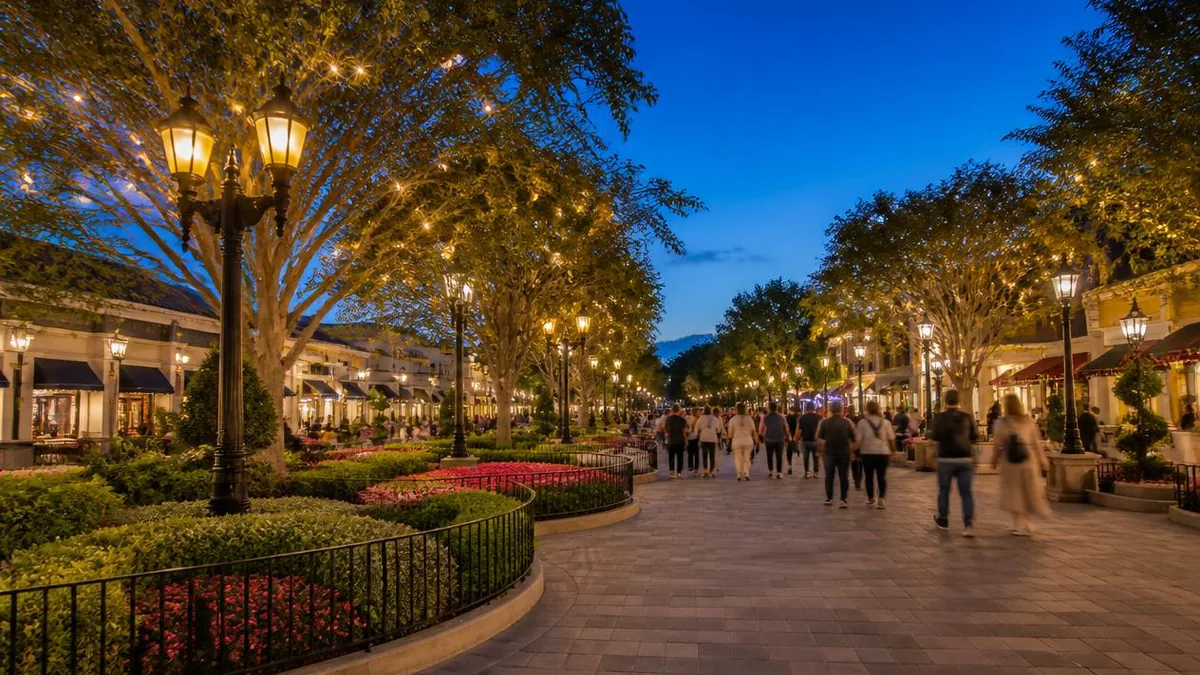
Stand at the entrance and you can audit it. The street ahead is not an American town. There is no berm behind you, so the Pudong skyline stays visible over the rooflines. The hub is a Chinese garden organised by the zodiac. The castle at the end belongs to a committee of princesses and wears a Shanghai peony.
What Disney received for all that was access, on a scale it had waited seventeen years for and could not have obtained on its own terms. What Shanghai received was majority ownership of the asset, three state enterprises inside the cap table, and a district in Chuansha that now has two metro lines running to it.
Both halves of that trade are visible in a single afternoon, if you know to look at the absences rather than the attractions.
The LoreLens app can identify landmarks around Shanghai and explain the history behind them, from Pudong’s skyline to the older city inside the ring road.
Location profile
Where it is
Frequently asked questions
Can you bring your own food into Shanghai Disneyland?
Yes, within limits, and the limits exist because of a public dispute. When the park opened in 2016 sealed food was allowed. On 15 November 2017 the guest rules were rewritten to ban all food and alcoholic drinks, with non-alcoholic drinks capped at 600 millilitres. In August 2019 a student at the East China University of Political Science and Law sued to have the clause declared void; state broadcaster reporters filmed staff searching bags by hand, and the Pudong consumer council reported that the park would not accept mediation. The park apologised, announced changes on 6 September 2019 and implemented them on 11 September: food for your own consumption is permitted, while items needing reheating, self-heating meals, instant noodles, whole melons that require a knife, durian, stinky tofu, alcohol, cans and glass containers are not. X-ray screening replaced part of the hand search from 2 December 2019. Rules of this kind are revised often, so read the current guest regulations on the resort's own channels before you pack.
How is Shanghai different from Tokyo Disney or Hong Kong Disneyland?
Ownership first. Tokyo Disney Resort is owned and operated by the Oriental Land Company under licence and is the only Disney resort in the world that Disney's parks division neither owns nor operates. Hong Kong Disneyland is a joint venture in which the Hong Kong government holds 52 percent and Disney 48. Shanghai's park company is 57 percent Shanghai Shendi Group and 43 percent Disney, with a separate management company split 70 Disney to 30 Shendi. Design follows from that. Tokyo and Hong Kong both have a version of Main Street, U.S.A. and a railroad circling the park; Shanghai has neither, and no earthen berm hiding the outside world. Shanghai is also much larger and much newer, with a castle that is the tallest at any Disney park and lands, such as Zootopia, that exist nowhere else.
How does ticketing work, and what should I expect to pay?
Shanghai was the first Disney park to adopt demand-based tiered pricing, announced in early 2016, and the tier structure has become more elaborate since: a given calendar date falls into one of several price bands, with weekends, holidays and summer at the top, and discounts for booking well in advance. Separate products cover annual passes, hotel stays and paid queue-skipping services, and all of them are repriced periodically. Any specific figure printed in a travel article ages within a season, so treat the structure as the durable fact and take the numbers from the resort's official app or website on the day you book.
How long do you need, and what should you prioritise?
One full day is the working minimum for the park itself and it will be a long day; two days is the comfortable version, particularly if you also want Disneytown and Wishing Star Park, which sit outside the gate. The rides with the most persistent queues are the ones built specifically for this park rather than imported: the Tron coaster in Tomorrowland, the boat ride through Treasure Cove, and the trackless dark ride in Zootopia. Metro Line 11 runs to Disney Resort station, and the Airport Link Line's Shanghai International Resort station opened in December 2024, so arriving by rail is straightforward from most of the city. Show times, land openings and shuttle arrangements change constantly; check the app the morning you go.
Sources and further reading
Background references for the history and place names in this guide. Opening hours, ticketing and access change often — always confirm with official local information before travelling.