Beijing
Universal Beijing: A Film Park for People Who Missed the Films
Twenty years of approvals, a resort footprint larger than Orlando's, and seven lands whose audiences arrived with wildly unequal knowledge of the movies. On opening day the queues told the story.
Most theme-park writing about Universal Beijing measures it against Orlando and asks whether the rides are as good. That is the least interesting question available.
The interesting one is this: what do you build when a large share of your audience has not seen the films your park is made of? Universal’s intellectual property does not travel through China evenly. Some of it arrived in the 1980s and is close to folk memory. Some of it arrived last year. Some of it never really arrived at all.
The resort opened to invited guests on 1 September 2021 and to the public on 20 September 2021, twenty years after the first joint preparatory office was established. The gap is not incidental. It is where the design brief came from.
Twenty years between the first meeting and the first ticket
Around 2000, Beijing decided that a major international theme park would be good for the city and began looking. At the same time NBCUniversal was scouting Asia. In 2001 the head of Universal’s Beijing representative office called on the municipal tourism bureau, and in October that year the chairman of Universal’s parks division signed a joint-venture agreement in Beijing committing to build and operate an international-standard park.
Then the project spent a decade in the approvals system. A joint preparatory office was set up in November 2001 and produced a plan built around twenty-two major installations. The feasibility study finished at the end of 2002; the proposal went to the state planning commission in 2003 and stalled under macroeconomic tightening.
The city revived it in 2008 as a priority project. In December that year Beijing Tourism Group signed a framework agreement with Universal whose core was intellectual property licensing. The application reached the national development and reform commission in February 2009 and received no answer. The reason given publicly by the commission’s Beijing head at the time is the single most useful sentence in the entire file: the State Council wanted the investment scale compressed and more Chinese elements added.
Everything after that is the project answering that instruction. In March 2013, eleven central ministries issued guidance on regulating theme-park development; the project was renamed from Universal Studios to Beijing International Tourism Resort and resubmitted. The State Council agreed in principle at an executive meeting in June 2013; demolition began at the Tongzhou site in July; the investment vehicle was incorporated in November; a licensing framework with NBCUniversal followed in December. Formal approval came on 25 September 2014, and the Sino-US joint venture agreement, covering more than twenty commercial documents, was signed on 13 September 2015.
Even the construction start has two dates: site earthworks began on 28 October 2016, while the official start of construction is recorded as 27 July 2018. Structural topping-out finished at the end of 2019. Phase one completed in April 2021.
Who owns it, and what was actually licensed
The operating company is Beijing International Resort Co., a Sino-foreign joint venture. 70 percent is held by Beijing Shouhuan Cultural Tourism Investment, a consortium led by Beijing Tourism Group and including municipal and Tongzhou district state enterprises. 30 percent is held by a wholly owned NBCUniversal subsidiary. Reported investment exceeds 30 billion yuan.
Compare the other Universal parks in Asia. Universal Studios Japan has been wholly owned by Comcast NBCUniversal since 2017, when it bought out the remaining stake. Universal Studios Singapore is owned by Genting Singapore under a licence from NBCUniversal, inside the Resorts World Sentosa complex.
Beijing is the only one of the three where Universal holds a minority equity position in a park it co-operates. And the sequencing matters: both the 2008 and the 2013 framework agreements are described as centred on intellectual property licensing. The rights deal came first; the equity structure was assembled around it.
”The largest Universal park”—on which measure?
This claim circulates constantly and is almost never qualified, so here is the qualification.
The project was approved with a total area of about 400 hectares, which 2015 reporting compared with Universal Orlando’s roughly 340—hence “the largest Universal resort in the world.” Phase one occupies 159.57 hectares.
The gated park is a much smaller number. The resort’s own material gives the theme park as about 53 hectares; the English figure of 130 acres agrees. Universal Studios Japan is about 54 hectares. Universal Studios Singapore is 25.
So the honest sentence is: the largest Universal resort footprint, containing a park roughly the size of Osaka’s. That is still a serious park—twenty-one rides, four roller coasters, seven lands—but the superlative describes the land bank, not the walk.
The forward numbers disagree with each other, which is worth flagging rather than smoothing. Phase two, planned for the 2021–2025 five-year plan period, is given as 165.83 hectares in one account and a total area of 2.2 square kilometres in another. It is to include a second park drawing on Chinese material, the Monkey King among it. A water park sits in a later phase.
Seven lands around a lagoon
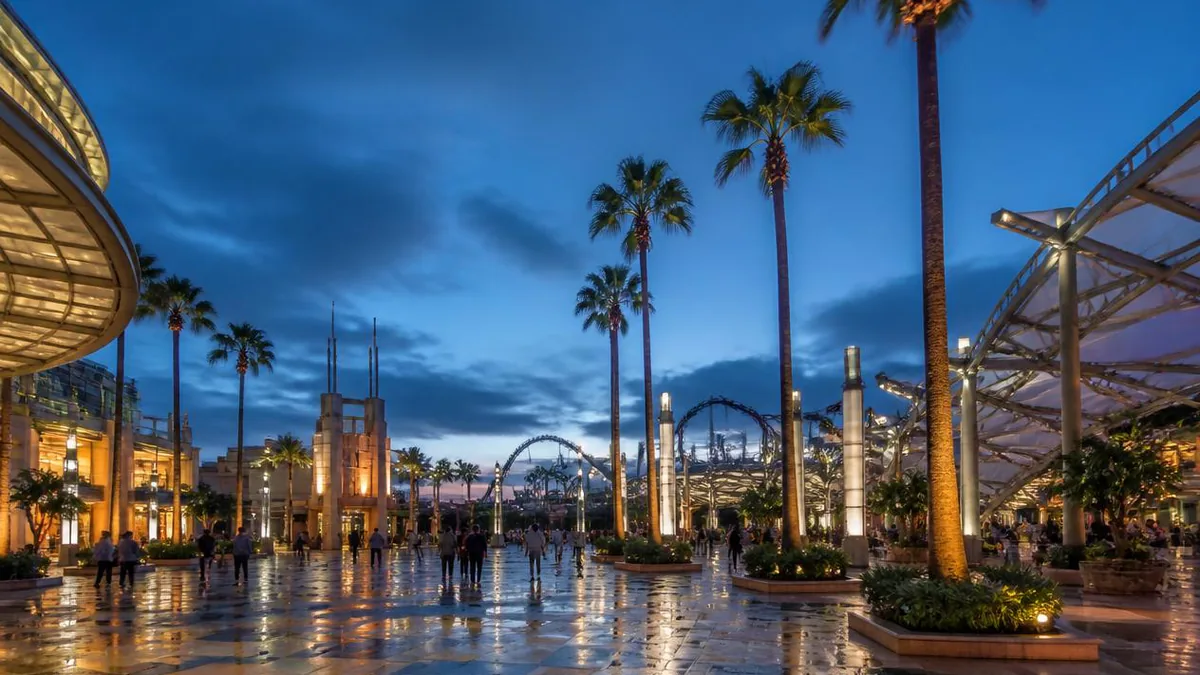
The park is laid out as seven themed zones surrounding a central lagoon, which is a Universal Studios Florida arrangement rather than a Disney one.
Hollywood is the entry boulevard, with the daily parade and a special-effects show hosted jointly by Steven Spielberg and Zhang Yimou—a piece of casting that tells you the whole strategy in one credit line. The Wizarding World of Harry Potter is the fourth installation of that land worldwide, after Orlando, Osaka and Hollywood. Transformers: Metrobase is the first standalone Transformers land at any Universal park, with an original storyline in which the Titan Metroplex works with Chinese scientists to site an Autobot base outside Beijing. Minion Land, Jurassic World Isla Nublar, WaterWorld and Kung Fu Panda Land of Awesomeness complete the set, with Woody Woodpecker’s Cartoon Village folded in.
Resort-level counts run to thirty-seven rides and attractions, twenty-four entertainment offerings, eighty dining outlets and thirty retail units, against twenty-one rides inside the park itself—two different scopes that get quoted interchangeably.
The recognition gradient
Now the argument. Line the seven lands up by how much the audience already knows, and the park’s design decisions stop looking arbitrary.
At one end, Transformers. The franchise reached China in the 1980s through a dubbed animated series and an aggressively distributed toy line—one of the earliest successful foreign merchandising operations in the country. The generation that watched it had children of their own by the time Age of Extinction arrived in 2014, co-produced with a Chinese broadcaster and a Chinese partner, carrying Chinese product placements cut in for the domestic release. It became the first film to take more than 300 million dollars in China and the highest-grossing release in the market at the time. A Transformers land in Beijing does not need to explain who Optimus Prime is.
In the middle, Harry Potter, which arrived as books and then films, and whose iconography—castle, wands, house colours—is legible even to people who have read none of it.
At the far end, WaterWorld. The 1995 film is not part of Chinese popular memory in any meaningful way. Universal Beijing is the first Universal park with a land dedicated to it, and the land’s content is a live stunt show: explosions, falls, a seaplane. It works on a visitor who has never heard the title, because it is built to.
That is the gradient, and it explains the texture of the place. Attractions here carry more setup, more pre-show, more explicit staging of who these characters are and why they matter than their overseas equivalents do. A Universal park in Florida can assume the audience arrives pre-loaded. This one cannot, and it was designed accordingly.
Kung Fu Panda, exported and returned
The most revealing land is the one built specifically for this market, and its story is a full circle.
Kung Fu Panda is an American studio’s rendering of Chinese martial-arts mythology. Its third instalment, released in 2016, was a formal China–US co-production between DreamWorks Animation and Oriental DreamWorks, a Shanghai studio founded in 2012. About a third of the film was made in China. To reach Chinese audiences properly, the Chinese-language version was fully animated to match the Mandarin dialogue—that version and the English one are the only two in which the characters’ mouths match the words. The film’s structure is worth restating: a Hollywood idea of China, partly manufactured in Shanghai, sold into China as something close to a domestic product.
The land completes the loop by making it permanent. Kung Fu Panda Land of Awesomeness is the world’s first themed area based on the franchise and Universal’s first entirely indoor land: the Jade Palace, Panda Village and the Tree of Heavenly Wisdom sit under a roof, with an indoor boat ride through the Valley of Peace, a carousel of franchise characters, a balloon-style family ride and an interactive play area.
The indoor decision is climatic rather than thematic. Beijing winters are severely cold and its summers are wet; an all-weather land keeps capacity available on days when an open-air land loses it.
And then the outcome that no marketing deck predicted. On opening day, the Wizarding World was the most crowded land in the park, while Kung Fu Panda Land—the one built for this audience out of material about this audience—was reported as lightly attended, sometimes walk-on. Draw your own conclusion about what a Chinese visitor to an American theme park is actually there for.
Hogsmeade in Tongzhou, and a three-layer licence
The Wizarding World here is worth a paragraph purely for its contractual geometry.
The land is anchored by recreations of Hogwarts Castle and Hogsmeade village. The castle houses Harry Potter and the Forbidden Journey, a motion-simulator dark ride combining physical sets with screens; outside it are the Flight of the Hippogriff family coaster, the Ollivanders wand-choosing experience, the Frog Choir, the Triwizard Spirit Rally and a nightly projection show on the castle.
None of that belongs to Universal. The property is Warner Bros.’, licensed to Universal for theme-park use. So the ownership chain reads: a Chinese state-led consortium owns 70 percent of a resort, operated with a minority American partner, presenting a land licensed from a third American studio, in a district of Beijing. Every layer of that is contractual, and each layer had to be separately approved.
What it did to Tongzhou
A resort of this size is a piece of city planning, and Beijing treated it that way.
The site sits in the southern part of the municipal sub-centre, the district the city has been shifting administrative functions into. The Xiaotaihou River was rerouted southward from 2016 so that it wraps the resort area. Universal Resort station opened on 26 August 2021 as the terminus of both the Batong line and Line 7. Two new expressway toll gates opened in the same month, and two bus routes were extended.
The spillover was immediate and slightly comic. Visitors reported walking thirty thousand steps a day, and massage and foot-treatment shops several kilometres away became the first industry the resort visibly stimulated. Shops, restaurants and hotels around Tuqiao saw night-time volumes rise; some added “Universal Studios branch” to their signage. Official estimates around opening put total per-visitor spending at roughly 3,300 yuan, which is a resort figure rather than a ticket figure.
Attendance settled at 9 million in 2023 and about 9.8 million in 2024, twelfth in the world.
If you have already done Osaka or Singapore
Many visitors from Japan and Korea arrive having done one or both, so the comparison is worth making precisely.
Universal Studios Japan opened on 31 March 2001 as the first Universal park outside the United States, covers about 54 hectares, and has been wholly owned by Comcast NBCUniversal since 2017, when it bought out the remaining stake. It drew about 16 million visitors in 2024, third in the world. Its distinguishing feature is the depth of Japan-originated and Japan-adapted content layered on top of the Hollywood base, plus twenty-five years of accumulated seasonal programming.
Universal Studios Singapore is the small, dense one: 25 hectares inside Resorts World Sentosa, owned by Genting Singapore under licence, soft-opened in March 2010 and formally opened on 28 May 2011, with seven zones you can genuinely walk in a day.
Beijing is the third Universal park in Asia. Its global sequence number is quoted variously as fifth or seventh depending on which parks are being counted, which is a good illustration of how loosely these rankings are used.
What Beijing offers that neither of the others does: the Transformers land, the Kung Fu Panda land, the WaterWorld land, and a resort footprint with room for two more phases. What it does not offer is Osaka’s density of finish or Singapore’s compactness. If you have done Osaka, come for the three exclusive lands and the scale, not for a better version of the same park.
What “more Chinese elements” turned out to mean
Go back to that 2009 instruction: compress the investment, add more Chinese elements.
Thirteen years later you can see exactly what was delivered against it. One land out of seven built on a Chinese subject, and that subject arrived via Hollywood. A Chinese director sharing top billing with Spielberg on the entry-boulevard show. A Transformers backstory rewritten to put an Autobot base in the Beijing suburbs. A second park full of Chinese material—the Monkey King and company—still on the drawing board, deferred to a phase that was not yet under construction when the first phase opened.
The instruction was answered, in other words, mostly by translation rather than by substitution. And the opening-day crowd flows suggest the audience was comfortable with that: they queued longest for the least localised land in the park.
Which brings the argument back to where it started. This is a film park for a market whose relationship to those films is uneven, recent, and mediated—by a dubbed cartoon from the 1980s, by translated novels, by a co-production animated in Shanghai. The park’s real subject is not the movies. It is the long, strange route by which those movies got here.
The LoreLens app can identify landmarks across Beijing and explain what stands behind them, from Tongzhou’s canal-era remains to the imperial city inside the Second Ring Road.
Location profile
Where it is
Frequently asked questions
Is Universal Beijing really the largest Universal park in the world?
It depends entirely on what is being measured, and the claim is usually made without saying. The defensible version concerns the resort footprint: the project was approved with a total area of about 400 hectares, which reporting at the time noted was roughly 60 hectares more than Universal Orlando, then the largest Universal resort. That makes it the largest Universal resort site. The gated theme park is a different number: the resort's own material gives about 53 hectares, and the English-language figure of 130 acres works out to the same order. Universal Studios Japan in Osaka is about 54 hectares. So the park you actually walk around is comparable in size to Osaka's, roughly twice the size of Universal Studios Singapore's 25 hectares, and the superlative belongs to the land holding rather than to the park.
Do you need to know the films to enjoy it?
Less than you would at a Universal park in the United States, which is a deliberate design outcome. Recognition of the source material is very uneven in China: Transformers has been familiar since the 1980s through a dubbed animated series and the toy line, and the 2014 film became the first release to gross more than 300 million dollars in the Chinese market; Harry Potter arrived through books and films; Waterworld, from 1995, is not a film most Chinese visitors have seen, which is precisely why its land is built around a stunt show that requires no prior knowledge at all. The attractions carry more setup and more explanatory staging than their overseas equivalents. On opening day the Wizarding World drew the longest queues while Kung Fu Panda Land of Awesomeness, the land built specifically for this market, was frequently walk-on.
How does ticketing work?
Admission uses date-based tiers rather than a single price: any given calendar date falls into a low, regular, peak or special-date band, with public holidays and much of the summer at the top. Separate products cover paid queue-skipping, hotel packages and early entry, and all of them are repriced from time to time. Numbers printed in travel articles date quickly, so take the current bands and the current express-pass arrangements from the resort's official app or website when you book, and note that the CityWalk retail and dining strip outside the gate has never required a ticket.
How do you get there, and how long do you need?
The resort sits in Tongzhou District, in the southern part of Beijing's designated municipal sub-centre, northwest of the interchange where the East Sixth Ring Road meets the Beijing–Harbin expressway. Universal Resort station opened on 26 August 2021 as the terminus of both the Batong line and Line 7 of the Beijing Subway, and it is roughly a seven-minute walk from exits B, C and D to the Universal Boulevard entrance checkpoint; bus routes 589 and T116 were extended the same day, and two new expressway toll gates opened days earlier. One full day covers the park if you are efficient about the two or three headline rides; two days is comfortable and lets you take CityWalk at a reasonable pace. Show schedules and land operating hours vary by season—check on the day.
Sources and further reading
Background references for the history and place names in this guide. Opening hours, ticketing and access change often — always confirm with official local information before travelling.