Hainan · Sanya
Nanshan: A Temple Built in 1995, and a Tang Record That Holds
The Guanyin park on Hainan's south coast is routinely sold as an ancient monastery. It broke ground on 11 November 1995. The Tang monk it commemorates really was blown onto this coast in 748, and the account of that is better than the legend built on it.
5A View location, maps and nearby scenic areasAlmost everything written about Nanshan in English opens by calling it an ancient temple. It is not one. Ground was broken on 11 November 1995 and the opening assembly held on 12 April 1998, and the operator’s own published material says exactly that.
That ought to end the discussion, and it does not, because the history this place invokes is better documented than the history at many sites five times its age. A Tang monk really was driven onto this coast in the winter of 748, and a detailed account survives, written in Japan in 779. What the account describes is not this temple.
Read Nanshan as two things at once, then: a fragment of eighth-century record that happens to be unusually precise, and a piece of 1990s construction whose commissioning file—who proposed it, who signed it off, which alloy the statue is made of, what wind it was engineered for—is almost entirely public.
The name arrived before the site did
The origin is administrative and it is on the record.
In 1993, Ruan Chongwu—then both party secretary and governor of Hainan, previously national minister of public security and of labour—received a letter from a monk asking for several hundred mu of land at Yalong Bay to build a temple. He refused that site on planning grounds, judging a monastery incompatible with the resort master plan then being drawn for the bay, and proposed instead a temple commemorating Jianzhen, the Tang vinaya master whose voyages to Japan are the most famous thing to have touched this coastline.
The name followed from the monk, not the map. Jianzhen belonged to the Nanshan school of vinaya, and “Nanshan Temple” was proposed on that basis. Only afterwards did the search for a site produce a hillside near Yazaitang village that was itself already called Nanshan, and had anciently been called Aoshan, the sea-turtle mountain, for its shape.
The criteria were infrastructural: a large open area backed by hills and facing the sea, few farms to clear, a road close by, a high-voltage line crossing it, a stream beside it, a planned reservoir nearby. The rear summit is given as 478 metres in one account and “over 500” in another.
Approval then ran up and back down: an outline plan submitted by Sanya and approved by the province on 24 July 1993, endorsement in Beijing from the Central United Front Work Department, the religious affairs administration and the Buddhist Association of China, and formal provincial approval the same year. In January 1994, the association’s president Zhao Puchu inspected the site with some sixty figures from Buddhist and architectural circles, and handed over his calligraphy for the temple plaque on the spot.
What the Tang record actually says
The source is a single text worth naming precisely. The Tō Daiwajō Tōseiden, the account of the great Tang master’s eastward journey, was compiled in Japan in 779, sixteen years after Jianzhen’s death, by Ōmi no Mifune, drawing on an earlier biography by Sitao, a disciple who was on the ships. It was translated into French in the 1920s and into English in the 2000s.
The fifth attempt is the one that matters here. The party left Chongfu Temple in Yangzhou on the twenty-seventh day of the sixth month of 748—fourteen monks, about thirty-five people in all—then waited months in the Zhoushan islands for weather, sailing at last on the sixteenth day of the tenth month.
What followed is described with unusual physical detail: black water, sea snakes, flying fish, birds heavy enough to press the boat down, then days with the ration reduced to a little raw rice and no water to swallow it. The crossing is stated plainly: fourteen days at sea before they reached land, arriving in the eleventh month on a coast where flowers were open and bamboo shoots were up, so that winter could not be told from summer. Three more days brought them to the river mouth at Zhenzhou.
There the biejia, the prefectural aide Feng Chongzhai, sent over four hundred men to meet them, held an ordination in the prefect’s own hall, and lodged the party at the prefecture’s Dayun Temple. Its Buddha hall was derelict; the monks gave up their own possessions to rebuild it, and the text says they stayed one year and finished it. Feng then escorted them onward under arms, more than forty days’ travel to Wan’an.
Zhenzhou’s seat was Ningyuan county, in what is today Sanya’s Yazhou District. When Jianzhen landed, the prefecture was officially Yande Commandery, a renaming that ran from 742 to 758.
Eighth-century Hainan, as the same record describes it
Read the Tōseiden rather than a summary, because the detour is the best surviving eyewitness description of Tang Hainan, and it is not romantic.
The Tang geographical treatise records Zhenzhou at 819 households and 2,821 people, and gives its distance from the capital as more than eight thousand li. That is the administrative content of the phrase “edge of the empire”: a prefecture with fewer registered people than a modern village.
Further up the coast at Wan’an, the record describes the local paramount chief Feng Ruofang, who by this account seized two or three Persian ships a year, took their cargo as his own and their crews as slaves, kept those slaves in villages spread three days’ travel north to south and five east to west, burned frankincense by the hundredweight as household lighting, and had sappanwood stacked behind his house like a hill. It is a matter-of-fact note in a monk’s biography, and one of the most cited passages in the historiography of early South China Sea trade.
The farming is recorded too: fields sown in the tenth month and reaped in the first, silkworms raised eight times a year, rice harvested twice, and a fruit list running from betel and coconut to lychee, longan and banana, plus one “as large as a winter melon” usually read as jackfruit.
Set that beside the miracles in the same text—four armoured gods on the mast, a pool that appeared and vanished, four white fish leading the boat in—and the reading posture is settled. This is a devotional biography that is also, incidentally, an administrative and ethnographic document. Neither half cancels the other.
What the record does not say
Four things, and they are the whole difficulty.
It does not put Jianzhen on this hillside. It puts him at the prefectural seat, and Dayun Temple was the prefecture’s temple.
It does not have him founding a monastery here. He repaired an existing hall. The park’s own introduction says he “built Dayun Temple”, which overstates a rebuild into a foundation.
It does not support the park’s second claim, that the Japanese monk Kūkai also came ashore at Nanshan. The standard account has his ship blown badly off course in 804 and making landfall at Chi’an, in Changxi county near Fuzhou in Fujian, where the party was held about fifty days on suspicion of piracy. The same copy calls him Japan’s first student monk to the Tang, which he was not.
And it establishes no continuity of fabric or lineage. What carried forward is local memory: Sanya has long pointed to a “sutra-drying slope” at Nanshan as a Jianzhen site, and a Japanese monk’s visit to that slope in 1991 helped put the story back into local circulation two years before the temple was proposed. Tradition of that kind is real as tradition. It is not evidence.
The Potalaka argument, which is at least an argument
Where the historical claim is weak, the doctrinal one is explicit, and the builders never hid it.
The Avataṃsaka Sūtra, in its Gaṇḍavyūha chapter, says that in the south there is a mountain named Potalaka, and there dwells the bodhisattva Avalokiteśvara. Devotional tradition lists twelve great vows of Guanyin, the second being to dwell always in the South Sea. Nanshan’s founding texts quote both, then make a geographical argument: this headland is the southernmost mountain in China, and it faces that sea.
The awkwardness is that Putuoshan, off Zhejiang, is named directly from Potalaka and has claimed the same identification for a thousand years. Nanshan’s position amounts to saying the older claimant is at the wrong end of the country. Neither claim is testable. Sacred geography works by assertion plus traffic, and Putuoshan has a millennium more of the traffic.
One genuinely pre-modern local text exists, and it is small and specific. The Yazhou gazetteer records that in the sixth year of Guangxu, lotuses appeared spontaneously at Yazaitang village at the southeastern foot of Nanshan, grew luxuriantly for three years and died back, then returned more strongly in the twenty-third year. The lotus is Guanyin’s emblem, which is why the record is quoted. Note that the park’s own page converts the sixth year of Guangxu to 1881, where the conversion is 1880; the second date is 1897.
The temple, dated
The construction record is precise enough to check, which is unusual and to the site’s credit.
Ground was broken on 11 November 1995 and the opening assembly held on 12 April 1998, timed to what the temple describes as the two-thousandth anniversary year of Buddhism’s arrival in China. Zhao Puchu wrote both the temple name and the phrase rendered “monastery of sea and sky” for its plaques.
The temple occupies about 400 mu in a High Tang revival style—a deliberate reference to Jianzhen’s century, not a claim of age. The first phase is given at about 5,500 square metres, and its vocabulary is Tang rather than Ming: the entrance is a Benevolent Kings gate named for the two vajra guardians rather than the usual three-gate arrangement, the main hall is called the Golden Hall in the Tang manner and holds the three Buddhas of the three realms, and there is a revolving sutra repository with climbing corridors running up the slope.
A second phase was planned on a single axis with twelve courtyards; completed to plan it would bring the temple to 188 by 416 metres, eight terraces with a total rise of 49 metres, and roughly 40,000 square metres of building.
The superlatives attached to it—largest Buddhist establishment built in China in fifty years, largest temple in southern China—come from the operator and are worth attributing rather than repeating. The institutional facts need no attribution: the first abbot was the elder Xincheng, and Yinshun, a vice-president of the Buddhist Association of China, was installed on 23 September 2012.
The statue, read as an engineering job
The 108 metres was not a devotional discovery but a planning decision, fixed in February 1994 when the sea Guanyin was written into the temple’s design brief. Two small bronze maquettes went to Beijing in January 1996 for Zhao Puchu’s opinion; national religious affairs approval followed about a year later.
The build chronology, as the project itself published it, runs on the lunar calendar: formal start on the nineteenth day of the ninth month of 1999, a Guanyin feast day; the artificial islet from early 2000; the Yuantong hall by the end of that year; the vajra throne by early 2003; the statue’s main steel structure from the third lunar month of 2003; consecration on the sixteenth day of the third lunar month of 2005, which is 24 April 2005, with 108 senior monks from the mainland, Taiwan, Hong Kong and Macau, including Theravāda and Vajrayāna representatives. Six years, at a cost usually given as 800 million yuan.
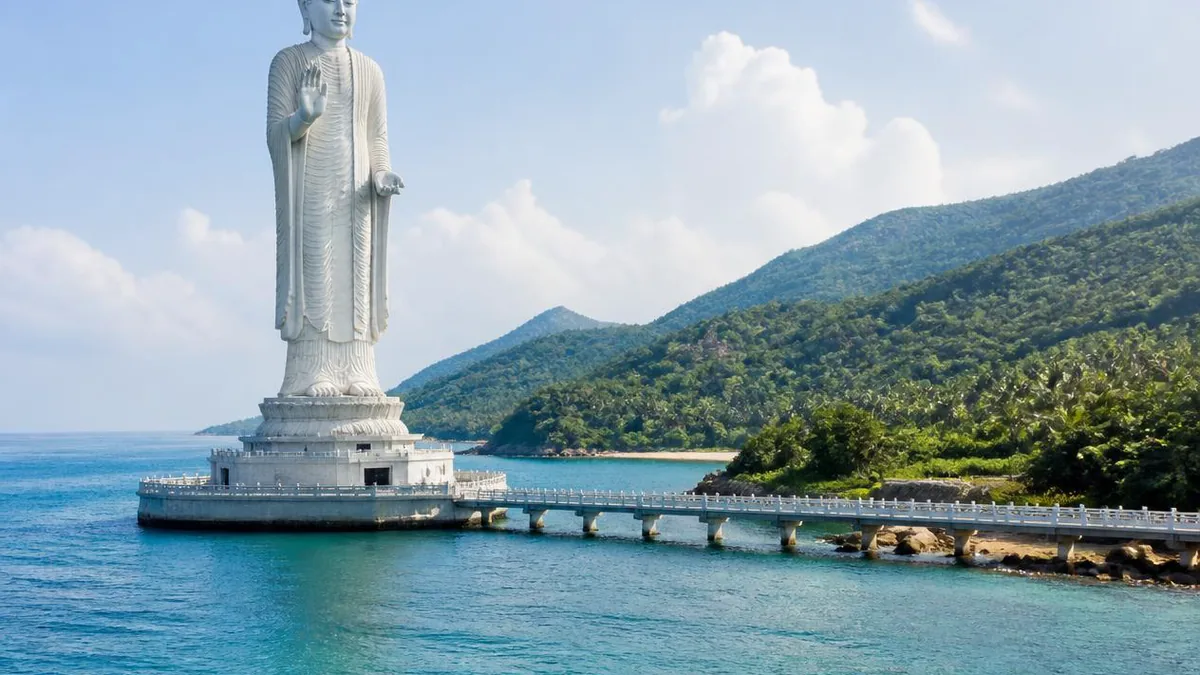
The material is the part most often reported wrongly. This is not gilded bronze. The operator’s own English description says the figure was made of white alloy by forging, its surface treated with a fluorine-based coating, weighing 2,600 tonnes and engineered against a maximum wind speed of 46 metres per second—force fourteen—with wave and corrosion resistance specified alongside. White was chosen for contrast against blue water as much as for the White-Robed Guanyin iconography. The contracting is equally concrete: the precinct designed by a Shanghai architectural design group, the marine works by a Gezhouba engineering subsidiary with a Shanghai bridge company, and the figure fabricated by Aerosun, an aerospace manufacturer.
Three faces, and the small statue the big numbers belong to
The brief was for one body with three aspects, so that no approach—from the sea, from the shore, from any angle of the causeway—ever shows you the back of the figure. North holds a sutra box for wisdom, east a lotus for peace, west prayer beads for compassion. Advisers from Buddhist studies, sculpture and metallurgy worked through dozens of drafts under the Buddhist Association of China. The operator’s own English copy offers a Statue of Liberty comparison, which tells you who it was written for.
Donations were recorded individually rather than aggregated, which is unusual: the eleventh Panchen Lama gave 11,180 yuan, the Macau figure Ma Man Kei 100,000, and the Taiwanese teacher Nan Huai-chin one million plus a bronze Shakyamuni.
Now the correction that matters most here. The dazzling material figures—over 100 kilograms of gold, more than 120 carats of South African diamond, thousands of rubies and sapphires, emerald, coral, turquoise, pearl and over 100 kilograms of jadeite, valued at around 192 million yuan—get attached in secondary sources, Chinese Wikipedia included, to the 108-metre statue. The temple’s own page attaches them to something else entirely: the gold-and-jade Guanyin, a 3.8-metre image of the eight-armed Amoghapāśa form kept in a pavilion in the Compassionate Ferry garden. Its gold body was raised from more than two hundred sheets averaging 1.2 millimetres thick, hand-beaten and welded; the halo is filled with 1,640 gold wires and outlined by 1,100 pearls; the lotus is 52 pieces of white jadeite. Dates vary—one record gives completion on 28 June 1997, certification as the world’s largest gold-and-jade Buddha image is dated 27 November 1998, and the Guinness entry is 1999.
The rest of the park, and the genuinely old thing next door
The entrance is the Gate of Non-Duality, built in a Northern and Southern Dynasties idiom rather than the Tang of the temple, carrying two inscriptions written by the calligrapher Gu Tinglong at ninety-four. The reference is Vimalakīrti’s silence: asked to explain non-duality, he says nothing, and Mañjuśrī approves.
East of the temple runs Longevity Valley, a landscaped ravine about 2,300 metres long that opened in 1999 with the first Nanshan longevity culture festival. It holds a giant rock-cut inscription of the phrase usually translated “may your years match South Mountain”, carved by Qi Gong, a four-metre longevity character by Liu Bingsen, a hundred-year stair and a Ming poem on the old Aoshan name. State the pun openly, because the park does not: the phrase comes from the Book of Songs, and its South Mountain is in Shaanxi. A whole zone has been built on a coincidence of names, and it is a pleasant zone.
The master plan explains the scale: a planning area of 50 square kilometres including 10 of sea, with numbered zones covering the Buddhist culture park and the temple but also a golf course, a villa conference village, resort hotels and an existing Li village left in place.
The genuinely old site is not inside the gate. Daxiao Dongtian, on the coast at the foot of the same mountain, covers 22.5 square kilometres and holds Song-dynasty rock inscriptions—named, tradition says, by a Song prefect, and adopted by the Daoist patriarch Bai Yuchan—listed as provincial protected heritage in 2009, plus a Qing longevity stele. Both areas were rated 5A on 8 May 2007, in the first national batch. Between them sits the Nanhai Buddhist Academy, a four-year college on a 618-mu site that opened on 23 September 2017 with 227 students across eight undergraduate programmes.
Using it, and what it is
Nanshan lies west of central Sanya in Yazhou District; the distance is given as 20 kilometres in the operator’s older material and 40 in other descriptions, so budget for the larger. The district has its own station, Yazhou, on Hainan’s western high-speed line.
Plan half a day at minimum. The site is large enough that internal buggies are part of the design, the seafront has almost no shade, and the causeway out to the statue is the most exposed stretch of the visit. Access to the islet has at times been ticketed separately. Vegetarian meals are available. Admission, combined tickets, buggy routes, opening hours and assembly times all change; confirm them at the gate on the day.
Then take the last point seriously. This is a working monastery with a resident community, a published calendar of rites and a Buddhist college attached, and the people prostrating on the terrace on a lunar feast day are not extras. A temple built in 1995 is still a temple.
What makes Nanshan unusual is not that it is new. It is that almost nothing about it is hidden. You can name the official who proposed it and the year the province signed it, read the sutra passage the siting argument rests on, check the alloy and design wind speed of the statue, then walk down the coast to a cliff with Song characters cut into it and see what a thousand years of accumulation looks like by comparison. Most sacred places conceal their construction file. This one publishes it, and is no less used for that.
The LoreLens app can help you identify Buddhist hall types, statue iconography and inscription styles while explaining the history around them.
Location profile
Where it is

Frequently asked questions
Is Nanshan Temple an ancient temple, and did Jianzhen found it?
No to both, and the operator's own material is clear about the first. Nanshan Temple broke ground on 11 November 1995 and held its opening assembly on 12 April 1998; the 108-metre Guanyin was consecrated in April 2005. The Jianzhen connection is real but indirect. The Tang record says the monk's fifth attempt to reach Japan ended when his ship was blown south in the winter of 748, that he came ashore in Zhenzhou prefecture, whose seat stood in what is now Sanya's Yazhou District, that he was housed at the prefecture's existing Dayun Temple, and that the monks spent a year rebuilding its ruined Buddha hall. The record does not place him at this hillside, does not describe him founding anything here, and there is no lineage or fabric connecting his year to the buildings you walk through. The honest formula is that the event is documented and the temple is new.
How tall is the sea Guanyin, and is it really the tallest Guanyin in the world?
The figure itself is 78 metres; with the pedestal the usual quoted total is 108 metres, and some accounts give 135 metres for the whole structure including its base platform, so always ask which number you are being sold. On the superlative, the answer depends entirely on the measurement. By total height including pedestal, 108 metres is the largest figure attached to any Guanyin. By the height of the figure alone, the eleven-headed thousand-armed Guishan Guanyin in Hunan, completed in 2009 and finished in gilded bronze, is given as 99 metres against Nanshan's 78. Both statements are in print; neither is dishonest; they are measuring different things.
Is Nanshan a theme park or an actual place of worship?
Both, and the second part is not decorative. Nanshan Temple has a resident monastic community and a named abbot: Yinshun, a vice-president of the Buddhist Association of China and head of the Hainan Buddhist Association, was installed on 23 September 2012. The temple publishes a calendar of assemblies, including water-and-land rites, repentance services and ordination ceremonies for lay precepts. Next door, the Nanhai Buddhist Academy, a four-year undergraduate Buddhist college approved by the national religious affairs administration and run by the Hainan Buddhist Association, opened on 23 September 2017 with a first intake of 227 students. Dress and behave as you would in any working monastery, follow posted photography rules inside halls, and expect the Guanyin feast days in the lunar calendar to be genuinely crowded with worshippers rather than sightseers.
How long does Nanshan take, and what should I know before going?
Half a day is the working minimum and a full day is comfortable. The site is very large by design, the master plan covers a planning area given as 50 square kilometres including 10 square kilometres of sea, and internal shuttle buggies exist because walking the whole thing is not realistic. There is very little shade on the seafront stretch, which in Sanya matters more than the distance. The statue stands on an artificial islet reached by a causeway, and whether access to it is inside your main ticket or sold separately has varied. Vegetarian meals are available on site. Every time-sensitive detail here—admission, combined tickets, buggy routes, opening hours, assembly schedules and whether the causeway is open in heavy weather—changes, so confirm at the gate on the day rather than trusting any figure printed in advance, including this one.
Sources and further reading
Background references for the history and place names in this guide. Opening hours, ticketing and access change often — always confirm with official local information before travelling.