Shanghai
Shanghai Wild Animal Park: The Cage Around the Visitor
A drive-through park inverts the nineteenth-century zoo: the barrier travels with you instead of standing around the animal. Take the bars away, though, and being seen at all becomes the problem — and this park's answer, printed on its own schedule boards, is food, on a timetable of more than ninety named items.
5A View location, maps and nearby scenic areasAlmost every zoo you have visited works the same way. The animal is inside something, you are outside it, looking in. That arrangement is a nineteenth-century invention, and in China its oldest surviving example is Beijing Zoo, laid out in 1906.
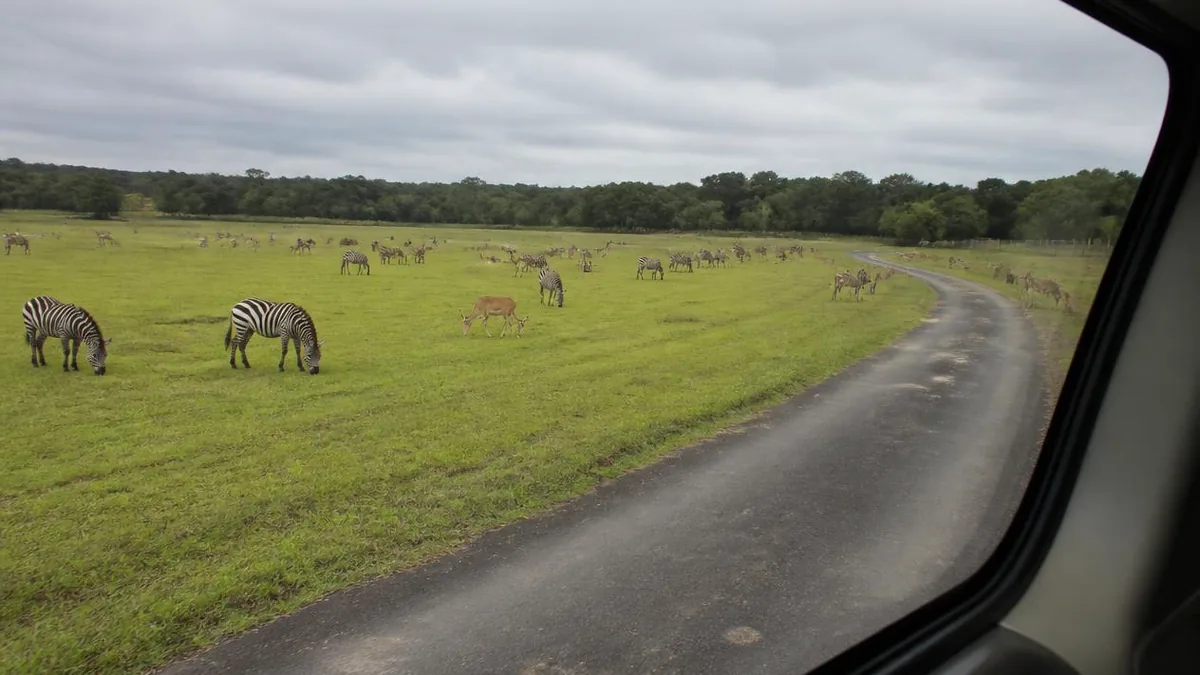
Shanghai Wild Animal Park is built the other way round. Its central experience is a drive: you sit inside a vehicle and the vehicle passes through ground the animals have. The barrier has not gone anywhere. It has changed sides and started moving.
That inversion creates its own problem. Once the bars are gone, an animal with no particular reason to come near you is not a poor exhibit — it is absent. This park’s answer to that, built over three decades, is printed on its own schedule boards.
A park built the other way round
The park sits at 178 Nanliu Road in Xuanqiao, in the far south-east of Pudong, on 153 hectares — 2,300 mu — roughly 35 kilometres out from central Shanghai. Chinese reference accounts describe it as the country’s first national-level wildlife park, built jointly by the Shanghai municipal government and the national forestry administration and opened in November 1995; the year is corroborated by the park and by news coverage, the specific date of 18 November only by reference works.
It was in the first batch of 5A-rated attractions, the 66 sites announced on 8 May 2007 when that grade was created. That is checkable, unlike the superlatives further down this page.
Three zones divide the site, and the division is not cosmetic: the car area, entered only by vehicle, holding the large herds and the carnivores; the walking area, a conventional zoo of enclosures and paths; and a boat route through a water zone, which the park describes as the first of its kind in China.
So the inversion is partial. One third of the park treats you as the thing to be contained; the pandas, elephants, chimpanzees and penguins are all in the older arrangement.
Three ways through the car area
Ten named sections make up the car circuit — Asian and African plains, giraffe, cheetah, lion, bear, tiger, white tiger, wolf valley, sun bear. The animals in them are not mixed: herbivore herds and large carnivores are held apart, and the sections are separated by fences and gates you drive between. “Free range” here means free of cages, not free of boundaries, and the fence is the reason a bus can drive through a lion section at all.
Access is rationed by vehicle size, and the published regulations are precise. Coaches over 30 seats may drive in on their own; 20-to-30-seat coaches only with a paid park guide aboard; travel-agency coaches of 10 to 20 seats reach the park car park and no further; anything under 20 seats, plus goods vehicles, is not admitted at all. So a family in a car parks and boards.
There are normally three boardings. A free enclosed coach, glass between you and everything. A chargeable feeding vehicle, open-sided and caged, fitted with ports. And from 5 August 2026 a third route on trial, boarding beside the hippo house: a winding drive past zebra, blue wildebeest and oryx, with what the park calls the only greater one-horned rhinoceros on display in China, plus white rhino and giraffe through glass — the park’s claim, and worth treating as one.
Inside, the rules are short: no overtaking, no getting out, no opening windows, no stopping part-way.
The port in the wall, and the argument about it
The feeding vehicle is why a large share of visitors buy a car-area upgrade, and it should be described plainly rather than around. You sit in a caged vehicle; food bought inside the park is passed out through small ports. The park’s own promotional language names the behaviours this produces: tigers and cheetahs coming up onto the vehicle, lions climbing trees, brown bears climbing poles.
There are two settled positions here and no need to invent a third. The institution’s case is that these are captive animals whose diet is managed regardless, that the responses are real predator behaviour rather than trained tricks, and that visitor income pays for the animals. The position of international zoo and aquarium welfare codes is that feeding large carnivores from a vehicle as paid entertainment is not accepted practice — an argument we set out in full in Harbin’s Siberian tiger park and will not re-run here.
What is worth noticing is the inconsistency the park lives with in public. Its visitor regulations forbid feeding animals any food you bring in yourself; its panda-house notices ask visitors not to feed, not to throw objects, not to bang on the glass; its bird-week material asks the public not to feed human food to birds. The feeding vehicle is the one place where the rule is suspended and a ticket sold instead.
Ninety-two items on a timetable
This is the section that explains the park, and it comes from the park’s own published schedules rather than anyone’s opinion of them.
As listed in August 2026, the programme comprises six theatre items, twenty-three interpretive talks, forty-one behaviour displays and twenty-two interactive experiences — ninety-two named entries, most running several sessions a day, many running again during evening opening.
Now look at what the behaviour displays are. Tiger pouncing, on the hour and then every half hour from noon to four. Tiger pole-climbing at the restaurant named after tigers, six to eight sessions a day. Hippo feeding and tooth-brushing, hourly. Feeding displays for tapir, giant and lesser anteater, raccoon, pelican. Giraffe feeding, one bucket per animal. Wolf food enrichment — inside the car area, at listed times. African lions climbing trees, Amur tigers and white tigers coming onto the vehicle, cheetahs onto the vehicle, cheetah speed runs, brown bears in the water: seven separate car-area displays, each with a published clock.
That last list dissolves the phrase “free range” more effectively than any critic could. The drive is not a lottery. It is a schedule, and food is what keeps it to time.
Some of the programme is genuine enrichment and should be credited as such: an orangutan aerial walkway above the visitor route, a chimpanzee puzzle session, gibbon climbing, lemur jumping. Enrichment and performance are not opposites — a food puzzle is both — but the distinction you can draw on the spot is whether the animal is solving something or delivering something.
What happened to the performances
The lineup has changed, and the change is documented rather than claimed. Reference lists for this park, compiled from earlier material, name a sea lion show, dog racing, horse racing and a paid Russian state circus. Coverage of the park’s 8 August 2019 night opening described a grand parade with animals on floats — golden snub-nosed monkeys, parrots, border collies, a tiger cub, alpacas, zebras, a Mongolian horse troupe and Asian elephants each holding the tail of the one ahead — plus stunts, dancing and a young Amur tiger posing for photographs.
None of the racing or circus items appears in the current schedules. Today’s parade is billed as a costumed-performer parade — humans in animal suits, running question-and-answer games at set points — while the live-animal processions that remain are species-specific: pelicans, capybaras, flamingos. What was called a performance is now generally called a behaviour display or an interpretive talk. One entry is still listed as a spider monkey playlet.
Whether renaming changed the underlying activity is a judgement you can make in front of the exhibit. The park also states in its own conditions that it may close exhibits or cancel interactions and theatre items to protect animal health and welfare, without notice or liability. That clause is the most honest sentence on the website, and it is why no printed schedule, including this one, beats the board at the gate.
The night park
On 8 August 2019 the park launched what it and Shanghai media called China’s first proper night wildlife park — the comparison everyone reached for was Singapore’s night safari. It is the one place where the visibility problem is solved by biology rather than catering: many of these animals are nocturnal or crepuscular, and the big cats that lie flat through a humid Shanghai afternoon are awake after dark.
In summer the park now runs evening hours, the car area and the feeding vehicle both operate into the night, and much of the behaviour and interaction programme has a second, later set of times. Light installations and a lakeside light show run alongside — two different products sharing an evening, and it is worth knowing which one you came for.
17 October 2020
On the afternoon of 17 October 2020, a member of staff working inside the car area was attacked by bears and killed.
The park’s statement, carried by Xinhua and reprinted by state outlets on 18 October, put it in those terms: an accidental animal injury incident, park workers carrying out operations in the car area, one worker dead. Accounts the same day from visitors on a sightseeing coach described construction work under way inside the section, other site workers unable to drive the bears off and sheltering in a vehicle, and police arriving afterwards. The park had already posted a notice on 17 October suspending the car area from the following day, refunding unused tickets and offering visitors who had entered a free return visit before the end of the year.
The car area operates again today. I could not establish a reliable reopening date from sources I was able to open, so this article does not give one.
This is not here for sensation. It is the plainest statement of what the inverted enclosure does and does not do: the barrier protects the person in the vehicle, not the person whose job is inside the fence. An enclosure large enough to drive through is also a workplace that has to be entered on foot.
Pandas: on loan, on display, disputed
The panda house is in the walking area, and it carries the park’s sharpest public controversy.
In January 2017 the deaths of a female panda, Guoguo, and her cub, Huasheng, became national news, along with a claim that five pandas had died here in ten years. The park’s reply, given to Jiefang Daily and carried by Xinhua on 26 January 2017, was that six had died in its 22 years, out of 34 kept and displayed: Guoqing in March 2007 of a high intestinal obstruction; Wuyang, one of the 2010 Expo pandas, in January 2011 of intestinal torsion; Yunhui in January 2015 of chronic severe hepatitis; Jiasi in October 2015 of old age, then called one of the three longest-lived giant pandas alive; and the two in 2017.
Two structural facts came out of that exchange, and they matter more than the count. First, display is not custody: pandas here are on loan, and under loan rules the exhibiting zoo may not treat a sick panda on its own authority — it must report to the national panda conservation and research centre, whose specialists set the treatment plan and, in Guoguo’s case, were on site throughout. Second, the park volunteered its own limitation — nine veterinarians and an annual surgical caseload of only twenty to thirty operations, therefore thin clinical experience — and described this as an industry-wide condition rather than a local failure.
Its current pandas show the loan system working. The park’s own posts describe Qianzhen as born in Sichuan on 26 July 2020 and moved here, spending over two months acclimatising in back dens before her first outdoor appearance on 20 April 2026, with the enclosure railings raised for her; Qianjin raising boy-girl twins, Qianran and Qianyi, whose first birthday the park dates to 22 August 2026; and Jiajia turning fourteen on 5 August 2026.
That is a display collection with breeding in it, not a breeding institution — a difference worth holding on to. For the reproductive science, the relevant place is the Chengdu panda base.
What it does that is not display
Three things here are conservation work in a sense that survives inspection, and none of them is what you buy a ticket for.
Rescue and confiscation holding. The park is a designated wildlife rescue and holding institution. In late January 2026 it took in two consignments of confiscated endangered animals, including rare turtle hatchlings and parrot eggs; keepers ran round-the-clock incubation, and by April more than a hundred of those eggs had hatched. Confiscated animals arrive whether or not anyone buys a ticket.
Elephant breeding, which is genuinely difficult in captivity. In 2026 alone the park recorded an Asian elephant, Gelan, giving birth to a male calf in January; an African matriarch, Lusi, appearing with a calf approaching a year old; and four calves — Lufei, Wuyue, Anan and Manman — named on 1 June by public vote, after a naming exercise run with three Shanghai primary schools.
The boat route, which holds Chinese conservation species rather than crowd-pleasers: Père David’s deer, crested ibis, and golden snub-nosed monkeys, of which the park claims the largest captive group in the world. Other superlatives belong in the same bracket and should be read as the park’s wording, not as findings: China’s largest ring-tailed lemur group, East China’s largest African and Asian elephant herds, China’s only cheetah run.
Shanghai sits at the Yangtze mouth on two migratory flyways and had recorded 543 wild bird species cumulatively by the end of 2025. This park is the Pudong venue for the national bird-protection week, and on its 2026 walk visitors logged more than ten wild species inside the grounds alongside the captive ones.
Getting there, and the day’s notice
The metro is the first thing to get right. Line 16 has a station called Wild Animal Park, but it is roughly two kilometres from the main gate, and the park’s own directions are to leave by exit 2 and take a taxi at the starting fare.
Everything else is a function of the day. Three seasonal timetables are published — a regular season, a summer and holiday evening season, and a short-day December-to-January season — and within each, ticket sales stop about an hour before the gates and the car area and boat route stop earlier still. In July and August 2026 the park issued three operating-time notices in four weeks, twice for typhoons, once shortening the day and once cancelling the evening session outright.
Two points beyond that. The walking area is what consumes a day, so do the car area early and the shaded houses in the afternoon heat. And the park put a detailed area plan and an upgrade design consultancy out to tender in April and July 2026 — the layout described here is a snapshot of a park being redesigned.
Stand at the gate and the argument is already visible. Nothing here is caged the way a Victorian menagerie caged things, and something is plainly caged: the bus you are about to board, and the timetable it runs to. Take the bars away and you inherit the harder question of why an animal should approach a stranger at all. This park answers it ninety-two times a day, with food — and pays for the pandas, the elephants and the confiscated parrot eggs out of the answer.
The LoreLens app can identify the species in front of you and explain enclosure design, feeding-based behaviour displays and enrichment, while you are still looking at them.
Location profile
Where it is

Frequently asked questions
Can I drive my own car through the animal enclosures?
No, and the rule is stated by seat count rather than by vehicle type. The park's published visitor regulations allow coaches of more than 30 seats to drive into the car area directly; coaches of 20 to 30 seats may enter only accompanied by a paid park guide; travel-agency coaches of 10 to 20 seats may enter the park car park but not the car area; and other vehicles under 20 seats, along with goods vehicles, are not admitted into the park at all. In practice that means a private car goes in the car park and you ride a park vehicle. Inside the car area the rules are explicit: no overtaking, no getting out, no opening windows, no stopping part-way. There are normally three ways through — a free enclosed coach, a chargeable open-sided feeding vehicle, and a separate chargeable route opened on trial in August 2026 boarding beside the hippo house. Which vehicles run, and what they cost, changes; confirm at the gate.
What is the feeding vehicle, and should I take it?
It is a caged vehicle with ports through which passengers pass food bought inside the park, and it is the reason many people come. Be clear about the two positions and decide for yourself. The park's case is that the animals are captive, their diet is managed either way, the behaviour on show is real behaviour, and the ticket income funds the institution. The position taken by international zoo and aquarium welfare codes is that feeding large carnivores from vehicles as a paid entertainment is not accepted practice; we set that argument out at length in our guide to Harbin's Siberian tiger park and will not repeat it here. Worth noticing on the spot: the park's own rules forbid feeding animals any food you bring yourself, and its panda-house notices ask visitors not to feed, not to throw anything and not to bang on the glass. The vehicle is the exception the institution sells.
Are there animal performances here?
The vocabulary has moved, and you can judge the substance yourself. Counted from the park's own published schedules in August 2026, the programme runs to six theatre items, twenty-three interpretive talks, forty-one behaviour displays and twenty-two interactive experiences. Most of the displays are structured around food: tiger pouncing every half hour through the afternoon, tiger pole-climbing at the Tiger Restaurant, wolf food enrichment inside the car area, hippo feeding, tapir, anteater, raccoon and pelican feeding. Older reference lists for this park include a sea lion show, dog and horse racing and a paid Russian circus; none of those appears in the current lineup, and one item is now listed as a spider monkey playlet. The park also reserves the right to close exhibits or cancel interactions and theatre items for animal health and welfare reasons, so treat every timetable as provisional and read the day's notice at the gate.
How do I get there, and how long does it need?
Allow a full day, and do not assume the metro drops you at the gate. Line 16 has a station called Wild Animal Park, but it is about two kilometres from the main entrance; the park's own directions send you out of exit 2, then a short taxi ride at the starting fare. Pudong bus route 125 serves the park stop. The park's FAQ describes four car parks with more than 6,000 spaces. The address is 178 Nanliu Road, in Xuanqiao, in the far south-east of Pudong, roughly 35 kilometres out from the centre. Three separate seasonal timetables are published, ticket sales close well before the gates do, and the car area and the boat route both stop running before closing time — in summer the park operates evening hours, which is when the big cats are most worth seeing. Typhoons closed or shortened the day twice in July and August 2026 alone. Check the notices before you travel.