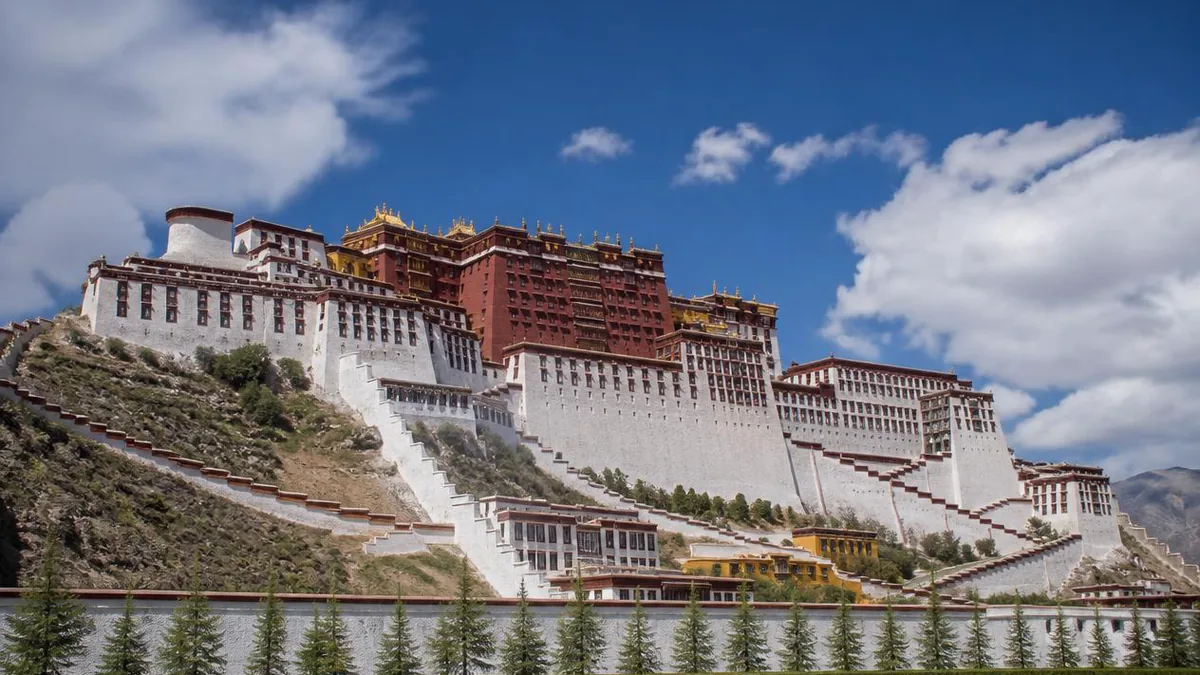
Tibet · Lhasa
Potala Palace: One Silhouette, Two Buildings
The most reproduced outline in China is the sum of two jobs. The white part was a residence and a government; the red part is a set of tomb chapels. Once you know which is which, the whole hill becomes readable.
5A View location, maps and nearby scenic areasThe building on the back of the fifty-yuan note is not one building. It is two, joined at the shoulder, doing two different jobs, and the join is the most useful thing to know before you walk up the ramp.
The white part housed a person and a government. The red part houses the dead. Everything else about the Potala Palace — the plan, the colours, the route visitors are walked along, even which parts you are allowed into — follows from that division.
Two functions, two colours
The Potrang Karpo, the White Palace, was the residence and the working seat of the Dalai Lamas and of the Ganden Phodrang, the government established in 1642 that administered central Tibet from Lhasa until 1959. It runs to seven storeys. The largest room in it is the East Great Hall, about 27.8 by 25.8 metres, where enthronements and the ceremonies marking a Dalai Lama’s assumption of authority were held; a plaque written by the Tongzhi emperor hangs on its north wall. The top floor holds the Sunshine Halls, private apartments named for their partly open roofs, in two versions east and west, used by the Thirteenth and Fourteenth Dalai Lamas. West of the White Palace, the Zhaxia quarters housed the monks who served the establishment.
The Potrang Marpo, the Red Palace, has almost no daily function at all. It is laid out as a mandala around the funerary stupas of the Dalai Lamas, with assembly halls, chapels and scripture rooms wrapped around them.
So: administration in white, commemoration in red; one wing worked, the other one remembers. Because the White Palace is largely closed and the Red Palace is largely open, most visitors see the memorial half and hear about the governing half.
Seventh century, and the two rooms that outlived it
The hill is Marpo Ri, the Red Hill. In the seventh century Songtsen Gampo, thirty-third of the Tibetan kings, moved his seat to Lhasa and built a fortified palace on it. The traditional date is given as 637 in some sources and 641 in others, the latter being the year of his marriages to the Nepalese princess Bhrikuti and the Tang princess Wencheng. Records describe three rings of wall and a thousand chambers.
Then it went. Part burned in a lightning fire during the reign of Trisong Detsen; most of the rest was destroyed as the Tibetan empire collapsed in the ninth century, and the political centre moved away to Sakya. Two chapels survived.
Both are still inside the Red Palace, at its northwest, and they are the reason the plan looks slightly off-centre. The Chogyel Drupuk, the Dharma King’s cave, is a recessed chamber identified as Songtsen Gampo’s meditation cave; it sits directly over the summit of the rock, which puts the oldest room in the building at its geometric heart. Beside it, the Phakpa Lhakhang, the Saint’s Chapel, holds a sandalwood image of Avalokiteshvara.
The name comes from the same source: Potala is the Sanskrit Potalaka, the mountain dwelling of Avalokiteshvara, placed in southern India in Buddhist tradition — the same word that gave Mount Putuo in Zhejiang its name.
1645, and the dates that will not line up
In 1642 the Ganden Phodrang was established with the military backing of Gushri Khan, and Lhasa became the seat of government again. In 1645 the Fifth Dalai Lama, Ngawang Lobsang Gyatso, began rebuilding on Marpo Ri, on the advice of Konchok Chophel, who argued the hill sat well between Drepung, Sera and the old city.
Now the disagreement. Chinese accounts say the White Palace was finished three years later, in 1648, and that the Fifth moved in in 1653. English accounts say the government moved into the White Palace in 1649. Japanese accounts say the White Palace took eight years from 1645, and that permanent residence began in 1659.
These are probably not four rival readings of one event but four different events: structure topped out, offices moved, the Dalai Lama took up occasional residence, the Dalai Lama took up permanent residence. No source we could find lines them up, so carry the spread rather than a single year.
A tomb built after the patron died
The Fifth Dalai Lama died in 1682, and the Red Palace was built to hold his stupa, under the regent Desi Sangye Gyatso. Accounts state that the death was concealed for years while the works went on.
The scale of the effort is well recorded. Up to 7,700 workers a day; craftsmen sent by the Qing court and from Nepal alongside Tibetan builders; a total reckoned at roughly 2.13 million taels of silver and 48 years counting from 1645.
Completion is another four-way split: substantially complete in 1693 in Chinese accounts, 1690 to 1694 in English ones, finished in 1695 in Japanese ones. All are in print, all with confidence.
The best evidence of how it was done hangs on the wall of the building itself. On a second-floor gallery of the Red Palace there is a mural roughly 210 by 160 centimetres showing the construction in progress, with the workforce at their tasks. Among the scenes is the preparation of arga, the compacted clay-and-gravel material used for floors and roofs, beaten flat with hand rammers by teams working in line. Arga is still used in the palace’s conservation today, its virtue being that the resulting slab is tough enough to hold together even if a supporting beam fails. The rhythmic song the rammers worked to is still performed.
The stupas, and why the gold figures scatter
Eight of the Dalai Lamas, from the Fifth to the Thirteenth, have stupas here; the Sixth does not. Five stupa halls are usually counted — for the Fifth, Seventh, Eighth, Ninth and Thirteenth — with the Tenth and Twelfth placed beside the Fifth’s and the Tenth also recorded in a separate chapel.
The Fifth’s is the one everything is measured against. It stands about 14.85 metres in Chinese accounts and 15 metres in Japanese ones, in a three-storey hall carried on sixteen great square columns. Its adjoining Great West Hall is the largest room in the Red Palace, over 725 square metres, with a Qianlong-era plaque and 698 murals, most of them concerned with the Fifth’s life.
Then the materials, where the numbers scatter and the units stop matching. Chinese accounts give 110,000 taels of gold, more than 15,000 pearls, agates and other gems, and a build cost of 1.04 million taels of silver. Japanese accounts give 3,724 kilograms of gold including the stupa itself and about 1,500 diamonds plus jade, agate and other stones. At the usual conversion, 110,000 taels is somewhere near four tonnes, so the two are the same order of magnitude but not the same claim, and “gems” and “diamonds” are not the same category. Quote a range, or quote one figure with its source named.
The last major addition was the Thirteenth Dalai Lama’s stupa hall, built in 1936: about 14 metres, some 19,000 taels of gold, and a mandala offering described as assembled from 200,000 pearls and corals.
How the walls are actually made
Everything about the profile follows from building tall on a rock, in a dry, cold, seismically active place.
The outer walls are large granite blocks, battered inward so they lean back as they rise — the reason the building looks heavier at the bottom than its dimensions require, and the reason its silhouette reads as a mountain rather than a box. Thickness is commonly given as 2 to 5 metres, thickest at the base. On seismic reinforcement the sources split: English descriptions say copper was poured into the foundations, Chinese descriptions say molten iron was poured into cavities within some wall sections. Same engineering idea, different metal, different location. Neither has displaced the other.
The apparent thirteen storeys are not thirteen floors. The lowest four are solid retaining walls built up from the bedrock to carry everything above, so the occupied building is about nine storeys standing on a four-storey plinth.
Then the detail worth walking up to see. The deep maroon band running under the roofline is not masonry. It is benma, also written pemai: the twigs of a shrub — commonly identified as a tamarisk, though sources differ on the species — stripped, dried, tied into tight bundles, laid in courses with the cut ends facing out, compressed, pinned and dyed. It does three jobs at once. It is far lighter than stone exactly where weight is most expensive, at the top of a tall wall. It insulates, and it lets that part of the wall breathe rather than trapping moisture. And it marks rank, since only the highest religious and aristocratic buildings were permitted it. Gilt-bronze medallions are set into its face — mirrors, conches, mantras, the twin deer flanking the wheel. The same construction crowns Sakya Monastery and other major Tibetan buildings, so once you can recognise it you will see it everywhere.
Above that sit the gilded copper roofs of the stupa halls, carried on timber bracketing.
How big is it? Choose your source
This is a good building for learning not to trust a single number.
The management office, on its own site, gives a site area of about 400,000 square metres, a floor area of about 130,000, a main building height of 115.703 metres, and 1,267 rooms, describing the ensemble as reaching that size by the 1930s.
Chinese reference works give 117.2 metres, 360 metres east to west, 140 north to south, and “nearly ten thousand” rooms. Japanese ones give 117 metres from the base and a length of about 400 metres. Widely repeated English figures give 119 metres above the hill and over 300 above the valley floor, more than 1,000 rooms, 10,000 shrines and 200,000 statues.
The gap between 1,267 and 10,000 is less carelessness than a real question about what counts as a room in a building where chapels, niches, storerooms and corridors interleave; the Fourteenth Dalai Lama wrote that he never knew how many there were. If you need one figure, use the management office’s, and say where it came from.
Around the hill: Zhol, a quarry that became a pond, Chakpori
The palace wall is about 6 metres high, 4.4 metres thick at the base tapering to 2.8 at the top, rammed earth faced in brick and stone, with three-storey gate towers east, south and west. Everything inside it is the Potala.
In front of the hill, inside that wall, is Zhol, the service town: offices of the Kashag government including the court and the printing house, the army headquarters, workshops, stables, stores and a prison. The Zhol pillar stands here, a stone inscribed in the reign of Trisong Detsen commemorating the general Takdra Lukhong and the campaign that reached Chang’an in 763.
Behind the hill is the Lukhang, the Dragon King’s pond, in a small park. The pond is a borrow pit: the earth for the Fifth Dalai Lama’s rebuild came out of here, and the hole filled with water. The Sixth Dalai Lama then put a three-storey octagonal pavilion on the island in it. A quarry that became a garden is a good summary of how this site works.
Across the road, Chakpori carried a Tibetan medical college founded in the seventeenth century. Its slope is the classic angle for photographing the palace, which is why the viewing platform is full before sunrise. UNESCO has raised concerns about modern construction crowding the ensemble, and a rule capping buildings in the surrounding area at 21 metres was enacted in response.
The Jokhang, about a kilometre east in the old city, and Norbulingka to the west are part of the same World Heritage property but are separate visits with separate tickets. On what the twentieth century did to these buildings, the accounts differ by subject: the Jokhang was attacked in 1966 and worship there stopped for roughly a decade, with renovation running from 1972 to 1980; the Potala is generally described as having escaped structural damage, with accounts crediting an intervention by Zhou Enlai, while the Tibetan writer Tsering Woeser has written that its movable collections were largely stripped. Those two statements are about different things — fabric and contents — and both are on the record.
The booking system, which is the part that changes
This is the most useful section of this page and the one most likely to be out of date, so here is what the palace’s own management office states, dated.
As posted in August 2026: no same-day tickets are sold. Every visitor must book under their real name and pass facial recognition. Booking through the official WeChat mini-program must be made ten days ahead; booking made on site must be made one day ahead. Half-price tickets are available on production of valid identification for those who qualify. Travel agencies book through a separate account system with its own rules. The management office states plainly that it has authorised no website or third-party platform to sell tickets, and that the mini-program is the only route — a warning aimed at exactly the resellers who appear when a quota tightens.
Posted hours: opening 09:00; closing given as 15:40 on the site’s Chinese pages and 16:00 on its English pages. That is not a trap, it is a reminder. A notice concerning Monday closure was published in November 2025, and separate notices cover Spring Festival and Tibetan New Year arrangements and maintenance closures, so the pattern in any given month is set by announcement.
Inside: photography in the chapels is prohibited. Group visits have long been held to about an hour within the palace, which is why the route through the Red Palace keeps moving and why lingering is not really available.
For context only, not for planning: a daily cap of 1,600 was introduced from 1 May 2003 and raised to around 2,300 after the Qinghai-Tibet railway reached Lhasa on 1 July 2006, with extended hours in the July-to-September peak; rooftop access closed after the restoration completed in 2006. Restoration itself has been continuous — a first phase from 1989 to 1994 and a second from 2002 to 2009 — which is why a chapel or a gallery may simply be shut.
What the two halves are doing now
Lhasa sits at roughly 3,650 metres, and the palace stands above the valley floor on top of that. The visit is a climb before it is anything else: a long zigzag ramp and several hundred steps to the entrance level, then more inside. Give yourself two quiet days in the city first and book the palace for the third — which also means choosing a later date when the mini-program asks for one ten days out.
Then read the building by its two halves. The white one is a government that no longer meets: offices, an audience hall, a bedroom with a partly open roof, all preserved as rooms rather than used as rooms. The red one is still doing its job. Its stupas are objects of devotion, not exhibits, and the pilgrims walking the circuit around the base of the hill are not visiting a museum.
One silhouette, two buildings. Only one of them stopped.
The LoreLens app can identify Tibetan wall construction, stupa forms and Buddhist iconography while explaining the history behind them.
Location profile
Where it is

Frequently asked questions
How do I actually get a ticket to the Potala Palace?
Through the official system only, and not on the day. As stated by the Potala Palace Management Office on its own website in August 2026: no same-day tickets are sold; every visitor must book under their real name and pass facial recognition at entry; booking through the official WeChat mini-program must be done ten days in advance, while booking made on site must be done one day in advance; concession holders can buy half-price tickets on production of valid identification; and travel agencies book through a separate agency account. The management office states that it has authorised no website or third-party platform to sell its tickets and that the mini-program is the only channel, which is a warning worth taking seriously in peak season. Bring the identity document you booked with; foreign visitors need their passport. Everything above is subject to change, so read the management office's own notices on the day rather than any guide, including this one.
What are the opening hours, and is it closed on Mondays?
The official site posts an opening time of 09:00. It posts two different closing times: 15:40 on its Chinese pages and 16:00 on its English pages, on the same day, which is the clearest possible argument for checking the source rather than a secondhand figure. The management office published a notice in November 2025 concerning Monday closure, and separately issues notices for Spring Festival and Tibetan New Year opening arrangements and for maintenance closures, so the pattern in any given month is set by announcement rather than by a fixed rule. Time inside is limited; group visits have long been held to roughly an hour within the palace, which is why the route keeps moving. Photography inside the chapels is prohibited.
Will the altitude be a problem?
Plan as if it might be. Lhasa sits at roughly 3,650 metres, and the palace stands well above the valley floor on top of that, so the visit involves a long zigzag ramp and several hundred steps before you reach the entrance level, with more stairs inside. Visitors who fly in and go straight to the Potala on their first morning are the ones who remember the climb rather than the building. The unglamorous fix works: allow two days in Lhasa doing nothing demanding, drink more water than feels necessary, skip alcohol, and book the palace for the third day rather than the first. This interacts with the booking rules, since the mini-program wants a date ten days ahead: pick a date later in your Lhasa stay, not earlier. Anyone with a heart or lung condition should take medical advice before travelling to the plateau.
What exactly is on the World Heritage list here?
The property is called the Historic Ensemble of the Potala Palace, Lhasa, and it was assembled in three steps. The Potala Palace itself was inscribed in 1994. The Jokhang, the temple at the centre of the old city about a kilometre east, was added as an extension in 2000. Norbulingka, the garden palace west of the city that served as the summer residence, was added in 2001. All three are separate visits with separate ticketing and separate queues; being on one list does not make them one admission. Within China the Potala was already listed in the first national group of protected cultural relics in 1961, and it was rated a 5A scenic area in 2013, in Tibet's first batch.
Sources and further reading
Background references for the history and place names in this guide. Opening hours, ticketing and access change often — always confirm with official local information before travelling.