Zhejiang · Wenzhou
Liu Bowen's Birthplace: The Strategist and the Prophet
A county in the mountains of southern Zhejiang is named after a compliment paid to a dead man 138 years after he died. The 5A area inside it is named after the man, and he exists twice over: Liu Ji, a Ming founding strategist who wrote satirical fables about corrupt officials, and Liu Bowen, a folk wizard credited with prophesying six hundred years of Chinese history and with laying out a city built thirty years after his death.
5A View location, maps and nearby scenic areasIn 1946 the Republic of China carved a new county out of the mountains of southern Zhejiang, inland from Wenzhou, and gave it a name that is not a landscape word at all. Wencheng — roughly, cultured and accomplished — is a posthumous name. It was granted in 1513 by the Zhengde emperor to a man who had been dead for 138 years, and the county took it because the man had been born there.
He is the reason for the 5A designation too, which makes this one of very few top-rated scenic areas in China named after a person rather than a mountain, a lake or a temple. The Liu Bowen Birthplace Scenic Area is a shrine, a waterfall and a gorge held together by a biography — and the biography exists in two incompatible versions.
One is Liu Ji (1311–1375), courtesy name Bowen: an examination graduate who served the Mongol Yuan dynasty without enthusiasm, resigned repeatedly, wrote some of the sharpest political satire of his century, then became chief civil strategist to the man who founded the Ming, and died in circumstances his own dynasty never satisfactorily explained.
The other is Liu Bowen: a wizard. In the folk tradition he reads the sky, moves weather, buries dragons under city walls, and — in texts published long after his death and attributed to him — foretells the next six centuries of Chinese history in rhyming couplets. A popular couplet pairs him with Zhuge Liang (181–234), the Three Kingdoms chancellor who is China’s standard emblem of the brilliant adviser: Zhuge Liang divided the realm in three; Liu Bowen made it one.
Almost everything sold at the gate belongs to the second man. Almost everything checkable belongs to the first. Keeping them apart is the pleasure of the trip.
A county named after a dead man’s title
Wencheng County sits in the interior of Wenzhou prefecture, which foreign visitors know, if at all, as the coastal city that exports shoes, lighters and people. The county is the opposite of the coast: high, folded, thinly populated, cut by the Feiyun River, and cool enough in summer that people drive up from the plain to sleep.
It is also a place people leave. Wencheng is one of the strongest emigration counties in a prefecture famous for emigration, and its diaspora is concentrated in Europe — Italy above all. It shapes the villages you drive through, where new houses go up on remittances and the old people mind the children, and it is why a remote agricultural county has European-language menus.
The county was assembled in 1946 from the margins of its neighbours and named for Liu Ji’s posthumous title — as if a French département had been named Eloquence after Bossuet. It tells you how completely the man had been absorbed into the identity of the district.
His birth village, Wuyang, lies in the upland township of Nantian, a plateau of terraces and camphor trees well above the river valleys. In 1311 it was not in Wenzhou at all: it belonged to Qingtian county, in Chuzhou prefecture, which is why older sources — and Liu Ji himself — call him a Qingtian man. Both counties claim him, and both are telling the truth about different centuries.
What the 5A actually contains
Chinese 5A designations are frequently not places. They are administrative baskets, and this is one.
The core block is Nantian: Wuyang village, the ancestral temple to Liu Ji, his tomb in a fold of hills nearby, and the upland farmland around them. This is the block the name refers to, and the quietest thing in the basket.
The two scenic blocks usually listed alongside it are Baizhangji, a three-stage waterfall in a gorge below the plateau, and Tonglingshan, a forested valley in the west of the county known for the potholes ground into its stream bed. Baizhangji and the reservoir lake below it have been managed as a scenic landscape since long before the 5A award; the shrine and the waterfall spent decades as separate propositions and were bundled together late.
The 5A confirmation itself is recent, from the batch at the end of 2020, and the block list should be treated as approximate. In this kind of designation the line between the rating, the county’s wider tourism apparatus and whatever a driver adds to your day is drawn differently in every document.
What does not change is the shape of the visit: a shrine on a plateau, a waterfall in a gorge, a pothole stream in a forest, and an hour or so of mountain road between each pair.
Liu Ji, before anyone needed a prophet
The documented life begins conventionally and then goes wrong in an interesting way.
Liu Ji took the jinshi degree in 1333, at twenty-three. The jinshi was the terminal qualification of the imperial examination system and the gate into the senior civil service; passing it that young marked a man as exceptional. He was posted as an assistant magistrate in Jiangxi, and thereafter his career is a repeating pattern: appointment, friction, resignation or dismissal, retirement to the hills, recall.
The friction was structural. He was a southern Chinese literatus serving a Mongol dynasty in its final decades, in a bureaucracy where his ethnic category sat near the bottom and where the state’s authority in the southeast was visibly failing. The episode usually singled out is his part in the campaign against Fang Guozhen, a coastal salt-smuggler turned rebel whose fleet the Yuan could neither destroy nor ignore. Liu Ji argued for suppression. The court bought Fang off with an official title instead. He resigned.
So the man who joined the Ming founder in 1360 was forty-nine, a provincial with a first-class degree, an unspent talent for administration, and a well-earned contempt for a government that rewarded the people who threatened it. That last point matters: it is the subject of nearly everything he wrote.
Gold and jade on the outside
Before the prophecies were attached to him, Liu Ji was known for prose. He is grouped with Song Lian (1310–1381) and Gao Qi (1336–1374) as the leading writers of the early Ming, and the work that survives is not mystical in the slightest. It is angry.
The famous piece is a short essay usually translated as The Words of the Orange Seller. The narrator buys a beautiful orange at a market in Hangzhou, opens it at home, and finds the inside dried to rotten wadding. He goes back to complain. The seller, unbothered, asks him to look around — at the generals in their tiger-skin seats who could not hold a border, at the ministers in their tall caps who cannot govern — and to say which of them is not also gold and jade on the outside, rotten wadding within.
That phrase entered the language as a set idiom and is still in daily use, the way emperor’s new clothes is in English. Most people who use it have no idea it comes from a fruit stall.
The other major work is the Yulizi, a collection of short fables written during one of his retirements in the years just before he joined the Ming cause — animals, merchants, incompetent officials, each vignette carrying a point about how states rot from the administration outward.
Read those two things and the folk wizard becomes almost inexplicable. Nothing in them predicts anything. They are the work of a systems critic.
The advice that won the war
He arrived at Zhu Yuanzhang’s headquarters at Nanjing in 1360, one of a group of eminent southeastern scholars recruited to give a peasant rebel movement a civil brain.
The strategic problem was a triangle. Zhu Yuanzhang held the middle Yangtze around Nanjing. To his west, Chen Youliang commanded the largest navy in the war and had murdered his own overlord to declare himself emperor of a state called Han. To his east, Zhang Shicheng held the rich Suzhou delta on salt money. Conventional advice was to take the soft target first.
Liu Ji argued the reverse: strike Chen Youliang, the strong and aggressive one, and Zhang Shicheng — cautious, comfortable, defensive — would sit still and watch it happen. That is what occurred. The decisive engagement came on Lake Poyang in 1363, a month-long fleet battle in which Chen Youliang was killed by an arrow; Zhang Shicheng, who could have taken Nanjing from behind at almost any point in it, did nothing, and was mopped up afterwards. The Ming dynasty was proclaimed in 1368.
The histories preserve a good anecdote from Poyang: Liu Ji, standing beside Zhu Yuanzhang on the flagship, abruptly ordered him into another boat, and the flagship was destroyed by enemy fire moments later. In the sober reading he had watched the enemy’s aim being walked onto the target. In the folk reading he had read it in the sky. The second reading is the one that got repeated.
When the founding honours were distributed in 1370, Liu Ji was made Earl of Chengyi — Earl of Sincere Intent — the lowest of the three noble ranks awarded, on a stipend usually given as 240 piculs of grain. The regime’s senior civil official, Li Shanchang, was made a duke on several thousand. The gap is the most eloquent surviving comment on Liu Ji’s standing at court: indispensable during the war, not of the inner circle after it.
The physician
He retired to his home county in 1371, which in the politics of the early Hongwu reign was the sensible move. It did not save him.
In 1375 he fell ill in the capital. The account in the official histories is that Hu Weiyong — then the dominant figure in the central government — sent a physician to attend him, that Liu Ji took the medicine, that something hardened in his abdomen, and that he went home to Qingtian and died there within months, at sixty-four.
The accusation of poisoning did not surface in 1375. It surfaced in 1380, when Hu Weiyong was destroyed on charges of treason in a purge that eventually consumed tens of thousands of people, and when a great many crimes were being attributed to him at once. That is exactly the moment at which a five-year-old death becomes a murder in the record, and it is why historians treat the poisoning as an allegation rather than a finding.
There is a darker reading, current since the Ming and impossible to test: that the emperor knew. Zhu Yuanzhang spent his last two decades eliminating the men who had helped him win, Li Shanchang and Hu Weiyong included. Liu Ji, on that reading, was an early item on a long list.
And there is one detail that reads badly in hindsight. The histories record a conversation in which Zhu Yuanzhang asked Liu Ji to assess the candidates for chancellor, and Liu Ji dismissed each in turn, warning of Hu Weiyong that he was a bad horse who would overturn the cart. If it happened as recorded, the man who died after taking Hu Weiyong’s physician’s medicine had already told the emperor, to his face, that Hu Weiyong would wreck the state.
How Liu Ji became Liu Bowen
The transformation took roughly two centuries and had help from both directions.
From above, the state rehabilitated him. In 1513 the Zhengde emperor granted the posthumous name Wencheng; in the Jiajing reign the family’s earldom was restored to a descendant and his standing as a founding meritorious official was formally reaffirmed. A man the founder had sidelined became, in the middle Ming, an official exemplar.
From below, popular fiction got hold of him. The Ming vernacular novel of the dynasty’s founding turned him into a Daoist adept trading spells with the enemy’s magicians, and once a historical figure enters that genre in China he does not come back out. The template already existed and everybody knew it: Zhuge Liang had gone through the same process eleven centuries earlier, becoming in the novels a summoner of winds. Liu Bowen was built to the Zhuge Liang pattern, which is why the couplet pairing them is the single most repeated sentence about him.
What made his version stick harder than most is that he had genuinely been a specialist in the technical arts the folk tradition cares about. Astronomy and calendrical calculation were standard equipment for a serious Yuan-era scholar-official, and Liu Ji had them. In a fourteenth-century court, reading the sky was a profession with an office attached. In the retelling it becomes second sight.
At the shrine in Wuyang the two versions coexist without embarrassment. The exhibition texts give you the strategist and the essayist. The visitors light incense for the prophet.
The Baked Cake Song
The most famous item attributed to him is the Shaobing Ge, the Baked Cake Song, and its frame story is unimprovable.
The Hongwu emperor is eating a sesame cake. He has taken one bite. An attendant announces Liu Ji, and the emperor covers the cake with a bowl and asks his adviser to say what is underneath. Liu Ji calculates and answers in verse: half like the sun, half like the moon, bitten once by the golden dragon — a cake. The emperor, satisfied, asks the obvious follow-up. What happens to my dynasty?
What follows is a long dialogue in couplets that appears to foretell the usurpation of the throne by the emperor’s own son, the capture of a later emperor by Mongol forces, the eunuch dictatorships, the fall of the Ming to invaders from the northeast, and events well beyond that — all in the deliberately opaque register of Chinese prophetic verse, where animals, numbers and colours stay readable in more than one way until after the fact.
It is not by Liu Ji. The consensus in Chinese scholarship is that the text is late — Qing at the earliest in the form we have — for the ordinary reasons: nobody cites it during the Ming, when it would have been electrifying; its language does not match his; and its predictions are precise about the past and vague about the future, in exactly the pattern retrospective composition produces. It belongs to a genre of prophecy texts back-attributed to famous advisers, the best known of which is credited to a pair of Tang astronomers.
The genre has not stopped. Several inscription-texts circulate under Liu Bowen’s name today, and they acquire fresh verses after every national crisis. When you see them quoted, you are watching a six-hundred-year-old authorship convention still in production.
None of this makes the tradition worthless. It makes it a different object: not evidence about the fourteenth century, but a very long-running record of what Chinese readers have wanted a wise man to have said.
The Beijing problem
The single most repeated Liu Bowen legend is the one about Beijing, and it is worth spelling out because it can be dismantled with a calendar.
The story, a staple of old Beijing folklore, is that the Ming capital was laid out on the body-plan of Nezha, the eight-armed child-god — the front gate as his head, the flanking gates as his arms, the drainage of the whole city organised around a dragon subdued beneath it. The designer, in the version told to children, is Liu Bowen, sometimes competing and sometimes collaborating with the monk Yao Guangxiao.
Liu Ji died in 1375. The Ming capital at Beijing was built between roughly 1406 and 1420, under the Yongle emperor, who was in 1375 a fifteen-year-old prince with no prospect of the throne. Yao Guangxiao was that prince’s adviser and did have a hand in the capital project. Liu Ji had been dead for three decades.
The legend is not a mistake anyone made. It is what happens when a culture needs a name attached to an achievement and reaches for the one it keeps in the drawer marked uncanny cleverness — the same drawer that produces the claims that Liu Bowen sited half the villages in Zhejiang. It is also the cleanest available demonstration of how far the second Liu drifted from the first.
Wuyang village
The birthplace block is an ancestral landscape rather than a museum campus, and it takes a moment of adjustment on arrival.
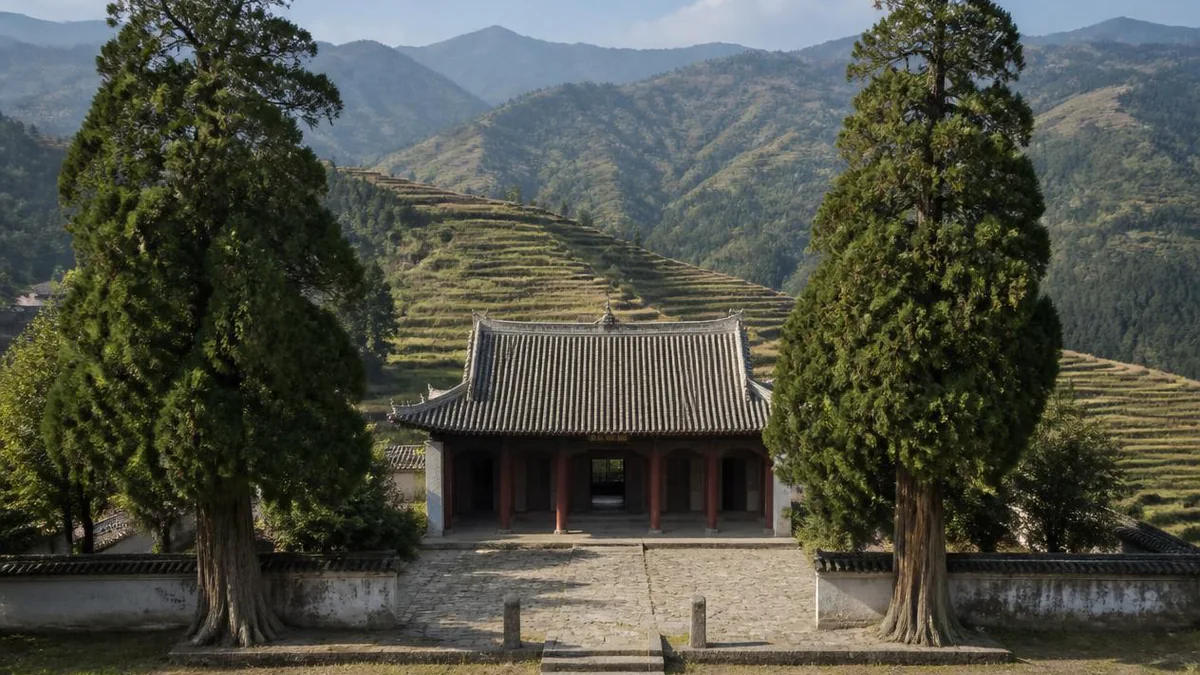
At its centre is the temple to Liu Ji in Wuyang village: a walled ancestral complex of halls and courtyards on the Ming and Qing pattern, with the founder’s image in the main hall, inscribed plaques on the beams, and a live lineage attached. The Liu descendants in Nantian have kept up commemorative rites here for centuries, and the temple works as clan property visitors are allowed into rather than as a public monument with a clan attached.
His tomb lies a short way off, in the hills, and it is small. Chinese visitors remark on this, because the expectation for a founding statesman is a spirit road, stone officials and an avenue of animals, and there is nothing of the kind — a mound in a fold of ground, oriented and maintained, with none of the theatre. Depending on which account you prefer, the modesty is his own choice, his descendants’ caution during a dangerous reign, or simply the fact that an earl of the lowest grade did not rate more.
Around the two of them the county has built the usual apparatus: exhibition halls, a memorial park, statuary, an interpreted village street. Competently done, and not why you have come. What is worth doing is standing in the courtyard holding both versions of the man at once — the plateau farm boy who passed the hardest examination in the world at twenty-three, and the sorcerer his neighbours’ descendants have burned incense to ever since.
Two hundred and seven metres of falling water
Down off the plateau, the county’s other headline is water.
Baizhangji falls in three stages, and the figures the site publishes are 207 metres for the first drop, 65 for the second and about 12 for the third. Those numbers put the top stage in the front rank of Chinese waterfalls and are the basis for the local claim to be the highest fall in East China — a claim on every sign in the county, and one that depends, as all waterfall records do, on whether you measure a single free drop or a cascade.
The important thing for a visitor is not the ranking but the hydrology. This is a small catchment on a mountain tributary, not the outflow of a large river, and its volume swings hard through the year. Southern Zhejiang takes most of its rain in the plum-rain front of early summer and the typhoons that follow into September; by late autumn the flow is thin, and by winter it can be a ribbon against the cliff. Go after rain if you can. The three drops are viewed from separate levels linked by stairways, so the visit is a descent, and the second stage — wider, less sheer, easier to get close to — is the one most people photograph.
Downstream sits Feiyun Lake, the reservoir on the Feiyun River that is also the water supply for a large part of Wenzhou. That is worth knowing about the county’s politics: the catchment is protected because the city drinks it, which is why there is less industry up here than economics alone would predict.
The potholes
The third block, Tonglingshan, is a forest park in the west of the county, and what you go for there is geological rather than scenic.
A stream drops through a narrow gorge in a series of small falls, and at the foot of each one the rock is drilled with potholes — smooth-walled cylindrical basins, some deep enough to swim in, filled with startlingly green water. The mechanism is simple: a stone caught in an eddy at the base of a fall is spun by the current long enough, in geological terms, to grind a hole in bedrock, and the hole then traps more stones and deepens itself. The result looks manufactured. Local material calls them jade kettles, which fits both the shape and the colour.
There is a genuine and unresolved argument in Chinese geomorphology about pothole fields of this kind, and you will meet it on the interpretive boards. One school reads them as evidence of Quaternary glaciation, in the tradition of the geologist Li Siguang, who argued from the 1920s onward that eastern China had been glaciated. The other reads them as ordinary fluvial erosion by fast water and entrained gravel, which needs no ice at all. Signage at pothole sites across southern China tends to state the glacial reading as fact; the fluvial one is more conservative and, at this latitude and elevation, easier to defend.
Either way the gorge is a cool, wet, dark-green walk under old forest, and after the Baizhangji stairways it is a relief.
Going, and what will disappoint you
Wencheng is reached from Wenzhou by road, an hour and a half or more into the hills, and the blocks are far enough apart that doing all three in a day means seeing them from a car park. Two days is the honest minimum: shrine and waterfall on one, Tonglingshan and the lake on the other.
Summer is the busy season, for a reason that has nothing to do with Liu Ji — Nantian is high enough to be cool when Wenzhou is unbearable, and the county sells itself to the coastal cities as a place to sleep in August. That is also when the waterfall runs. If you want the shrine to yourself, come outside the school holidays and accept a thinner fall.
What will disappoint you, if you have come for the prophet: there is nothing of him to see. The temple is an ancestral hall, the tomb is a mound, the exhibition halls are respectful and textual, and the marvellous stuff — the sky-reading, the buried dragons, the couplets about dynasties yet unborn — exists only in books written after the fact and in the heads of the people lighting incense next to you.
What is actually here is stranger and better than the marketing. A boy from a plateau village passed the empire’s hardest examination at twenty-three, spent his forties despising a government he could not fix, wrote a fable about a rotten orange that people still quote without knowing they are quoting it, then talked a rebel warlord into fighting the strong enemy first and helped found a dynasty that lasted 276 years — and was given the lowest rank on the honours list, sent home, and probably killed by the man he had warned the emperor about. Six centuries of folklore were laid over that, and the folklore is why the county has a 5A rating. Go for it, by all means. But the man underneath is the better story, and he is the one who was born here.
The LoreLens app can identify the halls and plaques at the Liu Ji temple in Wuyang, and tell you which parts of the Liu Bowen story are documented and which are folk tradition, in your own language, offline.
Location profile
Where it is

Frequently asked questions
What places does this 5A designation actually cover?
It is a container designation covering separate blocks in Wencheng County rather than one gated site. The core is Nantian, the upland township holding Wuyang village, the ancestral temple to Liu Ji and his tomb. The other blocks usually listed with it are Baizhangji, a three-tier waterfall on a tributary of the Feiyun River, and Tonglingshan, a forested gorge known for its river potholes. They are separate drives and separate kinds of day out. Confirm the current block list and ticketing locally rather than from any article, including this one.
Was Liu Bowen really a prophet?
No surviving prophecy can be traced to him. The historical Liu Ji (1311-1375) was a jinshi graduate, a disaffected Yuan official, then the leading civil strategist of the Ming founding, and a very good writer of satirical prose. The prophetic texts attached to his name, above all the Baked Cake Song, appear far too late to be his, and Chinese scholarship treats them as apocryphal. The reputation is real, old and culturally important; the authorship is not.
Did he design Beijing?
He could not have. The legend that Beijing was laid out on the plan of the eight-armed child-god Nezha, with Liu Bowen as its designer, is a Ming and Qing folk tradition of the capital. But Liu Ji died in 1375, and the Ming capital at Beijing was built from about 1406 to 1420, under the Yongle emperor. The monk-adviser Yao Guangxiao, who does belong to that reign, appears in variants of the same story. The arithmetic rules Liu Ji out.
When should I go, and will the waterfall be running?
That is the real question at Baizhangji, because it is a rain-fed fall on a small catchment rather than a big river. Southern Zhejiang gets its water in the plum rains of roughly June and in the typhoon season that follows; late autumn and winter are the dry months, when the drop is still impressive and the water may not be. Nantian is high enough to be a summer refuge from the coastal heat, which pushes the crowd towards July and August.
Is it worth going if I do not care about Ming history?
Partly. Baizhangji and Tonglingshan stand up on their own as a waterfall and a pothole gorge, and Wencheng is a genuinely mountainous, unhurried county of the kind coastal Zhejiang mostly is not. But the shrine block is small, quiet and text-heavy, and the reason to stand in it is the man's story rather than the architecture. Visitors expecting a spectacle at Wuyang tend to leave in twenty minutes.