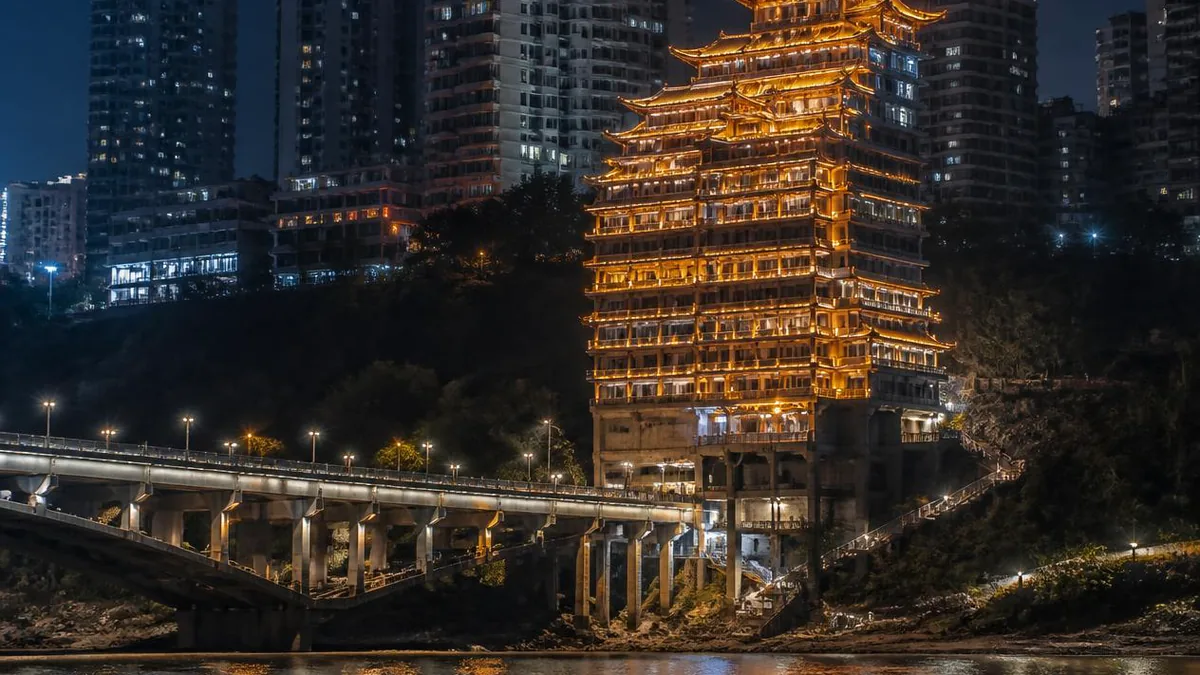
Chongqing
Hongyadong: A 2006 Building That Speaks a Real Dialect
It is not an ancient town. It is a shopping complex that opened in September 2006, eleven storeys tall, climbing a 75-metre cliff between two city streets at different heights—and the vernacular it imitates is the one thing about it that is completely genuine.
Almost everything written about Hongyadong gets the first fact wrong, and the first fact is the one that makes the rest interesting.
This is not an ancient quarter. It is a commercial complex that opened on 29 September 2006, eleven storeys of shops, restaurants, bars and hotel rooms bolted to a cliff on the Jialing River side of Chongqing’s Yuzhong peninsula. Reported total investment: 385 million yuan. Retail floor area: 53,000 square metres. National rating: 4A. It is, structurally, a mall.
And yet the architectural language it borrows is not invented. Chongqing genuinely built like this, for a genuine reason, for a very long time. The building is new; the logic in it is old. That gap is the whole subject.
Start with the dates, because everyone else skips them
The Chongqing municipal government’s own page is unusually blunt about the sequence. By the end of the twentieth century the site had become a district of dangerous, decayed shanty housing, with unstable cliff rock overhead threatening the people living beneath it. The redevelopment idea is credited to a proposal made in August 1999, when the local official He Zhiya recommended treating this stretch as a priority for the two riverbanks; the Yuzhong district government and its departments then worked the site up as the “Hongyadong traditional folk-custom district.”
After that, the record splits. The municipal government says the Chongqing Little Swan investment group won the tender in March 2004. A 2018 property-trade account says the group obtained the development rights in 2002. The scenic area’s own manager, in a 2018 broadcast interview, says simply that Hongyadong was built in 2005. He Zhiya’s recollection is that it took roughly three years to build. None of these are irreconcilable—tender, rights, groundbreaking and completion are four different events—but no source lines them all up, so treat any single date you are told as partial.
The opening date, at least, is firm, and so is what happened next: the complex lost money. Reported figures describe losses of roughly a million yuan a month in its first period of trading. For about a decade it was a municipal promotional set piece that visitors did not particularly seek out.
Why Chongqing built on stilts, and what that actually means
The imitated form is the diaojiaolou, usually translated as stilt house or hanging-foot building. It is a real regional type, documented across the mountainous south—in western Hunan and Hubei, in Sichuan, Guizhou and Chongqing—and it belongs to the broader family of raised-floor timber dwellings.
The mechanism is simple and worth carrying with you. On a steep slope there is no level plot to build on, and cutting one out of rock is expensive. So instead of levelling the ground, you level the floor: the uphill side of the house sits on the slope, and the downhill side is carried on long posts stepping down the gradient. The result is a flat platform hanging off a hillside. In the classic rural version the upper level is the living floor—dry, ventilated, above the damp—while the space underneath, awkward and irregular, takes storage or livestock.
Chongqing needed this more than most places. The old walled city occupies a ridge between two rivers, and the standard description of its wall makes the point better than any brochure: the builders used the cliffs and steep banks themselves as the wall, so that over much of its length the defence was not masonry but rock face. A city like that has almost no flat land. Cantilevering platforms out over slopes was not picturesque; it was the only affordable way to get floor area.
Hongyadong is a concrete-framed commercial building wearing that language. The timber frame is a finish, not a structure. But the reason the finish reads as convincing is that the building is doing the underlying thing for real: it is a stack of floors hung on a slope because there is no slab of level ground to put them on.
The name is genuinely old; the building is not
Separating these two is the honest way to handle Hongyadong’s history, and there is plenty of real history to separate out.
Hongya Gate was a gate of the walled city, on the Jialing side between Linjiang Gate and Qiansi Gate. It appears in the record early: accounts of the Song defensive rebuild under Peng Daya, around 1240, list Hongya among the handful of gates then in existence, and Yuan-dynasty histories record the gate being taken during the siege of Chongqing. When the Ming officer Dai Ding rebuilt the walls from 1373, Chongqing acquired its famous seventeen-gate arrangement—nine open gates and eight sealed ones, a scheme usually explained as deliberate nine-palaces-and-eight-trigrams symbolism, though the sheer difficulty of the terrain is an equally good explanation for needing that many openings. Hongya Gate was one of the eight sealed ones: a gate in name and form that you could not walk through.
You will sometimes see English sources date the gate to the fourteenth century. That is the Ming rebuild, not the origin.
The gate was named for the cave, not the other way round. A natural cliff cavity here, with a seasonal waterfall over its mouth, was a recognised local sight, and it entered the canonical list when the Qianlong-era Ba County magistrate Wang Erjian compiled the twelve views of Ba and Yu and included this one under a name meaning roughly “Hongya dripping jade-green.” The waterfall feature was retained at the outside of the modern complex.
What did not survive was the settlement. Stilt housing multiplied along this bank in the 1940s when river trade was booming, and declined with it afterwards. By the 1990s what stood here was substandard housing under a hazardous cliff, and it was cleared. The new complex reproduces the form of what was demolished. It does not contain any of it.
Two streets, one building: the fact worth travelling for
Here is the spatial fact that no photograph conveys.
The complex is built against a cliff the municipal government gives as 75 metres high. Its registered address is on Jiabin Road—the Jialing riverside road, at the bottom. Above it, at the top of the cliff, runs Cangbai Road; the developer’s own description of the project is that it took the caves beneath the Cangbai Road cliff as its setting. The government’s account of the complex’s economic effect names both streets as the ones it revived.
In practice this means the building spans two separate levels of the city’s road network. Enter from the riverside and you are at the bottom of eleven floors. Ride the lifts to the top and you step out onto a street with traffic on it, at the level of the district above. Visitors routinely describe the disorientation of walking out of a “roof” into ordinary city life; residents treat the building as a vertical shortcut.
That is the most Chongqing thing about Hongyadong, and it is the part that is not decoration. In a city built on this gradient, “ground floor” is not a property of a building. It is a property of which street you arrived from.
One consequence is worth knowing before you go: the interior is not evenly busy. Trade reporting has described a hot-and-cold split roughly at the fourth-floor snack street—crowds above, quiet below—and the lifts are the pinch point of the entire complex.
How it actually became famous
The mechanism here is documented well enough that we do not need to guess.
For its first decade Hongyadong was promoted conventionally, through travel agencies and print, and it did not take. What changed was short-video platforms. Chinese accounts date the online surge to 2016 onward, with the scenic area’s general manager specifically saying that from 2017 the volume of Douyin clips using Hongyadong as a backdrop rose sharply. His framing is worth quoting for its honesty: the platform did not create the image, it extended an image the building already had.
Then a small, concrete, unglamorous detail. The site replaces its facade lighting on a cycle, and by the manager’s account the interval had been shortened from five years to two, at roughly three million yuan per replacement, with the most recent change made in the second half of 2017. In other words, the viral moment landed when the lighting was brand new. The prettiest version of the building was the one the algorithm found.
The result arrived at the 2018 May Day holiday, when Hongyadong appeared second on a national ranking of the holiday’s most-visited attractions, behind the Forbidden City. On 29 April 2018 alone the site recorded more than 80,000 visitors. For the holiday period as a whole, a figure of 142,000, up around 120 percent year on year, was reported from municipal data. Those two numbers are frequently confused with each other; they measure different windows.
The Spirited Away comparison, handled carefully
This needs one clean paragraph and no more.
The comparison to the bathhouse in Hayao Miyazaki’s Spirited Away is everywhere, and there is no confirmation of any relationship from the studio or the filmmakers. The chronology settles the obvious direction: the film came out in 2001, the complex opened in 2006, so the building cannot have been the film’s model. The reverse—that the developers designed towards the film—is not documented either, and the project’s stated brief was a regional vernacular district.
What is documented is how loosely the claim travels. In the 2018 interview, the scenic area’s own general manager credited the likeness with drawing crowds “years ago,” and then, in the same breath, named the film as Castle in the Sky—a different Miyazaki picture entirely. When the site’s own management cannot keep the reference straight, the reference is folklore. Enjoy the resemblance; do not repeat it as a fact.
Crowding is the real design story
The numbers here are unusually well published, and they describe a building overrun by its own success.
The manager’s account of the original brief: the complex was designed for a daily capacity of roughly 5,000 to 8,000 people. Actual weekday-scale flow by 2018 was 10,000 to 20,000 a day, and on May Day and National Day holidays 50,000 to 80,000. The municipal page gives typical daily receipts of around 15,000, statutory-holiday peaks of 30,000 to 40,000, and annual visitors of roughly 6 million.
Against that, the officially assessed carrying capacity: a maximum of 52,500 per day and 8,750 at one time. Note a wrinkle worth noticing rather than smoothing over—the municipal page calls the 8,750 figure an instantaneous maximum, while the manager describes the same number as an hourly maximum. Those are not the same measurement.
The physical constraints are ordinary and stubborn: 442 units of retail space, 415 parking spaces, lifts sized for the original brief, and narrow approach passages toward the adjacent bridge. Reported responses have included added safety equipment, extra sightseeing lifts, more security and cleaning staff, additional toilets and facial-recognition entry systems—and, in 2018, the leaked proposal to charge a small holiday admission fee purely to throttle numbers, which was criticised and shelved.
Where to stand, and what to look at from there
The best views of Hongyadong are not inside Hongyadong.
The Qiansimen Jialing River Bridge, which opened on 29 April 2015, passes directly beside the complex and gives the classic elevated three-quarter view of the whole cliff face. It is a combined road and rail bridge—Chongqing Rail Transit Line 6 runs on the lower deck, four lanes of road on the upper, with a main span of 312 metres—and it has a pedestrian walkway. The opposite bank, at Jiangbeizui, gives the wider frame with the towers behind.
Rail access is via Xiaoshizi station on Lines 1 and 6, or Linjiangmen on Line 2; both involve a walk on gradients. Chaotianmen, where the Jialing meets the Yangtze, is the neighbouring landmark.
Lighting hours vary with season and are set by the operator, so treat any published switch-on time as provisional and check on the day.
The vernacular is still in use, just not here
If Hongyadong makes you curious about the underlying condition rather than the finish, Chongqing offers better evidence a few kilometres away.
The Liziba monorail station occupies the middle floors of a nineteen-storey residential tower—not because anyone wanted a spectacle, but because the site had no room for a station and a building separately. Same terrain, same arithmetic, no historical costume. Ordinary Chongqing streets do the smaller version constantly: staircases doing the work of blocks, buildings whose lobbies and roofs are both at street level on different sides.
Hongyadong is the theatrical version of a condition the whole city lives in. That is a reasonable thing for a building to be, provided nobody claims it is the original.
What you are actually looking at
Stand on the bridge at night and try to hold two thoughts at once.
The first is deflationary: this is a shopping complex from 2006, financed by a private group, that lost money for years and then was rescued by a video app and a new set of lights. Nothing about it is ancient, and the gold glow is a maintenance budget.
The second is not. The reason the illusion works—the reason it photographs as though it grew there—is that the building is genuinely doing what buildings here have always had to do. It is hanging floors off a cliff because the cliff is what there is. Underneath the borrowed timber detailing, the section is honest: eleven levels, seventy-five metres of rock, a street at the bottom and another street at the top.
Most reproduction heritage fails because it copies the appearance and drops the reason. This one kept the reason and invented the appearance. That is the rarer mistake, and it is why the place is worth an hour of your attention rather than a photograph.
The LoreLens app can identify vernacular building types such as stilt-frame construction and explain the terrain logic behind them while you are standing in front of one.
Location profile
Where it is

Frequently asked questions
Is Hongyadong an old building?
No, and this is the single most common misunderstanding about it. The complex opened on 29 September 2006. It was built by the Chongqing Little Swan group at a reported total investment of 385 million yuan, on a site that had become a district of dangerous, dilapidated housing under unstable cliff rock. What is old is the name and the place. Hongya Gate was one of the seventeen gates of the walled city of Chongqing—specifically one of the eight sealed gates in the nine-open, eight-closed arrangement—and it took its name from a natural cliff cave here. The cave's seasonal waterfall was listed among the twelve scenic views of Ba and Yu selected under the Qianlong-era county magistrate Wang Erjian. So the site has centuries of record behind it. The building you photograph has fewer than twenty years.
Does the top floor really open onto a street?
Yes, and it is the most interesting thing about the place. The complex is built against a cliff face given by the Chongqing municipal government as 75 metres high, and it is commonly described as running from Jiabin Road—the Jialing riverside road, where its registered address is—up to Cangbai Road at the top of the cliff. Eleven storeys later you walk out of what feels like a building's roof and find yourself on an ordinary city street with buses on it. That relationship is not a gimmick invented for tourists; it is what happens when a city is built on slopes steep enough that ground level is a matter of which side you approach from.
Is Hongyadong really the bathhouse from Spirited Away?
There is no confirmation of any connection, and the chronology rules out the obvious version of the story. Spirited Away was released in 2001; Hongyadong opened in 2006, so the film cannot have been drawn from this building. Nor has the studio or the film's makers, as far as any accessible record shows, said anything about the resemblance. What is documented is that the comparison circulated online and was then repeated by everyone including the site's own management: in a 2018 interview the general manager of the scenic-area management company credited the likeness to the film for bringing crowds, while in the same conversation actually naming a different Miyazaki film, Castle in the Sky. That is a fair snapshot of how solid the claim is. The resemblance people are responding to is real enough—tiered timber-styled galleries lit gold at night—but it is a resemblance, not a lineage.
Does it cost anything, and when is it least unbearable?
It has been free to enter, and the municipal government describes it as an open-access scenic area rather than a gated one. In 2018 a leaked internal notice proposed charging up to 20 yuan per person on peak holidays purely as a flow-control measure; the proposal drew heavy criticism and the operator subsequently said no ticket would be charged for the time being. Arrangements like this change, so check the day's notices rather than trusting any article, including this one. On timing: the municipal page puts the daily visitor peak between 15:00 and 23:00, with the crush concentrated after dark when the facade lighting is on. A late morning or early afternoon visit gets you the building without the lights; if you want the lights, go on a weekday and stand outside it rather than inside it.
Sources and further reading
Background references for the history and place names in this guide. Opening hours, ticketing and access change often — always confirm with official local information before travelling.