Shaanxi · Xi'an
Datang Everbright City: A Street Built for a Dynasty
A 2,100-metre pedestrian street begun in 2002 and rebuilt in 2018 to look like the Tang, with a pagoda founded in 652 at its northern end and the line of Chang'an's outer wall at its southern one. The two ends are old. The street between them is not, and that is what makes it worth reading.
Walk the length of Datang Everbright City and the architecture gets genuinely old exactly once, right at the end.
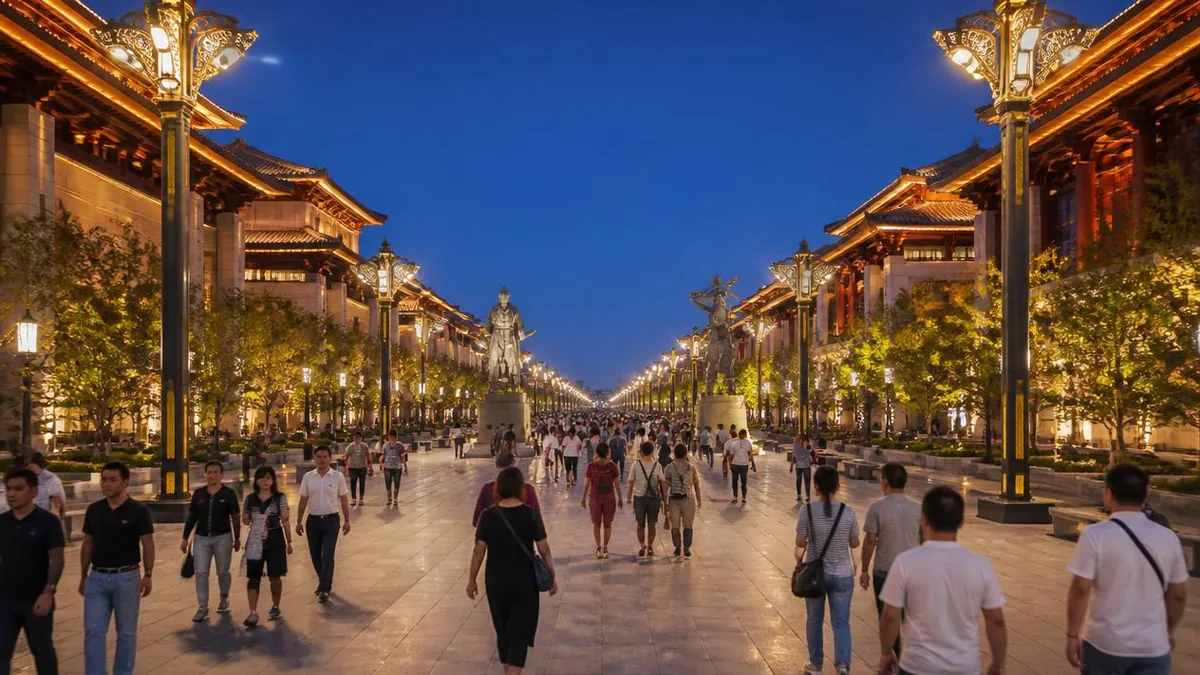
Everything on the street itself was put there this century: the vermilion columns, the deep eaves, the bronze emperors, the LED dragon pillars. Then, at the northern end, past the last shopfront and across a square, stands a brick pagoda founded in 652.
That geometry is the whole subject. This is a street built to look like the Tang dynasty, standing next to something the Tang dynasty actually built. Neither fact is a scandal. Both are more interesting when you keep them apart.
Two thousand one hundred metres between two old points
The street runs north–south for 2,100 metres and is about 500 metres wide, bounded east and west by Ci’en East Road and Ci’en West Road. Its total floor area is usually given as 650,000 square metres, a figure that also circulates as the site area; those are not the same measurement, and published sources use them interchangeably.
At the northern end is the south square of the Giant Wild Goose Pagoda, and behind it Daci’en Temple, established in 648 by the crown prince who became Emperor Gaozong, in memory of his mother. The pagoda was founded in 652 to hold the scriptures Xuanzang brought back from India. It became a national protected monument in the first batch of 1961 and a World Heritage component in 2014.
At the southern end is the Tang City Wall Heritage Park, opened on 1 July 2008, free, running 4.2 kilometres long and about 100 metres wide along the line of the outer wall of Tang Chang’an, its western end at the site of the Qixia Gate.
So the two terminal points are real Tang traces, one standing and one archaeological. Between them, four to five hundred metres wide and two kilometres long, is new city. For the pagoda itself, read the Giant Wild Goose Pagoda guide; this article is about the street.
The plan has an author and a date
This is not an accretion. It was designed.
Qujiang was approved as a provincial tourism resort in 1993 and renamed Qujiang New District by the municipal government in July 2003. The core layout was planned by Zhang Jinqiu, an academician of the Chinese Academy of Engineering known for Tang-revival work in Xi’an, under the formula “seven parks, one city, one pagoda.” The pagoda is the Tang one. The “city” is this street.
The construction sequence is on record. Building work began in 2002. Commercial leasing was organised from December 2008. A lighting programme started in April 2009 and reconstruction of the central landscape avenue in May 2009. Kaiyuan Square opened on 26 September 2010, which is when the street became continuously walkable end to end.
You will therefore see the opening dated to 2009 in some accounts and 2010 in others. Both are defensible depending on whether you mean a first phase or the full length, and neither is wrong.
One detail from the same planning period is worth keeping. The park next door was originally to be called Chang’an Furong Garden; the name was changed to put Tang at the front. The dynasty in the branding was a decision, made in a meeting, around the year 2000.
What the 2018 rebuild actually changed
In late 2018 the commerce ministry selected eleven pedestrian streets nationwide for an upgrade pilot. This was the only one in northwest China.
The rebuild ran through the second half of 2018, explicitly benchmarked against the 5A scenic-area standard. Several roads were converted to vehicle-free walking surfaces, enlarging the pedestrian area. The street reopened on 25 December 2018, and a formal ceremony on 29 January 2019 relaunched it under the label “modern Tang people’s street.”
The official account of what was done is unusually frank, and it is the most useful thing to know before you arrive. Planted greenery was substantially reduced and replaced with constructed scenery, so that the street would read as more emphatically Tang. Large-scale night lighting was installed.
Read plainly: the street was re-engineered to photograph well after dark. That is not a criticism, it is a design brief, and it explains almost everything about how the place behaves at nine in the evening.
The policy recognition followed quickly. A national on-site meeting on pedestrian-street upgrading was held in Xi’an on 29 April 2019, and in July 2020 the street entered the commerce ministry’s first batch of national model pedestrian streets.
The sculptures are an argument, not decoration
The central spine is a sculpture avenue, and the sequence is a chronological claim about Tang greatness rather than a set of ornaments. Five sculpture themes are usually listed: Tang Buddhist culture, a gallery of Tang notables, the Zhenguan reign, Empress Wu’s procession, and the Kaiyuan zenith.
The Zhenguan monument is the landmark piece. Emperor Taizong rides at the centre, surrounded by a 24-person honour guard with trumpeters, standard-bearers, drummers and officials. The main group is given as 36 metres north–south by 18 metres wide, 17.95 metres tall, weighing roughly 8 to 10 tonnes, with a warm-yellow granite body and bronze figures. The front carries the four characters for “the good governance of Zhenguan”; the back carries extracts from a Tang political compendium. It was made by a team led by Duan Haikang of the Central Academy of Fine Arts, who has described the work as combining Tang sculptural elements with a Western monument tradition.
The Empress Wu procession group is placed deliberately between the Zhenguan and Kaiyuan sections, taking a painting attributed to the Tang court artist Zhang Xuan as its model, so that the timeline runs continuously from one high reign to the next.
At Kaiyuan Square, a plaza of about 161 by 78 metres and roughly 12,200 square metres, the Kaiyuan zenith group stands 12.95 metres high, with an Emperor Xuanzong figure of 4.59 metres, a dimension chosen for the imperial numerology of nine and five. The published tiers are six senior ministers, twenty foreign envoys and forty-two musicians. The published total is 78 figures, which is more than the itemised tiers add up to, so treat the total as approximate rather than counted. Eight LED dragon columns 20 metres tall ring the square.
Flanking the Empress Wu group are 24 relief columns in a bracket-set form, carrying 48 Tang cultural events. Taken together the avenue teaches a syllabus: order under Zhenguan, continuity under Wu, abundance under Kaiyuan, and the world coming to court.
Four squares, four venues, and a public-culture layer people walk past
The street is not only retail and sculpture, and the part most visitors miss is the part the city actually uses.
Four squares are named along the spine: the pagoda’s north square, Xuanzang Square, Zhenguan Square and a fourth at the modern end. Zhenguan Square is the substantial one. Four cultural buildings stand there, arranged symmetrically about the north–south axis that runs to the pagoda: a concert hall, a large theatre, an art museum and a cinema. Their roof forms were coded to match their pairing, the two northern buildings taking one double-eaved hip-and-gable type and the two southern ones another. Four sunken plazas at ground level tie the surface to the concourses below.
The published master plan describes the whole as one axis, two markets, three cores, four districts and five internal lanes, and divides the length into five landscape zones running from commercial street through Zhenguan Square, a cultural exchange plaza and a ceremonial plaza to the wall-site park.
That is worth knowing for a practical reason. A concert hall and a repertory theatre are not props. On many evenings the most interesting thing happening on this street is inside a building, ticketed separately, and unadvertised to the people photographing the bronzes outside.
Free street, ticketed neighbour, and the confusion between them
The street is free, with paid seating only for particular performances. Tang Paradise next door is not.
Tang Paradise, or Datang Furong Garden, opened on 11 April 2005 on a site of roughly 1,000 mu, one source giving 998, with a lake of about 300 mu. It is gated, ticketed, has its own opening hours and runs its own evening water-and-light production.
The two also sit in different official systems, which is where most of the confusion comes from. The 5A scenic-area designation in this district is held jointly by the pagoda and Tang Paradise. The street holds a pedestrian-street designation from the commerce ministry, an entirely separate list with entirely separate criteria. A 5A ticket, a park ticket and a show booking are three different things here.
How a street act became national news
The street’s fame is not architectural. It is performative, and the mechanism is documented well enough to describe without guessing.
In November 2019 a dancer in Tang costume began performing a life-size version of a roly-poly doll on a rotating rig, leaning far out over the crowd and taking visitors’ hands. Chinese national media were covering it by 22 November 2019. The performer most associated with the act, Feng Jiachen, later became a provincial tourism ambassador and carried the torch at the 2021 National Games.
The operator’s own strategy account, published while the act was at its peak, is candid about the method: cultivate a performance that is cheap to run, distinctive enough to be recognised in a few seconds, then let short-video platforms multiply it. The document says outright that the street treats performances costing a few thousand yuan a month as seriously as its multi-billion-yuan capital works, because a project where almost everything is free can only monetise through the footfall it generates.
In the spring of 2023 a second act broke out nationally: two performers in costume as the Tang statesmen Fang Xuanling and Du Ruhui, quizzing passers-by on history and handing out small prizes. Interviews with its creators were published in April 2023 and industry analyses by June 2023. One qualification the viral coverage missed: a sketch on the same famous pairing was already on the street’s National Day programme in 2019. What happened in 2023 was a format finding its audience, not an invention.
The other half of the story is what happens next. In March 2026 Feng Jiachen announced she was leaving the street. Chinese trade coverage that year was already asking what became of the performers whose faces had carried a district’s marketing.
Numbers to discount, and one designation that holds
Figures here are large and should be read as promotional accounting rather than measurement.
During a 66-day festival campaign around Chinese New Year in 2019, the street reported close to 17 million visits, with more than 800,000 on the Lantern Festival day alone. No methodology is published with these figures, and pedestrian counts on an open street with multiple entrances are estimates by nature.
What the numbers do produce is real, though. On peak days the operator has used one-way pedestrian circulation, capacity ceilings, temporary barriers and, from 2023, digital crowd-monitoring systems. All of these are decided on the day. Any specific figure or arrangement you read, here included, is a snapshot.
Three superlatives also attach themselves to this street, and none comes with published criteria: Asia’s largest sculpture landscape street, Asia’s largest landscape avenue, and China’s first facial-recognition-payment street. Treat all three as marketing copy.
One designation does check out and is worth knowing because it links this street to another article on this site. In July 2020 the commerce ministry named its first batch of national model pedestrian streets. There were five: Nanjing’s Confucius Temple street, Hangzhou’s Hubin street, Chongqing’s Jiefangbei, Chengdu’s Kuanzhai Alley and this one.
That list is instructive. Two of the five are Tang-or-Qing-themed heritage products, and they were made in opposite ways: Kuanzhai Alley is new building inside an inherited street plan, while Datang Everbright City is a new street plan with new buildings beside an inherited monument. Same policy, same year, different raw material.
What Xi’an lost while it rebuilt what it never had
Here is the part that rarely appears on a signboard, and it is the reason this street exists in the form it does.
Xi’an had a genuine, layered, walkable old quarter within living memory of the city’s records. The Qing dynasty established a Manchu garrison city in the northeastern quadrant inside the Ming walls from 1645, essentially complete by 1649, one of the earliest provincial garrison cities of the dynasty. It covered roughly 3 square kilometres, something over a quarter of the walled city, with five gates. An 1893 city map of Xi’an records seven avenues and ninety-four lanes inside it.
That district was stormed during the 1911 revolution with heavy casualties, and its street grid now survives mainly as modern east–west arteries. The physical fabric is gone.
So the pattern is not hypocrisy, it is substitution. Xi’an markets a dynasty that ended more than eleven centuries ago partly because the layer it actually inherited did not survive, while Chengdu, whose garrison city was founded a century later, still has three of its lanes. The same municipal strategy produced the staged historical production at Huaqing Pool: where fabric is thin, performance fills the gap.
Walk it in the order that makes it legible
Take the temple first, in daylight, then walk south. Doing it in that direction means you meet a seventh-century building before you meet a twenty-first-century interpretation of one, and the interpretation becomes readable instead of confusing.
Metro lines 3 and 4 both serve Dayanta station at the northern end, which is the stop you want. Line 8 opened a station named after the street on 26 December 2024, but it is reported to be about 800 metres away; the name is closer than the platform. The street is free and open all day, and it was built for the hours after dark, which is also when it is least comfortable.
Give the sculpture avenue more attention than the shopfronts. It is the only part of the street with a thesis, and it tells you plainly what version of the Tang a Chinese city chose to enlarge in the first decade of this century: imperial order, court ceremony, foreign envoys, abundance. Not the granaries, not the tax registers, not the frontier garrisons.
That selection is the historical document here. The street is only twenty-odd years old, which makes it a poor source on the eighth century and an excellent one on the twenty-first.
The LoreLens app can distinguish surviving historic fabric from modern reconstruction in mixed districts like this one and explain what each layer is actually made of.
Location profile
Where it is
Frequently asked questions
Is Datang Everbright City a historic street?
No, and it has never claimed to be. Construction began in 2002 as part of the Qujiang New District development; a first phase is generally dated to 2009, and the street became continuously walkable when Kaiyuan Square opened on 26 September 2010. It was then rebuilt in the second half of 2018 and reopened on 25 December 2018. What is genuinely old sits at the two ends. At the north, past the last shopfront, is Daci'en Temple, established in 648, with the Giant Wild Goose Pagoda founded in 652 and inscribed on the UNESCO World Heritage List in 2014 as part of the Silk Roads Chang'an–Tianshan corridor. At the south, the Tang City Wall Heritage Park follows the line of Chang'an's outer wall. The Tang-style buildings, bronzes and eaves in between date from this century.
What is the difference between Datang Everbright City and Tang Paradise?
They are separate places under separate arrangements, and visitors mix them up constantly. Datang Everbright City is an open pedestrian street, free to enter, with paid seating only for certain performances. Tang Paradise, or Datang Furong Garden, is a ticketed theme park that opened on 11 April 2005 on a site of roughly 1,000 mu, with a lake of about 300 mu, and has its own gate, hours and show schedule. They also sit in different official systems: the 5A scenic-area designation in this district covers the pagoda and Tang Paradise, while the street holds a national pedestrian-street designation from the commerce ministry. Do not assume any ticket or booking covers both.
When did the street's viral performances start, and are they still running?
The first to reach national coverage was the life-size roly-poly act, performed on a rotating rig in Tang costume, which drew Chinese national media attention from 22 November 2019; the dancer most associated with it, Feng Jiachen, announced in March 2026 that she was leaving the street. The quiz act in which two performers appear as the Tang statesmen Fang Xuanling and Du Ruhui broke out nationally in the spring of 2023, with interviews with its creators published that April and trade write-ups by June, although a sketch on the same historical pairing was already on the street's 2019 National Day programme. Line-ups, stages and times rotate constantly, so treat any list of acts, including this one, as history rather than schedule and check the day's notices.
How do I get there, and when should I go?
Metro lines 3 and 4 both serve Dayanta station at the northern end, which is the useful stop. Line 8 opened a station named after the street on 26 December 2024, but it is described as roughly 800 metres away, so it is not the closer option despite the name. The street is free and open all day, but it was rebuilt specifically for night lighting, so most people come after dark and the crowding follows. On major holidays the operator has used one-way pedestrian flow, capacity limits and temporary barriers; those arrangements are decided day by day, so confirm at the gate or through the official notice rather than from an article.