Jilin · Changchun
Puppet Emperor's Palace: Read the Architecture of Control
Follow office corridors, private rooms and ceremonial halls to see how Puyi's court projected imperial authority while power rested with Japan's occupation regime.
5A View location, maps and nearby scenic areasWhen you reach the doorway of Qinmin Building, pause before looking for a throne. The corridor is narrow, the rooms feel administrative, and a desk may command more space than any symbol of dynastic ritual. That mismatch is not a failure of preservation. It is the most revealing evidence in the Puppet Emperor’s Palace Museum.
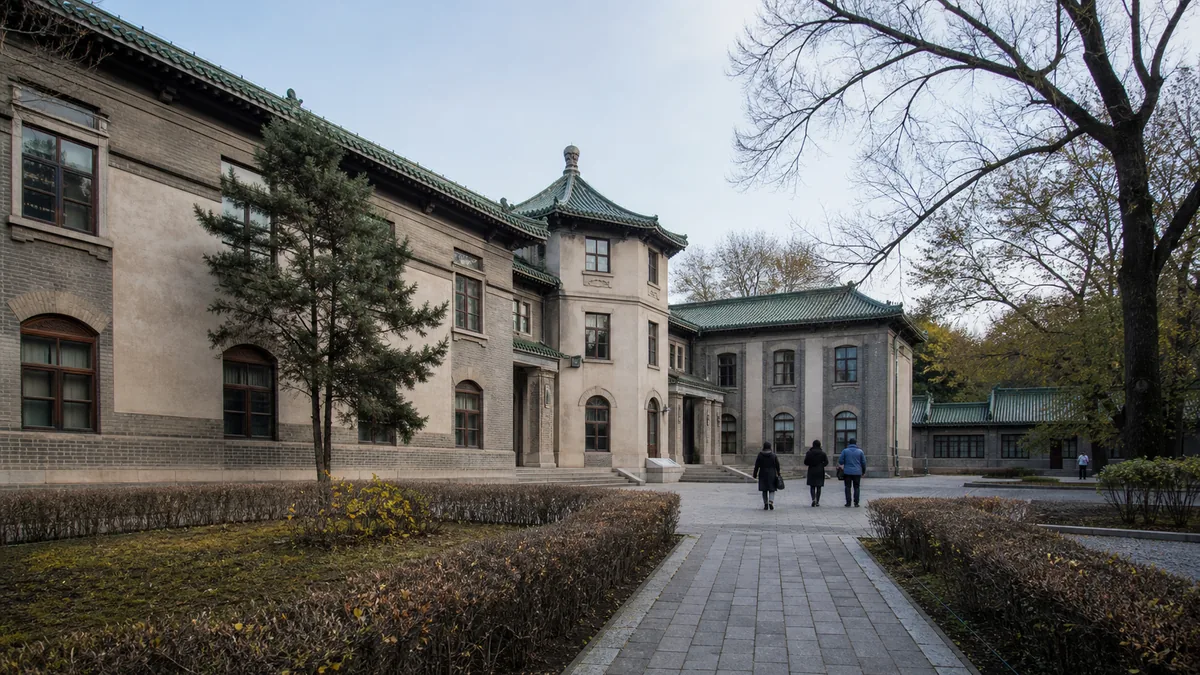
This was a court that needed to look imperial while remaining governable by another power. Chinese roofs, Japanese-influenced details, European-style rooms and office planning sit close together because the compound was adapted, enlarged and staged for a political project. Even if a particular room or object is temporarily off display, the doors, sightlines and changes of architectural language still tell the story.
Read three sites at once: an earlier salt-administration compound, the 1932–45 court of Puyi under the Japanese-sponsored regime of Manchukuo, and a modern museum interpreting occupation and memory. Follow function before decoration: where was business conducted, where did people live, and where was authority performed?
Begin with a palace made from offices
The compound did not begin as an ancient imperial enclosure. Its early core was associated with a regional salt-administration bureau serving Jilin and Heilongjiang. Salt taxation was an ordinary but important arm of state finance, so the site already contained offices, storage and service spaces before Puyi arrived.
After Japanese forces occupied northeast China in the wake of the 1931 Mukden Incident, a new regime needed a capital, institutions and symbols quickly. Changchun was renamed Xinjing, meaning “new capital,” by the Manchukuo authorities. Existing administrative buildings here were converted for Puyi’s use, while new halls, residences, gardens and support buildings were added over time.
That origin explains the scale. This is not the vast north-south ceremonial world of Beijing’s Forbidden City, where gates and courtyards separate an emperor from the city. Here, offices, bedrooms and reception rooms remain uncomfortably close. The modest distances made daily work efficient, but they also make the court feel supervised rather than sovereign.
Look for seams rather than a single architectural style: a roofline that announces rank above an office-like plan, a Chinese decorative motif beside a Japanese or European interior, a formal room reached by a practical corridor. Some surfaces have been restored, but the compound’s mixed grammar reflects successive uses, construction campaigns and the regime’s desire to manufacture legitimacy.
Understand what the word “puppet” is doing
The museum’s Chinese name is 伪满皇宫博物院, Weiman Huanggong Bowuyuan. Wei means “false,” “illegitimate” or “puppet” in this political context; man abbreviates Manchukuo. The term therefore rejects the regime’s claim to lawful statehood. It does not say that every room is a replica or that nothing here is historic.
This matters because English labels are inconsistent. You may encounter “Museum of the Imperial Palace of Manchukuo,” “Manchukuo Imperial Palace,” or “Puppet Emperor’s Palace.” The first can sound neutral unless the political context is supplied. The last makes the power relationship visible, although it requires explanation rather than caricature.
Manchukuo was proclaimed in 1932 after the Japanese occupation of northeast China. It had ministries, uniforms, currency, ceremonies and international contacts, but institutional appearance was not the same as independent sovereignty. The Japanese Kwantung Army and associated colonial authorities exercised decisive control over security and major policy. Puyi’s seal and audience chamber offered a usable image of continuity while Japanese power set the boundaries of action.
The precise language also keeps responsibility specific. It belongs to the military commands, officials, companies and institutions that built and benefited from occupation—not to an abstract national character, and not to present-day visitors because of their nationality. Historical clarity and collective blame are different things.
Follow Puyi from child emperor to controlled ruler
Puyi (roughly “poo-yee”) became the last emperor of the Qing dynasty in 1908, when he was still a small child. He abdicated in 1912 as the Republic of China replaced dynastic government, although a special settlement allowed him to retain titles and live for a time inside the Forbidden City. He had known imperial ritual before he could understand political choice.
In 1924, troops expelled him from the palace in Beijing. He later lived in Tianjin’s foreign-concession world, where competing Chinese factions and Japanese representatives watched his ambitions. Japanese planners could use a former Qing emperor—especially one from the Manchu ruling house—to dress territorial conquest as restoration. Puyi, hoping to recover status and authority, accepted the role.
He became Manchukuo’s chief executive in 1932 and was enthroned as emperor in 1934. From 1932 until the regime collapsed in 1945, this compound served as his court. Titles changed; the imbalance of power did not. He could sign documents, receive visitors and perform rites, yet Japanese advisers and the Kwantung Army constrained decisions that an independent ruler would have controlled.
Puyi should therefore be read neither as a fully autonomous monarch nor as a harmless stage prop. He was manipulated by a colonial system and also lent his name and dynastic symbolism to that system. Those facts can coexist. When the Soviet advance and Japan’s defeat ended Manchukuo in August 1945, the palace’s political world dissolved with striking speed.
His later life adds another layer without resolving the earlier one. After Soviet custody he was transferred to the People’s Republic of China, imprisoned and subjected to political re-education, pardoned in 1959, and lived as a civilian in Beijing until his death in 1967. His memoir and the public story of an “emperor turned citizen” are valuable sources, but they were also shaped by memory and the politics of their time. A later civilian life is not a simple redemption that cancels earlier choices or coercion.
Let three buildings separate work, home and performance
The names can blur after several rooms, so give the principal buildings one verb each: Qinmin Building worked, Jixi Building housed, and Tongde Hall performed. Their uses overlapped, and museum room labels should take priority where details differ, but this framework preserves the compound’s logic.
Qinmin Building was associated with Puyi’s official work, formal audiences and the business of the court. Its scale is useful evidence. Stand far enough back to include the corridor and adjoining rooms: authority here depended on paperwork, appointments, interpreters, guards and advisers as much as on a decorated seat.
Jixi Building contained private living spaces connected with Puyi and Empress Wanrong. Bedrooms, sitting rooms and household displays can tempt visitors into celebrity biography. Look instead for boundaries: who could enter, how private rooms connected to official ones, and how little “private” could mean inside a closely watched court. Furnishings may include period objects, later restorations or interpretive reconstructions; the label, not atmosphere, determines which is which.
Tongde Hall was a later, more conspicuously palatial building designed for residence and reception. Its mixture of decorative languages advertised modern imperial prestige. Museum accounts and later recollections commonly say Puyi suspected that listening devices had been installed and was reluctant to live there. Treat that as an attributed story, not a proven fact about every wall. What can be observed is a deeper irony: a building intended to magnify the emperor also embodied his fear of surveillance.
Other halls, gardens, service quarters and exhibition buildings expand the story beyond these three. Do not race through them as a list of names. Ask what each space enabled—administration, ceremony, domestic life, security, transport or remembrance—and the plan becomes readable.
Connect court life to occupation beyond the walls
Bedrooms, banquets and uniforms can make the site look like a sealed royal drama. It was not. The court belonged to a regime created during Japan’s military occupation and colonial rule in northeast China. Its institutions helped legitimate policing, censorship, economic extraction, wartime mobilization and settlement policies whose consequences reached far beyond the palace.
Coal, grain, timber, land, railways and industrial production were directed toward imperial and wartime priorities. Workers and rural communities experienced coercive labor systems, displacement, requisition, surveillance and violence in different ways. Soldiers and civilians across northeast China and the wider war endured consequences that no polished reception room can show on its own.
This does not mean every atrocity in occupied northeast China was personally designed at Puyi’s desk or planned inside this compound. Decisions were distributed among the Kwantung Army, colonial administrations, police bodies, economic agencies, companies and local collaborators. The palace mattered because it gave these structures a ceremonial face and a claim to political continuity.
Keep people in view when labels name only institutions. Clerks translated orders; cooks and cleaners maintained the court; guards controlled movement; railway and factory workers powered the regime’s economy; farmers faced changing demands on land and harvests. Wanrong and other members of the household lived under restrictive court politics, but proximity to confinement did not place every resident in the same relationship to power. Biography needs structure, and structure needs human consequences.
Treat the museum as evidence with layers
The site you visit is both historic fabric and a museum made after 1945. Buildings have been repaired, rooms re-presented, objects collected or reproduced, and narratives organized for later audiences. A convincing period room is not automatically an untouched room from a single day in 1938.
Use labels actively. Look for words such as original, restored, reconstructed, replica, period object and former site. A surviving doorframe can be original while paint is renewed and furniture re-created. This does not make the exhibit worthless; it changes the question from “Is everything authentic?” to “Which part carries which kind of evidence?”
Exhibition emphasis also changes. Rooms may close for conservation, temporary displays may replace older ones, and occupation-history galleries may be reorganized. Confirm the current plan at the entrance. If the principal residence rooms are crowded, begin with a historical exhibition so that later furnishings sit inside a political timeline rather than becoming palace spectacle.
Museum interpretation has its own date and viewpoint. Compare dates, object captions and stated sources. Puyi’s memoir is one perspective, official records another, and testimony from people affected by occupation another. No single restored desk can settle questions of intention, coercion and responsibility.
Build a route around the argument, not the room count
For a first visit, use a context–power–consequence sequence if current circulation allows it. Begin with an orientation display or site map, then enter Qinmin Building to see administrative authority. Continue to Jixi Building for the household scale and Tongde Hall for ceremonial ambition and the surveillance story. Finish with occupation-history galleries or memorial displays that reconnect the court to life outside its walls.
If you have only about two hours, prioritize those three buildings and one substantial historical exhibition. If you can give the museum half a day, slow down for captions, service spaces and the transitions between old administrative fabric and later palace additions. Published opening hours, last admission, reservation and identity-document rules can change; check the museum’s current official channel before travel.
Crowds often compress around furnished rooms. Step to the side after a doorway rather than stopping in the threshold, and let groups pass before examining a plan or caption. A second look at a quiet corridor may explain control better than another close-up of a bed or uniform.
Do not assume the numbered route is always identical. Conservation work, security arrangements and seasonal operations can redirect visitors. Photograph the current map, note the exit, and ask staff which major interiors are open before committing to a sequence.
Photograph the power mismatch and plan for thresholds
The most informative photograph is rarely the tightest portrait of a throne-like chair. Use a doorway to frame an office, include a desk and the corridor leading to it, or place Chinese-style exterior ornament against a European- or Japanese-influenced interior. Those contrasts show the regime assembling a visual language of authority.
Courtyards can help explain scale: step back far enough to show how Qinmin Building, Jixi Building and Tongde Hall relate rather than making each look like an isolated palace. Side light can reveal repaired surfaces and roof detail, while snow or rain may make courtyards atmospheric but slippery. Never cross a barrier for symmetry or pose on furniture, platforms or steps reserved from visitors.
Photography rules can vary by room. Flash, tripods, filming, or photography of documents and temporary loans may be restricted. Follow the sign at each entrance and ask before photographing staff or other visitors at close range. Quiet conduct matters in galleries dealing with war, occupation and victims; these are not costume sets.
Expect historic thresholds, stairs, narrow passages and uneven paving. Some ground-floor or modern exhibition areas may be easier to access than upper rooms in older buildings, but arrangements change. Ask in advance about step-free entrances, lifts, wheelchairs, accessible toilets and a route that avoids repeated stairs. In winter, allow for ice and severe cold between buildings; in summer, carry water and plan rests because much of the visit moves between exposed courtyards.
Leave the palace inside a larger Changchun
This museum can dominate an entire day emotionally, so choose the next stop by contrast. Changchun World Sculpture Park moves from a controlled interior to open-air art and international exchange. Changchun Movie Wonderland explores the city’s screen-industry identity through entertainment, while Jingyuetan gives you forest, water and a slower landscape outside the historic core. Opening arrangements and transfers should be checked for the day rather than stacked into an inflexible timetable.
Before leaving, return mentally to the first corridor. The compound presents roofs, titles, seals, bedrooms and audience rooms—the equipment of a palace. Yet its administrative bones, compressed distances and stories of supervision expose a different structure underneath. The evidence is not that imperial ceremony was absent. It is that ceremony was abundant precisely because independent power was not.
That is the lasting value of the place. A façade can announce sovereignty while a corridor reveals who could move, a desk reveals how decisions traveled, and an unused hall reveals fear inside display. Leave with the contradiction intact: on the surface, a royal court; in operation, a palace made to serve occupation.
LoreLens App can help identify the compound’s principal buildings while you compare surviving fabric, restoration and museum reconstruction on site.
Location profile
Where it is

Frequently asked questions
Why is it called the Puppet Emperor's Palace?
The Chinese name, Weiman Huanggong Bowuyuan, uses wei to deny the legitimacy of Manchukuo, the regime Japan established in occupied northeast China, and man as its abbreviation. It does not mean that the surviving buildings themselves are fake. English names vary, so searching the Chinese name can help with maps and tickets.
How much time should I allow for the museum?
Allow roughly half a day if you want to read the occupation-history displays as well as the principal palace rooms. A shorter visit can focus on Qinmin Building, Jixi Building and Tongde Hall, but security, crowds, temporary closures and exhibition changes can lengthen or alter the route.
Was Puyi an independent emperor here?
No. Puyi held the titles of chief executive from 1932 and emperor from 1934, but Manchukuo was a Japanese-sponsored puppet regime under decisive Japanese military and political control. The palace supplied ceremonial authority; it was not evidence of independent sovereignty.
Can visitors photograph the interiors, and is the route step-free?
Rules can differ by gallery and exhibition, and flash, tripods or photography of particular objects may be restricted. Historic thresholds, stairs and uneven surfaces also make some rooms difficult to reach. Confirm current photography and step-free access at the entrance, then follow signs in each building.