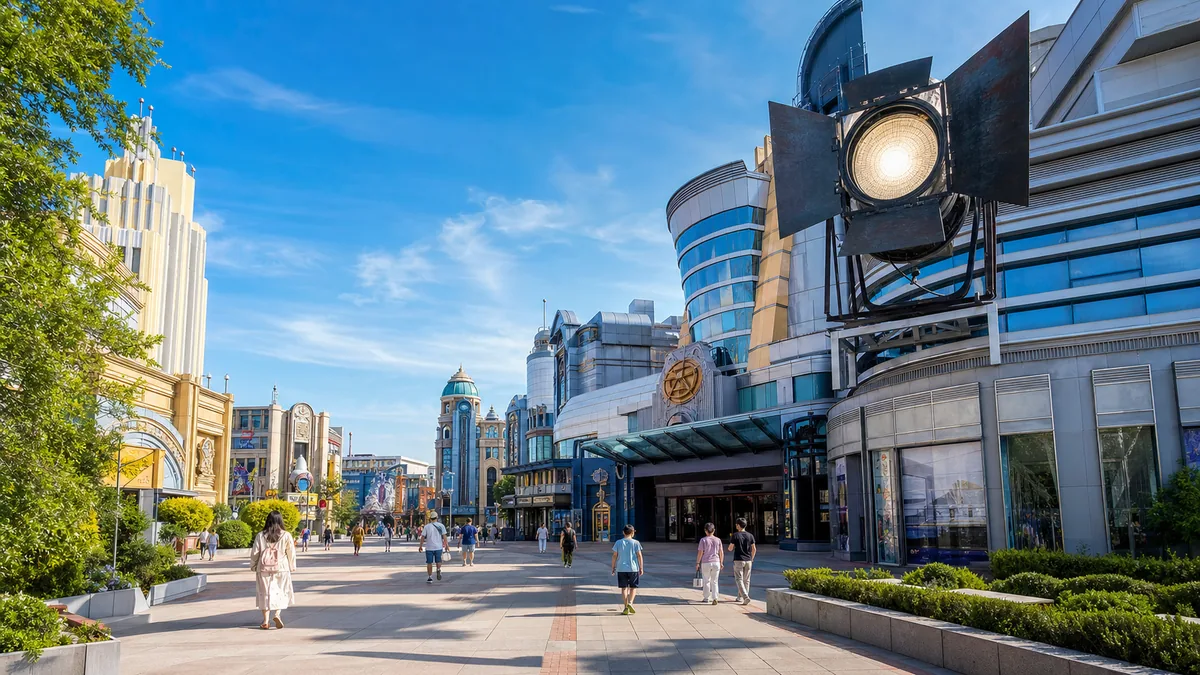
Jilin · Changchun
Changchun Movie Wonderland: How the Screen Becomes Physical
Look past the spectacle to see how sound, moving seats, wind, mist, set scale and editing turn Changchun's film heritage into a changing theme-park experience.
5A View location, maps and nearby scenic areasAfter an effects attraction convinces you that you have fallen, flown or entered a storm, wait one second before discussing the story. Listen for the fan slowing down. Feel the seat return to level. Notice whether mist remains on your sleeve a moment after the image has cut away. The illusion ends in pieces because it was built from pieces.
That moment is the key to Changchun Movie Wonderland, commonly known in Chinese as Changying Century City. The park translates screen technology into bodily entertainment: an image supplies a world, sound directs attention, motion unsettles balance, and air or water makes the fiction cross the edge of the screen. It opened around 2005, but its programme is not a preserved list from opening day.
Plan by operations, not by brochure totals: check the day’s timetable and hard restrictions first; reserve popular timed experiences; fit flexible indoor attractions around them; use outdoor sets and performances as weather-dependent layers. A title remembered from an old review may have changed, paused or disappeared.
First separate the theme park from the studio museum
Two Changchun destinations are often collapsed into one film-history story. Changchun Movie Wonderland is a movie-technology and themed-entertainment park developed by the Changying group and opened around 2005. It uses projection, motion, effects, performance and designed scenery to turn media technique into an attraction.
The Changchun Film Studio Former Site Museum, often called the Changying former-site museum, is elsewhere in the city. It occupies a location directly connected with the historic studio and is the more appropriate place to trace production offices, stages, equipment, archives and institutional memory. The two sites have different locations, admissions and current operations.
This distinction prevents a major historical mistake. Film production associated with the Northeast Film Studio and Changchun Film Studio from the 1940s onward did not all occur inside the theme-park buildings you visit today. Movie Wonderland inherits the name, reputation and technical imagination of Changying, but it is a later cultural-tourism project rather than the original studio floor preserved intact.
If film history is your priority, consider the former-site museum separately and confirm its current arrangements. If you want to feel how cinematic cues are converted into motion, spectacle and group entertainment, Movie Wonderland is the relevant destination. Visiting both can be revealing precisely because they are not interchangeable.
Put the “cradle of New China’s cinema” in context
Changchun Film Studio’s institutional lineage is usually traced through the reorganisation of film facilities after 1945, the Northeast Film Studio, and the later development of Changchun Film Studio. It trained crews and produced newsreels, documentaries, feature films, animation and other forms within the expanding state film system of the People’s Republic of China.
That record supports the often-repeated title “the cradle of New China’s cinema.” Read the phrase as an institutional and commemorative claim, not a literal statement that Chinese film began in Changchun. Shanghai and other cities had rich filmmaking and exhibition cultures before 1949. “Cradle” identifies Changying’s formative role in the new state studio network, the circulation of personnel and the establishment of production practices.
Film also reached audiences through more than a camera and a studio. Distribution offices, cinemas and mobile projection teams carried screenings to factories, schools, military units, neighbourhoods and rural areas. Watching could be a collective event, with technical breakdowns, spoken explanation and audience response becoming part of the memory. State messaging mattered, but viewers did not become identical merely because they shared a screen.
The phrase remains part of Changchun’s civic identity. Museum displays, festivals, street names, studio branding and the theme park all reuse it differently. Ask at each site whether “film history” means production evidence, institutional memory, city promotion or entertainment design.
Dubbing, animation and effects widened what film could do
Foreign films did not simply arrive in China unchanged. Dubbing required translators, dialogue adaptors, directors, actors, recording engineers and editors to rebuild timing, emotion and cultural reference in Chinese. Changying’s dubbing tradition helped generations encounter voices, places and genres from outside China through performances that became memorable in their own right.
Translation is never invisible. A phrase may need to fit mouth movement and scene length; a joke may require another cultural route; a voice actor can reshape how a character is understood. The result is not merely a linguistic copy but a second performance built under technical limits. That craft is a useful bridge between studio history and a theme park where synchronisation still makes illusion persuasive.
Animation and special-effects work add another bridge. A drawn figure, model, miniature, matte image or composited layer asks viewers to believe in movement and scale that were constructed frame by frame. The exact departments and production lineages changed over time, and not every achievement remained inside one Changchun institution. Still, the city’s film identity includes artists and technicians as well as live-action stars.
Movie Wonderland does not contain every historic dubbing booth, animation desk or effects workshop. Instead, it turns a broad technical heritage into public demonstration and sensation. The visitor becomes the test subject: does the sound arrive at the right instant, does the motion match the image, and does the body accept the invented world?
Break one illusion into image, sound, motion and air
Marketing terms such as 4D, motion cinema and dome-screen film can sound like scientific categories. In a theme park they are better understood as packages of sensory techniques. The exact equipment varies by attraction, but you can watch the same components at work.
First comes framing and editing. The camera hides the edge of a set, removes unused space and cuts from wide view to close reaction before your eye can test continuity. A façade may be convincing from the marked sightline while its side reveals a thin wall or support structure. Forced perspective can make a short street seem deep by shrinking doors, windows and texture with distance.
Then sound directs the body. A low-frequency rumble can imply size before anything appears. A voice behind you forces a turn. Silence just before impact creates expectation. Speakers and acoustic treatment place events around a room even when the image remains in front.
Seat motion adds information to the inner ear. A tilt suggests climbing; a short downward movement suggests falling; vibration supplies impact. When movement and screen image disagree, some visitors feel nausea because vision and the vestibular system report different motion. More intensity is not automatically better design.
Finally, air, mist, heat, scent or light can cross the screen boundary. The effect often works because it is timed to a cut or sound cue, not because it physically reproduces a storm or explosion. Afterward, notice which component persuaded you first. Analysis does not ruin the trick; it reveals how precisely several departments had to cooperate.
Look for the labour hidden behind the spectacle
A simulator that runs for a few minutes depends on work before, during and after your ride. Designers plan the sequence; camera and animation teams create images; programmers align motion; sound editors place cues; engineers maintain actuators, projection and ventilation; operators check restraints and dispatch; cleaners reset seats and wet floors; performers rehearse timing; safety staff prepare for interruption and evacuation.
Visible scenery has its own workers. Set builders make light structures appear heavy, scenic painters imitate stone or distance, costume teams repair garments and stage crews move props between performances. A clean illusion often succeeds by hiding joins, cables, exits and contingency plans—precisely the things a safe attraction must still possess.
Visitors contribute too. A scream can cue the next row; laughter spreads; a group applauds because other people begin. Theme-park viewing revives one aspect of mass cinema: the audience experiences media collectively rather than alone. Yet crowd energy can also exclude visitors who need lower sound, more time or clear instructions.
Changchun’s film identity was similarly produced by networks, not a single director or slogan. Translators, projectionists, animators, laboratory workers, carpenters, drivers, ticket sellers and audiences all helped cinema circulate. The park is most historically useful when spectacle points back to those often-invisible choices and jobs.
Treat every attraction as a live operating system
A statue can remain visible while a museum changes its label. A media attraction depends on far more moving parts: software, projection, seats, restraints, water and air effects, performers, licenses, inspection, spare parts and trained staff. Its current form is therefore operational, not permanent.
Project names, films, show casts and technical effects may rotate. A dome venue can be open while a remembered film no longer plays. An outdoor performance can be cancelled for weather. A motion system may undergo maintenance even when the surrounding building admits visitors. Queue estimates can change quickly after group arrivals or a technical pause.
Height, age and companion rules are not arbitrary obstacles to “try anyway.” A restraint must fit, an evacuation route assumes particular movement, and a sudden effect may be unsuitable for some bodies. Read the entrance board before joining a long queue. If the published restriction conflicts with advice from an old blog, the current operator’s sign controls.
Do not build a guide around a guaranteed checklist of branded titles or imported characters. Content and licenses change, and similarity to a famous international theme park does not establish an official relationship. Judge the attraction you can actually enter: what medium does it use, what bodily response does it seek, and how clearly does it explain the risk?
Build the route from timed shows, then use the weather
At the entrance, photograph the current timetable and mark three things: timed performances, attractions with restricted capacity, and experiences for which anyone in your group may be ineligible. This prevents a day from being organised around a show you cannot attend or a ride one person cannot safely use.
Reserve the most important timed or capacity-limited experience first. Fill the gaps with flexible indoor projects nearby rather than crossing the whole park after every show. Treat outdoor scenery and walk-through areas as adjustable segments. If an outdoor performance matters, confirm its weather policy and arrival requirement early.
In Changchun’s cold winter, indoor attractions provide shelter, but transfers between buildings can involve severe cold, wind, snow and ice. Bulky coats may interact with restraints or storage rules. Leave time to dress and move safely rather than assuming “mostly indoors” means a climate-controlled continuous route.
In summer heat or heavy rain, reverse the logic: use indoor projects during the harshest period and visit outdoor sets when conditions ease. Covered queue does not always mean air-conditioned queue. Carry water where permitted, follow lightning or storm closures and do not count on every water effect as cooling.
A half day works for a selective media-technology visit. A fuller operating schedule can occupy most of a day, especially with queues. The objective is not to complete the park map; it is to experience enough different techniques to compare how each manufactures belief.
Ask about access, sensory load and medical restrictions project by project
“Indoor” is not a synonym for accessible. A wheelchair user may reach a theatre lobby but still be required to transfer into a moving seat. A platform may have a lift while an emergency evacuation procedure sets other limits. Ask whether a wheelchair can remain in place, what transfer assistance staff can provide, and whether a non-motion viewing option exists.
Sensory conditions deserve the same precision. An attraction may use flashing light, darkness, loud or low-frequency sound, sudden motion, wind, mist, smoke-like theatrical effects or enclosed spaces. Visitors with epilepsy, sensory sensitivities, hearing concerns, anxiety or vestibular disorders should request a current effects description rather than rely only on a title or age rating.
Pregnancy and heart, neck or back conditions can conflict with restraint pressure, vibration or acceleration. Follow the posted medical exclusions and ask staff when uncertain; this guide cannot override onsite safety rules. Motion-sickness medication has individual risks and is not a substitute for eligibility requirements.
Families should identify exits and meeting points before darkness or effects begin. Children who meet a height line may still dislike loud sound or separation seating. A calmer show, effects demonstration or outdoor set can be a better shared memory than pressuring someone into the most intense simulator.
Photograph the constructed edge and leave the protected show unrecorded
For an outdoor photograph, move toward the edge of a façade rather than hiding it. Include the painted front, the thinner side and a real building or tree beyond. That single frame explains how camera angle and set scale manufacture a world. Leading lines can exaggerate depth, while a person at a respectful distance supplies scale.
Inside, photography and recording may be restricted for copyright, performer safety or ride safety. Do not record a protected film or live show merely because a phone can see it. Flash breaks controlled darkness, distracts performers and visitors, and can be dangerous during movement. Secure loose devices whenever instructed; a dropped phone can injure someone or halt an attraction.
Ask before taking a recognisable close portrait of a performer, operator or fellow visitor. Follow rules for tripods, commercial equipment and drones. A queue or emergency route is not a camera position, and an exit sign should remain visible even when it spoils a symmetrical image.
For another side of modern Changchun, the Puppet Emperor’s Palace Museum exposes architecture used to stage controlled political power. Changchun World Sculpture Park asks the body to move around static forms, while Jingyuetan replaces programmed effects with forest, water and weather. Check current transfers and operations before combining them.
As you leave, remember the fan winding down and the seat returning to level. Screen wonder depends on choices you were not meant to notice: where an editor cut, when a speaker fired, how far a seat tilted, whether an operator stopped the cycle, who dried the floor and who translated a line. The marvel is not that technology eliminated labour. It is that many forms of labour became briefly invisible so an audience could believe together.
LoreLens App can help identify media techniques and Changchun film-history references while you compare the park’s designed illusion with the city’s studio legacy.
Location profile
Where it is

Frequently asked questions
Is Changchun Movie Wonderland the same as the Changchun Film Studio Museum?
No. Movie Wonderland is a movie-technology theme park that opened around 2005. The former-site museum occupies a different location connected directly with the historic Changchun Film Studio. Both relate to the Changying name, but they offer different experiences and require separate map, ticket and opening checks.
How much time should I allow for Movie Wonderland?
A focused visit can fill half a day, while a schedule built around several timed attractions may take most of a day. Actual duration depends on the day's programme, queues, maintenance, weather and eligibility rules. Check the current timetable first instead of counting attraction names.
Which attractions and shows will be open, and are there height limits?
The lineup is operational rather than permanent. Film titles, performances, showtimes and effects can rotate, while maintenance or weather can close an attraction. Height, age and companion rules also differ by project. Use the official same-day notice and the sign at each entrance as the authority.
Is the park suitable for wheelchair users, pregnancy or motion sensitivity?
Do not infer access from an attraction being indoors. Some experiences may require a wheelchair transfer or use restraints, motion, flashing light, darkness, loud sound, wind or mist. Ask each attraction about transfer and evacuation, and follow posted restrictions for pregnancy, heart conditions, epilepsy, motion sickness, and neck or back problems.