Jilin · Changchun
Changchun World Sculpture Park: Art Changes as You Move
Circle outdoor sculpture, cross lakeside lawns and choose among changing indoor displays to see how public art reshaped a large piece of modern Changchun.
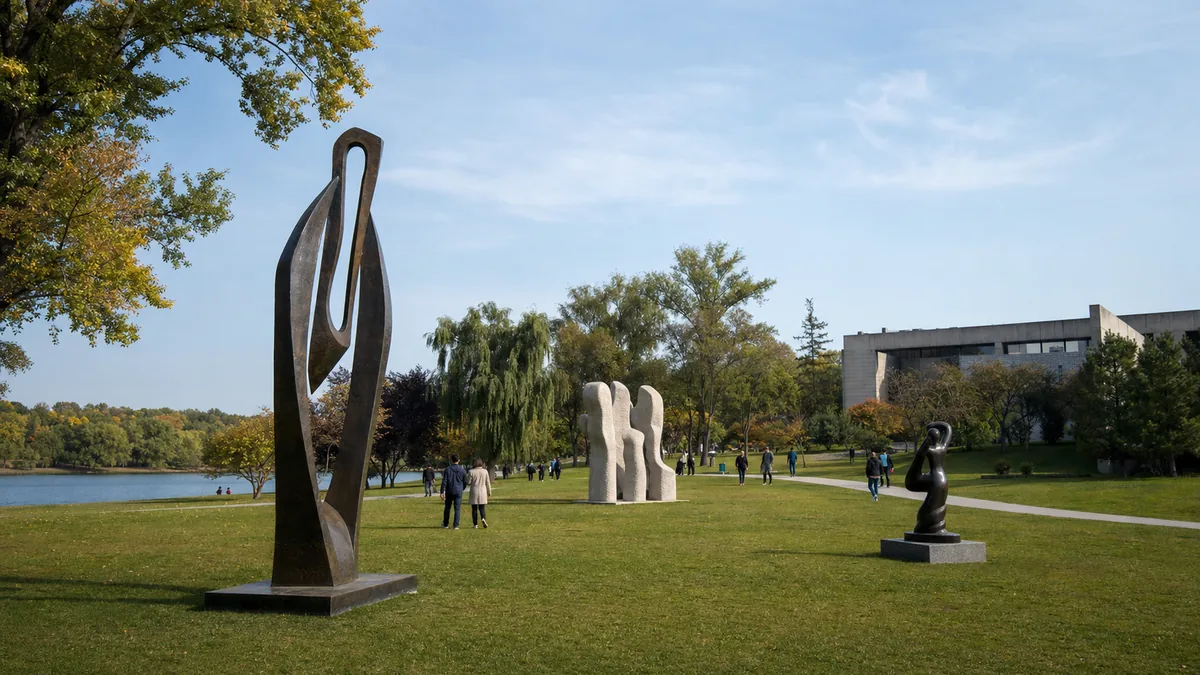
5A View location, maps and nearby scenic areasChoose one sculpture near your route and take three slow steps to the side. Do not photograph yet. A solid torso may split into two planes; an opening may frame a tree; a line that seemed balanced may begin to lean. Take three more steps and the skyline changes again. Sculpture does not sit inside one correct view. Your moving body completes it.
That simple experiment is the best way into Changchun World Sculpture Park. Spread across about 92 hectares—roughly 0.92 square kilometres or 227 acres—the park is too large to understand as a cabinet of objects. Works meet lake water, lawns, trees, paths, winter snow and other visitors. Indoor halls add further layers, but not every building or collection is available on every visit.
Read the park in four layers: begin with the central theme sculpture, use the lake and main paths to orient yourself, choose one outdoor zone for slow looking, then add an indoor hall only after checking what is open. Old totals for artworks, artists or countries are snapshots, not a live inventory.
A sculpture movement became a city park
Changchun’s international sculpture activities developed from the late 1990s, when symposium-style events brought invited artists, works and public attention to the city. A sculpture symposium is not simply an exhibition delivered in boxes: artists may make or finish work in relation to a host city, while organisers acquire, install and interpret the results. Repeated events can turn temporary exchange into a collection.
The park was established in 2001 and opened to visitors in 2003. Those dates describe an institution taking shape, not a collection frozen at opening day. Later acquisitions, events, relocations, conservation work and indoor exhibitions continued to change what could be seen and how it was grouped.
This timing matters to Changchun’s urban story. The city was already associated with automobile manufacturing, film and the administrative legacy of twentieth-century northeast China. As Chinese cities invested in new civic landscapes and international cultural exchange around the turn of the millennium, a large sculpture park offered Changchun another public identity: industrial and cultural, local and outward-facing at once.
Do not turn that relationship into a neat claim that art “replaced” industry. Cars, film, universities, construction and public culture developed together, and the park itself required land, public funding, curators, fabricators, translators, gardeners and maintenance crews. Its history is a story of city-making through institutions, not only of artists leaving objects on grass.
Read “Friendship, Peace, Spring” as a civic proposition
The tall theme sculpture commonly translated as “Friendship, Peace, Spring” acts as the park’s main visual anchor. Its vertical form can be found again between trees and across open ground, helping you recover orientation when individual paths begin to look alike. Approach it from a distance before studying details.
The title joins three broad ideals. “Friendship” suits the international invitation model; “peace” gives public art a diplomatic aspiration; “spring” echoes Changchun’s name, which literally contains the characters for “long” and “spring,” while suggesting renewal. These associations belong to the work’s civic and curatorial setting. They do not tell you exactly what every shape must mean.
Separate three kinds of statement. The label can establish title, artist or collaborative authorship, date and material. A park guide may explain how the monument represents the institution. Your own observation may notice lift, tension, enclosure or distance. None of those levels should impersonate the others.
Walk a full arc if access allows. From one side the monument may align with a formal approach; from another, people and trees interrupt its authority. That change is useful. Public sculpture is never viewed in the controlled silence of a single plinth: weather, circulation and daily life continually edit its composition.
Ask what kind of “original” each object is
Large sculpture parks can mix works created for a symposium, purchased pieces, artist-authorised editions, casts made through estate or museum arrangements, loans, replicas and educational displays. “Original” is therefore not a switch applied to the whole site. It is a question asked of each object.
Look for four label facts: maker, production date, material and provenance or edition. The date of a composition may differ from the date of the cast in front of you. Bronze is often editioned; stone or wood may be unique but restored; a work may have been fabricated by a workshop under the artist’s direction. Authorship does not always mean one pair of hands touched every surface.
Be especially careful with famous names. Auguste Rodin’s The Thinker, for example, is a composition represented by multiple bronze casts in different scales and histories, including casts produced under authorised institutional arrangements. Calling any displayed version “the world’s only original” without provenance is misleading. Calling every later cast “fake” can be equally careless. Read the park’s current label and, if it makes an exceptional claim, look for edition, foundry and ownership information.
Tourism copy often compresses these distinctions because famous names attract attention. A careful visit restores them. The work in front of you has a specific object history even when its image is globally familiar.
Let “world” remain plural, especially in the African galleries
The word World in the park’s name describes an international ambition and a collection formed through cross-border invitations. It does not mean every country is represented equally, every artist speaks for a nation, or the display offers a complete map of global sculpture. Symposium networks, budgets, diplomacy, curatorial choices and available translations all shape who appears.
Treat national labels as starting points, not explanations. An artist can work across countries, oppose an official tradition or borrow materials far beyond a birthplace. Two artists from the same country need not share a style, while artists far apart may respond to similar questions of body, memory, abstraction or land.
This is essential in an indoor display of African art. Africa is a continent of many societies, languages, histories and modern art worlds—not one visual culture. If a hall brings different regions together, read the label for specific community, country, maker, date, material and route into the collection. Do not use “tribal” as a catch-all substitute for information.
Makonde carving belongs more specifically to communities in what are now northern Mozambique and southeastern Tanzania. Ebony and other dense woods became associated with several modern sculptural forms, including family or community groupings and imaginative spirit figures, but no single motif defines every Makonde artist. Twentieth-century workshop practice, anti-colonial and postcolonial histories, tourism, dealers and the international art market all influenced how works were made and circulated.
That context does not reduce the carvings to souvenirs, nor does museum display remove market history. Ask whether the label identifies an artist, community, period and acquisition route. A precise East African story is more respectful—and more interesting—than treating the gallery as a timeless sample of an undifferentiated continent.
Notice how landscape and weather co-author the work
Outdoors, material keeps changing. Bronze develops patina; steel catches sharp winter light; polished stone mirrors cloud and movement; rough surfaces hold snow. Trees grow and alter sightlines. Water may duplicate a silhouette or break it into wind-driven fragments. Conservation teams manage corrosion, drainage, foundations and vegetation even when their work is invisible.
Season changes interpretation as well as comfort. Summer foliage can create intimate rooms but also hide a distant work. Autumn opens colour contrasts. Snow clarifies dark silhouettes and fills negative space, yet it can conceal low bases, kerbs and uneven edges. Ice and severe cold may close or complicate paths. No photograph of a summer lawn guarantees the same approach in January.
Daily public use is another layer. A child running past can reveal scale; a person resting beneath a work can show whether it creates shelter or exclusion. At the same time, not every object is playground equipment. Climbing, sitting on bases, touching vulnerable surfaces or hanging bags from sculpture can damage both art and visitor safety unless a label expressly invites interaction.
Notice maintenance without treating age as failure. A repair line, renewed joint or protected lawn may show the cost of keeping public art outdoors. If a route is fenced for conservation, observe from the permitted angle rather than crossing for a cleaner photograph.
Choose one compact loop or a layered half day
For a compact visit, locate “Friendship, Peace, Spring,” make a loop along one side of the lake, and choose one outdoor cluster for close looking. Stop at three works rather than photographing thirty. At each, walk around, read the label, compare material with landscape, then decide whether the work earns another angle.
For a layered half day, begin with the theme monument, follow a longer lakeside section, cross into a contrasting outdoor zone and finish with one indoor hall. Alternating open air and interior reduces visual fatigue and gives weather protection, but only if the chosen building is actually open.
The 92-hectare scale makes backtracking expensive. Photograph the entrance map, mark the gate you need, and note bridges or water edges that limit direct movement. A sculpture visible across a lake may require a long curve rather than a short crossing. Do not plan from a promotional aerial image as if every lawn were a path.
Opening hours, last admission, entrance gates, internal transport and ticket arrangements can change. Confirm current official information, especially if you have a particular gallery in mind. If you arrive late, an honest outdoor loop is better than racing between locked doors.
Use indoor halls as focused chapters, not a completion test
The park includes multiple indoor exhibition spaces, which may encompass a main sculpture museum, collection galleries, African-art displays and rooms focused on particular artists or themes. Names, entrances and institutional groupings can vary across maps and translations. Temporary exhibitions and collection rotations also change what is on view.
At the entrance, ask two practical questions: which halls are open today, and does your admission cover each one? Maintenance, exhibition installation, special events and seasonal schedules can close a building even while the outdoor park operates normally. A named collection may remain part of the institution without every object being displayed.
Choose by question rather than prestige. If outdoor scale interests you, select a hall with models or smaller works that show how volume changes indoors. If materials interest you, compare wood, bronze and stone under controlled light. If the Makonde collection is available, give it enough time to read regional and acquisition context rather than using it as a quick “Africa” stop.
Indoor labels can also correct assumptions made outside. A familiar-looking composition may have a specific cast date; a monumental object may begin as a hand-sized maquette; a title translated into several languages may shift nuance. Photograph labels where permitted so the artist does not disappear from your memory once the image enters your camera roll.
Photograph movement, negative space and human scale
Start with the technique from the entrance: take three steps, then three more. Watch gaps between forms before watching the solid mass. Negative space—the air framed by an arm, arch or split plane—can be the work’s most active part. Use trees, water or sky inside that opening instead of centring every object against a blank lawn.
Change height carefully. A low viewpoint can make an upright form dominate, while eye level preserves its relationship to walkers. A longer lens compresses several sculptures and may falsely make them look like one group; a wider view explains distance but can distort edges. Choose the effect knowingly rather than treating the camera as neutral evidence.
Include a person when scale matters, but ask consent if the person is identifiable or central to the image. Waiting for a passer-by to enter a distant silhouette is different from aiming closely at a stranger. Keep tripods out of paths and follow any current rules for drones, commercial photography and indoor equipment.
Most importantly, do not climb a base or touch a surface to manufacture interaction. Circle the work, let your shadow or the path create a relationship, and use framing rather than physical contact. Sculpture rewards movement without requiring possession.
Plan for distance, thresholds and a contrasting next stop
Main park paths can be broad, yet a 92-hectare visit still demands sustained walking. Slopes, textured paving, bridge approaches, grass shortcuts and museum thresholds can interrupt an otherwise accessible route. Wheelchair users and visitors with limited stamina should ask about step-free loops, cleared winter paths, lifts, accessible toilets, rest points and the gate closest to a priority hall.
Open lawns offer less shade than a map suggests. In warm weather, carry water and alternate exposed sections with trees or an open indoor hall. In winter, use insulated footwear with grip, protect hands needed for wheels or a camera, and expect benches or ramps to be snow-covered. Strong wind across water can make the temperature feel lower than the forecast.
Choose Changchun’s next chapter by contrast. The Puppet Emperor’s Palace Museum asks how architecture performed power under occupation. Changchun Movie Wonderland turns the city’s screen heritage toward themed entertainment, while Jingyuetan expands the forest-and-water experience beyond an art park. Check transfers and current operations before combining them.
At the final sculpture, repeat the first experiment. Move sideways until a gap opens, another body supplies scale, or the lake enters the silhouette. The park is not valuable because you can recite a changing count of works and countries. It is valuable because hundreds of encounters ask the same physical question in different ways: where must your body stand, and how must it move, for space to become part of the art?
LoreLens App can help identify works and record label details while you compare material, landscape and changing viewpoints across the park.
Location profile
Where it is
Frequently asked questions
How much time should I allow for Changchun World Sculpture Park?
Allow at least two or three hours for a focused outdoor loop around the central monument, lake and one sculpture zone. A half day is more realistic if you want to read labels, circle works slowly and enter one or more indoor halls. Open buildings, weather and walking distance can change the plan.
Are all the sculptures original works?
Do not assume one answer for the whole park. A display may be an artist's unique work, an editioned or authorised cast, a later reproduction, a loan or an interpretive display. Famous compositions such as The Thinker also exist in multiple legitimate casts. Read the individual label for maker, date, material, edition and provenance.
Are the indoor museums always open and included with admission?
No single rule should be assumed. Hall names, opening days, maintenance closures, temporary exhibitions and ticket boundaries can change, and a park ticket may not describe every current interior arrangement. Check the official notice and the entrance map on the day you visit.
Is the park suitable in winter or for wheelchair users?
Winter snow can make the sculpture landscape striking, but ice, hidden kerbs, cold wind and closed paths can increase difficulty. Main routes may be broad, while slopes, textured paving and museum thresholds remain. Ask about cleared step-free paths, lifts, accessible toilets and available rest points for the exact day.