Chongqing
The Chongqing Provisional Government Site: Everything but Recognition
Five grey-brick buildings on a slope at Lianhuachi, the largest surviving site of Korea's government-in-exile. Here it acquired an army, a head of state and a declaration of war against Japan, and still went home in 1945 as private individuals.
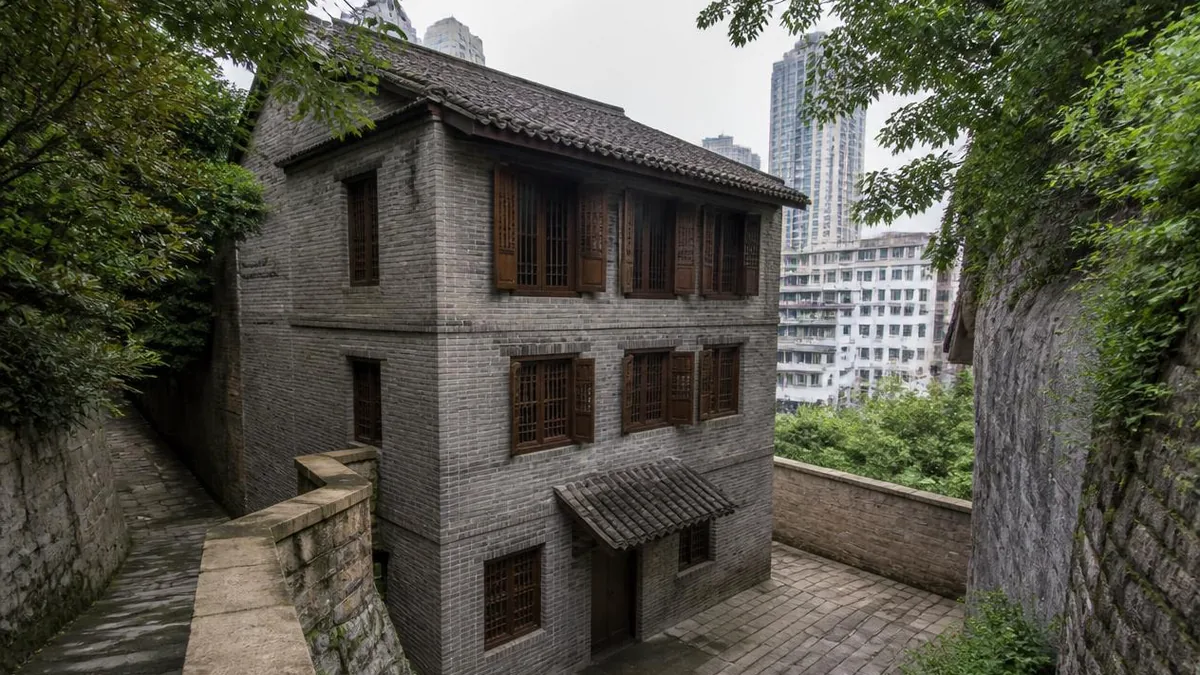
Number 38, Lianhuachi, is a walled compound of five grey-brick buildings with tiled roofs, set on a slope in Qixinggang, in the dense old core of Chongqing’s Yuzhong District. The gate opens off a normal street. There is a shopping district a few minutes away and a metro station closer than that.
It is the largest surviving site of the Provisional Government of the Republic of Korea anywhere. Korean descriptions give the plot as about 1,300 square metres and the floor area as about 1,770, with roughly 284 square metres open to visitors; the museum’s own account calls itself the biggest Korea-related heritage museum in China. And it is the address where, between 1940 and 1945, a government in exile assembled almost everything a state has — a head of state, a founding programme, an army, a declaration of war — and failed to obtain the one thing all of it was for.
The road here has already been walked
The Provisional Government was founded in the Shanghai French Concession in April 1919 and left the city in 1932. The eight years that followed ran through Hangzhou, Zhenjiang, Nanjing, Changsha, Guangzhou, Liuzhou and Qijiang, and that itinerary is set out in full on the Shanghai site. There is no reason to repeat it here.
Two things about the last leg matter for this building. The government’s immediate previous base was Qijiang, a county south of Chongqing, from May 1939 — a rural stop where its chairman Yi Dong-nyeong died on 13 March 1940, where Hong Jin briefly succeeded him, and where on 9 May 1940 three exile parties merged into a single Korean Independence Party with Kim Ku as executive chairman. Most of the Qijiang buildings were demolished in 2002 and 2003, and the last surviving one was pulled down by mistake in 2011. The bookshop at Lianhuachi sells a volume specifically about that stage.
And Chongqing was not a refuge. It was the Nationalist wartime capital and the most heavily bombed city in China between 1938 and 1943. The exiles arrived into an air-raid economy, which is the usual explanation for why they changed address inside the city more than once.
Four addresses, and the one disagreement that matters
Korean accounts list three earlier Chongqing offices — Shibanjie, Yangliujie and Wu Shiye Lane — and date the move into Lianhuachi to January 1945, making this building the government’s home for roughly the last eight months.
Chinese accounts read it much more broadly. The museum’s own history says the Nationalist government funded and settled the exiles at the Lianhuachi guesthouse after they reached Chongqing in 1939, and describes the Chongqing years as six. One Chinese reference work dates the office here to 17 September 1940. The heritage designation covers the years 1938 to 1946.
Both sides agree the government was in Chongqing from 1940 until late 1945 and that this compound is where it ended. Nobody has reconciled the occupancy dates of the building itself, and it is worth knowing that before you walk in, because the museum presents the whole five-year period inside a structure that one of its two national narratives says was in use for the last eight months of it.
October 1940: a chairman, and a programme for a state
The Provisional Government reached Chongqing in September 1940 and immediately rebuilt itself as an institution.
On 9 October 1940 it amended its charter to replace collective rule by a State Council with a chairman, and elected Kim Ku to the post along with six state councillors, among them Yi Si-yeong and Cho So-ang. For the first time since the impeachment crisis of 1925 the government had an undisputed head.
It also wrote a plan for the country it did not govern: the Founding Programme, a document setting out land policy, education and the shape of a post-independence state. Its date is contested — the museum’s account and some Korean summaries attach it to the 1940 reorganisation, while Korean chronologies more often date its promulgation to 28 November 1941. The two readings have not been squared.
Money came from three directions. The museum’s history states flatly that all expenses of the government and the Liberation Army in Chongqing were paid by the Nationalist government. Korean accounts add that the costs of the government, the party and the army were borne by Korean communities in the United States, Mexico and Hawaii, and that a women’s committee led by Soong Mei-ling contributed 100,000 Chinese yuan. Both are on the record and they are not mutually exclusive.
Chongqing also holds the government’s private losses. Kim Ku’s mother, Kwak Nak-won, died in 1939 at the age of eighty-two; his eldest son Kim In died of tuberculosis here. In 1948 Kim Ku had his mother’s remains brought back from China, and sent his second son to exhume his wife in Shanghai and Kim In in Chongqing for reburial in Seoul.
17 September 1940: an army, founded in a hotel
The Korean Liberation Army is the reason this stage of the story is different from the ones before it. Kim Ku had asked Chiang Kai-shek’s government in May 1940 to authorise it, and the authorisation came on the condition that the force operate under Chinese military command.
Kim Ku issued the founding declaration on 15 September 1940. The inauguration ceremony was held on 17 September 1940 — not at Lianhuachi and not at the Zourong Road building now preserved as the army’s headquarters site, but at the Jialing Hotel in Chongqing, with government figures, local Korean residents, officers sent by the Chinese defence ministry, the Chongqing garrison commander Liu Zhi, and foreign guests present. Ji Cheong-cheon was appointed commander-in-chief and Lee Beom-seok chief of staff.
What was founded that day was a headquarters. Korean accounts describe the initial establishment as around thirty men — an army with no soldiers — which then moved toward Xi’an, closer to the front, to recruit. A Chinese account puts the founding strength at about three hundred.
In November 1941 the Chinese Military Affairs Commission issued the Nine Action Principles, which bound the Liberation Army to move only on the orders of the Chinese chief of staff in exchange for uniforms, equipment and medical support. The Provisional Government was angry enough to consider relocating itself to Washington and to open contact with Syngman Rhee about it; Chiang’s side talked Kim Ku out of it. The Nine Principles were rescinded in August 1944 and command passed to Kim Ku, who then held the party, the government and the army at once.
How many soldiers, and where they were
This is where the numbers stop agreeing, and the gap is large enough to be the point.
Provisional Assembly documents give the Liberation Army’s strength as 514 in March 1945, of whom 65 were Chinese nationals, leaving 449 Koreans; another assembly paper gives 339 in April 1945. A Chinese reference account says the force grew from a few hundred to more than fifty thousand after the headquarters moved to Xi’an. A United States embassy report from January 1942 recorded the entire Korean resident population of Chongqing as under two hundred. The Provisional Government’s own publicity claimed five hundred at the founding ceremony, and a spokesman claimed ten thousand at a press conference on 25 November 1945, a figure Korean scholarship treats as inflated.
The archival documents are specific and internally consistent; the fifty-thousand figure has no comparable paper behind it. Both circulate.
Location matters as much as headcount. The headquarters moved from Chongqing to Xi’an in 1942, with detachments at Xi’an and Fuyang and one in Chongqing. So for most of the Chongqing years, the army founded here was administered from elsewhere. In 1942 the Korean Volunteers Corps under Kim Won-bong was folded in and Kim Won-bong became deputy commander; in October 1942 his Korean National Revolutionary Party entered the Provisional Assembly, which roughly doubled in size. In 1943 a small unit was attached to British forces in the India-Burma theatre. From late 1944 the army trained with the American Office of Strategic Services.
A declaration of war with two dates on it
On 9 December 1941, two days after Pearl Harbor, the Provisional Government issued a statement declaring war on Japan. It has five clauses: that all Koreans were already in the anti-aggression front and now declared war as a combat unit; that the 1910 annexation treaty and all unequal treaties were void; that the fight would continue until Japanese forces were expelled from Korea, China and the western Pacific; that the Japanese-sponsored regimes at Changchun and Nanjing were not recognised; and that the Roosevelt-Churchill declaration should apply to Korean independence. It was signed by Chairman Kim Ku and Foreign Minister Cho So-ang.
The date is a small, exact example of what this site is like to research. Korean narrative accounts give 9 December 1941 as the day of the announcement. The signed text itself is dated 10 December 1941, in the government’s own era count as year 23 of the Republic of Korea. A Chinese reference work also gives 10 December. So the declaration has two defensible dates, one for the act and one for the document, and both are in print without explanation.
Nobody was obliged to notice it. No Allied power had recognised the government that issued it.
July 1943, and two words in the Cairo Declaration
On 26 July 1943 Kim Ku, Cho So-ang, Kim Kyu-sik, Ji Cheong-cheon and Kim Won-bong met Chiang Kai-shek and asked China to press for Korean independence at the Allied conference then being planned.
The Cairo Declaration, issued that December, stated that Korea would in due course become free and independent. The phrase in due course is the whole of what the meeting achieved, and it is the phrase that made trusteeship possible later. Korean historians who defend Kim Ku’s diplomacy point to Cairo as its best result; those who criticise it note that recognition never followed. In April 1945 the foreign minister met the French ambassador in Chongqing and was told France regarded the government as recognised in fact but not officially — the closest thing to recognition the exiles got in twenty-six years.
November 1945: going home as private individuals
Word of the surrender reached Chongqing on 16 August 1945. On 18 August the Provisional Assembly resolved to return. On 3 September Kim Ku published a fourteen-point programme for the transition, built on the claim that the Provisional Government’s legitimacy carried into the new state.
The Liberation Army had already tried to get there first: an advance force was organised on 11 August under Lee Beom-seok, flew toward Korea on 16 August and turned back, then landed at Yeouido airfield in Seoul on 18 August and was turned back again by Japanese troops still under arms.
The departure from Chongqing was ceremonious. On 3 November 1945 Chiang Kai-shek and Soong Mei-ling hosted a farewell for some two hundred government and party figures, at which Chiang said China’s own independence would be incomplete without Korea’s. On 11 November Zhou Enlai and Dong Biwu held a farewell dinner for the state councillors on behalf of the Chinese Communist Party. A Chinese account records loans of 100 million yuan and 200,000 United States dollars.
Kim Ku and the first party flew out of Chongqing on 5 November 1945 in two aircraft, to Shanghai. They reached Seoul on 23 November; a second group landed at Gunsan on 1 December. The American military government in Korea permitted the return only in a personal capacity. Kim Ku’s response, on arrival, was that when he returned the government of Korea returned with him. The Americans did not accept that either.
Nearly demolished, then restored twice
After 1945 the compound went back to ordinary use: an inn, a school, housing. In the early 1990s Chongqing’s redevelopment programme put it on the demolition list.
It survived because of one person. Lee So-shim, the eldest daughter of the independence activist Lee Dal, who was decorated posthumously in 1992, appealed to both the Korean and Chinese authorities to protect the buildings. In June 1994 the Independence Hall of Korea and the Chongqing People’s Association for Friendship with Foreign Countries signed a restoration agreement, and the site opened as a museum on 11 August 1995, with funding described by the museum as coming from both countries. Chongqing’s humidity then damaged the fabric; a second programme of repair and re-display, again with the Independence Hall, reopened it on 17 September 2000 — the sixtieth anniversary of the Liberation Army.
The paperwork tracks the same story. The site was listed as a municipal protected cultural relic on 19 March 1992, when Chongqing was still a city in Sichuan, and again on 7 September 2000 in the first list issued after Chongqing became a directly administered municipality. It is now registered as a national third-grade museum, and it marked thirty years as a museum with a photographic exhibition.
What is in the five buildings, and how to visit
Inside, the display runs across the compound: a restoration monument, a hall named for Lianhuachi, a reception room for foreign guests, and the exhibition rooms proper. A bust of Kim Ku, material on his meetings with Chiang Kai-shek, copies of the Dongnip Sinmun, and Liberation Army documents are the core. Recent additions include the army’s own periodical, a 1943 Bank of China Chongqing remittance slip for overseas donations, and an immersive projection room.
Practically: it is free, open Tuesday to Sunday from 09:00 to 17:00 with entry closing at 16:30, and shut on Mondays outside public holidays — the museum’s own notice, worth re-checking on the day. Allow an hour. Commentary in Korean has been a feature here for years, provided partly by student volunteers from Chongqing and Korean universities. Sitting figures who have come include Moon Jae-in on 16 December 2017, the first serving South Korean president at this site, and Ban Ki-moon; Lee Jae-myung visited in November 2019 as governor of Gyeonggi, six years before becoming president.
The Liberation Army headquarters on Zourong Road is close enough to pair with this in a morning, and the rest of central Yuzhong is on the same peninsula — Hongyadong, which is a shopping complex of 2006 rather than an old town, sits about two kilometres north on the Jialing bank.
Read the site as an inventory. By 1945 the Provisional Government had a chairman, a constitution, a founding programme, a party, an assembly with an opposition in it, an army with a general staff, a declaration of war, and a printing operation. It had every component of a state except the acknowledgement of one, and the men who assembled all of it boarded the aircraft on 5 November 1945 as private citizens.
The buildings almost went too. What is standing at Lianhuachi is there because a redevelopment plan was interrupted by a letter.
The LoreLens app can identify wartime-capital buildings and heritage plaques across Chongqing and explain what happened in them.
Frequently asked questions
What are the opening hours, and is there an admission charge?
The museum's own visitor notice states that it is free and open Tuesday to Sunday from 09:00 to 17:00, with entry closing at 16:30, and that it is shut on Mondays except when a Monday falls in a national public holiday. It also gives a general enquiries number and asks that groups needing a guided commentary contact the visitor reception desk. The nearest metro stations are Qixinggang, on Lines 1 and 10, and Jiaochangkou, on Lines 1 and 2; both are a short walk. Hours, holiday arrangements and any booking requirement can change, so confirm on the day rather than working from this page.
How long was the Provisional Government actually in this building?
This is the genuine dispute at the site, and the two sides are far apart. Korean accounts treat Lianhuachi as the last of four Chongqing addresses, after Shibanjie, Yangliujie and Wu Shiye Lane, and date the government's occupancy of it to January 1945 onward. Chinese accounts read it more broadly: the museum's own history says the Nationalist government housed the exiles at the Lianhuachi guesthouse after they reached Chongqing in 1939 and refers to six years there, one Chinese reference work dates the office to 17 September 1940, and the heritage listing gives the protected period as 1938 to 1946. Nobody disputes that the government was in Chongqing from 1940 to 1945, or that this compound is where it ended. The length of time it spent inside these particular walls is not settled, and the museum does not resolve it either.
Is this the same place as the Korean Liberation Army headquarters?
No, and they are two separate museums about ten minutes apart. The Provisional Government site is at Lianhuachi, in Qixinggang. The Liberation Army headquarters building is at 37 Zourong Road, also in Yuzhong District. It was included in a Chongqing redevelopment plan in 2010 and faced demolition; South Korea asked for it to be preserved, China agreed and said it would meet the cost, and the restored building opened on 30 March 2019, with the South Korean prime minister cutting the ribbon. One further point catches people out: the Liberation Army's founding ceremony on 17 September 1940 was not held at either address. It took place at the Jialing Hotel.
Should I see this or the Shanghai site, and is either one a rated scenic area?
Chronologically Shanghai comes first, by twenty-one years, and the two are complementary rather than repetitive: Shanghai is a rented lane house where a government began, and Chongqing is a five-building compound where it ended with an army and a war declaration. If you can only do one, do the one in the city you are already in. Neither is in China's national A-grade scenic area system, the scheme behind the 5A and 4A labels; the Chongqing site is registered as a national third-grade museum and is free, and the Shanghai site charges a small admission and has its own closure notices to check. Both are museums rather than rated attractions.
Sources and further reading
Background references for the history and place names in this guide. Opening hours, ticketing and access change often — always confirm with official local information before travelling.