Heilongjiang · Qiqihar
Zhalong Nature Reserve: Read the Wetland Behind the Crane
Wait at the reed edge before the cranes rise: learn how water, breeding habitat, rangers and managed releases shape Zhalong, then visit without disturbing the birds.
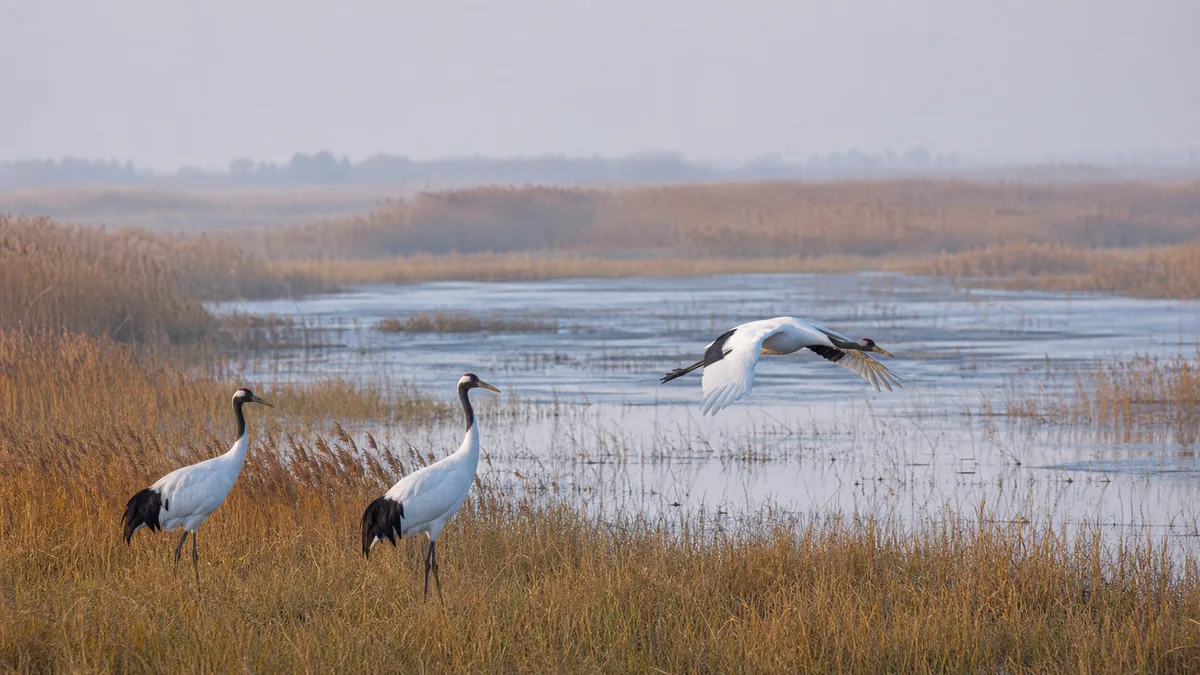
5A View location, maps and nearby scenic areasAt the first authorised wetland overlook, keep the camera down for one minute. Wind moves the reed tops together, but one patch shakes against the rhythm. A grey-brown shape steps into a shallow opening; a far carrying call arrives before its source appears. This is the useful first lesson at Zhalong (roughly “jah-LOONG”): the crane is only the most visible part of a system built from water, reeds, distance and patient human work.
The tourist area is famous for red-crowned cranes rising on broad black-and-white wings. Some of those flights are managed. Wild cranes may remain far beyond the boardwalk, hidden by reeds, or absent from view. Knowing which encounter you are watching does not diminish it; it makes the reserve more intelligible.
Read Zhalong in four layers: learn the wetland map at the visitor facilities, watch the edge between reeds and shallow water, observe wild birds without closing the distance, and treat any scheduled crane release as a separate conservation-and-interpretation event.
Begin with the water map, not a crane checklist
The Ramsar Sites Information Service records 210,000 hectares—about 2,100 square kilometres—for Zhalong. That is the protected wetland landscape, not the area a visitor can walk. The public route shows only a small, controlled window into permanent and seasonal freshwater marshes, shallow lakes, ponds, wet meadow and grassland on the Songnen Plain.
Much of the wetland developed along the lower Wuyuer River, where water spreads across extremely flat ground, loses a simple channel and fills shallow depressions. The Shuangyang River, rain, snowmelt, groundwater exchange and managed transfers also contribute at different times and scales. Evaporation is strong in this semi-arid part of western Heilongjiang, so the same viewpoint can show open water, flooded reeds or exposed ground in different years and seasons.
That movement is ecological structure. Shallow water can protect a crane nest while leaving feeding areas within reach. A falling level can expose mud for shorebirds, but prolonged drying increases fire risk and breaks the connections used by fish and amphibians. Deep, uniform water would not solve every problem either. Managers need a shifting mosaic, not a lake filled to one permanent line.
Watch for the evidence. A dark mark low on reed stems records a recent level. Floating leaves and bent stems reveal flow and wind. Narrow water lanes may be channels, old animal paths or managed openings; do not assume they are trails. The wetland map is written vertically in centimetres of water.
Reeds are habitat infrastructure, not a golden backdrop
Common reed can dominate the view, especially when autumn turns the stems gold, but a reedbed is not one solid wall. Young shoots, old standing stems, flattened litter, pools, sedge patches and open lanes create different shelter and feeding conditions. Red-crowned cranes use reeds and other marsh plants to build broad nest platforms, while smaller birds feed, hide and sing at different heights through the stand.
The most useful view is often the edge. Scan where dense reed meets a shallow opening. A heron may wait there for fish; a crane can lead a chick through cover; ducks use the water while passerines move through the stems. If every pool grew shut, some feeding habitat would disappear. If every reed were cut, nesting cover, wind shelter and next spring’s structure would go with it.
Reeds also belong to local economic history. The official Ramsar information sheet notes winter reed cutting as a source of income, and communities around Zhalong have long used the marsh for reeds, fishing, grazing and farming. Conservation has therefore involved rules, compensation and negotiation, not simply drawing a boundary around empty land.
Recent provincial reporting describes paid reed-reservation belts and no-harvest trials that leave thousands of hectares standing for the next breeding season. Reserved stems provide nest material and concealment, while compensation recognises the income forgone by residents. A strip of uncut winter reed is both habitat and the visible result of a social agreement.
Why red-crowned cranes can breed here
The red-crowned crane, Grus japonensis, is a globally threatened wetland bird. The migratory mainland population breeds across parts of north-east China, the Russian Far East and Mongolia, then many birds travel towards wintering grounds farther south or on the Korean Peninsula. Zhalong is an important breeding and staging landscape within that much larger route; it is not an isolated “crane kingdom.”
A breeding pair needs more than picturesque water. It builds a mound from reeds and other marsh vegetation, commonly in shallow water with enough cover and a clear view of danger. The adults normally lay two eggs and share incubation and chick care. Water depth, food, fire, predators and disturbance can decide whether a nest succeeds long before a visitor arrives.
Look for behaviour rather than demanding a close portrait. A crane repeatedly lowering its head may be probing for plant material, insects, fish or other small prey. A pair calling together is reinforcing a bond or territory, not performing for the platform. An adult standing high and alert while another bird remains low can be a sign to give the area more space.
White-naped cranes, Oriental storks, geese, ducks, herons, raptors and many smaller marsh birds also use the reserve. None is guaranteed. Begin with shape, movement and habitat—long legs in shallows, a flock turning above open water, a small bird climbing a reed—then use a field guide or ask an interpreter for the name.
From a 1979 reserve to one of China’s first Ramsar Sites
The protection story came in stages. The official Ramsar information sheet records a 42,000-hectare reserve established in 1979, expansion to 210,000 hectares in 1982, and promotion to a national nature reserve in 1987. These dates matter because they show that today’s visitor landscape rests on decades of zoning, research and enforcement rather than on the later tourism label alone.
On 31 March 1992, Zhalong became Ramsar Site no. 549. The current official China list shows that six Chinese wetlands received that same first designation date, so the careful wording is: Zhalong was one of China’s first six Wetlands of International Importance.
Ramsar designation belongs to the Convention on Wetlands. It commits attention to a site’s ecological character and wise use; it is not a species guarantee, a UNESCO World Heritage inscription or a quality grade for a sightseeing show. Likewise, the national 5A title applies to the managed visitor experience. It does not make the core and buffer zones public parkland.
Use the Zhalong 5A profile for coordinates and broad orientation, then use the current reserve map for access. A ticket, shuttle route or old online map never overrides a closed-area sign.
Separate wild cranes, managed breeding and the release display
“I saw cranes flying at Zhalong” is true but incomplete. Four situations can overlap around the visitor area:
- Wild cranes choose their own nesting, feeding and migration movements. They may carry research rings or transmitters, but they do not arrive for a timetable.
- Artificially bred or hand-reared cranes remain under direct care for food, health and breeding management.
- Semi-free-ranging breeding groups live with more room to pair and raise young; managers use this as a transition between captive breeding and independent life.
- Flight training or a visitor release is a controlled exercise using human-managed birds. Staff cues, feeding and a familiar route make the visible flight possible.
Provincial reports describe two routes towards greater independence: offspring born to semi-free-ranging pairs, and birds that leave during release training and later survive outside direct care. Ring records and repeated observations have documented some successful migration and pairing. A 2026 provincial account reports roughly 400 cranes successfully rewilded over more than four decades, but “success” is a management conclusion based on monitoring, not something a visitor can diagnose from one flight.
The release display can therefore explain wing shape, flock response and the labour of crane keepers. It should not be used to estimate the wild population. Times, numbers, flight direction and even whether a session operates may change with weather, breeding, animal health, conservation work or crowd safety. Confirm on arrival, and accept cancellation as animal care rather than a failed attraction.
Water, rangers and communities keep the wetland functioning
Protection does not mean leaving Zhalong untouched. Provincial reporting says emergency water supplementation began in 2001 and a long-term mechanism was formalised in 2009. A 2025 government account describes an intended annual transfer of about 250 million cubic metres of Nen River water through the diversion system. The useful lesson is not the impressive number: timing, entry point, water quality, evaporation and habitat response determine whether transferred water helps.
Water transfer also has costs and limits. The water is shared within a wider basin, infrastructure needs maintenance, and one wet year cannot cancel a dry sequence. Ecological monitoring must compare open water, reed condition, fish, amphibians, nesting distribution and fire exposure rather than declaring success from surface area alone.
On the ground, patrol staff check boundaries, fires, illegal nets, injured wildlife and visitor intrusion. Local reporting describes watchtowers, camera networks, satellite interpretation and regular bird surveys, alongside staff who break winter ice, feed human-managed cranes and record eggs and chicks. Those different jobs—ranger, hydrologist, keeper, veterinarian and researcher—should not be collapsed into the romantic image of one “crane guardian.”
People lived and worked here before the reserve. Some core-area residents have moved to new settlements; some reed access has been restricted or compensated; villagers from surrounding communities have also been hired as patrol staff. Relocation can reduce disturbance but changes homes and livelihoods. Community co-management, fair compensation and schools or services in resettlement areas are part of conservation quality, not a side story.
Build a half-day route around patience
Begin at the visitor or interpretation centre if it is open. Check the legal route, current water conditions, recent sightings, transport, breeding closures and any release session. Learn the difference between a wild crane and a managed bird before reaching the viewing area; it will prevent the most common misunderstanding of the day.
Next, take the authorised path or scenic transport to one reed–water transition. Spend at least ten quiet minutes there. Scan near reeds first, then open water, then the sky. Listen between scans. A bird that was invisible while you walked may reveal itself as soon as the group becomes still.
Add one fixed overlook rather than chasing every named stop. Height helps show why channels, pools and reed islands form a mosaic, while a lower boardwalk gives detail in stems, insects and water movement. Finish at the managed crane area only if a current session is operating. Seeing the habitat first turns the flight from a spectacle into a conservation question.
A half day suits a first visit; serious birders may prefer longer at fewer points. Admission, opening time, shuttle pattern, release schedule and allowed equipment can change. Confirm with the reserve’s current official channel or at the entrance instead of building the entire day around an old screenshot.
Choose a season, not a promised bird
Spring brings thaw, returning migrants and the start of breeding. It can be exciting but also sensitive: closures and long viewing distances protect territorial pairs and nests. Mud, wind and sudden cold remain possible after the city feels like spring.
Summer makes water–reed relationships easiest to see. The wetland is green, insects are active and chicks may be present far from public paths. Heat, strong sun, mosquitoes, ticks and thunderstorms require water, repellent, covered skin and a flexible pace.
Autumn can combine migration movement with gold reeds and broad light. Flock composition changes with weather fronts, so “peak” is a window rather than a date. A quiet common species at close ethical range can be more rewarding than a rare bird repeatedly flushed in the distance.
Winter reveals reed architecture, snow tracks and the scale of the open plain. Many wild migrants have departed, while human-managed cranes may remain. Severe wind chill, short daylight, ice and temporary closures are real constraints. Clothing needs to protect hands and face long enough to use binoculars safely.
Observe and photograph without changing behaviour
For a first visit, 8× or 10× binoculars are more valuable than pursuing a larger lens. A spotting scope helps at a fixed platform if it does not block the passage. For photography, a telephoto lens lets the bird remain part of the wetland: include reeds, water or sky around it instead of cropping away the habitat that explains the image.
Never play recorded calls, feed birds, step off the boardwalk or cross a barrier for a lower angle. Do not fly a drone. Sound, a moving silhouette and close approach can stop feeding, expose a nest or separate adults from chicks even when the bird does not fly away. Do not publish precise nest or roost coordinates.
Flat terrain is not automatically accessible or safe. Ask which route has continuous step-free surfacing, accessible toilets, suitable vehicle boarding and viewing rails at seated height. Boardwalk gaps, ramps, crowds and long unsheltered stretches can remain difficult. Bring water, sun or cold protection, secure loose equipment in strong wind and keep children beside you near water.
Thunder, wildfire risk, fog, ice, deep mud or conservation work can alter access without notice. Stay on the authorised return route and do not improvise a shortcut across reeds. If a tripod, wheelchair or dropped item blocks a narrow path, ask staff for help rather than entering habitat.
Leave the last crane enough room to choose
Before leaving, return to a reed edge and wait for another minute. You may now read what looked empty: dark stems marking water, an opening kept clear by movement, an uncut belt reserved for nesting, a patrol road stopping where a core zone begins.
If managed cranes fly, watch the keepers and cues as well as the wings. If a wild crane remains a distant white point—or never appears—the wetland has not failed. Its purpose is to let a bird feed, pair, hide and depart without arranging those decisions for us.
Zhalong is neither untouched wilderness nor an outdoor aviary. Rivers and evaporation shape it; transfers and gates now help sustain it; residents, rangers and researchers negotiate how much to cut, flood, close and reveal. The honest ending is not “the land belongs to cranes.” It is that people have chosen to leave cranes enough room to choose for themselves.
Continue through Heilongjiang with an urban wetland perspective at Harbin Sun Island, the volcanic waters of Wudalianchi, or the borderland history of Hutou.
The LoreLens app can help identify reed-wetland features and bird behaviour on site, then explain how water management and conservation shape the view.
Location profile
Where it is
Frequently asked questions
Am I guaranteed to see red-crowned cranes at Zhalong?
No wild-bird sighting is guaranteed. Season, water level, wind, breeding behaviour, food and disturbance all affect where wild cranes stay. A human-managed release or flight-training session may offer a more predictable view, but its time, route and operation can change or be cancelled; confirm on the day.
Are the cranes in Zhalong's release display wild?
The visitor display normally involves cranes under human management or in a training and semi-free-ranging programme, not a spontaneous flock of wild cranes. Some captive-bred cranes have later survived and reproduced outside direct care, but that transition requires monitoring; flight alone does not prove that an individual is wild.
Which season is best for visiting Zhalong?
Spring and autumn can bring migration movement, summer reveals the green reed-and-water mosaic, and winter opens stark views across ice and dry reeds. Breeding closures, insects, heat, wind, snow and ice create different trade-offs. Choose the habitat you want to understand rather than expecting one fixed peak date.
Is Zhalong accessible for visitors with limited mobility?
Some principal visitor facilities, surfaced paths and authorised transport may reduce walking, but boardwalk joints, steps, viewing-rail height, long exposed distances, ice and access to the release area can still be barriers. Ask the visitor centre which route, toilet and vehicle connection are step-free that day.