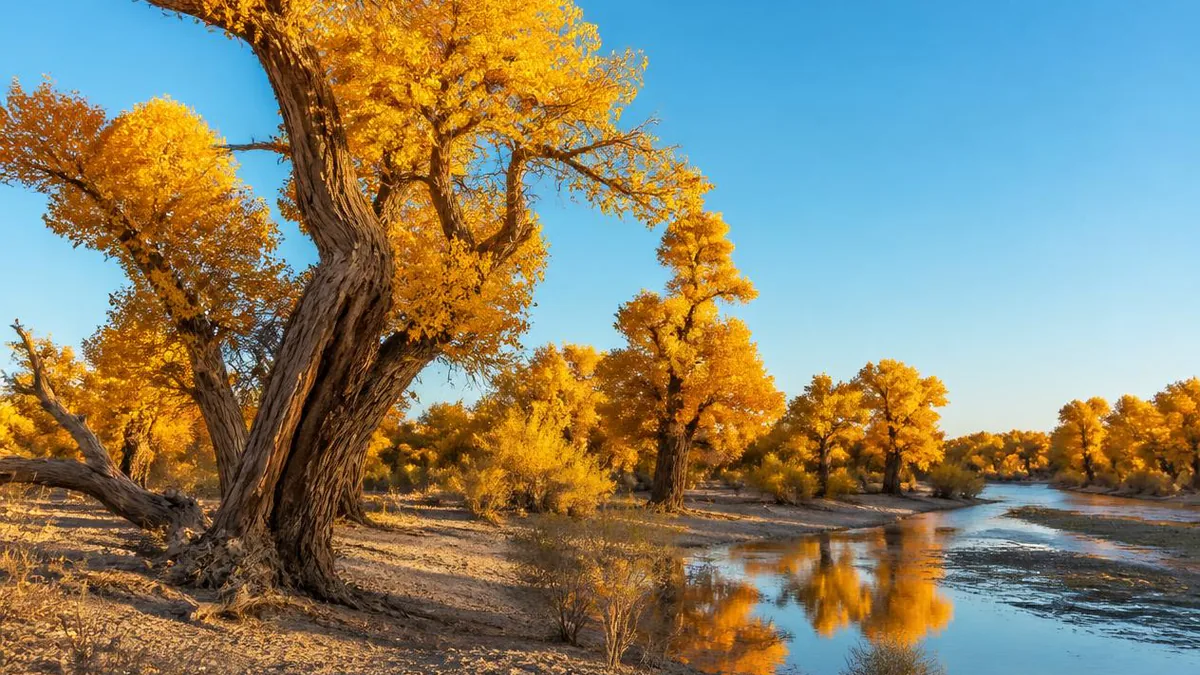
Xinjiang · Yarkand River
Zepu Golden Poplar Forest: How One Tree Survives a Desert
Fifty millimetres of rain a year against two thousand of evaporation—and a forest anyway. Read Xinjiang's desert poplars leaf by leaf: four shapes on one trunk, salt crystallising at old scars, and roots ten metres down.
5A View location, maps and nearby scenic areasZepu county, in the far southwest of Xinjiang, receives about 54.8 millimetres of precipitation in an average year and loses roughly 2,079 millimetres to evaporation. That is a deficit of nearly forty to one. Nothing in that arithmetic predicts a forest.
There is one anyway. On the upper edge of the Yarkand River’s alluvial fan, thirty-odd kilometres southwest of the county seat, stands a large body of desert poplar—Populus euphratica, the tree Uyghur speakers call toghraq. The scenic area sells it as gold: leaves turning in late October, doubled in still water. That is worth seeing.
But the rainfall figure forces a better question than “where is the best photo spot.” How does one tree stay alive here? Almost everything in the park turns out to be part of the answer.
A spindle of land with water on three sides
The park occupies a spindle-shaped tongue of land inside the Yasidun forest farm, enclosed by the Yarkand River and its distributaries—official descriptions say water on three sides. Coordinates run roughly 76°52′ to 77°00′ east and 37°58′ to 38°04′ north, at county elevations of 1,215 to 1,490 metres.
Be careful with areas. Provincial and prefectural sources give the scenic area as 40,000 mu (about 2,667 hectares) with 20,000 mu of natural poplar; the county government says 30,000 mu, travel material 18,000. The forest park’s own planning document gives a total of 2,000 hectares, of which continuous natural woodland is 489 hectares, with forest cover around 76%. These are different boundaries from different decades, possibly on different definitions of “forest.” No single number deserves quoting as if the others did not exist.
In the northeast, along the river, roughly 100 hectares of tamarisk grows as a natural stand, including a nationally protected species. Recorded flora is modest—about 74 species in 51 genera and 21 families—and vertebrates some 102 species, including white and black storks.
One tree wearing four different leaves
Here is the fact that makes this forest worth reading rather than only photographing. A mature desert poplar does not have one leaf shape. It has a sequence.
Botanical reviews describe four forms developing in order: linear, lanceolate, ovate, and serrated broad-ovate. Lanceolate leaves sit mainly in the lower crown, serrated broad-ovate in the upper. The narrow ones look like willow. The broad toothed ones look like the poplar you expected. They can be on the same trunk.
The shift is not decoration, and not tied to a tidy age: researchers index it to trunk diameter and developmental stage. Moving up the crown, leaf width, area and thickness increase while the length-to-width ratio falls.
The two extremes do different jobs. Lanceolate leaves carry more of the light-harvesting proteins—good at capturing photons, weak against strong light and heat. Serrated broad-ovate leaves have greater stomatal density, a higher light saturation point, higher water-use efficiency, more Calvin-cycle enzyme, and tolerate leaf temperatures above 45°C. Cuticular wax covers more than 90% of the surface and thickens through development.
So the tree grows a shade leaf low down and a sun-and-heat leaf up top, from one set of genes. One review predicts that under continued warming the narrow form may decrease or disappear.
Find the leaf boundary yourself
The best thing to do in this park is free.
Pick a large poplar standing clear of its neighbours. Start at the bottom. Look at the leaves on low shoots, on suckers near the trunk, and on any sprouts along the lower trunk. They will tend to be narrow—strap-like or lance-shaped, smooth-edged, thin.
Now look up into the outer crown, with the sun behind you or through a phone zoom. Those leaves should be broader, rounder, visibly toothed along the margin, and thicker—often with a duller, waxier sheen than the ones near your knees.
Then hunt for the boundary. Trace one branch outward and watch the shape change along its length. On some trees the transition is obvious within two metres of height; on others it is so gradual you cannot draw a line. Both outcomes are correct—the literature describes a graded series, not a switch.
Repeat on three trees of different sizes and a second pattern appears: small young trees carry the narrow forms throughout, because leaf shape tracks developmental stage rather than the calendar.
You will have read a drought strategy off the outside of a tree, with no guide and no sign.
The roots are where the tree actually lives
Fifty millimetres of rain does not water a poplar. Groundwater does. P. euphratica is a phreatophyte—a plant that lives off the water table rather than the sky—and in this basin the dependence is close to total.
The root system is the part you never see and should keep in mind anyway. Published accounts describe a taproot reaching more than 10 metres; in an abandoned channel of the Tarim, investigators reported roots still present where the water table lay 13.5 metres down. Popular sources push that past 20 metres, which I would treat as unverified. Horizontal roots spread as a dense network tens of metres across, and excavation studies find almost no fine roots at the surface—density peaks well below, and stays high at nearly three metres where the water table is deep.
That geometry is why the park’s water is infrastructure rather than scenery. The Yarkand River rises in the Karakoram and is fed roughly 64% by ice and snowmelt, carrying water year-round when the Tarim’s other headstreams do not. The forest here is, at one remove, drinking glaciers.
Where the salt goes, and how it ended up in bread
Groundwater in an endorheic basin is salty. Draw on it for a century and the salt has to go somewhere.
The peer-reviewed picture is management rather than expulsion. P. euphratica is reported to grow in soils around 2% salinity and survive up to about 5%, by excluding sodium at the root, sequestering it in vacuoles, extruding it into the apoplast, and diluting it in succulent, thick-walled leaves. Notably, the broad upper-crown leaves accumulate more sodium and chloride than the narrow lower ones, with higher proton-pump activity to package it away. The leaf story and the salt story are one story.
Then there is the part local people have used for centuries. Chinese accounts describe surplus salt seeping out at trunk scars, bark wounds and broken branch stubs, drying into white or pale-yellow crystalline lumps: poplar tears, also called poplar alkali. Composition is usually given as sodium bicarbonate and sodium carbonate, with reported purity of 57% to 71%. Households in southern Xinjiang crushed it into flour to leaven dough; it also went into soap, and under the name hutonglei it entered Chinese materia medica by the Tang dynasty as a dental remedy.
Two caveats. International plant-physiology literature documents exclusion, compartmentation and succulence rather than dedicated salt glands, so the exuding crystals are better described as attested in Chinese sources than as textbook mechanism. And yields conflict by an order of magnitude between accounts. Either way, do not cut bark to go looking.
Seeds that need a flood, and a forest that clones instead
This is where the tree’s fragility becomes arithmetic.
Desert poplar produces staggering quantities of seed—one study measured dispersal of up to 85,743 seeds per square metre across July to September, timed to the summer flood peak. They are viable and extremely fussy about where they land: in one set of trials germination ran about 92% in distilled water and 60.8% on silt, but only 3.6% on unflooded soil. Flood overflow is the primary dispersal mechanism, and freshly deposited wet silt is the nursery.
Remove the floods—with dikes, straightened channels and upstream storage—and that pathway closes. Surveys report that across much of the range the species now largely fails to regenerate from seed in the wild.
What it does instead is clone. Roots running almost horizontally within the top 0.6 metres of soil send up root suckers as far as 40 metres from the parent, a capacity beginning at about 11 to 15 years old. Root suckers were recorded in 86% of surveyed forest gaps, and at the southern fringe of the Taklamakan a single clone has been mapped at 121 hectares.
Which means a poplar forest can look healthy and still not be replacing itself. Count small trees, not big ones.
Four metres is the number that decides this forest
If you remember one figure from this page, make it this one.
Research along the Tarim converges on groundwater depth as the direct control on poplar growth, and on a rough ladder of thresholds. Shallower than about 4 metres is repeatedly described as desirable for growth and restoration. Sap flow becomes abnormal around 4.5 to 5 metres. A 2025 multi-trait study put rapid stomatal closure near 4.65 metres, photosynthetic decline near 5 metres, and community collapse at 6.75 and 7.8 metres. At 9 metres or deeper, partial or total senescence is reported.
The cruel detail is the age ordering. Minimum tolerable depths derived from tree rings came out around 4.0 metres for young trees, 5.0 to 5.4 for near-mature, 6.9 for mature and 7.8 for over-mature. Regeneration fails first. The photogenic veterans die last.
This is balanced rather than simple, and worth stating without a sermon. The Yarkand’s water also underwrites a large irrigated agriculture—Zepu alone reports on the order of 540,000 mu of fruit trees. The Altash dam upstream, impounded in 2019 and the largest water project in Xinjiang, lifted flood protection from roughly a one-in-2.5-year standard to one-in-50 and is reported to release about 330 million cubic metres a year for Tarim ecological flow plus 120 million for downstream poplar forest. The same storage that delivers those releases can also withhold the floods seedlings need. Both facts belong in the same paragraph.
The Poplar King, and a place told to let a prince sleep
About 200 metres northeast of the forest farm headquarters stands the tree the park calls the Poplar King: recorded at 10.05 metres tall with a trunk diameter of 1.2 metres, identified as male, and described locally as a thousand years old.
Hold that last part loosely. Tradition credits the species with “a thousand years alive, a thousand years standing, a thousand years without rotting,” and Chinese scientific summaries deflate all three: typical lifespan is given as 100 to 300 years, rarely approaching 500; “standing” is a dense root network holding a dead trunk upright; “not rotting” is desert air mummifying wood where decay organisms barely function. Fossil leaves from Paleocene strata near Kucha and Dunhuang, reported in 1935, do support the lineage being ancient. The widely repeated 65-million-year figure is standard in Chinese sources but one I could not corroborate internationally—take the fossils as firm, the round number as convention.
Human longevity is claimed here too, on firmer ground. A 2010 household count reported 147 centenarians in a county population of about 220,000, roughly four in five of them Uyghur. The Longevity Folk Culture Village inside the forest farm dates to 1959, and when the county built tourism around it from 2003, local accounts say no household was moved out—residents run guesthouses and sell produce instead.
The place name carries its own story. Yasidun is Uyghur for something close to “let him sleep.” Local history tells of a Karakhanid prince ambushed and buried here during the region’s religious turn, and of a later decision to leave the grave where it lay. Nearby tombs and Buddhist-era traces make this layered ground.
Plan around a three-week gold window
The colour is why most people come, and the least controllable part of the trip. The window commonly cited is mid-October to mid-November. Turn dates shift with the season and vary between riverside and interior stands, so treat any date—including that one—as a forecast.
Recent published prices have been 40 yuan for entry and 20 yuan for the internal shuttle; private cars are not admitted, and the poplar zone is reached from the entrance by that shuttle. Three to four hours covers the standard circuit. All of that is exactly the kind of detail that changes between seasons; confirm it at the gate rather than trusting this paragraph.
Signposted stops include the Poplar King, the Golden Lock Bridge, an oleaster corridor and a preserved courtyard from the sent-down youth era; the park lists more than thirty. Newer additions—a glass walkway, a tourist train, a dinosaur exhibit—are worth knowing about mainly so you can route around them if you came for trees.
Two practical notes. This is a working forest farm and village, not a set, so ask before photographing people at close range. And the gravel and river flats are exposed; carry water and sun protection even in late autumn.
Put your hand on the bark before you leave
Find a poplar with an old scar on it—a broken branch stub, a healed wound, a split in the bark.
That scar is where a tree in a salt basin puts its surplus. Above you, its upper leaves are wide, toothed and waxed against heat that can pass 45°C; below you, the narrow ones work the dim light under the canopy. Beneath your feet, roots you will never see hold a line ten metres or more down, following a water table fed by Karakoram ice, and push up clones because the floods that once planted seeds mostly no longer arrive.
The gold is real, and it photographs well. But it is only the last fortnight of a problem solved over and over, longer than anyone here has been counting. What is worth carrying out of Zepu is the solution rather than the colour: a tree that changed its leaves, moved its salt, sank its roots and gave up on seeds—and a forest whose future is written in metres of groundwater.
Location profile
Where it is

Frequently asked questions
Why does one desert poplar have differently shaped leaves?
The species is heterophyllous: botanical reviews describe four leaf forms developing in sequence—linear, lanceolate, ovate and serrated broad-ovate—with the narrow lanceolate leaves concentrated in the lower crown and the broad toothed ones in the upper crown of the same tree. The difference is functional rather than cosmetic. Lanceolate leaves carry more light-harvesting protein and cope poorly with strong light and heat; serrated broad-ovate leaves have greater stomatal density, a higher light saturation point, higher water-use efficiency, and tolerate leaf temperatures above 45°C. Researchers index the change to trunk diameter and developmental stage rather than to a fixed age, and describe it as a graded series rather than a switch.
When do the poplars turn gold at Zepu?
The window commonly cited for this park is mid-October to mid-November, and the scenic area's own promotion is built around it. Turn dates move with the season, and the leaves do not change everywhere at once—riverside stands and drier interior stands can be a week or more apart. Treat any specific date you read, including this one, as a forecast rather than a schedule, and check current conditions before booking a flight around a single weekend.
What are the white crystals sometimes seen on desert poplar trunks?
Chinese accounts describe excess salt seeping out at trunk scars, bark wounds and broken branch stubs, then drying into white or pale-yellow crystalline lumps known as poplar tears or poplar alkali. Composition is usually given as sodium bicarbonate and sodium carbonate, with reported purity of 57 to 71 percent. Households in southern Xinjiang crushed it into flour as a leavening agent for centuries, and under the name hutonglei it entered Chinese materia medica by the Tang dynasty, mainly as a dental remedy. Reported yields differ by an order of magnitude between sources, so treat quantities cautiously—and do not cut bark to look for it.
How long do desert poplars actually live?
Popular tradition credits the species with a thousand years alive, a thousand years standing and a thousand years without rotting, and this park's signature tree is described locally as a millennium old. Chinese scientific summaries are more conservative: a typical lifespan of roughly 100 to 300 years, rarely approaching 500. The other two thousands have explanations rather than confirmations—a dense root network holds dead trunks upright, and desert air mummifies wood in the near-absence of decay organisms. The species itself is genuinely ancient as a lineage, with fossil leaves reported from Paleocene strata in Xinjiang and Gansu.
Sources and further reading
Background references for the history and place names in this guide. Opening hours, ticketing and access change often — always confirm with official local information before travelling.