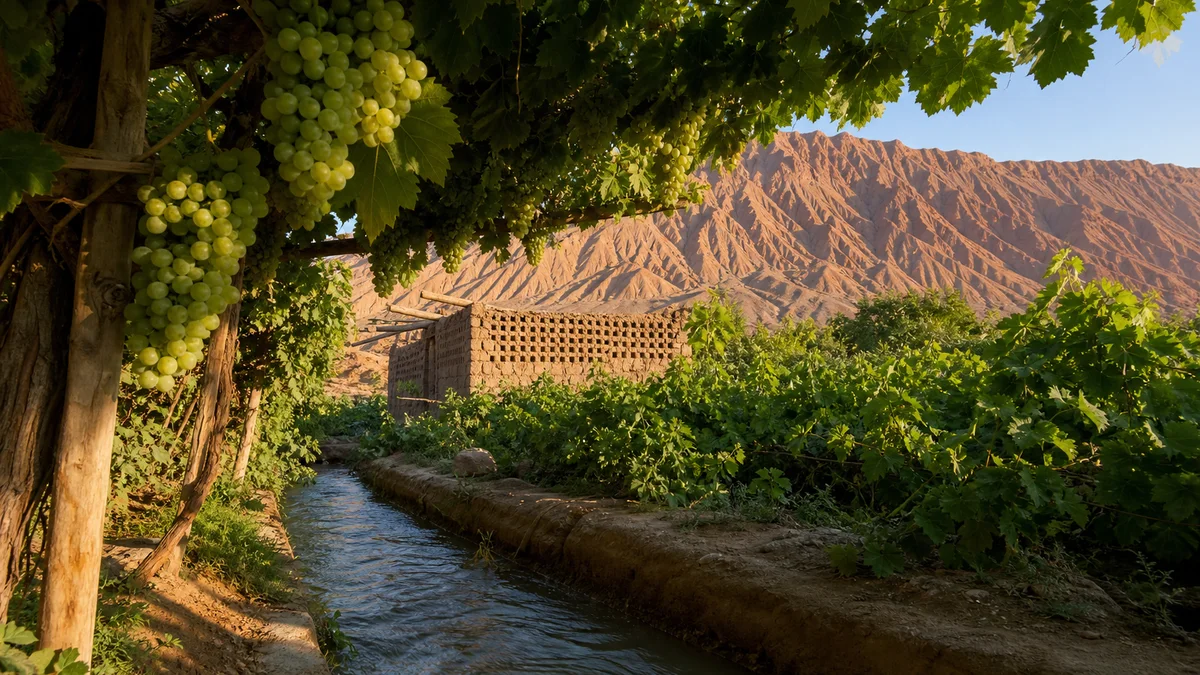
Xinjiang · Turpan Oasis
Turpan Grape Valley: Follow the Water beneath the Vines
Step under Turpan's vine trellises and read the oasis from the ground up: moving water, engineered shade, seedless white grapes and wind-breathing rooms that turn fruit into green raisins.
5A View location, maps and nearby scenic areasStand under the first dense trellis and look in two directions. Above you, sunlight breaks into moving green coins. Below, water runs through a narrow channel beside roots planted in one of China’s driest basins. Turpan Grape Valley makes sense only when you hold those two views together: the canopy is beautiful, but water made it possible.
Grape Valley—Putaogou, pronounced roughly poo-taow-go—cuts into the western end of the Flaming Mountains near Turpan. It is a scenic area, an agricultural landscape and a neighbourhood where families have grown fruit, managed irrigation and received visitors across generations. The right question is not simply “Which grape is sweetest?” It is “How does a green corridor keep working inside a desert?”
Read the valley as a four-part system: mountain water creates the oasis; trellises turn vines into shade; hot, dry air concentrates sugar; perforated drying houses convert fresh grapes into raisins. Follow that sequence and the souvenir stalls become the final chapter, not the whole story.
A green ravine measured two ways
Published descriptions give Grape Valley a length of about 7 or 8 kilometres and a width that varies from roughly 600 metres to 2 kilometres. The difference is not a mystery to solve with false precision: sources may measure the named ravine, the cultivated corridor or the wider scenic boundary. On the ground, its shape matters more than a single number.
The valley is long and narrow enough to collect water, cultivation, homes and roads in one strip. Look beyond the trellises and the bare, folded slopes of the Flaming Mountains reappear. That edge—the place where green planting stops and red-brown rock begins—is the most useful orientation point in the landscape.
Official descriptions call the valley a fold or opening on the southern side of the Bogda range and identify the Builuk River, also called the People’s Canal in some accounts, as a watercourse through it. Do not let the marketing phrase “natural oasis” hide the human work. Channels need cleaning, vines need pruning, trellises need repair and water must be shared.
The shade above you is agricultural engineering
A grape trellis is a small climate machine. Training vines overhead lifts fruit away from the path, spreads leaves towards the sun and creates a shaded working space below. For visitors, it feels like a green tunnel. For growers, it is an arrangement of light, air, labour and harvest access.
Turpan’s intense sunshine and dry air help grapes accumulate sugar and reduce fungal pressure, while irrigation supplies what the sky does not. Coolness under a trellis is relative, not magical: shade can make a dramatic difference, but the valley remains hot in summer and open sections can be fierce.
Pause where one row is visible from the side. Trace a trunk from soil to branch, then follow the horizontal arms across the support. Leaves are the solar surface; clusters hang below; water works out of sight through roots and channels. A photograph of grapes alone records the product. A frame containing channel, trunk, trellis and dry mountain records the system.
Karez explains Turpan—but label the water carefully
Turpan is famous for karez irrigation, related to the qanat systems found across arid Eurasia. Workers dug a gently descending underground gallery towards water-bearing ground, then opened a line of vertical shafts for excavation and maintenance. Gravity carried water towards fields and settlements; keeping much of the route underground reduced evaporation.
From above, a karez can resemble a dotted line of shallow craters crossing empty land. Underground, those dots connect to one long passage. The technology helped oasis communities support farms and Silk Road traffic in a basin where exposed water disappears quickly.
But do not call every stream or concrete ditch in Grape Valley a karez. The visible watercourse here is also described through the Builuk River and the People’s Canal, while Turpan’s wider irrigation network combines underground galleries, springs, canals, reservoirs and modern wells. Onsite signs may identify a particular source; without that evidence, “irrigation channel” is the honest term.
This distinction also prevents an easy myth: a clear scenic channel does not mean water is limitless. Karez conservation across Turpan faces changing groundwater use, agricultural demand and a warming mountain environment. The vines are proof of successful water management, not proof that scarcity has disappeared.
Grapes carry a Silk Road history without one origin story
Turpan grew as an oasis on routes around the Taklamakan Desert. Merchants, monks, envoys and armies moved through the region, carrying crops, tastes and techniques in more than one direction. Grapevines belong to that connected history, but it is too simple to claim that one named caravan “brought the first grape” to this exact valley.
By the Ming period, written agricultural accounts praised seedless green grapes from the western regions. In the Qing era, poet Xiao Xiong described the Turpan scene in Poems and Notes on the Western Regions:
“Pale vines spread over trellises before the eaves,
round pearls hang everywhere in clustered strings.”
His next lines invoked Dayuan, the ancient Chinese name associated with the Ferghana Valley, to give the fruit a prestigious western flavour. The poem is not a shipping record. Its value is more intimate: it places vines over household eaves, exactly where agriculture, architecture and daily shade meet.
That image has a modern echo. Generations of Chinese schoolchildren have encountered Grape Valley through a primary-school text about fruit ripening under thick leaves. A place once described in frontier travel writing became part of national childhood memory. When you walk under the trellis, you are inside both an agricultural space and a sentence many Chinese visitors learned years before arriving.
Read the label before deciding which grape is “the” grape
The signature variety is the seedless white grape, often called wuhebai in Chinese. When ripe it can appear pale green rather than paper-white. Other names you may see include the long mare’s-teat grape, red and black grapes, aromatic varieties and cultivars introduced from elsewhere.
A Xinjiang government overview published in 2019 listed 52 varieties in the valley. Treat that as a documented snapshot, not an eternal inventory: collections, names and planted areas change, and a display garden is not the same as a commercial field.
Compare shape, skin colour, seed, aroma and acidity instead of ranking every sample by sweetness. Ask which variety you are tasting and whether the price is per portion or by weight before accepting a large plate. Fruit straight from a display vine may not be available for picking; wait for a clear invitation or buy from the grower.
Claims that one grape is “the sweetest in the world” belong to promotion unless a test, variety and harvest are specified. The more interesting fact is how growers use strong sun, dry air, irrigation and variety choice to produce distinctly sweet fruit in an arid basin.
The perforated house turns wind into a tool
Look for a plain earthen or brick structure whose walls are punctured by rows of openings. This is a grape-drying house, known in Uyghur as chunche and in Chinese as liangfang or “drying room.” Its dark interior and porous walls are not unfinished construction. They control sun and airflow.
Fresh bunches are hung on racks inside. Hot, dry wind passes through the openings and removes moisture while direct sunlight is limited. The process commonly takes about 40 days, though grape size, weather, ventilation and the desired result all matter. Shade- and air-dried raisins often remain green or yellow; grapes dried directly in strong sun usually darken more.
Stand back and read the façade like a piece of equipment. The wall filters light, admits air and protects hanging fruit. One grape has now linked four structures: the mountain water system, the vineyard trellis, the household or farm economy and the drying room.
Do not enter a working drying house without permission. Racks can be fragile, floors uneven and the fruit is somebody’s crop, not a prop. If an interpretation room provides a view inside, use it to compare fresh cluster, partially dried fruit and finished raisin.
This is a visitor attraction inside a lived landscape
Grape Valley contains ticketed visitor zones, displays, shops, staged performances and family-run courtyard experiences. It also contains homes, work areas, orchards and irrigation infrastructure. A courtyard offered to visitors can be welcoming and commercial at the same time; neither fact makes the encounter false.
You may see music, dance or dawaz, the Uyghur tradition of high-wire performance. A scheduled show can introduce real skills, but its time and format belong to the tourism programme. Confirm the day’s schedule and do not treat every resident in festive clothing as permanently performing.
Ask before photographing people at close range, especially inside courtyards. Do not peer through private doors, handle tools or pose children. Buying fruit, raisins or a meal directly can support local households, but ask about price and origin with the same ordinary clarity you would use in any market.
Tourism changes the valley as well as sustaining it. Visitor income can support businesses and landscape maintenance; crowds can also turn working lanes into sets and reward simplified stories. The most respectful visit keeps the workers, water and present-day choices visible alongside the “timeless oasis” image.
Follow water, shade and wind in that order
For a two- to three-hour core visit, begin at an orientation map and ask which walking sections, shuttles and demonstrations are operating. Start with a vine corridor while your attention is fresh. Find an irrigation channel and identify the direction of flow. Then compare labelled grape varieties before visiting a drying-house display. Finish at an authorised open viewpoint where cultivated green meets the Flaming Mountains.
With half a day, add a slower courtyard stop, a meal or tasting and time to study more than one trellis. If a museum or cultural presentation interests you, check its current schedule rather than building the entire route around an old listing.
Shuttles can reduce distance but may separate you from the agricultural transitions that make the valley intelligible. Walking reveals more, yet surfaces may include ramps, kerbs, steps, wet paving and exposed road sections. A mixed route—vehicle for the long connection, walking for the vine-and-water core—is often the best compromise.
Combine Grape Valley with another Turpan site only if heat and travel time leave a safe margin. Flaming Mountains, a karez museum and the ancient cities explain different parts of the oasis, but collecting all of them in the hottest hours can turn understanding into endurance.
Taste with attention, not as a challenge
Fresh grapes vary by season. Raisins, nuts, melon and other dried fruit are easier to offer year-round, though stock may come from different farms or parts of Xinjiang. Ask what was grown locally, which grape made a raisin and whether anything has been sweetened or treated.
Use clean serving utensils, wash fresh fruit when appropriate and tell a host about allergies. Dried fruit concentrates natural sugar; the sensible tasting is comparative, not unlimited. Tea may be offered with fruit, but hospitality does not remove the need to confirm what is complimentary and what is sold.
The useful souvenir question is not “Which bag is most expensive?” Compare variety, texture, dryness and packing date. Green does not automatically mean fresher, and dark does not mean inferior; drying method changes colour.
Plan for heat, uneven edges and honest photographs
Summer heat is the main safety condition. Carry water, sun protection and any medication you need; use the trellised route, but do not assume shade continues between zones. Early or later light is often gentler for walking and photographs, yet opening and transport times must be confirmed locally.
Some main paths may be paved, but narrow channels, kerbs, steps, courtyard thresholds and vehicle boarding can complicate wheelchair or limited-mobility access. Ask staff for the shortest step-free circuit and accessible toilet information. Irrigation edges can be slippery; keep children away from unguarded water and working areas.
For photographs, expose for the bright gaps between leaves so grapes retain detail. A low diagonal view along a trellis shows repetition; a side view with dry slopes beyond explains the oasis. In a drying-house façade, use the pattern of ventilation holes as scale. Confirm current drone rules and never step into planted rows for a cleaner composition.
Leave by looking at where the green stops
Before you go, stand where the trellis opens and the bare mountain returns. On arrival, the contrast may have looked like a miracle of nature: desert outside, cool grapes within. Now the boundary should feel more demanding.
Every metre of green contains gravity, channels, pruning, shared water, harvested fruit, drying wind and people adjusting an old oasis system to present conditions. Lower the camera for one minute and listen for water beneath the leaves. Grape Valley’s deepest sweetness is not a superlative on a sign. It is the fact that a desert ravine has been made habitable—and must be made habitable again each season.
The LoreLens app can help you identify trellis structures, irrigation features and drying houses while explaining the oasis system around them.
Location profile
Where it is

Frequently asked questions
What makes Turpan Grape Valley special?
Grape Valley concentrates the logic of a Turpan oasis into one ravine: water descends from the mountains, vines turn it into fruit and shade, and ventilated drying houses use hot, dry air to make raisins. The contrast with the bare Flaming Mountains is as important as the grapes themselves.
Is every water channel in Grape Valley part of a karez?
No. Turpan's karez systems carry groundwater through gently sloping underground galleries, but Grape Valley is also associated with the Builuk River and the People's Canal. Treat a visible channel as irrigation infrastructure unless onsite interpretation identifies its source.
When are grapes ripe in Grape Valley?
Different varieties ripen at different times, but summer through early autumn is the broad fruit season and August to September is commonly associated with the main grape harvest. Weather and farm schedules vary, so confirm current conditions rather than expecting every trellis to be full.
How long should I allow for Grape Valley?
Two to three hours can cover a vine corridor, irrigation channel, variety display and drying-house stop; a half day allows a slower courtyard visit, tasting and viewpoints. Shuttle routes, performances and open areas can change, so check the current circuit at the entrance.
Sources and further reading
Background references for the history and place names in this guide. Opening hours, ticketing and access change often — always confirm with official local information before travelling.