Guangxi · Dong Villages
Chengyang Eight Villages: Cross the Bridge into Dong Life
Begin with Chengyang's roofed Wind and Rain Bridge, then walk beyond the postcard into eight living Dong villages shaped by drum towers, rice fields, timber craft and songs carried without a conductor.
5A View location, maps and nearby scenic areasBefore you photograph the bridge, walk into it. Rain taps on grey tiles, the river flashes between timber rails, and a bench turns a crossing into somewhere to pause. Chengyang Wind and Rain Bridge makes its first point through your feet: in a Dong village, architecture does more than stand beautifully. It connects people and gives them room to meet.
The bridge is the famous face of Chengyang Eight Villages—Chengyang, pronounced roughly chung-yahng—but it is not the whole destination. Beyond it lies a connected landscape of homes, drum towers, lanes, fields and streams belonging to eight Dong communities. The Dong, who may also be called Kam in English-language scholarship, are one of China’s officially recognised ethnic groups with their own language and a celebrated tradition of multipart singing.
Read the landscape in three layers: Wind and Rain Bridges join the route, drum towers mark community centres, and houses and fields reveal everyday life. If you only collect the first layer, you have seen the icon but not the villages.
Eight villages, not one heritage set
The scenic area gathers eight neighbouring settlements in Linxi, Sanjiang Dong Autonomous County, in northern Guangxi: Ma’an, Pingzhai, Yanzhai, Dongzhai, Dazhai, Pingtan, Pingpu and Jichang. Romanised spellings vary, which is why maps and signs may not always match letter for letter.
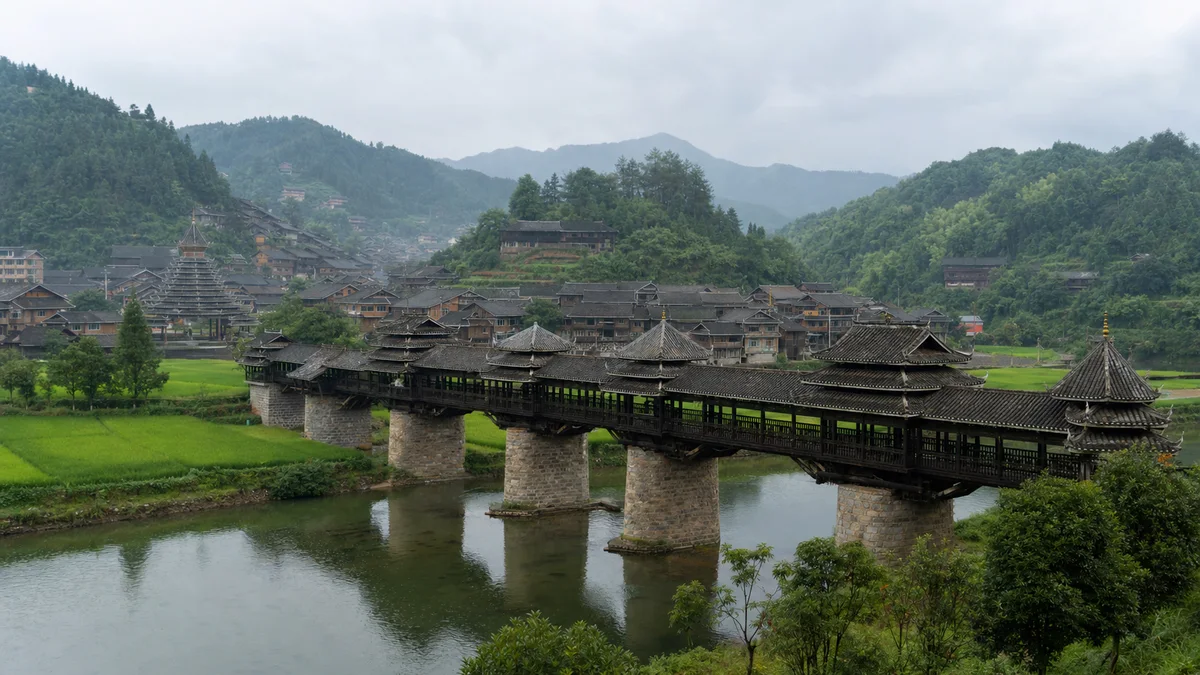
The villages sit along the Linxi River and its cultivated valley. Rooflines overlap, footbridges shorten the route between communities, and rice fields occupy flatter ground between wooded hills. From a high viewpoint, the pattern is clear: this is not one monument with scenery behind it, but a settlement system organised around water, farming and paths.
“Eight Villages” also describes a visitor area layered over lived-in communities. Tickets, shuttles, shows and restored public spaces belong to the tourism system; kitchens, schools, workshops, fields and family courtyards belong to daily life. The two share the same lanes. That overlap is what makes Chengyang rewarding and what asks most from a considerate visitor.
Start by reading Chengyang Wind and Rain Bridge
The best-known structure is also called Chengyang Yongji Bridge. It was built in the early twentieth century, commonly dated to 1912, and is often described as about 64.4 metres long, 3.4 metres wide and roughly 10 metres high. Measurements can differ slightly by source, but the form matters more than a decimal point.
Begin with the stone piers in the river. Above them sits a covered timber corridor, interrupted by five pavilion-like towers with rising tiled roofs. The roof protects walkers from sun and rain; railings and benches make it possible to stop; the towers give a practical crossing the silhouette of a small linear palace.
Now notice what is absent: the bridge does not require one huge arch to jump across the water. Loads pass from the timber superstructure into multiple stone supports. The repeated bays distribute weight and create sheltered rooms along the route. Engineering, climate and social use arrive in one design.
Do not hurry straight through. Look upstream and downstream from different openings. A Wind and Rain Bridge edits the landscape into a sequence of framed views, one river scene per bay.
“No nails” is an invitation to look closer
You will often hear that Dong bridges and drum towers were built “without a single nail.” The useful truth behind the slogan is interlocking timber joinery: carpenters shape posts, beams and brackets so that fitted wooden members transfer loads through compression and carefully planned connections.
The absolute version is less helpful. Roof tiles, metal fittings and later conservation work are different questions from the primary frame, and a century-old bridge has a maintenance history. Rather than trying to win a nail-counting contest, look at how horizontal beams meet vertical posts, how brackets step outward below an eave, and how one repeated joint becomes a whole structure.
This is knowledge held in hands as much as in drawings. Dong carpentry was historically transmitted through masters, apprentices, measurements, templates and collective building practice. The modern echo is visible whenever damaged timber is surveyed and repaired: preserving the bridge requires preserving the people who know how its logic works.
Drum towers are village living rooms turned vertical
Once you enter the villages, find a drum tower and stand far enough back to see its full outline. Tiered eaves rise around a central timber frame, making the roof appear to stack upward like a tree. Different villages have distinct towers, and size alone does not tell you which community matters most.
Historically, the drum could summon residents for warnings, deliberation or collective action. The sheltered space below served as a place to talk, rest, settle matters, welcome guests and gather around a fire. Think of it as a town hall, community notice system and living room combined—then expressed through carpentry rather than a stone façade.
If people are meeting inside, do not assume the space has become a performance stage because it appears on your map. Stay at the edge until invited, keep passageways clear, and ask before photographing faces. Public architecture can still host private moments.
“Rice nourishes the body; songs nourish the heart”
A saying frequently associated with Dong culture declares:
“Rice nourishes the body; songs nourish the heart.”
The first half belongs to the fields around you. Rice cultivation shaped labour, seasons, food and settlement. The second belongs to Dong Grand Song, a multipart choral tradition inscribed by UNESCO on the Representative List of the Intangible Cultural Heritage of Humanity in 2009.
Grand Song is striking because multiple vocal lines interweave without a conductor in the Western orchestral sense. Traditionally, songs were passed from older singers to younger ones through listening and practice rather than a conventional written score. Repertoire can carry stories, social knowledge, courtship, memory and close observation of nature; some vocal textures echo insects, birds or flowing water.
Tourism creates a turn in this story. A scheduled presentation can give visitors a valuable first encounter and income can support performers, but a short stage set is not the entire tradition. The deeper modern echo lies in children learning from elders and communities continuing to sing for their own occasions. Listen for the relationship between voices, not only for a soloist—Grand Song’s power is collective.
A living village is not an open-air museum
Timber houses are often described as diaojiaolou, buildings adapted to slopes with parts of the structure raised on posts. Ground levels may serve work or storage functions while family life occupies upper floors. Smoke-darkened wood, patched walls, concrete additions, electric cables and satellite dishes can appear in the same lane.
Do not edit those modern details out of your understanding. Heritage villages are sometimes marketed as places where time stopped; Chengyang is more honest and more interesting when you recognise adaptation. Families want safe wiring, plumbing, schools, phones and easier transport while also maintaining houses, bridges, festivals and language.
Tourism can help finance conservation and local businesses, yet it can also raise property pressure, turn customs into fixed showtimes and concentrate visitors in a few picturesque lanes. Residents do not owe every camera a timeless scene. Buy food and crafts with normal courtesy, avoid peering into windows, and treat doorways without clear signs as private.
Choose a half-day core or a full-day village circuit
For a half-day visit, begin at Chengyang Wind and Rain Bridge before the busiest period if possible. Cross slowly, continue into Ma’an and the nearest village lanes, locate at least one drum tower, and climb to an authorised viewpoint that reveals bridge, roofs and fields together. This gives you the architectural grammar without pretending to cover all eight communities.
For a full day, extend the walk through additional villages and cultivated ground. The reward is repetition with variation: another bridge uses a different span, another drum tower changes its profile, another lane shows how buildings meet a slope. Pause for lunch or tea rather than treating the route as a checklist.
The complete circuit is not one perfectly flat heritage promenade. Expect stone paving, uneven thresholds, bridge approaches, occasional steps and stretches exposed to rain or heat. Visitor shuttles may reduce some road walking, but routes and stops change. Ask at the entrance which paths are open and arrange a shorter loop if mobility or weather requires it.
Taste the valley without turning food into a dare
You may encounter youcha, often translated as oil tea: a savoury, warming preparation whose exact ingredients and accompaniments vary by household and shop. Glutinous rice, pickled vegetables, river fish, pork and seasonal produce also appear in local cooking.
Ask what is included, especially if you have allergies or dietary restrictions; translated menu names may not list broths, peanuts or other ingredients. Shared hospitality matters more than proving you can eat everything. A simple question and genuine attention to the answer travel better than treating a family’s food as an exotic challenge.
Craft stalls may sell textiles, silver-coloured ornaments and woodwork. Ask whether an item was made locally and by whom rather than assuming every product beside a heritage site is handmade in that village. The conversation is part of buying responsibly.
Photograph relationships, not costumes alone
For the classic bridge view, look for an authorised elevated position where the Wind and Rain Bridge crosses diagonally through the frame. Early or late light gives texture to dark timber; after rain, roofs and fields deepen in colour. Reflections depend on current, water level and wind, so they are never guaranteed.
Inside the bridge, use the repeated posts as a frame and expose for the brighter river outside. Near a drum tower, include surrounding houses or people at a respectful distance to show its community role. From higher ground, a moderate focal length can compress bridge, roofs and fields into one legible settlement pattern.
Do not ask residents—especially children—to dress, pose or interrupt work unless they clearly offer a portrait. Ask before close photographs, accept “no” immediately and check current drone restrictions. Wet stone and timber can be slippery; a safe foot position is worth more than a perfectly centred image.
Cross the bridge a second time
On arrival, Chengyang’s bridge can look like the entire reason to come: five roofed towers floating above a green river. By the time you return, it should look different. It is now connected to carpenters, singers, farmers, shared meetings, repaired houses and eight villages negotiating how to remain both home and destination.
Cross once more without stopping at every opening. Listen to footsteps under the roof and voices moving ahead of you. The bridge’s finest achievement is not that it survived as an object. It is that, more than a century after it was built, people and stories still pass through it.
The LoreLens app can help you identify the bridge’s towers, timber joints and nearby drum towers while narrating the living culture around them.
Location profile
Where it is

Frequently asked questions
What are the Chengyang Eight Villages?
They are eight connected Dong villages in Linxi, Sanjiang Dong Autonomous County, Guangxi: Ma'an, Pingzhai, Yanzhai, Dongzhai, Dazhai, Pingtan, Pingpu and Jichang. English spellings vary because the names are transliterated from Chinese and local speech.
Was Chengyang Wind and Rain Bridge really built without nails?
Its traditional timber frame relies mainly on fitted wooden joints, a hallmark of Dong carpentry. 'Built without a single nail' is a memorable shorthand, but visitors should not treat it as a forensic claim about every tile, fitting or later repair.
How much time do I need at Chengyang Eight Villages?
A half day can cover the main Wind and Rain Bridge and nearby central villages; a full day gives more time for outer villages, fields, drum towers and unhurried meals. Shuttle routes, performance times and open paths can change, so confirm the current visitor circuit on arrival.
Can visitors hear the Dong Grand Song at Chengyang?
Cultural presentations often include Dong singing, but schedules and formats vary. Grand Song is a living community tradition, not only a stage number. Check the day's programme, listen quietly, ask before close-up photography and do not assume every gathering is a public performance.
Sources and further reading
Background references for the history and place names in this guide. Opening hours, ticketing and access change often — always confirm with official local information before travelling.