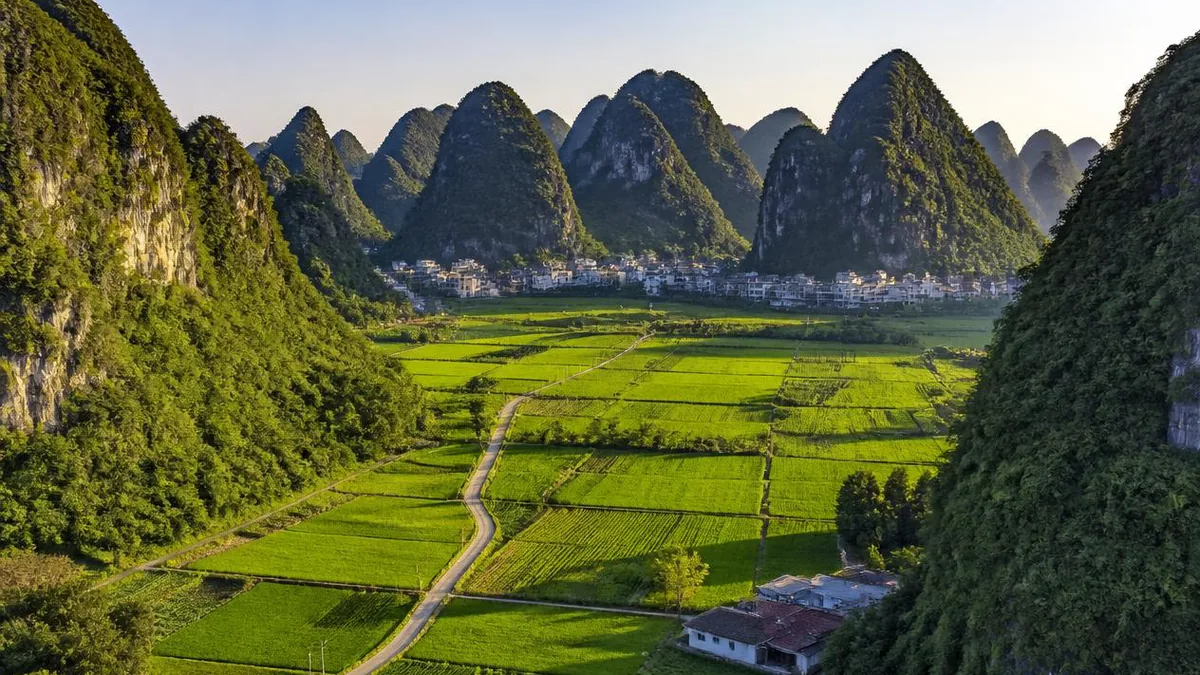
Guangxi · Guilin
Yangshuo: The County Town That Was Rebuilt Twice by Outsiders
A small county seat at the end of the Li River cruise was remade in the 1980s and 1990s by foreign backpackers and climbers, and then remade again after most of them left. Both rebuildings are still legible on the same street.
The Li River cruise ends here. That single fact has organised the last forty years of this town.
Yangshuo is a county seat in the karst country southeast of Guilin, with a resident county population given as about 273,000 at the 2020 census and most of it in and around the town. It is not a village and it is not a resort. It is an ordinary administrative centre that happened to sit at the downstream end of China’s most photographed stretch of river, and that was therefore among the first small inland places in the country to be handed a foreign clientele.
What makes it worth a separate article from the river is that the clientele has now largely gone, and the town it built is still standing.
A county much older than its famous street
Yangshuo County was established in 590 CE, under Emperor Wen of the Sui, and it kept the name and the seat through the Tang, the Song reorganisation of Guizhou into Jingjiang, the Yuan and the Ming, when the prefecture became Guilin. It has been under Guilin municipal administration continuously since 1981.
There is a detail in the county’s own history that later became load-bearing: at the time of establishment the seat had a street about five metres wide and two hundred metres long, and that alignment is the ancestor of today’s West Street. A separate account dates the walled town proper to 1408, in the Yongle reign of the Ming. Neither claim is extraordinary, and together they mean the tourist street is a genuinely old street rather than a reconstruction.
The town also holds more conventional heritage than its reputation suggests, most of it ignored by the crowds a hundred metres away: the former residence of the painter Xu Beihong, who worked here in the 1930s; a hall and a site commemorating a visit by Sun Yat-sen; and the cliff inscriptions on Bilian Peak, the green pinnacle that closes the southern end of the riverfront. The county’s small municipal park and the walled-garden site by Binjiang Road charge modest entry and are usually empty.
The county’s productive base is worth knowing because it is still visible from any bicycle. Six towns and three townships; a landscape of karst hills and basins with the Li running north to south through the middle; the highest point in the northeast reaching 1,701 metres; and a fruit economy — kumquats, pomelos, summer oranges, ponkan, persimmons and chestnuts — with the Yangshuo kumquat carrying a geographical-indication designation.
The end of the boat
Understand Yangshuo’s relationship to the Li River as arrival, not ownership.
The cruise from Guilin, about 83 kilometres, docks here. By road the town is about 70 kilometres from Guilin, which is why the standard itinerary is boat down, bus back. Most of the river scenery people associate with Yangshuo is technically upstream of the town, in Xingping, which is about 25 kilometres away and is itself part of Yangshuo County — the reason the high-speed railway station in Xingping is officially named Yangshuo Station, roughly 36 kilometres from the county town by road.
This geography created the town’s original business. Visitors arrived in the afternoon with the rest of the day unplanned, no train out, and one street of accommodation. Yangshuo’s entire economy is the answer to the question of what those people do next.
How West Street became bilingual
The sequence is well documented and worth stating precisely, because it is a rare case of a Chinese county town internationalising from the bottom up.
Domestic tourism here was already routine by the 1970s, and the local government worked to open the county to foreign visitors, European and American included. Through the 1980s the town became a fixture for young independent travellers — a stop on the overland Hong Kong to Kunming route and the Chinese extension of the Southeast Asian backpacker circuit. Foreign arrivals grew through the following decades, with West Street as the hub, and because visitors and residents used the street together, signage went up in Chinese and English side by side. A side effect that persists: a much higher proportion of local people speak some English than in comparable Chinese towns, and an English-teaching industry grew up to serve both directions.
Two commonly repeated claims deserve flags rather than repetition. One is that by the 1990s nearly all shops on West Street were run by foreigners; the other is that foreign visitors outnumbered domestic ones by 2005. Both appear in reference summaries without a clear underlying statistic, and both are difficult to reconcile with the scale of Chinese domestic travel even then. We would read them as descriptions of atmosphere rather than counts.
The second rebuilding
The part most guides have not caught up with is what happened after.
By August 2023, travel sources reporting from the ground described most resident foreigners as having left during the pandemic period, very few foreign visitors on the streets, and the majority of foreign-owned or foreign-focused businesses closed. The verdict was blunt: Yangshuo had become very much a domestic Chinese destination.
The volume did not fall. West Street is reported to have received over 21.1 million visitors in 2023. What changed was who they were and what they wanted, and the street adapted: more photo-oriented retail, more short-stay groups, more evening spectacle, fewer people staying three weeks to learn to climb.
One institutional fossil of the earlier era is the county’s list of foreign partnerships, which is longer than a place this size would normally accumulate: Morehead in Kentucky, Rapid City in South Dakota, Bled in Slovenia, and Annecy-le-Vieux in France, plus a Russian sister city. The dates attached to these do not agree between sources — one set gives 1994, 2000, 2009 and 2011, another gives 2011 and 2013 for two of the same pairings — so we would treat the list as reliable and the years as not. Small county governments do not normally acquire American and European twins; this one did because its street was full of Americans and Europeans.
So the honest description of West Street today is neither “authentic foreigner quarter” nor “fake tourist trap.” It is a streetscape built for one kind of traveller and now occupied by another, with the bilingual shopfronts left in place because they read as cosmopolitan. Parallel to it runs Diecui Road, the newer tourist axis, with a small creek and Guihua Road between them.
Sport climbing: the other thing outsiders built
The climbing scene is the most durable thing the foreign years left behind, because it is infrastructure rather than fashion.
Yangshuo has over 300 routes distributed across many crags, with difficulties from roughly 5.6 to 5.13. Much of the early development was done by visiting foreign climbers in the 1990s; the American climber Todd Skinner is credited with pioneering a number of the lines at Moon Hill, which remains the most famous crag and carries several routes graded 5.13. Other named crags include Low Mountain, Twin Gates, Baby Frog, the Egg, Bamboo Grove and Wine Bottle Cliff. A local guidebook of route topographies is sold in the climbing shops, and the shops themselves function as the partner-finding network.
Access is governed by a specific and instructive episode. Climbing at Moon Hill was banned from the first half of 2017, after a piece of falling debris nearly hit a security guard on the viewing deck; during the ban climbing was permitted only during the annual festival in late October. The hill was then leased to a new private company, which met the Yangshuo Climbers Association and removed the ban at the end of 2019, on the condition that routes be inspected annually with the inspections funded by the climbers’ compulsory insurance. That is an unusually explicit settlement between a landholder and a user community, and it is why the crag is open at all. A 2025 travel listing records the hill as temporarily closed again, so verify before you plan around it.
Moon Hill, measured
The arch is worth separating from the climbing, because it is a textbook landform.
Moon Hill stands south of the town across the Jinbao river along the national highway. Published measurements give an elevation of about 380 metres, a relative height of 230 metres, a length of 410 metres, and an arch about 50 metres high. The hole is not a natural bridge in the erosional sense; it is the surviving span of what was once a limestone cave formed below the water table, with the rest of the chamber weathered away.
The walk up is commonly given as about 1,000 steps and twenty minutes to the arch, longer to the summit above it. There is an entrance fee, and vendors follow walkers up and down. On the road back towards town lies the Big Banyan Tree park beside the Yulong, built around a banyan usually described as 1,400 years old, and the Assembling Dragon Cave, a lit show cave between the two.
The Yulong is not the Li
This is the practical confusion the town generates most often.
The Yulong is a right-bank tributary that rises in the south of Lingui District, runs southeast and then east, takes in the Jinbao river near the Big Banyan, and joins the Li at the Gongnong Bridge below Shutong Hill on the southeastern edge of the county town. Its older name was Anle Shui; the present name comes from the Yulong Bridge, a stone arch on the upper river usually described as around four hundred years old.
Its length is genuinely unsettled: one hydrological description gives a main stem of 54 kilometres with a catchment of 665 square kilometres, another gives 45.9 kilometres with 32.2 kilometres inside the county and a catchment of 356, and an English summary says over 35 kilometres. These are different starting points, not different rivers.
What matters on the ground is that it is shallow — maximum depth around five metres, average width around twenty-five — that there are no motorboats, and that a series of low weirs has been built across it roughly every kilometre so that people and animals can cross. Rafts go over those weirs in a short drop, which is most of the entertainment. The valley floor is farmland, and the riverside tracks are the best cycling in the county. It floods suddenly, which is one reason there is relatively little building close to the bank.
The show on the river, and the format it started
Impression Liu Sanjie is staged on about two kilometres of the Li below Shutong Hill, with twelve karst peaks and the open sky as the backdrop. It draws on the Zhuang song traditions attached to the legendary singer Liu Sanjie, whose story is documented in Guangdong and Guangxi sources from the Ming and Qing and who was made nationally famous by a 1960s film. The production is directed by Zhang Yimou and premiered on 20 March 2004.
It is generally credited as the first Chinese large-scale performance to use a real landscape as its stage, and the format spread: comparable productions now run at West Lake and at Huaqing Pool near Xi’an, where the Song of Everlasting Sorrow uses Mount Li and the palace pools the same way. Published cumulative figures for 2025 give more than 92,000 performances, over 31 million spectators and box office in the billions of yuan.
The show also has a documented consumer problem. During the 2014 National Day holiday, CCTV’s Focus Report recorded touts around Yangshuo selling admission at 50 yuan when the lowest official ticket was 188 yuan; buyers were seated on stools on an earth slope several hundred metres behind the stage, where the performance was audible but invisible. Some travel agencies were reported to be working with the touts. Buy through official channels.
Rain, bicycles and the shape of a day
Two closing practicalities, both about the fact that this is a county rather than a viewpoint.
The rain is not a detail. On 7 June 2020 Yangshuo recorded 327.7 millimetres in a day, breaking the local record, with 296.1 millimetres in fourteen hours; upstream releases flooded West Street, the county park and the Ten-Mile Gallery road, several townships were inundated, and a small reservoir dam at Gaotian failed. Guangxi’s plum rains fall mostly from April to June. Check the forecast the way you would check the tide somewhere coastal.
Otherwise, the useful unit here is the bicycle. The Ten-Mile Gallery road running south from the town towards Gaotian strings together the Big Banyan, the Assembling Dragon Cave, the Butterfly Spring and Moon Hill; the Yulong tracks run north through farming villages and over old stone bridges; and the Yangdi to Xingping riverside footpath, 18 to 24 kilometres, does on foot what the boats do at speed. Fares, opening hours, raft operations and which crags are accessible all move from season to season, so treat every number in this section as something to confirm locally on the day.
What the town is actually a record of
Most places that get famous for scenery are ruined by a single wave of visitors. Yangshuo has had two, and the second one arrived after the first had built the town.
The bilingual shopfronts, the climbing shops, the guidebook of route topos, the bike-hire counters, the cafes with English menus: these are the physical residue of maybe three decades in which a Chinese county seat was substantially shaped by young foreigners with time and no money. Very little of that population is left. The infrastructure is, and it is now being used by twenty million domestic visitors a year who did not commission it.
That is a more interesting thing to look at than the karst, which you can see better from the river anyway. Walk West Street once for the hills at the end of it, and once for the layers of signage.
The LoreLens app can identify karst formations, river landmarks and historic buildings around Yangshuo and explain what you are looking at.
Location profile
Where it is

Frequently asked questions
Is West Street still a foreigners' street?
Not in the way the phrase implies, and being clear about this saves disappointment. The bilingual signage, the western-style cafes and the English-speaking shopkeepers are genuine and go back to the 1980s and 1990s, when Yangshuo was a fixed stop on the overland backpacker circuit through southern China. What changed is the customer. Travel sources reported that by 2023 most resident foreigners had left during the pandemic years, that a large share of foreign-owned or foreign-focused businesses on and around the street had closed, and that Yangshuo had become overwhelmingly a domestic Chinese destination; the county reported over 21 million visitors in 2023, almost all of them Chinese. So the street still looks international and still carries English menus, but the economy behind it is now mainstream mass tourism. Read it as a preserved streetscape from an earlier era of travel rather than a live expatriate quarter.
What is the difference between the Li River and the Yulong River, and which raft should I take?
They are two different rivers with two different ticketing systems, and visitors confuse them constantly. The Li is the big river the Guilin cruise runs down; near Yangshuo its celebrated section is Yangdi to Xingping, and the rafts working it are now mostly plastic pipe with small outboard motors. The Yulong is a much smaller right-bank tributary that joins the Li at the Gongnong Bridge, on the southeastern edge of the county town; it carries no motorised traffic, its rafts are punted, and the drops you go over are man-made weirs built so livestock and people could cross. Choose the Li for scale and the Yulong for quiet and for the cycling that runs beside it. Lengths for the Yulong are inconsistent across sources — 54 kilometres for the main stem, 45.9 kilometres, and over 35 kilometres all appear — which mostly reflects different definitions of where it starts.
Can I climb at Yangshuo without bringing gear or a partner?
Yes. Yangshuo has over 300 bolted routes across many crags, with grades running from about 5.6 to 5.13 on the Yosemite scale, and a resident guiding industry that rents equipment, sells the local topo guidebook and runs single- and multi-day trips for people arriving alone. Access to individual crags does change. Moon Hill, the best-known formation and the site of routes pioneered by visiting foreign climbers in the 1990s, was closed to climbing from the first half of 2017 after falling debris nearly struck a viewing-deck guard, with an exception for the annual October festival; the ban was lifted at the end of 2019 after the new leaseholder met the Yangshuo Climbers Association, on condition that routes be inspected annually and funded by mandatory climbing insurance. A later travel source lists the hill itself as temporarily closed as of May 2025. Check current access with a local operator before planning around any single crag.
What is Impression Liu Sanjie, and how do I avoid buying a fake ticket?
It is an outdoor evening performance staged on about two kilometres of the Li River below Shutong Hill, using twelve karst peaks and the sky as its set, directed by Zhang Yimou and first performed on 20 March 2004. It is generally credited as the first of the Chinese large-scale live-landscape shows, a format later applied at other sites including the Song of Everlasting Sorrow production at Huaqing Pool near Xi'an. Cumulative figures published for 2025 give more than 92,000 performances and over 31 million spectators. The scam to know about was documented by CCTV's Focus Report during the 2014 National Day holiday: touts selling 50-yuan admission when the cheapest legitimate ticket was 188 yuan, seating buyers on stools on an earth bank several hundred metres behind the stage where the show could be heard but not seen. Buy through the official channel or your accommodation, and be suspicious of any price far below the published minimum. Show times, prices and whether performances run at all in a given week change.
Sources and further reading
Background references for the history and place names in this guide. Opening hours, ticketing and access change often — always confirm with official local information before travelling.