Shaanxi · Yan'an
Yan'an Revolutionary Sites: Read a Wartime Network
Move among cave dwellings, meeting halls, press sites and Pagoda Hill to understand why Yan'an became a revolutionary centre—and how mobilisation, coercion and local lives shared the same landscape.
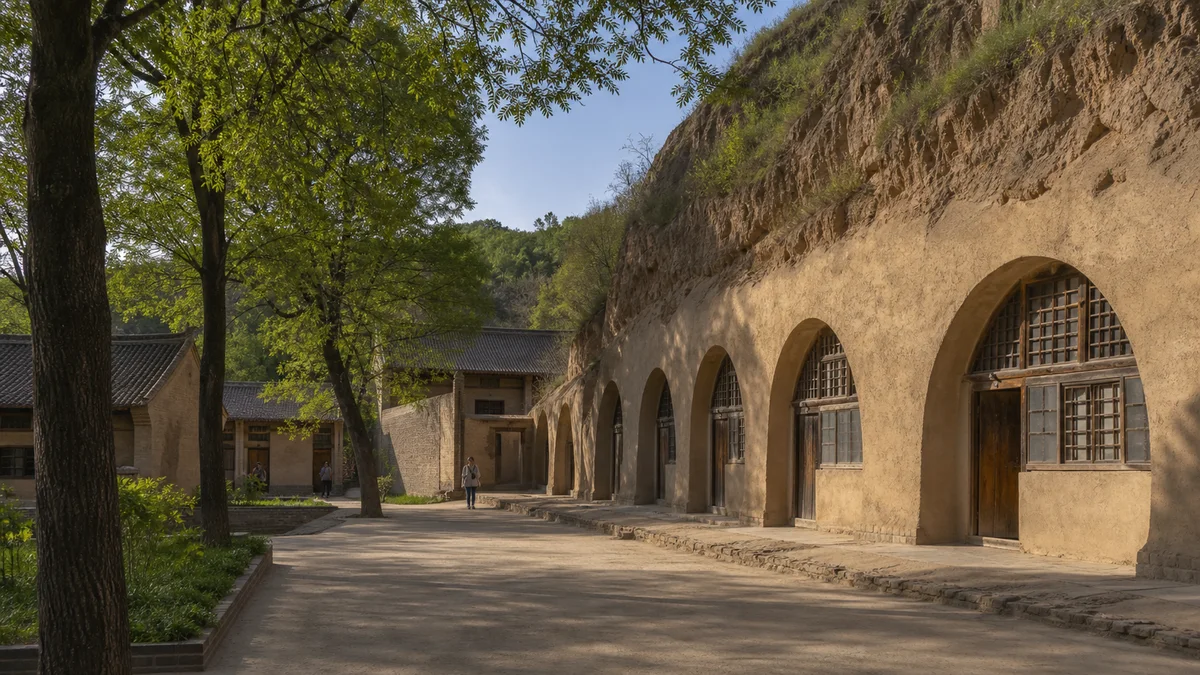
5A View location, maps and nearby scenic areasAt Yangjialing, stand outside a row of arched yaodong cave rooms and look at the packed loess above their whitewashed doors. A desk, map or bed may be arranged inside, but the first evidence is the cut hillside itself: local building knowledge adapted into offices, residences and meeting spaces during war.
Then open the visitor map. Another courtyard lies at Zaoyuan, major exhibitions and former offices cluster around Wangjiaping, and Pagoda Hill rises in the old urban centre. These are not wings of one museum. The Yan’an Revolutionary Sites form a distributed network across the city, with roads, neighbourhoods and substantial travel between parts.
Plan by cluster, not by checklist: choose one central landmark, one political-residential compound and one museum or media site. Learn what function each place served before adding another stop. Current entrances, internal routes, opening galleries and traffic can change the order.
One scenic-area name covers many different places
The 5A designation groups several memorial resources under one visitor identity, but their geography and historical roles remain distinct. Baota, or Pagoda Hill, is the visual symbol most closely associated with Yan’an. Yangjialing preserves meeting and residential settings connected with central leadership. Zaoyuan is a later leadership and office compound. Wangjiaping connects former military and administrative sites with the Yan’an Revolutionary Memorial Hall area.
Other places, including the former news and publishing sites around Qingliang Hill, add institutional history. Not every map, combined ticket or tour uses precisely the same boundary. The Yan’an Revolutionary Sites 5A profile gives a reference point, not a single gate from which all rooms branch.
This matters for interpretation as much as logistics. A cave residence explains private work and austerity; a large auditorium stages collective political decision-making; a press site shows how messages travelled; Pagoda Hill explains why one skyline became a national emblem. Treating them as interchangeable “red tourism” stops erases those functions.
Modern memorial buildings, restored cave fronts, paved courtyards, statues and explanatory panels also belong to different dates. They help make dispersed history visible but are not all fabric surviving unchanged from the 1930s or 1940s.
From the Long March’s arrival to the 1947 evacuation
In October 1935, the Communist Party’s Central Red Army reached Wuqi in northern Shaanxi after the Long March. The central leadership first operated from other places in the region, including Bao’an, now Zhidan. Yan’an city became the principal centre from 1937, after the political settlement surrounding the Xi’an Incident and as full-scale war with Japan approached.
This careful sequence avoids making modern Yan’an the finish line of every Long March unit. Different Red Army forces followed different routes and schedules; many people died or dropped out before reaching the northwest. The arrival preserved a Communist leadership under extreme pressure, but it was also the beginning of a new relationship with an already inhabited northern Shaanxi landscape.
During the War of Resistance against Japan, Yan’an served as the Chinese Communist Party’s headquarters and the symbolic centre of its base-area system. The second United Front joined Nationalist and Communist resistance in principle, while distrust, armed clashes and competition continued. Yan’an was distant from many front lines, yet bombing, blockade, shortage and military mobilisation shaped daily decisions.
In March 1947, amid renewed civil war, Communist leaders evacuated Yan’an before advancing Nationalist forces took the city. The departure did not mean immediate political defeat: central leaders remained mobile in northern Shaanxi while Communist forces later returned. The 1935–1947 arc is therefore one of arrival, institution-building, wartime consolidation and strategic withdrawal—not an uninterrupted heroic ascent.
Read each cluster by the work performed there
At Yangjialing, the Central Auditorium and former residential caves connect the site to major meetings, leadership routines and the 1942 forum on literature and art. The surviving landscape moves between collective spaces and small rooms, showing how official and domestic functions stood close together.
Zaoyuan, used by central organs in the later wartime period, has a more spread-out garden and cave-dwelling setting. Its peaceful appearance can hide the administrative work once conducted there. Wangjiaping was associated with the Central Military Commission and headquarters functions; nearby museum displays can provide chronology and objects before or after the courtyards.
Pagoda Hill works differently. The Ming-period pagoda predates the Communist arrival by centuries, but its silhouette became a visual shorthand for the revolutionary capital through photographs, posters, songs and later tourism. The symbol is real cultural history, yet the tower was not built by the twentieth-century movement it came to represent.
At every cluster, distinguish a historic location from a staged interior. A repaired yaodong, reproduced map and period desk can communicate use without being the exact room and furniture encountered on a particular date. Labels should carry that evidentiary burden; atmosphere alone cannot.
Presses, classrooms and clinics made a political centre
Yan’an functioned through institutions, not just famous residences. The Anti-Japanese Military and Political University, the Central Party School and other training programmes educated cadres and military personnel. The Lu Xun Academy of Arts trained writers, artists and performers. These organisations changed locations and forms, so a surviving marker should not be treated as their entire history.
News workers at Xinhua and the Liberation Daily, founded in 1941, wrote, edited, translated, typeset and printed under difficult material conditions. Radio and telegraph staff connected leadership with base areas and events beyond Shaanxi. Paper, ink, spare parts and reliable power were strategic resources. Qingliang Hill’s publishing memory shows that a revolution was also an information system.
Medical workers treated illness, childbirth, malnutrition and war injuries with limited supplies. Couriers crossed rough terrain; cooks and quartermasters stretched grain; mechanics repaired equipment; teachers organised literacy and political study. Many names never entered museum headlines, but the institutions could not operate without them.
Education created opportunity and discipline at once. Cadres learned reading, administration and political theory, while curricula also standardised ideology and behaviour. That double effect—capacity-building alongside institutional control—recurs throughout Yan’an’s history.
The literature forum asked “for whom?”—and narrowed the answer
At the 1942 Yan’an Forum on Literature and Art, Mao Zedong framed cultural work with a question later repeated across China:
为什么人的问题,是一个根本的问题,原则的问题。
The question of “for whom?” is a fundamental question, a question of principle.
The talks took place during war and the Rectification Movement, when artists and intellectuals debated popular audiences, artistic independence and political responsibility. Mao argued that literature and art should serve workers, peasants and soldiers, and that cultural workers should learn from their lives. Popular forms, accessible language and participation gained institutional support.
The consequences extended far beyond one auditorium. The talks shaped Communist cultural policy and later People’s Republic institutions for decades. They encouraged mass-oriented art and expanded some audiences, while also tying legitimate cultural production closely to Party goals and narrowing space for dissenting or private expression.
Today the quotation appears in museums, study tours and performances, while “Yan’an spirit” is invoked in political education. A careful visitor can recognise its continuing influence without treating the displayed slogan as the only voice present in 1942. Writers’ doubts, revisions and silences are also part of the historical record.
Rectification joined learning, unity and coercion
The Yan’an Rectification Movement, usually dated from 1942 to 1945, aimed to unify Party thinking, correct styles of work and educate a rapidly expanded membership. Participants read assigned texts, wrote autobiographies, attended criticism and self-criticism sessions, and examined their political histories. It helped establish shared language and Mao’s authority within the Party.
It also produced pressure and abuse. During the “Rescue Campaign,” suspicion of spies led to forced confessions, repeated interrogation, detention, public accusation and false cases. Experiences varied by institution and period, and corrective action later addressed some excesses, but that does not erase the fear or harm.
The movement cannot be reduced either to a successful school or to a single machinery of terror. Study created real administrative competence and group cohesion; coercive techniques enforced conformity and damaged individuals. Both outcomes mattered to the institutions built in Yan’an and to later political practice.
When a restored meeting room explains self-criticism only as moral improvement, look for what the label omits. When an account describes only repression, ask why many participants also experienced education, purpose and social mobility. Evidence supports complexity, not compulsory admiration or automatic dismissal.
Cave life belonged to local society before it became an icon
The yaodong is a longstanding loess-region building form, not a revolutionary invention. Thick earth moderates temperature, and arched rooms use a hillside efficiently, but comfort depended on drainage, ventilation, fuel, maintenance and crowding. Wartime photographs and restored rooms should not romanticise dampness, smoke, insects, hunger or winter scarcity.
Local residents supplied knowledge, food, labour, pack animals, housing and market exchange. Some supported Communist programmes; others negotiated taxation, requisition, recruitment and political campaigns under severe constraints. Japanese bombing and blockade, Nationalist-Communist conflict, harvest conditions and local inequalities all shaped survival. “The people supported Yan’an” is too broad unless it leaves room for differing choices and costs.
Women worked as doctors, nurses, teachers, journalists, radio operators, couriers, textile workers and administrators. New schools and organisations opened routes into public life, while domestic labour and unequal authority did not disappear. A photograph of a prominent female cadre should lead to questions about the many cooks, caregivers and messengers left unnamed.
Modern conservation also depends on labour. Craftspeople repair earthen faces and timber doors, curators test provenance, and local guides translate national history for visitors. Surrounding neighbourhoods continue to live beside memorial landscapes; they are communities, not simply scenic backdrops.
Build a route from clusters, not from optimistic drive times
For a short visit, combine the Yan’an Revolutionary Memorial Hall and Wangjiaping with either Yangjialing or Zaoyuan. The museum supplies an overview; one compound then lets you test that narrative against rooms, paths and terrain. Add Pagoda Hill only if its slope and transport fit the day.
A full day can begin with Pagoda Hill or nearby urban memory, continue to Wangjiaping and Yangjialing, then finish at Zaoyuan. This is a conceptual order, not a guaranteed transport schedule. City traffic, group arrivals, security controls, road works and parking can turn a short map distance into a longer transfer.
Use one vehicle plan for each cluster and confirm whether any scenic shuttle actually connects your chosen sites. Do not assume the last bus, ride-hailing pickup or museum closing time from an old travel post. If Qingliang Hill or another specialist site matters to you, remove a leadership compound rather than stacking every name into one day.
Yan’an can anchor a wider northern Shaanxi journey. The Mausoleum of the Yellow Emperor represents a very different national ancestry narrative. The Yellow River Qiankun Bend and Hukou Waterfall shift attention to river landscapes, but long road transfers and changing conditions make them separate excursions.
Visit respectfully, and let loess shape the photograph
Memorial rooms may receive ceremonies, school groups and Party study tours. Give them space, keep conversation quiet and do not treat portraits, flags, beds or desks as costume props. Follow instructions about bags and photography, do not touch earthen walls, and never enter a closed cave because a rope looks low.
For photographs, use side light to show the curve of cave fronts and the texture of loess. A doorway framed by earth communicates adaptation better than a tight portrait of staged furniture. On Pagoda Hill, city views depend on haze, weather and current access. Museum flash, tripod and object-photography rules can differ by venue.
Several compounds include steps, thresholds, uneven courtyards and slopes cut into loess. A site may have an accessible entrance without making every cave room step-free. Ask each cluster about ramps, lifts, wheelchairs, accessible toilets and vehicle drop-off; choose a museum-led route when terrain excludes the hillside rooms.
Summer heat, sudden rain, winter cold, dust and wind all change the visit. Wet loess and stone can be slippery, while exposed hills offer limited shelter. Wear shoes with grip, carry weather protection and leave transfer time between sites.
At the final cave doorway, look beyond the famous name on its sign. Yan’an’s revolutionary period was made by strategy and belief, but also by paper shortages, nursing shifts, forced confessions, harvested grain, local negotiation and messages carried after dark. The network matters because no single courtyard can contain that history. Moving between sites restores the distance—and the people—that a slogan removes.
The LoreLens app can identify compounds and cave rooms as you move across Yan’an, then separate historic fabric, restoration and later memorial display.
Location profile
Where it is

Frequently asked questions
Is the Yan'an Revolutionary Sites scenic area one museum?
No. It is a network of memorials and former sites distributed across Yan'an, including clusters around Wangjiaping, Yangjialing and Zaoyuan, plus landmarks such as Pagoda Hill. Each has its own entrance, terrain and exhibitions, so confirm the current scenic-area map before planning a route.
Can I see the main Yan'an revolutionary sites in one day?
A selective day can combine one central landmark with Wangjiaping, Yangjialing and Zaoyuan if traffic and opening conditions cooperate, but it will be rushed. A shorter visit should pair the Revolutionary Memorial Hall and Wangjiaping with one other cluster. Travel time, queues and shuttle arrangements are not guaranteed.
Are the cave rooms and furnishings all original?
The loess caves and courtyards occupy historic locations, but many structures have been repaired, conserved or reconstructed, and furniture or documents may be period-style displays or replicas. Read object labels carefully and distinguish an original artefact from a restored room used to explain past life.
What etiquette is expected at Yan'an memorial sites?
Treat them as places of political and wartime memory. Keep voices low in memorial rooms, do not sit on displayed beds or desks, cross barriers or use portraits and flags as comic props. Follow photography rules, allow organised study groups to conduct ceremonies, and ask before photographing individuals closely.