Shaanxi · Yan'an
Yellow Emperor Mausoleum: Memory beneath the Cypresses
Walk from Xuanyuan Temple through Qiaoshan's cypress forest to the traditional burial mound, separating ancient texts and local tradition from archaeological proof while reading a living landscape of remembrance.
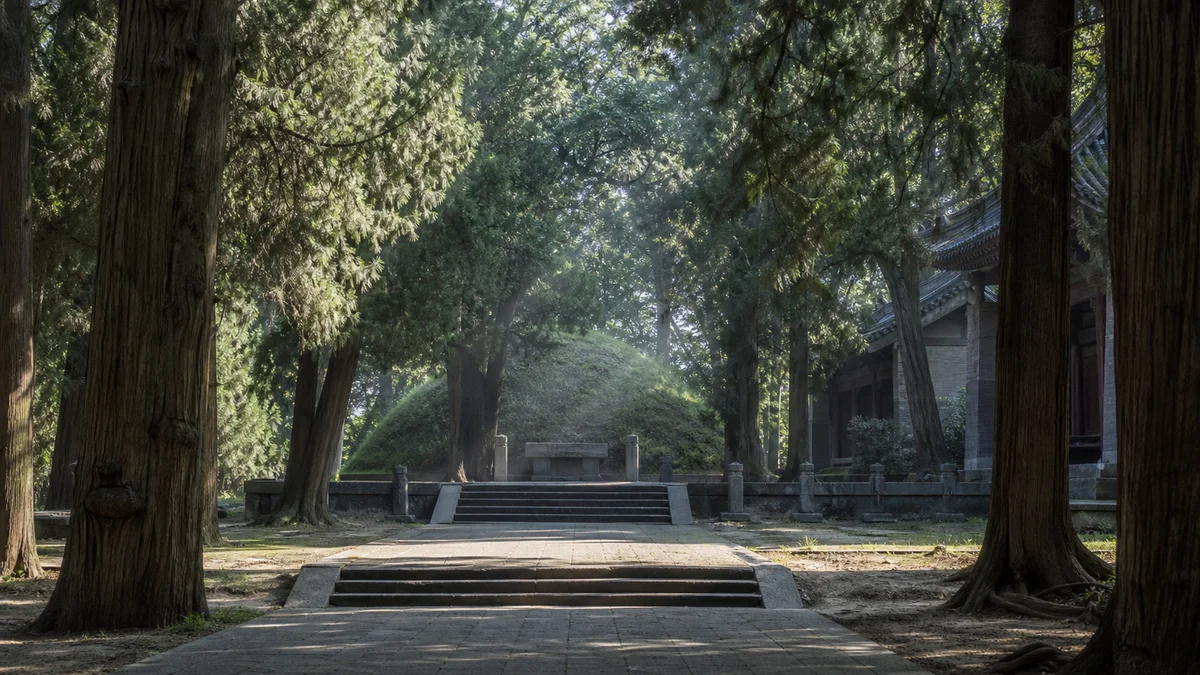
5A View location, maps and nearby scenic areasStand beneath the cypresses on Qiaoshan (roughly “chyaow-shahn,” literally “Bridge Hill”) and look along the route before climbing. At the lower precinct, courtyards and halls of Xuanyuan Temple frame incense, steles and ceremonial space. Higher on the wooded hill, an earthen mound marks the place long honored as the Mausoleum of the Yellow Emperor. The route moves from public ritual to a quieter grave-shaped landscape.
What you can see is real: old trees, rebuilt halls, inscriptions, offering spaces, steps and a mound cared for across generations. What the site cannot give you is archaeological proof that one recoverable individual lies here. Huangdi, the Yellow Emperor (pronounced roughly “hwahng-dee”), belongs to China’s ancient cultural memory as a legendary ancestor and culture hero. The site is powerful because people repeatedly chose Qiaoshan as a place to remember him—not because an excavation has settled every story.
Read the visit in this order: first notice how Xuanyuan Temple makes remembrance public; then let the cypress forest slow the ascent; finally approach the mound as a traditional focus of mourning and identity, keeping written record, local tradition and archaeological evidence in separate layers.
Two precincts tell two kinds of story
The visitor experience is commonly divided between the temple area below and the mausoleum zone on Qiaoshan. Xuanyuan (roughly “shwen-ywen”) is another name associated with the Yellow Emperor. Temple courtyards contain celebrated cypresses, inscribed stones and halls used for commemoration. Their axial arrangement creates a civic and ceremonial setting: groups assemble, names are spoken, offerings are presented and collective memory becomes visible.
The route to the mound shifts the register. Forest, incline and repeated steps replace the broad ceremonial court. The mound itself is materially modest compared with the meanings attached to it. An inscription and managed forecourt identify the traditional burial place, but the visitor does not enter a chamber or inspect excavated grave goods.
The temple explains what later societies did with the Yellow Emperor’s memory; the mound shows where that memory was located. Neither should be dismissed because the biography is legendary, or promoted as laboratory proof. Buildings, paving and paths have also changed through repair and site management; their value lies partly in that chain of renewal.
Legend, ancient record and archaeology are different evidence
Chinese texts credit the Yellow Emperor and figures around him with victories, government, medicine, writing, clothing and music. These are not eyewitness biographies: the fullest narratives were compiled centuries after the remote era assigned to Huangdi, and versions reflect later political, philosophical and ritual concerns. Prehistoric archaeology illuminates societies from which memories grew, but pottery or burials cannot simply be labelled “the Yellow Emperor.”
The mound at Huangling therefore belongs to the category of a traditional mausoleum. Its authenticity as a continuously meaningful place does not automatically establish the biological identity of a tomb occupant. Visitors should be cautious with signs, videos or guides that slide from “tradition identifies this place” to “archaeology proved this exact person.”
A measured visit can hold several truths together: Huangdi is central to Chinese historical imagination; Qiaoshan records and ritual are old; and the legendary ruler is not a scientifically verified individual. Legend can have historical consequence without becoming archaeology.
“The Yellow Emperor died and was buried at Qiaoshan”
In the Records of the Grand Historian, compiled by Sima Qian around the turn of the first century BCE, a concise line says: “The Yellow Emperor died and was buried at Qiaoshan.” It is the sentence most often used to anchor this landscape in early written tradition.
The story around the line matters more than treating it as a modern certificate. Sima Qian was organizing accounts of exemplary rulers, dynasties and rites into a connected past. By giving the Yellow Emperor a death and burial place, the text placed a culture hero inside geography and historical succession. Qiaoshan became a location where later rulers could approach an imagined beginning and present themselves as responsible heirs.
The same work records that Emperor Wu of the Han dynasty offered sacrifice at the Yellow Emperor’s mound at Qiaoshan during a northern tour, conventionally dated to 110 BCE. That passage does not prove who lay beneath the earth. It does show that by Sima Qian’s time the link among Huangdi, a mound called Qiaoshan and state ritual already carried political meaning.
The modern echo appears on the ceremonial axis. Officials, community representatives and visitors use the site to speak about origins and belonging. The sentence became a script for returning to a named place—powerful through repetition, yet still separated from archaeological verification.
Why “Humanistic First Ancestor” is a cultural claim
At the temple you will encounter the title Renwen Chuzu, usually translated as “Humanistic First Ancestor” or “First Ancestor of Chinese Civilization.” “Humanistic” here points to culture-making: institutions, skills, social order and ways of living attributed to Huangdi and the circle of culture heroes around him. It does not mean scientists have identified a single genetic ancestor of everyone considered Chinese today.
Founder stories work by making dispersed change memorable. Agriculture, textiles, medicine, writing and governance emerged through long processes involving many communities. Tradition gives those processes names and relationships: the Yellow Emperor becomes an ideal ruler; Leizu is associated with sericulture; Cangjie with writing; other companions with instruments, calculation or healing. The cast turns cultural development into a story people can retell.
The phrase “descendants of Yan and Huang” later became a powerful way to imagine kinship among Chinese people. It can express cultural attachment and a wish for solidarity, especially among communities separated by region or migration. It should not be used to erase ethnic diversity, rank one community’s ancestry above another, or convert citizenship and culture into a blood test.
A comparison with a national founder, biblical patriarch or classical culture hero offers an initial bridge, but none is exact. Huangdi combines ancestral, political, technological and cosmological roles. Ask not “Did he invent everything?” but why later communities chose him to represent a shared beginning.
Ritual turned a legendary ancestor into a public symbol
Commemoration at Qiaoshan did not follow one unbroken script. Governments, local officials, temple keepers and communities repaired structures and renewed rites in changing forms. Today’s halls and plazas reflect those accumulated interventions.
In the twentieth century, Huangdi’s image gained new force as China confronted invasion, political division and the problem of national unity. During the resistance against Japan in 1937, memorial texts and commemorative acts associated with both Nationalist and Communist participants invoked the Yellow Emperor as a symbol of shared resolve. The actors did not thereby agree on every political future; the point was that an ancient ancestor could be asked to speak for a modern community under pressure.
Later public memorial ceremonies, especially around Qingming, developed into highly organized events. Music, offerings, formal language and collective bows turn the plaza into a stage of civic remembrance. Participants may include state and local representatives, cultural organizations, people from Hong Kong, Macao and Taiwan, overseas Chinese communities and ordinary visitors. The composition and protocol vary by year.
Ceremony is both heritage and contemporary politics: it creates connection while selecting which past receives the microphone. Compare Yan’an Revolutionary Sites, where caves and meeting rooms support a more recent foundation story. At both places, notice who speaks, in which era and for whom.
The cypress forest is an archive, not a collection of certificates
Site descriptions count tens of thousands of cypresses, including many classified as ancient. Totals vary with survey boundaries, age categories, planting and loss, so each figure belongs to a particular inventory.
One celebrated tree in the temple precinct is traditionally called the cypress planted by the Yellow Emperor. Another is associated by tradition with Emperor Wu of Han. The first attribution is devotional and local memory, not a documented planting event. Claims that a living tree is five thousand years old also exceed what should be asserted without a transparent botanical study. The tree may be exceptionally old and culturally priceless without proving Huangdi’s hand touched it.
Look beyond the labels. Trunks twist around deadwood; bark records scars and weather; younger trees fill gaps among veterans. The forest’s meaning comes from mixed generations. It embodies continuity more honestly than a claim that every tree has stood unchanged since a legendary age.
Conservation is active work. Compacted soil restricts roots; touching and climbing damage bark; ribbons, nails, smoke and uncontrolled incense create harm; drought, storms, fire, pests and disease add risk. Arborists, foresters and site staff monitor tree health, manage visitors and decide when support or treatment is necessary. A fenced root zone is not an obstacle to your photograph. It is part of why the tree remains alive.
Remember the people who maintain remembrance
The site operates through less visible labor. Temple staff prepare offerings; ritual specialists learn sequences; cleaners reset courtyards; forest workers inspect cypresses; conservators document steles; guides translate layered traditions.
Local residents are not scenery around a national symbol. Huangling’s economy, traffic and public space are affected by tourism and ceremonial calendars. Some families participate in service work or community traditions; others encounter the less romantic effects of congestion, restricted access and commercial pressure. Respect for heritage includes noticing how a site of “shared origins” is also somebody’s present-day home and workplace.
Ritual continuity is likewise not automatic. Each generation chooses which practices to keep, revive or redesign. Women and men whose names do not appear on imperial steles have swept paths, guarded against fire, replanted hillsides and received pilgrims. The claim that memory spans thousands of years is meaningful only because real people performed maintenance in much shorter human lifetimes.
Fresh paving, a supported branch or a managed incense point shows negotiation between living ritual, mass visitation and fragile material. Preservation is not freezing one legendary moment, but managing change without losing the place’s ability to gather memory.
Walk temple first, mound second—and keep the day flexible
For a first visit, begin at Xuanyuan Temple. Read the forecourt and main axis, then spend time with the cypresses and inscriptions before entering the principal commemorative space. This sequence explains the language of “ancestor” and public ceremony before the quieter ascent. During events, barriers may reverse or compress normal circulation, so follow the current map rather than forcing an online route.
Continue toward the mausoleum on Qiaoshan. The slope, stone paving and stairs are part of the transition, but they can be tiring or slippery after rain, frost or snow. Internal vehicles or alternative access may operate on some days; routes, stops and eligibility can change. Visitors who need step-free access should confirm the current arrangement with the site before booking rather than assuming the forest path is fully accessible.
At the mound, pause at the identifying inscription and observe how trees enclose the space. Keep voices low, stay behind barriers and leave offerings only where permitted. Do not expect an interior chamber. The point is to understand how an unexcavated mound, a forest and repeated ceremony work together as a memorial.
Qingming and major organized rites can bring crowds, security screening, reserved zones and long pauses. On ordinary days, weather may matter more: summer heat and humidity, winter cold, wind under the trees and wet steps all change the effort. Bring suitable footwear and water where allowed, and avoid scheduling a fixed departure immediately after the visit.
In northern Shaanxi, compare the Yellow River Qiankun Bend with Hukou Waterfall: one is a vast bend read from above, the other water compressed into sound and spray. Check weather, river conditions and access separately.
Photograph the living ritual, then let the forest close the story
In the temple precinct, use gates or cypress trunks to frame the ceremonial axis without standing in the path of a group. Side light can reveal bark and carved inscriptions; overcast conditions can make dark trees and pale stone easier to balance. At the mound, a wider composition showing forest and approach is more honest than a tight crop implying access beyond the barrier.
Photography rules may tighten during formal rites. Do not use flash close to participants, push into an offering line, photograph mourners intrusively or fly a drone without explicit permission. Avoid comic poses on ritual platforms and never climb, touch or attach objects to ancient trees. Ask before photographing identifiable local participants at close range.
Put the camera away for the descent. Trees live, die and are replaced; halls are repaired; ceremonies are rewritten; communities return. Continuity does not require pretending that legend is archaeology.
The mound ties a short ancient sentence to a landscape and generations of ritual. Huangdi is not a scientifically verified universal ancestor, yet remembrance around him has shaped Chinese ideas of origin and belonging. Qiaoshan is not a solved biography in earth, but a living argument about how a community chooses its beginning.
The LoreLens app can help identify halls, inscriptions and ceremonial features, then distinguish what belongs to ancient text, later tradition and the site’s continuing life.
Location profile
Where it is

Frequently asked questions
Was the Yellow Emperor a proven historical person?
The Yellow Emperor is a foundational figure in ancient Chinese cultural memory, described in texts compiled long after the remote era assigned to him. Scholars study how those traditions developed, but archaeology has not verified one individual who can simply be matched to every deed in the stories. Treat him as a legendary culture hero and remembered ancestor, not a documented ruler with a modern biography.
Is the mound at Huangling archaeologically confirmed as his tomb?
No conclusive archaeological evidence identifies the mound as the burial of one verified historical Yellow Emperor. The site matters because ancient writing associated the Yellow Emperor with burial at Qiaoshan and generations of local, imperial, civic and national commemoration anchored that memory here. It is a traditional mausoleum and memorial landscape, not proof of an excavated body.
How much time should I allow at the Yellow Emperor Mausoleum?
Several hours normally allow a measured visit to Xuanyuan Temple, the cypress courtyards and the traditional mound. More time may be needed for ceremonies, crowds, rest stops or a longer forest route. Ticketing, internal transport and open areas can change, so check the current official map rather than relying on an exact itinerary from an older guide.
What should visitors expect around major memorial ceremonies?
Qingming and other major commemorative dates can bring formal rites, security controls, altered circulation and much heavier crowds. Some spaces or sightlines may be reserved for participants. Confirm current access in advance, arrive with flexible timing, keep voices low near rituals and follow staff directions about photography and standing areas.