Hebei · Shijiazhuang
Xibaipo: Read a Revolution Through Village Rooms
Walk from the memorial chronology into plain courtyards where strategy, radio messages, supplies and village labour connected national transformation to a rural base in 1948–1949.
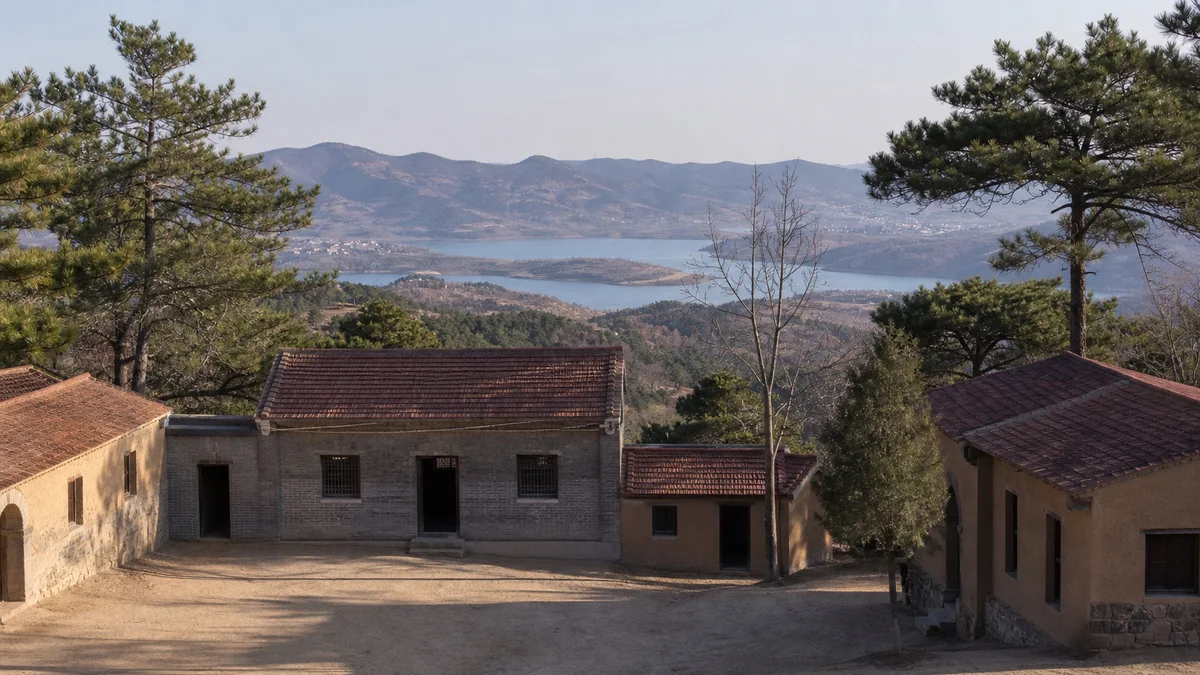
5A View location, maps and nearby scenic areasEnter one of Xibaipo’s plain courtyards and notice how little it resembles a capital. Low tiled rooms, packed-earth colour and modest windows held desks, maps and communications during a decisive change in Chinese history. The contrast between small rooms and national consequence is the site’s first lesson.
Xibaipo, in Pingshan County west of Shijiazhuang, was an important base for the Communist Party Central Committee and People’s Liberation Army headquarters in 1948–1949. It was a rural node in a political, military and logistical network—not one leader’s private headquarters or a collection of slogans.
Read chronology before rooms. If open, begin with the main memorial exhibition to establish dates, maps and participants. Then walk the former-site courtyards, matching buildings to functions such as leadership work, communications, meetings and operations. Finish by looking towards the reservoir landscape that explains why the present memorial setting is not identical to the old village.
A village base within a moving wartime network
Work units and leaders moved through north China’s rural bases as the civil war changed. By 1948, central institutions had concentrated here; on 23 March 1949, the leadership departed towards Beiping.
Relative security, links to liberated areas, food, roads and proximity to the North China Plain supported the base. Couriers, radio operators and supplies connected it to distant commands.
The Xibaipo 5A scenic-area profile locates the attraction. On site, distinguish the memorial hall, the cluster of historic-site courtyards and the wider modern scenic area. An entrance map is more useful than assuming every building belongs to one enclosed original compound.
Three campaigns were directed, not fought, in these rooms
From September 1948 into early 1949, the Liaoshen, Huaihai and Pingjin campaigns reshaped the military balance of the civil war. Central strategic direction and coordination came from Xibaipo, while field armies and commanders made decisions across Manchuria, eastern China and the Beijing–Tianjin region.
A map room did not move troops, and no person controlled every battlefield detail. Mao Zedong and other central leaders sent instructions; Lin Biao, Liu Bocheng, Deng Xiaoping, Chen Yi, Su Yu, Nie Rongzhen and others commanded distinct theatres. Soldiers, support personnel and civilians experienced the consequences.
Display arrows can make results look inevitable. Dates and message sequences reveal incomplete intelligence, limited transport and revised plans—and alternatives once open.
Radio, paper and logistics turned strategy into action
The modest operations rooms depended on information. Telegrams and radio carried reports, orders and questions; staff encrypted, transmitted, copied, sorted and archived them.
Orders still needed roads, food, ammunition, medical care and replacements. Civilian and military logistics moved supplies by carts, shoulder poles, boats and railways; burden and risk were uneven.
Look for desks, lamps, maps and equipment, but read their labels carefully. Some objects are period artefacts, while others may be reproductions placed to explain a function. The meaningful unit is not a heroic desk; it is the chain from observation to message, decision, delivery and action.
Villagers were participants, hosts and people under pressure
Xibaipo was not an empty stage awaiting famous arrivals. Villagers supplied or lent rooms, carried messages and materials, provided food, guarded information and adjusted daily life around a headquarters. Nearby communities and regional institutions sustained the base.
Support could combine conviction, community obligation, mobilisation and material pressure. Recognise contribution without making every resident equally enthusiastic. War and land reform were also transforming village relationships.
A room described by official function may also have belonged to a household. Domestic scale is part of the history. Ask before photographing residents or staff; rural life is not decoration.
Plain courtyards reveal how authority was organised
The former-site cluster associates modest houses with the work and residences of Mao Zedong, Zhou Enlai, Liu Shaoqi, Zhu De, Ren Bishi and central institutions. Names help orientation, but the spaces become clearer when compared by function.
Compare group, private-work and meeting rooms. Thresholds and courtyards controlled movement; close distances aided conversation, while security and rank shaped access.
Do not assume every chair, telephone or map remains in place. Displays combine surviving buildings, moved fabric, records and reproductions. When labels are unclear, keep claims modest.
The Second Plenum looked beyond military victory
In March 1949, the Second Plenary Session of the Seventh Central Committee met at Xibaipo. With major military victories changing the balance, discussion turned towards governing cities, economic recovery, political organisation and the transition from a rural revolutionary base to national power.
Mao’s later-famous “two musts” urged modesty and prudence, and continued arduous struggle. Official memory highlights them, but the meeting also addressed administration and postwar conduct.
Read the room institutionally: reports, documents and participants prepared the shift from rural command to urban government.
“Going to take the examination” became a political echo
When the leadership left Xibaipo for Beiping in March 1949, Mao is remembered as comparing the journey to “going to the capital to take an examination”. Accounts commonly place the remark in conversation with Zhou Enlai and frame success as avoiding the failures of past regimes.
The wording reaches visitors through recollection and later commemoration, not a recording. It has an event context and an afterlife: political speeches reuse the “examination” to discuss governing, corruption and public support.
The metaphor turns victory into an ongoing test. Neutral history explains that political function without reciting the phrase as proof or dismissing its influence.
The reservoir changed the village and the memorial
The landscape seen today is not the untouched setting of 1949. Construction of Gangnan Reservoir transformed the area, and the old village was relocated. Buildings and the memorial site were preserved, moved, restored or reconstructed in relation to the new water landscape.
This changes what “authentic” means. Historic material may stand in a shifted context; a reconstructed room can explain function without being original. The reservoir records the later project that displaced old relationships.
Use the on-site labels to separate original location, relocated building, restoration and replica. A precise account is more respectful than claiming either that everything is untouched or that nothing is real.
Build a route from context to material evidence
A strong half-day route moves from the memorial exhibition to the former-site courtyards, then pauses at a point where the reservoir and present village geography can be seen. This order establishes chronology before asking small rooms to carry a national story.
Exhibitions, guides, security and reservations change. Confirm open buildings and fixed group routes. If lectures fill narrow rooms, wait outside.
Thresholds, uneven paving and steps affect access. Ask about drop-off, ramps, toilets, wheelchairs and step-free alternatives. Summer sun and winter wind can be strong.
Photograph evidence, not a performance of belief
Use doorways to frame a desk or meeting room at human scale. A moderate lens reduces distortion in tight interiors; in courtyards, include rooflines and paths to show how workspaces related. Follow current bans on flash, tripods, restricted documents or commercial filming.
This is a politically important memorial and a place carrying war memory. Keep voices low during talks, do not interrupt ceremonies, climb furniture or stage comic military poses. Visitors can hold different political interpretations while sharing basic respect for people who lived, fought, worked and died.
Before leaving, look from the rural roofs towards the reservoir. Xibaipo’s history is neither contained in one famous room nor erased by relocation. It survives through documents, material fragments, reconstructed relationships and the questions later governments ask of 1949.
Baiyangdian offers another Hebei landscape where water projects, residents and state priorities interact; Hengshui Lake shifts the discussion towards wetland conservation, while Guangfu Ancient City shows daily life continuing within another historical enclosure. At Xibaipo, the most useful examination is not whether a visitor repeats the right words, but whether small evidence is allowed to complicate a large story.
LoreLens App can connect rooms, communications equipment and meeting sites to the wider networks and later memorial choices behind them.
Location profile
Where it is

Frequently asked questions
How much time should I allow for Xibaipo?
Allow at least half a day to see the main memorial exhibition and walk through the former-site courtyards without reducing them to a checklist. Transfers, security and guided groups can add time. Confirm the day's open areas and last admission before adding reservoir viewpoints or other sites in Pingshan.
Why is Xibaipo important in modern Chinese history?
It was a major base of the Chinese Communist Party Central Committee and People's Liberation Army headquarters in 1948–1949. Strategic direction for the Liaoshen, Huaihai and Pingjin campaigns was coordinated here, and the Second Plenary Session of the Seventh Central Committee met here before the leadership moved towards Beiping.
Are the buildings at Xibaipo all original and in their original positions?
No. Gangnan Reservoir construction transformed the old village setting, and the settlement was relocated. The memorial landscape includes preserved, moved, restored or reconstructed elements. Read each building's label to distinguish surviving fabric from reproduction and the original location from the present interpretive site.
What should international visitors confirm before going?
Confirm reservation, passport or identification, security screening, guide availability, photography rules and current exhibition access through official channels. Requirements can change, and some displays may permit phones but not flash, tripods or commercial filming. Carry the original passport used for booking and keep a respectful, non-disruptive manner.