Hebei · Baoding and Xiong'an
Baiyangdian: Read a Living Wetland from the Water
Move between reed beds, open pools and inhabited islands to understand how Baiyangdian's water, livelihoods, wartime memory and ecological repair belong to the same changing landscape.
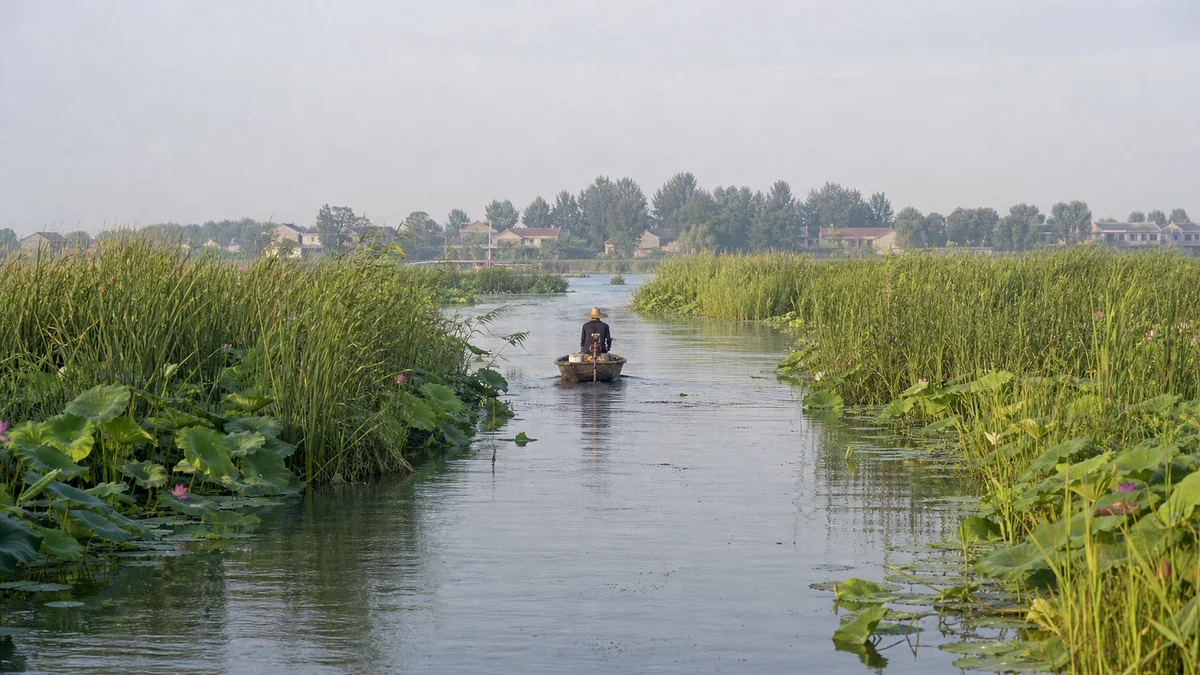
5A View location, maps and nearby scenic areasAt the first open water, wait before raising your camera. A motor fades behind reeds; leaves rub in the wind; a channel turns towards a village roof. Baiyangdian is understood through these interruptions. It is not one empty lake, but a mosaic of shallow pools, reed beds, ditches, embankments, settlements and working water.
The Chinese word dian (淀) suggests low-lying water and marshy basins rather than a single deep lake. That distinction prevents the postcard label “Pearl of North China” from flattening the place.
Orient yourself first. Baiyangdian lies in Hebei’s Baoding–Xiong’an area. Anxin is a major gateway, but docks and managed zones are multiple. A ticket for one route does not open every channel, village or conservation area. Confirm the landing, stops and return, then read the trip from shore to channel, reed edge, open pool and inhabited ground.
A network of dians, not one blue oval
From above, Baiyangdian resembles woven cloth. Channels join shallow basins; reeds divide views; embankments and villages interrupt the water. Publications often cite more than a hundred connected basins and an overall area around 366 square kilometres, but neither figure equals the open water visible on one day.
Rainfall, inflow, groundwater, evaporation, irrigation, water transfers and engineering all affect what is wet. Boundaries also change according to whether a source measures a scenic area, wetland system, water surface or one water-level year.
Claims such as “North China’s largest freshwater lake” therefore express regional importance, not a permanently measurable title. The Baiyangdian 5A profile supplies a map anchor; the real place spreads beyond a pin and changes with water.
Water level redraws the map
Drought and reduced inflow have contracted Baiyangdian, while floods, replenishment and management measures have expanded or reconnected parts of it. Reservoirs, irrigation, urban demand, aquaculture and wastewater have also altered water quantity and quality. No single intervention explains every change.
Since the development of Xiong’an New Area, water replenishment, pollution control, habitat work and monitoring have improved important indicators reported by authorities. Yet “restored” does not mean “returned to an untouched past.” Clean inflow, flood safety, urban growth, livelihoods and biodiversity still require continuous choices.
A debris line on reeds, newly flooded stems or exposed mud can reveal recent levels. A concrete bank may protect a settlement while reducing a soft habitat edge. Old videos cannot guarantee today’s channel depth, boat route or lotus coverage; check current conditions.
Reeds are habitat and work
Reeds slow water, catch sediment and shelter small aquatic life. Their margins can feed fish, amphibians and birds, while open water, mudflats and wet meadows support other communities. “More reeds” is not automatically better everywhere.
Depending on season, visitors may see egrets, herons, grebes, coots and ducks. Official monitoring has reported rare protected waterbirds in the wider wetland, but those records are evidence of ecological value—not a tourist checklist.
Reeds have long been cut, dried and used for mats, screens, craftwork and fuel. Harvest supports livelihoods while altering habitat, so timing and rules matter. Fishing and aquaculture are equally complex: water quality, stocking, conservation and markets shape what remains possible. Confirm current controls rather than assuming every regional fish dish came from unrestricted local harvest.
Villages belong inside the wetland story
Baiyangdian is not wilderness without people. Families have travelled by boat, tended reeds and lotus, fished, farmed aquatic products and adapted homes to damp ground. Tourism added boat crews, restaurants, homestays and guides.
Environmental regulation can improve habitat while changing where residents may fish, build or operate boats. Tourism can bring income but also waste, uneven benefits and intrusion into private life. Ecological repair is therefore a social negotiation as well as a technical programme.
Distinguish public visitor areas from courtyards and working banks. Ask before close portraits and never treat children as anonymous “water-village” scenery. Raised thresholds, reed stacks and adaptable landings tell a better story: a community still responding to variable water.
Wartime resistance moved through the channels
During the War of Resistance against Japanese Aggression, Baiyangdian’s reeds and waterways supported local resistance, communication and concealment. The Yanlingdui, or Wild Goose Feather Detachment, is remembered as a waterborne guerrilla force whose boats and local navigation knowledge mattered.
That terrain did not make war romantic. Villagers faced occupation, searches, retaliation and scarcity. Memorial narratives foreground courage; responsible visitors should also distinguish documented operations, later recollection and patriotic storytelling.
Read dates and sources in memorial displays. A reconstructed boat may explain movement without being the original object from a specific action. This history can be compared with Xibaipo, but the timelines differ: Xibaipo centres on Communist leadership in the later civil-war period.
Little Soldier Zhang Ga is a cultural echo
The novel and screen adaptations of Little Soldier Zhang Ga gave Baiyangdian a nationally familiar boy hero. Reed channels, wooden boats and village courtyards became a visual language of wartime childhood and resistance.
The work is important cultural memory, not a documentary itinerary. Writers and filmmakers combine experience, research, drama and later education. An associated location can show how heroism was imagined, but cannot prove every character or scene corresponds to one verified event.
Ask why a small boat became such a strong image, or how knowledge of water challenged a stronger occupier. Those questions connect literature to place without turning the wetland into a film set. Today’s quieter work—water testing, sewage treatment and habitat patrols—also shapes its modern meaning.
Choose water depth or village texture
A first water route needs only contrast: a narrow reed channel, an open pool and, where permitted, one public village or cultural stop. Ask the operator about separate tickets and the final return; online route names may not match the day’s service.
A shore-focused visit suits travellers who dislike small boats or arrive when services are reduced. It cannot reproduce the channel perspective, but embankments, interpretation and village edges show how water is managed. For quieter wildlife observation, ask staff about open low-disturbance routes rather than seeking shortcuts into closed reeds.
Boats vary in noise, shelter and step height. Confirm life jackets, load, toilets and last return. Keep hands free when boarding. Travellers with limited mobility should request exact information about the dock and boarding gap; not every landing is step-free.
Watch and photograph without making wildlife move
Use binoculars before a long lens. At reed edges, scan for a head breaking the vertical pattern. On open water, reflections, vegetation and a distant boat show scale better than a tight wildlife portrait.
Lotus flowering varies with temperature, water depth and maintenance. Never request entry to planted or restricted water because an earlier photographer did. Protect equipment from spray, keep bags low and do not stand suddenly in a small craft. Confirm drone, tripod, flash and commercial-shoot rules.
Do not feed, call, chase or flush wildlife. If a bird stops feeding or repeatedly moves away, increase the distance. Keep voices low and take all litter ashore. A photograph that changes an animal’s behaviour records intrusion, not intimacy.
Leave with a less simple “pearl”
At the end, wait where reeds give way to open water. The surface may still shine like the celebrated “Pearl of North China.” Now the image also contains variable hydrology, habitat under repair, villages facing present-day choices, labour inside the reeds and memory edited by literature.
Hengshui Lake offers another Hebei wetland shaped by conservation and managed access. Yesanpo replaces the open plain with mountain valleys. Together they show how varied “nature” can be within one province.
Baiyangdian need not be imagined as untouched wilderness to deserve care. Its value lies partly in the difficult coexistence of water, wildlife and people—and in the fact that this relationship is still being renegotiated. Leave the reeds unparted, let birds choose their distance, and carry away a map that remains unfinished.
LoreLens App can connect visible details—boats, reeds, memorial objects and village architecture—to the stories behind them.
Location profile
Where it is

Frequently asked questions
When is the best time to visit Baiyangdian?
Late spring through early autumn is commonly chosen for open water, reeds and seasonal plants, but lotus flowering, water levels, heat, rain and boat operations vary. Migration seasons can interest birdwatchers, although sightings are never guaranteed. Check current wetland and scenic-area notices before fixing a route.
Do I need to take a boat at Baiyangdian?
A boat best reveals the channels when services operate, but weather, water, maintenance and conservation controls can change routes. Shore facilities and public village areas can still form a worthwhile visit. Confirm the landing, stops and return before boarding.
Can I see rare birds at Baiyangdian?
Official monitoring records protected waterbirds, but a record is not a promise of a sighting. Season, water depth, food and disturbance all matter. Use binoculars, stay in open areas and never ask a boat operator to chase or flush birds.
What should international visitors confirm before going?
Confirm the open entrance, reservation or identification rules, boat product, last return and payment options through official channels. Baiyangdian has multiple access points rather than one universal gate. Carry the original passport used for booking and keep a land-based alternative.