Hebei · Handan
Guangfu Ancient City: Walls Between Water and Wetland
Circle Guangfu's moat before entering its lived-in streets, then connect the rebuilt walls, Yongnian lowland and the Yang- and Wu-style taijiquan traditions without reducing the city to a slogan.
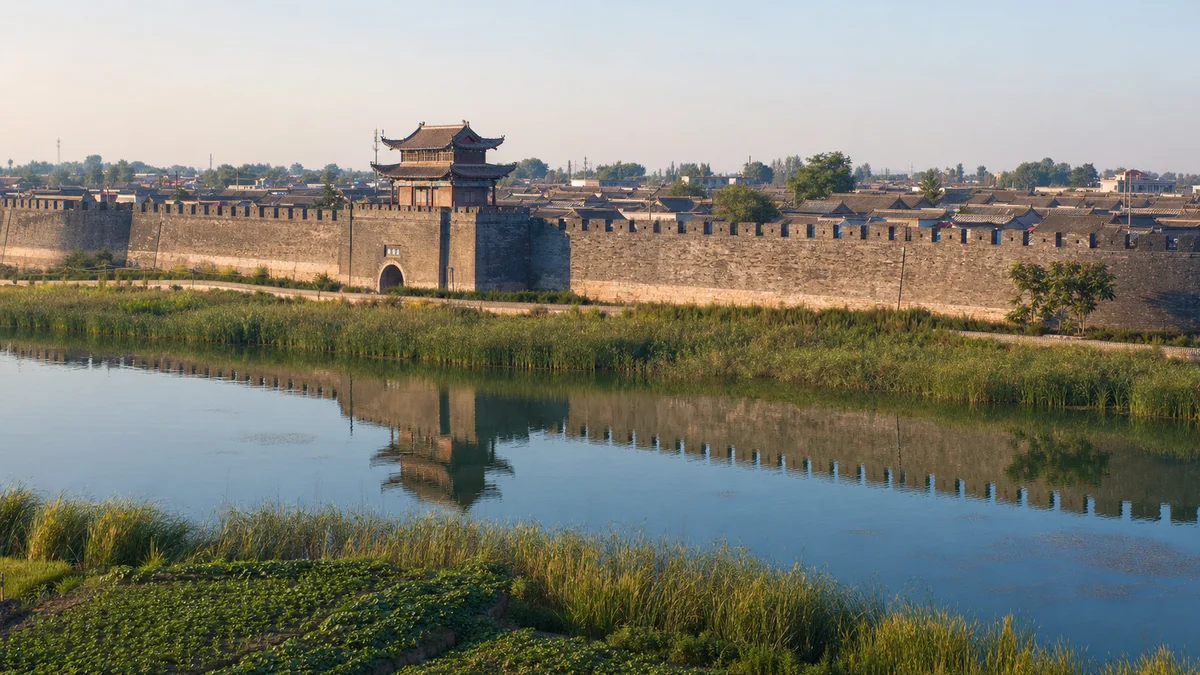
5A View location, maps and nearby scenic areasBefore entering Guangfu Ancient City, stand across the moat and lower your eye to the waterline. The wall does not rise from a dry plain like an isolated fortress. It sits inside the low Yongnianwa landscape, where embankments, channels, reeds and cultivated ground make water part of the city’s structure.
Cross a bridge only after taking in that outer ring. Inside are shops, homes, scooters and visitors—not an evacuated historical set. Guangfu is clearest when wall, water and ordinary life share one story.
A useful order is outside-in: moat and wetland edge → gate and wall → inhabited streets → one taijiquan residence or courtyard → another exterior wall view. Wall access, house interiors, performances and wetland transport are operational details, so verify them rather than making them essential.
A compact city inside a much larger wetland plain
The walled core is commonly described as roughly 1.5 square kilometres, with a wall circuit of about 4.5 kilometres. Treat these as orientation figures because measurements follow different boundaries. The scenic area and broader wetland are larger than the enclosure.
Four principal gates organise the roughly rectangular city. The moat separates brickwork from the low plain and reflects the wall. Guangfu’s defensive strength and visual identity depend on shallow gradients, stored water and controlled crossings.
The Guangfu Ancient City 5A profile helps locate the scenic area. On site, begin with one corner or gate seen across water. The relationship is clearer there than from a narrow commercial street where the wall can disappear behind roofs.
The walls record rebuilding, not one perfect founding date
Promotional accounts sometimes push Guangfu’s origin deep into the Spring and Autumn or Warring States periods, while local history also connects the settlement with later military and administrative centres. Such claims may refer to occupation in the region, an earlier earthen enclosure or a named jurisdiction—not necessarily the brick-faced circuit now in front of you.
The visible fortifications owe much to Ming-period reconstruction and brick facing, followed by Qing repairs and modern conservation. As the seat of Guangping Prefecture, Guangfu developed a formal street and gate pattern. Flood, war and changing needs repeatedly altered it.
Look for different brick colours, mortar and restored surfaces rather than one untouched ancient layer. Officials commissioned work, but brick makers, earth carriers, masons and residents maintained the defences. Historical authenticity does not require every brick to share one date.
Water defended the city—and made it vulnerable
Yongnianwa is a low-lying basin within the North China Plain. The moat and surrounding waters could slow attackers, carry goods, support fishing and irrigation, and receive floodwater. Yet the same low relief exposed residents and crops to waterlogging and changing river or drainage conditions. “City in water” is both an attractive image and a long history of hydraulic work.
Embankments, sluices and pumps belong to different management periods. Not every reed bed is untouched nature or water level traditional: agriculture, urban growth, conservation, drought and seasonal rain shape the wetland.
After heavy rain, paths may be muddy or temporarily controlled; in hot months, humidity and insects can increase. Boats or wetland excursions, where offered, depend on water, weather and operation. The moat view is still complete without them: compare the wall’s heavy line with wind moving through reeds and crops.
A living town cannot be preserved like an empty exhibit
Enter a gate and the heritage argument changes. People live, shop, worship, study and move goods within the walls. Everyday signs, parked vehicles and renovated storefronts may frustrate anyone expecting a film set, but they show continuity of use. Residents are not decoration in a visitor experience.
Tourism can fund repairs and livelihoods, yet also raise rents, standardise shops and turn practice into spectacle. Conservation may protect a façade while complicating household repairs. Ask who benefits, who bears restrictions and which kinds of daily life remain possible.
Keep residential doorways clear, ask before photographing people or private courtyards, and lower your voice in side lanes. Some historic-looking compounds are businesses or reconstructed displays; read labels before assigning them an imperial or martial-arts history.
Yang Luchan: from local student to Yang-style tradition
Yang Luchan (1799–1872) was born in this area and became the central figure associated with Yang-style taijiquan. Traditional accounts describe him travelling to Chenjiagou in Henan to study the Chen family’s martial art before teaching and adapting what he learned. Details of his training are told differently across lineages, but movement between places is fundamental to the story.
Yang later taught in Beijing; students and descendants developed forms that spread widely. Calling Guangfu the sole “birthplace” hides Chen teachers, later Yang-family innovators and other transmitters. More precisely, Guangfu formed a teacher central to one major global lineage.
If the Yang Luchan residence is open, treat it as a place to connect biography with domestic scale, not as proof of every legend. Exhibitions, demonstrations and instruction can change; a quiet courtyard may reveal more than a timed show.
Wu Yuxiang and the written life of taijiquan
Guangfu was also home to Wu Yuxiang (1812–1880), the scholar-martial artist associated with Wu/Hao-style taijiquan. His path intersected with Yang Luchan and other teachers, but he did not merely copy one system. Practice, study and textual interpretation fed a distinct lineage later carried by relatives and students.
A line preserved in the taijiquan textual tradition says, “Stand balanced like a scale; turn lively like a wheel.” It moves the art away from the stereotype of slow choreography: balance must remain responsive. The thought survives in present practice whenever a teacher corrects weight, centre and unnecessary force.
The Wu family compound gives this history an architectural setting if open. Do not compress two lives into a rivalry or origin myth. Yang and Wu show how travel, teaching, writing and reinterpretation carried several traditions from one small city.
Choose a route by interest, heat and wall access
For a first visit, start with the moat outside one gate, enter the main streets, then turn into a quieter residential lane before choosing one heritage residence. Finish with a short wall section or another outer-water viewpoint. This preserves the outside-in logic without demanding a complete circuit.
For a martial-arts visit, pair the Yang and Wu sites if open and watch public practice only if it occurs naturally. Performances and classes are not guaranteed; never interrupt training for a photograph.
For a lower-strain route, remain at street and moat level. The ground is broadly flat, but paving, thresholds, kerbs, drainage channels and mixed pedestrian-vehicle traffic require attention. Wall stairs can be steep and exposed. Confirm accessible entrances and toilets with the operator, and carry a route that does not depend on a sightseeing vehicle.
Photograph water, brick and daily scale safely
The strongest establishing image often comes from across the moat, with water beneath a gate or corner tower. A person, bicycle or reed bed supplies scale. On the wall, use the parapet as a leading line toward the low horizon; avoid climbing or sitting on unprotected masonry for a cleaner frame.
Morning or late light can model brick and reflections, but haze, water level and access vary. Midday has little shade; after rain, stone and earthen margins may be slick. Prepare for summer heat and storms or cold-season wind on the wall.
Check current rules for tripods, drones and commercial photography. Keep out of traffic lanes and do not photograph through residential windows. The best street pictures show evidence of habitation without turning a resident into anonymous “local colour.”
Leave by the moat, with two kinds of movement in mind
Return to the water before leaving. The wall appears stable, but repaired bricks, managed channels and inhabited streets reveal constant adjustment. Taijiquan can also look still to an untrained eye while weight and attention continue to shift. The comparison is evocative, not proof that landscape mechanically created the martial art.
Nuwa Palace offers Handan another meeting of terrain, architecture and living tradition. Xibaipo turns political memory into a different kind of heritage landscape, while Tangshan South Lake · Kailuan shows water and industry remade through modern planning.
Guangfu’s value lies neither in pretending nothing changed nor in smoothing it into a heritage brand. It is a rebuilt fortification in a managed wetland, a home to residents and commerce, and a major node in several taijiquan histories. Watch the reflection break as wind crosses the moat: preservation here is not stillness, but the difficult practice of adjusting without losing form.
LoreLens App can identify Guangfu’s gates and heritage sites, then connect the view to the city’s water and taijiquan histories.
Location profile
Where it is

Frequently asked questions
How long should I allow for Guangfu Ancient City?
Allow about half a day to see the moat, enter through a gate, walk the inhabited streets and visit one or two heritage courtyards if open. A wall circuit or wider wetland outing needs more time. Confirm current wall access, house opening and transport before building a full-day plan.
Can visitors walk all the way around Guangfu's city wall?
Sections are commonly promoted for wall walking, but entrances, restoration areas and complete-circuit access can change. Stairs are steep and shade is limited. Check the day's official notice before committing, and keep a street-level route as a complete alternative.
Is Guangfu the birthplace of taijiquan?
Guangfu is crucial to taijiquan history as the home of Yang Luchan and Wu Yuxiang, associated with the Yang- and Wu-style traditions. Taijiquan developed through several places, teachers and lineages, however, so the city is better understood as a major centre of transmission than the single uncontested origin of every style.
Is Guangfu Ancient City accessible for wheelchair users?
Street-level routes can be relatively flat, but old paving, kerbs, thresholds, traffic and drainage edges create obstacles. Wall stairs and many historic courtyards are not step-free. Ask about an accessible gate, toilets and current vehicle restrictions, and consider enjoying the wall-and-water relationship from ground level.