Hebei · Tangshan
Tangshan South Lake & Kailuan: A City Repairs Its Ground
Walk from managed lakes and reclaimed subsidence land to Kailuan's mine heritage, reading Tangshan's industrial rise, workers' lives, earthquake rebuilding and unfinished ecological repair together.
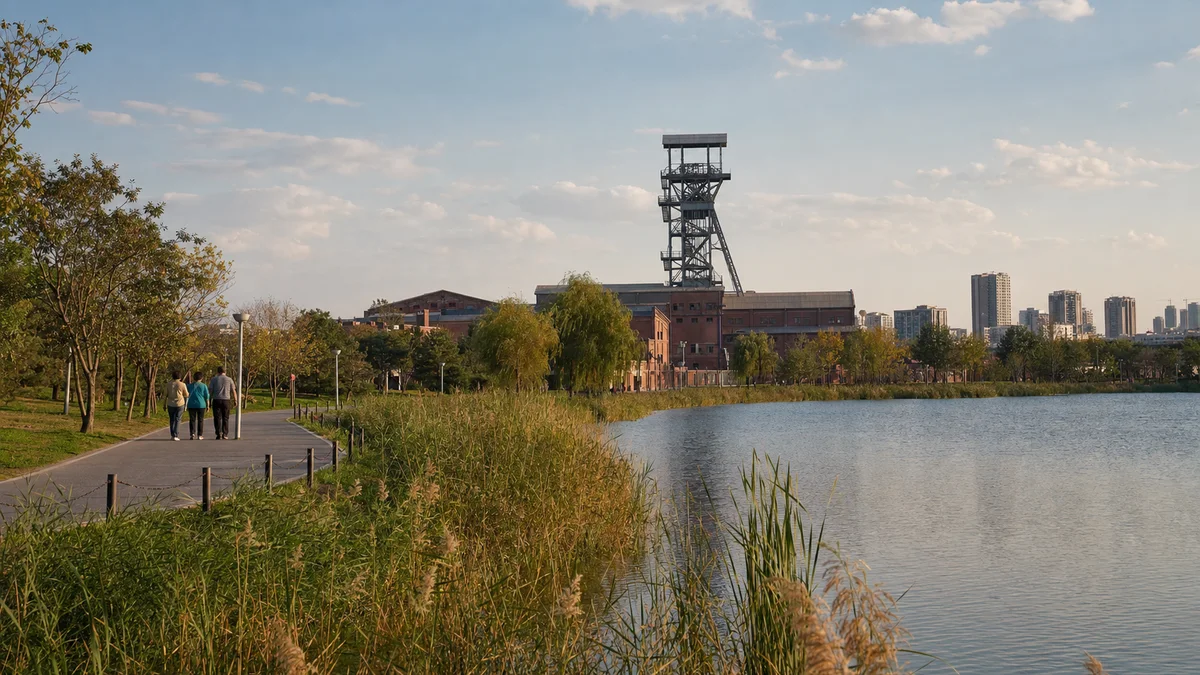
5A View location, maps and nearby scenic areasAt Tangshan South Lake, find a place where reeds, open water, a bridge and the city skyline occupy one frame. The view feels spacious and settled. Then remember that much of this southern urban ground was shaped by coal extraction, subsidence, waste and later engineering. The calm is an achievement, not a return to untouched nature.
Move next toward Kailuan’s industrial heritage—headframes, tracks, brick buildings and machinery. South Lake and Kailuan form one 5A destination because they tell opposite-looking chapters of the same urban story: digging into the ground, then trying to make damaged ground habitable again.
Use a two-part route: one selective South Lake loop → Kailuan museum and exterior industrial structures → underground interpretation only if open and suitable. The combined area is large; shuttle services, shows, night lighting, museum rooms and special events are never guaranteed.
One attraction, two landscapes and several boundaries
Official descriptions use different area figures for the water body, core park, former expo grounds, wider ecological zone and combined 5A boundary. Those numbers cannot be exchanged casually. What a visitor needs to know is simpler: South Lake covers many kilometres of paths, while Kailuan’s heritage buildings form a separate concentration of industrial material.
The lake landscape is horizontal—water, wetlands, lawns and urban views. Kailuan is vertical and mechanical: shafts descend, headframes rise, rails direct movement. Geology, labour and planning connect them, not one historic enclosure.
The South Lake and Kailuan 5A profile provides regional orientation. Use the current visitor map for actual gates and transfers. A destination visible across water may require a long detour, and an event closure can make an old online route obsolete.
Coal, rail and the making of modern Tangshan
The Kaiping mining enterprise, a predecessor in Kailuan’s history, was established in 1878 during the late Qing Self-Strengthening era. Under figures including official Li Hongzhang and entrepreneur-administrator Tang Tingshu, coal production, rail transport and modern machinery became closely linked around Tangshan.
The railway developed to move coal became one of China’s earliest modern rail projects. Promotional histories call the mine, railway or locomotive “China’s first,” but answers change with definitions such as ownership, gauge or construction. “Among the earliest and most influential” is safer.
Kailuan’s later history involved mergers, changing ownership, foreign capital and national politics. Coal supported railways, shipping, industry and urban growth far beyond Tangshan. In return, the city’s landscape and economy became deeply dependent on extraction. The mine museum should be read as a node in a national industrial network, not merely a local collection of machines.
Put miners back into the machinery
A headframe is elegant in silhouette, but its purpose was to move people and coal between surface and underground. Miners worked with darkness, dust, water, gas, heat, noise and the possibility of collapse. Engineers, railway workers, sorters, repair crews and miners’ families also sustained production. Industrial heritage becomes distorted when machinery appears to operate without bodies.
Kailuan workers organised and faced conflict as industry expanded. Ownership and management shaped household wages, discipline, safety and housing. Beside production records and technical innovation, look for protective equipment, shifts, accident prevention and workers’ testimony.
Coal brought employment and infrastructure while exporting environmental costs into air, water, waste heaps and unstable ground. A balanced account neither treats miners as symbols of backwardness nor romanticises dangerous labour. Their skill and solidarity deserve recognition alongside the limits of a coal-dependent city.
The 1976 earthquake belongs to the context, not one cause
On 28 July 1976, a magnitude 7.8 earthquake devastated Tangshan and killed hundreds of thousands of people. Homes, factories, railways and public systems collapsed across the city. Survivors, rescue workers and later migrants rebuilt an urban society as well as its structures.
The earthquake is essential context for modern Tangshan, but it did not by itself create South Lake’s subsidence landscape. Coal extraction, ground movement, waste disposal, water management and subsequent planning followed different causal paths, even where their histories overlap geographically. Do not turn every depression into an earthquake scar.
Rebuilding encouraged a civic language of resilience. It can honour collective effort while leaving room for grief, unequal losses and long-term consequences. Recovery was difficult human work, not miraculous erasure.
From subsidence ground to a managed urban lake
South of central Tangshan, long-term mining contributed to subsidence and low-lying ground that also accumulated waste and polluted water. From the late twentieth century onward, municipal projects reshaped terrain, treated water, planted vegetation, connected paths and converted a neglected zone into public parkland. The 2016 Tangshan International Horticultural Exposition accelerated and displayed parts of that transformation.
Restoration does not mean contamination vanished. Soil may be capped or moved, water treated, slopes stabilised and habitats maintained. Outcomes require monitoring, budgets and choices about species and public use. Landscaped beds are not a self-regulating wetland.
Residents nevertheless gained water views, walking space and a new southern identity. Watch birds from a distance, stay on paths and do not feed wildlife. Events and crowds can disturb habitat; ecological and recreational goals sometimes compete.
Read the museum, then question the underground experience
Begin Kailuan with the museum or introductory displays if open. A chronological sequence makes headframes, rail artefacts and machinery intelligible. Look for the connection between a piece of equipment and the task, worker and risk it changed. A locomotive is not just a photogenic object; it reorganised the distance between coal seam, factory and port.
An underground route can communicate darkness and mining processes, but remains controlled interpretation. It may mix historic space, replicas, lighting or staged figures. Do not confuse removed hazards with production conditions or assume every dramatic scene is original.
The museum, underground section and particular galleries may close for inspection, maintenance, capacity or programme changes. Check accessibility separately: lifts on one route do not guarantee that platforms, uneven floors or emergency procedures suit every visitor.
Plan one park loop before transferring to Kailuan
For a first visit, choose one South Lake circuit with water, a restored landscape feature and a city view. Pause at a reed edge, then transfer to Kailuan for the museum and exterior structures. Add an underground experience only after confirming time, access and comfort with enclosed spaces.
For an ecology-focused visit, compare designed lawns with reed margins and managed water; birds and flowers cannot be promised. For industrial history, shorten the park loop and reserve energy for labels, buildings and workers rather than every machine.
Internal buses, sightseeing vehicles or event shuttles may reduce distance, but schedules and stops vary. Keep a route that works without a particular service. Check exit locations before dusk; night shows and illuminated landscapes can be cancelled or seasonally absent.
Photograph industry and ecology without hiding either
At South Lake, include a bridge, former industrial silhouette or skyline beyond reeds so the image remains urban rather than pretending to be wilderness. Low light can reflect structures beautifully, but water, haze, sunset colour and illumination are not guaranteed. Avoid entering planted or nesting areas for a cleaner foreground.
At Kailuan, use rails or conveyors as leading lines and include a person beneath a headframe for scale. Side light reveals brick, steel and repaired surfaces. Check rules inside galleries and underground spaces; tripods, flash and commercial equipment may be limited, and drones should not be assumed legal anywhere in the combined area.
Broad paved paths can be wheelchair-friendly, yet distance, bridge gradients and detours matter; underground areas may be narrow. Prepare for summer heat and storms or severe winter wind, and confirm accessible toilets, lifts and emergency arrangements.
Leave with repair understood as a continuing verb
Return mentally to the first calm lake view. It contains mining geology, public investment, ecological design and residents’ desire for a liveable city. It does not prove that pollution, subsidence or dependence on coal have been erased. Restoration is a continuing relationship with damaged ground.
The Eastern Qing Tombs organise an older political landscape of memory. Hengshui Lake raises different questions about wetland protection and visitors, while Shanhai Pass connects defence, movement and later industrial geography along the Bohai corridor.
South Lake and Kailuan belong together when neither side cancels the other. The park is more meaningful when miners and subsidence remain visible in its story. The mine is more meaningful when the environmental bill and the city’s effort to respond remain visible too. Between reed and headframe, Tangshan offers no finished redemption—only difficult, valuable work carried forward.
LoreLens App can identify South Lake landmarks and Kailuan machinery, then connect them to Tangshan’s industrial and ecological history.
Location profile
Where it is

Frequently asked questions
How much time should I allow for South Lake and Kailuan?
Allow most of a day for a meaningful South Lake section and the Kailuan museum area. The combined destination is too dispersed for a quick circuit. Check openings and transport, then choose one park loop rather than every garden and shore.
Are South Lake Park and Kailuan Mine Park in the same place?
They form one 5A destination and historical story, but the park and industrial heritage areas are distinct zones. Routes and transfers can change, so consult the current official map instead of assuming a continuous walking path.
Is the Kailuan underground experience an active coal mine?
No visitor attraction should be understood as an operating production face. The experience interprets mining through historic fabric, reconstructed settings or controlled underground spaces, depending on the current route. Confirm what is open and distinguish museum simulation from documented working conditions.
Is the scenic area accessible for wheelchair users?
Many South Lake paths are broad and level, but distances are substantial and detours may occur. Historic mine buildings, platforms or underground experiences can add steps, slopes and narrow spaces. Ask each venue about step-free entrances, lifts, toilets and permitted mobility equipment before relying on a complete route.