Hebei · Qinhuangdao
Shanhai Pass: Where the Great Wall Meets a Corridor
Read the First Pass gate, walled city and Old Dragon's Head as parts of a dispersed frontier system shaped by mountains, sea, soldiers, merchants and the contested choices of 1644.
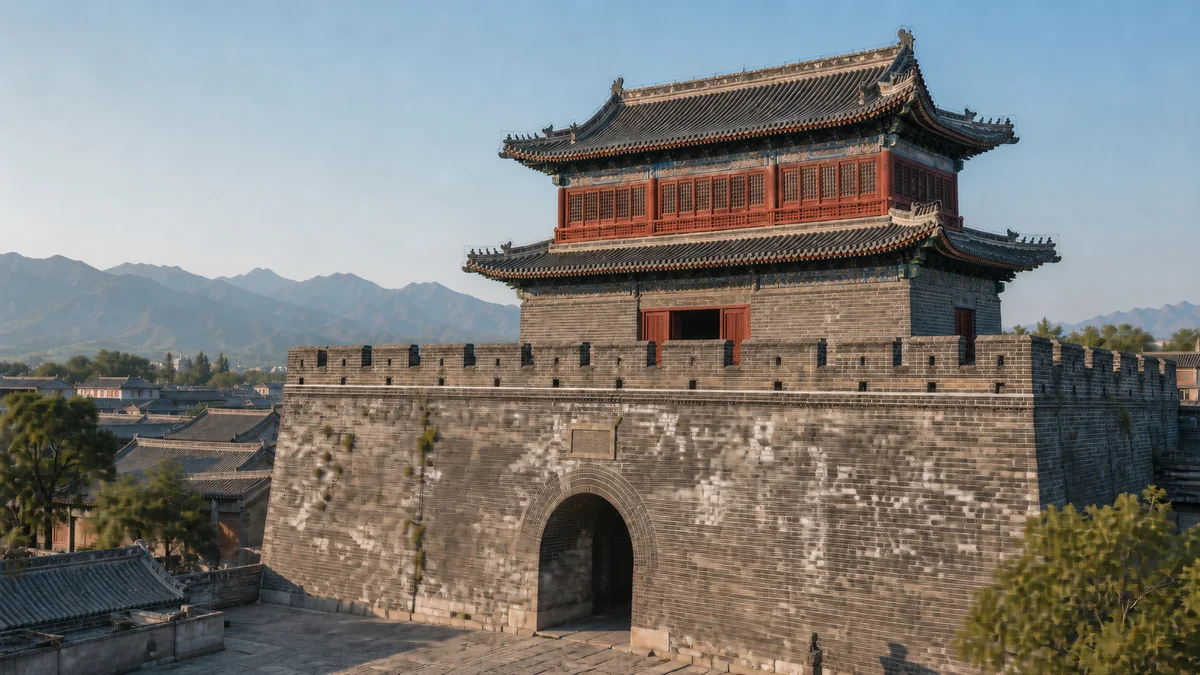
5A View location, maps and nearby scenic areasStand beneath the arrow tower and look through the gate before looking up at its plaque. The opening frames a road—the corridor between the Yan Mountains and Bohai Sea used by armies, officials, merchants and residents.
That corridor explains Shanhai Pass, or Shanhaiguan, better than “First Pass Under Heaven.” It was a walled city, military checkpoint and transport junction whose power came from movement.
Plan separate clusters. Start with the First Pass gate and old pass city. Add Old Dragon’s Head on the coast or Meng Jiangnü Temple only with time and transport. They belong to the wider tourism area but are several kilometres apart, with different entrances and operating conditions.
One scenic-area name covers several places
The pass city contains the east gate and arrow tower called the First Pass Under Heaven, with wall lines, streets and exhibitions around it. Access changes; an open street does not guarantee every tower or wall walk.
South at the coast, Old Dragon’s Head shows Great Wall masonry reaching the Bohai. Meng Jiangnü Temple, associated with a woman who wept down a wall, occupies another location. Neither is visible from the main gate.
The Shanhai Pass 5A profile supplies a map anchor. For visiting, use a current map with entrance names and road distances; one marketing label does not mean one pedestrian enclosure.
Mountain and sea compressed movement into a corridor
Shanhai joins “mountain” and “sea.” The Yan Mountains restrict travel north and west; the Bohai lies south. Their coastal plain became a strategic route between the North China Plain and Liaodong.
Roads, hill passes, water, coastal conditions and military supply determined how the corridor worked. The city concentrated inspection, defence and communication where movement could be watched.
Look from the tower towards both horizons. The mountains explain why the wall descends towards the city; the coast explains why defences continued south. The landscape is not a decorative backdrop. It is the reason a major fortified settlement developed here.
The 1381 foundation was followed by centuries of work
The conventional account dates the Ming pass to 1381 and attributes its planning to general Xu Da. This founding point does not mean one commander produced the surviving complex in one project.
Later Ming governments strengthened gates, towers, barracks and coastal works. Soldiers, military households, artisans, quarry workers and transport labourers built and repaired them. Destruction, reuse and reconstruction also shape today’s site.
Compare masonry rather than assuming equal age. Rebuilt parapets clarify defensive form; worn bases retain different evidence. New surfaces are not untouched fourteenth-century fabric.
“First Pass Under Heaven” is a claim, sign and tradition
The 天下第一關 characters are traditionally associated with Ming calligrapher Xiao Xian. Stories about the original and copies accumulated over centuries. Follow the display label rather than declaring every visible plaque original.
“First Pass Under Heaven” does not settle a modern fortress ranking. It advertised strategic pre-eminence on an eastern corridor and made the gate an emblem of imperial order.
Study the architecture beneath the words. The arrow tower provided height, observation and firing positions; the gate channelled traffic; connected walls made the tower part of a city defence. The plaque is memorable because the structure and geography give the claim weight.
In 1644, a gate did not make decisions by itself
In 1644, Li Zicheng’s forces captured Beijing, the Chongzhen Emperor died and Ming authority fractured. Wu Sangui, a commander at Shanhai Pass, faced Li’s regime, his own army and an established Qing state northeast of the wall.
Wu allied with Qing prince-regent Dorgon. Their forces defeated Li’s army near the pass, enabling Qing movement towards Beijing. This began a decisive conquest phase, but warfare continued for years.
“Opening the gate” hides the Ming collapse, Li’s position, Wu’s army and Qing organisation. Personal calculations mattered, but the pass channelled these choices; it did not cause them.
A military city also fed, housed and traded
Garrisons needed grain, water, fuel, weapons, horses and repairs. Military households and residents cultivated land, transported supplies, made goods and served travellers.
Control and exchange coexisted. Officials inspected movement while merchants and envoys used the same corridor. Markets, smuggling and changing restrictions connected both sides.
Today’s old-city streets are not a perfectly preserved Ming market. Buildings have changed, tourism has altered shopfronts, and residents continue ordinary life. Distinguish heritage displays from active homes and businesses; ask before photographing people at close range.
Old Dragon’s Head is coastline, reconstruction and symbol
At Laolongtou, or Old Dragon’s Head, the wall appears to enter the Bohai like a dragon drinking from the sea. It is one of China’s strongest Great Wall images, but not proof that the entire Great Wall literally begins at one stone platform. Ming frontier works extended through different regions and periods.
Coastal works suffered heavy damage, including in 1900, and substantial reconstruction shaped today’s site. Read the rebuilt line as coastal-defence interpretation, not an untouched Ming wall.
Tide, wind, spray and maintenance change the view. Stone can be slick; stay behind barriers and do not climb seaward structures. Weather need not reveal a postcard horizon.
Meng Jiangnü belongs to cultural memory, not a site report
The legend of Meng Jiangnü tells of a wife who travelled to find her conscripted husband and wept so powerfully that part of the Great Wall collapsed. Versions of the story developed over many centuries, with roots older than the Ming wall at Shanhai Pass.
The temple shows how communities gave the story place and ritual form; it does not prove the events occurred here. The tale shifts attention from rulers to conscription, separation and construction’s human cost.
Treat the temple as cultural and devotional space. Follow photography rules, keep voices low and avoid mocking ritual gestures. Moral meaning need not become literal engineering history.
Choose a route by theme and transfer time
A half-day military route can focus on the First Pass gate, arrow tower, wall-city relationship and one museum or street circuit. It gives the clearest explanation of how traffic passed through a fortified settlement.
A full-day landscape route can add Old Dragon’s Head to connect mountain corridor and coast. Add Meng Jiangnü Temple only if its cultural theme matters to you and transport remains practical. Trying to collect all labels can leave less time for the architecture that explains them.
Combined tickets, shuttles, performances, night opening and wall access change. Confirm inclusions and last return. Paving, thresholds and stairs limit mobility; ask about step-free routes, toilets and drop-off points.
Photograph the corridor without losing the people
Frame the First Pass through its street so the tower remains connected to movement. A moderate telephoto compresses gates; a wide view includes mountains or city. Do not block the arch for symmetry.
At Old Dragon’s Head, use shoreline to explain orientation. Sea wind, reflected summer sun and haze can be strong. Secure hats and tripods, protect equipment from salt spray and avoid wet edges. Confirm drone rules.
As you leave, look once more through the gate rather than only at its plaque. Shanhai Pass did not seal two worlds apart, and in 1644 it did not act alone. It organised movement through a difficult corridor—and therefore became a place where soldiers, rulers, traders and residents repeatedly negotiated power.
Compare that corridor logic with the ridge surveillance of Jinshanling Great Wall, the ancestral landscape of the Eastern Qing Tombs and the mobile Qing court at Chengde Mountain Resort. “First Pass” is most useful not as a boast, but as an invitation to ask what passed through.
LoreLens App can connect the gate tower, coastal wall and inscribed names to the armies, travellers and legends that moved through Shanhai Pass.
Location profile
Where it is

Frequently asked questions
How much time should I allow for Shanhai Pass?
Allow half a day for the First Pass gate and a thoughtful walk through the old pass city. A full day is more realistic if you add Old Dragon's Head or Meng Jiangnü Temple because they require separate transfers. Confirm current opening sites, ticket scope and the last return before combining them.
Are the First Pass, Old Dragon's Head and Meng Jiangnü Temple together?
No. They belong to the wider Shanhai Pass tourism area but are separated by several kilometres and different operating boundaries. Old Dragon's Head lies on the Bohai coast south of the pass city, while Meng Jiangnü Temple is another separate site. Do not plan them as rooms in one compact attraction.
Did Wu Sangui simply open Shanhai Pass to the Qing in 1644?
That summary is too simple. After Li Zicheng's forces took Beijing and the Ming order collapsed, Wu Sangui made an alliance with the Qing prince-regent Dorgon. Their forces defeated Li's army near the pass, enabling Qing entry. The outcome involved several armies, political calculations and a wider state crisis—not one gate moving by itself.
Can I walk the walls at night or buy one ticket for every site?
Wall access, performances, night programmes, combined tickets and shuttle arrangements can change by season, maintenance and event schedule. A ticket name may not include every interior or outlying site. Confirm the exact inclusions, last admission and exit route through official scenic-area channels on the day.
Sources and further reading
Background references for the history and place names in this guide. Opening hours, ticketing and access change often — always confirm with official local information before travelling.