Hebei · Handan
Nuwa Palace: Where Myth Meets a Carved Mountain
Climb Zhonghuang Mountain from lived ritual spaces to Northern Qi cliff sutras and the rebuilt halls of Nuwa Palace, keeping myth, historical evidence and mountain safety clearly in view.
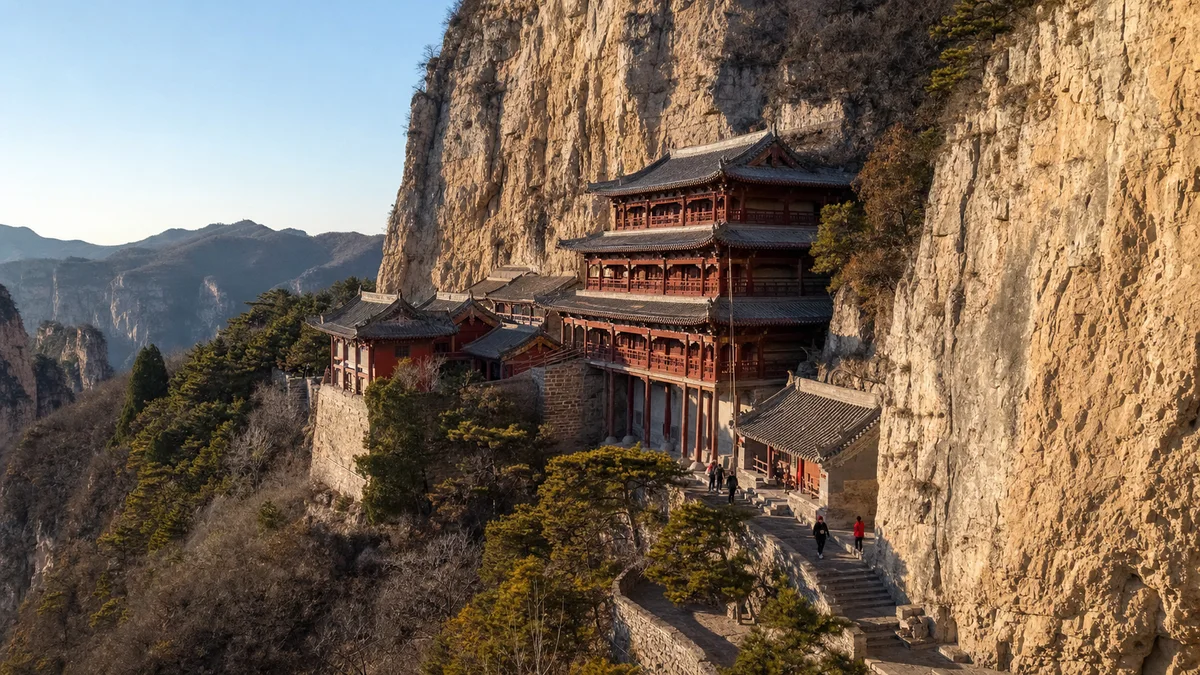
5A View location, maps and nearby scenic areasAt the first open view on Zhonghuang Mountain, stop and find the buildings before taking a photograph. Roofs seem to cling to a band of cliff above you. Below are terraces and paths; behind them is rock carrying inscriptions far older than much of the visible timber architecture. Nuwa Palace asks you to read upward—and to separate what the mountain proves from what people believe upon it.
The site joins three kinds of inheritance: Northern Qi cliff-carved Buddhist scriptures, halls repeatedly repaired across later dynasties, and living devotion to the creator goddess Nüwa. None needs to be disguised as another for the whole place to matter.
Read the ascent in order: lower ritual precinct → mountain path and changing cliff view → carved scriptures → upper halls and Nuwa Pavilion. If steep steps, heat or weather make the full climb unsuitable, the lower courts and exterior view still tell a coherent story.
A vertical sacred landscape on Zhonghuang Mountain
Nuwa Palace stands in Shexian County, western Handan, where the Taihang foothills compress movement into ledges and stairways. Unlike a level temple reached through one central gate, this complex reveals itself in layers. Height creates drama, but it also determines time, effort and access.
Lower buildings organise arrival and worship. Higher routes approach carved text, then halls and the cliff-backed Nuwa Pavilion, popularly described as a “hanging temple.” The wider scenic boundary includes more than one building, so ticket and heritage maps may differ.
Use the Nuwa Palace 5A profile to understand location, then check the current on-site plan. Closed paths can change the logical order, and a route that looks short in projection may gain substantial height.
Northern Qi evidence beneath later roofs
The strongest early evidence is not a palace preserved from one founding year, but Buddhist scriptures carved into the cliff during the Northern Qi period in the sixth century. They place organised patronage and skilled stone work here long before the upper halls gained their present appearance.
Promotional histories often connect the first complex directly to Northern Qi rulers. Distinguish the studied inscriptions from timber buildings damaged and rebuilt later. The pavilion and halls embody continuity through repair, not an untouched sixth-century skyline.
Patrons and officials could commission work, but anonymous engravers, quarry workers, carpenters, roof-tile makers and porters made the mountain usable. Monastics, temple keepers, pilgrims and nearby communities then renewed its meaning. Reading those people back into the site prevents “dynasty” from becoming the name of a single builder.
Read the cliff sutras before searching for legends
Approach slowly. Mottled rock resolves into lines of characters, spacing and tool marks. The texts are Buddhist: a place now associated with Nüwa preserves another religious layer. Sacred landscapes can accumulate traditions rather than follow one programme.
Do not touch, trace, chalk, wet or make rubbings from the characters. Skin oils, abrasion and water accelerate loss; barriers also protect visitors from the cliff. Use angled natural light with your eyes—side illumination often makes shallow cuts clearer—but do not assume that a camera will record everything visible in person.
Counts of texts, characters or carved area vary with fragments and measurement rules. Prefer an official panel’s stated method to a superlative. What matters is that scripture was made physically present in rock and survives there.
Nuwa repairs the sky: myth, not eyewitness history
In Chinese myth, Nüwa appears as a powerful creator and restorer. One famous line, usually associated with the Huainanzi, says she “smelted five-coloured stones to repair the blue sky.” The longer story describes a world whose supporting pillars had failed, followed by acts that restored order. Other texts and later traditions tell of Nüwa shaping human beings from earth.
These episodes were not one consistent biography or verifiable modern history. Sky-repair and human-creation motifs emerged through different texts and retellings. Present them as myths, not events archaeology proves happened in Shexian.
That distinction does not empty them of truth. “Nüwa repairs the sky” remains a metaphor for responding to catastrophe and mending a broken order. On a mountain exposed to rock, storm and distance, the restoration story gains physical force. The modern echo lies in how worshippers and visitors continue to use it, not in converting symbolic stones into geology.
Living worship changes how you should behave
Nuwa Palace is cultural heritage, but it is also a ritual destination. Worshippers may offer incense, bow, pray for family wellbeing or join community observances. Their intentions will not always match a visitor’s desire for photographs. Leave room at altars and processional paths, and never direct someone to repeat a gesture for your camera.
Temple-fair traditions can draw gatherings, but lunar dates, programmes and controls vary. Confirm current notices rather than promising a performance. Incense may be confined to designated places; follow fire instructions and never carry flame onto paths.
Keep voices low inside halls, remove hats if local instructions request it, and avoid touching statues, offerings, painted surfaces or ritual objects. Ask before photographing officiants or worshippers. A mythology-themed costume or playful pose that seems harmless outside can be disrespectful at an active altar.
The “hanging temple” is a repaired structure, not a stunt
The cliff is both backdrop and constraint. Timber halls rise on terraces where buildable ground is scarce. Iron chains at the pavilion feed the saying that it is “hung” against the rock, but repairs complicate their structural role; chains alone do not hold up the building.
Do not push railings, pull chains or try to make the pavilion move. The popular idea of a “living building” is not an invitation to test protected fabric. Read how columns meet stone, how rear walls approach the cliff and how successive platforms transfer visitors upward.
Interiors may close for ritual, conservation, capacity or weather. Even from outside, the construction is intelligible: builders negotiated between a sacred rock face and the need for stable floors. Later repairs are part of that achievement, not evidence that the monument has lost all historical value.
Build the climb around a safe turnaround point
For a first visit, begin in the lower precinct, then climb slowly enough to look back as the valley opens. Prioritise the cliff scriptures before the highest hall; they are the site’s clearest Northern Qi evidence. Continue to the upper complex only if the route is open and your knees, breathing and weather remain comfortable.
For a myth-and-ritual visit, read temple panels and observe worship respectfully. Ceremonies or performances are bonuses, not guarantees. For an architecture visit, photograph the cliff relationship below before entering tight upper spaces.
Cableway, shuttle or other assisted transport can change with inspection, wind, maintenance and crowd control. Confirm its current route and last service directly, and keep enough time and energy to descend by an approved alternative. Never enter a closed shortcut.
Photograph the cliff without sacrificing safety or access
The most explanatory photograph includes rock above, supports and terraces in the middle, and a person or path below for scale. From a lower switchback, a longer focal length can compress pavilion and cliff without stepping outside barriers. Near the inscriptions, use oblique available light and photograph only from permitted positions.
Long views depend on haze, cloud and open viewpoints; no season guarantees visibility. Check hall signs, expect restrictions on flash or tripods, and do not assume drones are legal. Keep stairs clear.
The climb is exposed to sun and can be humid in summer. Rain or snow makes stone stairs slippery; shaded sections may retain ice, and gusts can be stronger near ledges. Wear shoes with grip, carry water and layers, and stay behind railings. Visitors with limited mobility should ask about step-free lower areas, toilets and assistance rather than assuming mechanical transport solves every stair.
Descend with evidence and belief still distinct
On the way down, look once more at the timber roofs against the rock. The cliff inscriptions establish sixth-century religious activity; the buildings show repeated repair; prayers and offerings show a sacred place still being used. Nüwa’s stones belong to myth, yet the human practice of mending damaged structures is visible everywhere.
Guangfu Ancient City preserves another Handan landscape where maintenance sustains identity. Baishi Mountain and Yesanpo offer different negotiations between Taihang terrain, visitor access and conservation.
Nuwa Palace becomes smaller if every story is forced into literal history, and colder if worship is treated as scenery. Let each layer keep its character: scripture in stone, architecture held through repair, myth carried by retelling, devotion enacted by people. The mountain does not prove that a goddess repaired the sky. It shows how generations have continued to repair a place where that story matters.
LoreLens App can identify Nuwa Palace’s halls and cliff features, then connect what you see to the site’s historical and mythic layers.
Location profile
Where it is

Frequently asked questions
How much time should I allow for Nuwa Palace?
Allow at least half a day for the lower precinct, climb, inscriptions and upper halls. Crowds, heat and weather can extend the visit. Check which paths and buildings are open, then choose a turnaround point before starting uphill.
Are the stories of Nuwa repairing the sky and creating humans historical facts?
No. They are creation and restoration myths preserved in different early texts and later tradition. They have helped communities interpret disaster, renewal and human origins, but are not evidence that a historical person performed these acts.
Can I use a cableway or shuttle instead of climbing?
Mechanical transport may be available, but its route and operation can change with weather, inspection and crowd control. Confirm same-day information and do not rely on it as the only way back. Upper paths may still require steps.
Is Nuwa Palace accessible for visitors with limited mobility?
The mountain complex has sustained slopes, long staircases, thresholds and narrow historic approaches. Some lower areas may be easier, but step-free access to the upper cliff buildings should not be assumed. Ask the operator about current accessible routes, toilets and assistance before travelling.