Tianjin · Haihe River
Tianjin Ancient Culture Street: A Port City's Living Memory
Step past the painted archways to find Tianhou Palace at the heart of a street rebuilt in 1986—a compact route into Tianjin's river trade, popular belief and living craft traditions.
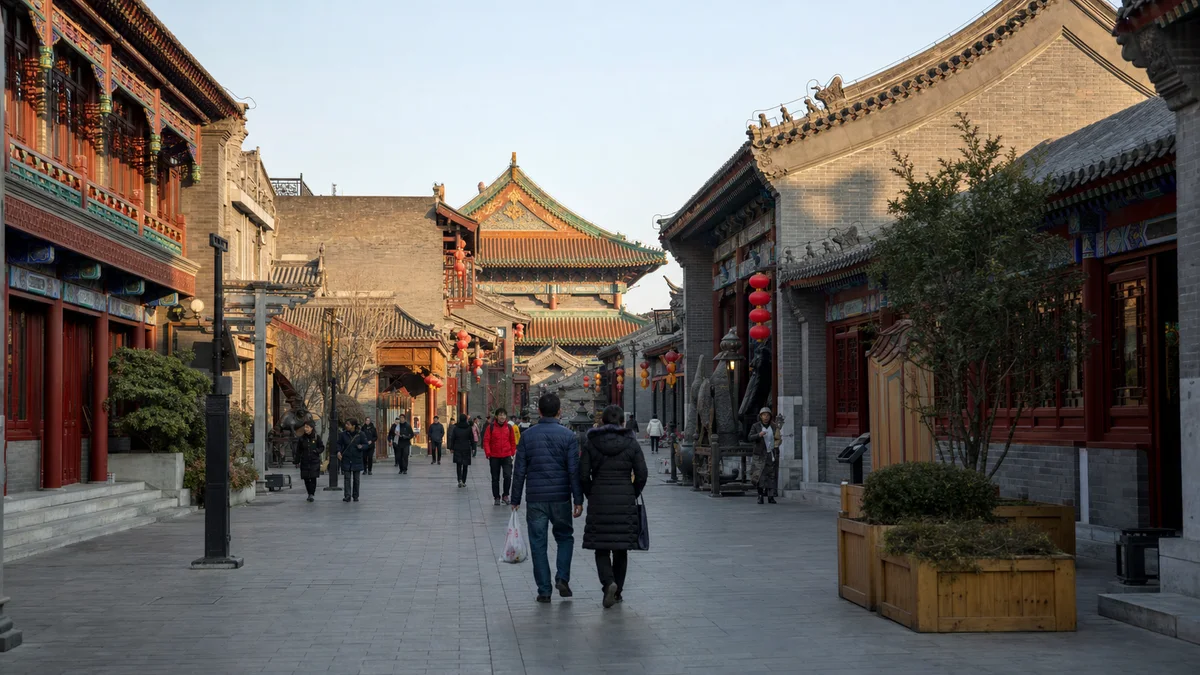
5A View location, maps and nearby scenic areasPause just inside one of Tianjin Ancient Culture Street’s painted gateways. The roofs, shopfronts and decorative panels create an immediate “old Tianjin” scene, but the most useful first question is not whether everything looks ancient. Ask instead: which parts preserve an older institution, which parts reinterpret the past, and which traditions are still being practised now?
The answer begins at Tianhou Palace, the religious and spatial anchor of the street. Around it, a pedestrian district rebuilt and opened in 1986 gathers the visual language of northern Chinese commercial streets, Tianjin foods, folk art and the memory of a city shaped by the Grand Canal, the Haihe water system and access to the Bohai coast.
Compact orientation: treat the main street as a spine, not the whole story. Walk first to Tianhou Palace, look outward towards the lanes and Haihe, then return slowly through the craft shops. The temple explains why a trade street grew here; the river explains why the temple mattered.
Begin with an honest date: the visitor street opened in 1986
“Ancient Culture Street” is a modern visitor name. The present streetscape was reconstructed in traditional style and opened in 1986. Its arches, grey-brick façades, painted eaves and continuous shopfront rhythm were assembled to evoke an older commercial Tianjin; they should not be mistaken for an entire Ming- or Qing-period neighbourhood that survived unchanged.
That distinction does not empty the place of history. Cities often remember themselves through rebuilding, selection and display. Here, the reconstruction preserved a historic urban focus around Tianhou Palace and gave folk artists, food businesses and religious customs a highly visible stage. It also simplified a much more complicated city into a walkable cultural district.
Read the street in layers. The layout and decorative ensemble largely belong to the late twentieth-century tourism project. The temple institution and river-city memory reach much further back. Individual objects, craft lineages and rituals may have their own dates again. A restored hall is not automatically original fabric, and a new workshop can still teach an old skill.
The name Jinmen Guli, often translated loosely as “the old home of Tianjin,” appears as part of the district’s identity. Treat it as an invitation to explore local memory, not as proof that every building is an ancestral relic.
Tianhou Palace is the historical anchor, not a themed backdrop
Tianhou Palace—also called Niangniang Palace locally—is commonly dated to 1326, during the Yuan dynasty. The date refers to the foundation of the temple, not to every structure a visitor sees today. Fires, repairs, changing patronage and later restoration have all shaped the compound, so the surviving ensemble contains multiple historical layers.
The temple honours Mazu, a deified woman from coastal Fujian whose worship spread among sailors, boat crews, merchants and communities dependent on dangerous waters. Imperial titles elevated her from a local protector to Tianfei and then Tianhou, the “Heavenly Empress.” In Tianjin, her presence linked coastal belief with an inland river port where cargo and people moved between sea routes, the Haihe system and canal connections.
Enter as you would enter a functioning religious site. Notice the sequence from gateway and courtyards towards the principal hall, the changing rooflines and the way incense, offerings or quiet gestures of respect make the space different from the commercial street outside. Current access to particular halls can vary; barriers and signs matter more than an old online map.
A local saying is often rendered, “First came Tianhou Palace, then came the Tianjin garrison.” The temple’s commonly accepted foundation date does predate the establishment of Tianjin Wei in the early fifteenth century, but the saying is a mnemonic, not a complete origin story. Settlements, waterways and markets existed through longer processes. Its real value is to show how strongly residents place the temple near the beginning of Tianjin’s civic identity.
Follow grain, salt and travellers to understand the port city
Tianjin’s historic importance came from connection. The city stood where waterways converged near the approach to the Bohai, tying northern coastal movement to the Haihe basin and Grand Canal transport system. Tribute grain sent towards the imperial capital was a central part of this logistics world, while salt and other commercial goods supported wider markets. Routes, cargoes and administrative arrangements changed across dynasties; there was never one timeless trade pattern.
Tianhou worship made sense in this environment. Boat crews faced storms at sea, shifting river conditions, winter ice, shoals, collisions and the ordinary uncertainty of long transport chains. Merchants and families also sought protection for people and cargo. A temple near a busy landing area was therefore a ritual institution, a meeting point and a marker of arrival.
The link with the Beijing Grand Canal is especially revealing. Tongzhou shows the northern logistics corridor close to the capital; Tianjin shows a river-and-sea hinge through which goods, people and beliefs circulated. Neither place was simply a picturesque waterfront. Warehousing, unloading, accounting, hauling and waiting made trade work.
Much of that labour is difficult to see on the reconstructed street. Restore it mentally: boat hands securing ropes, porters shifting loads, clerks recording cargo, cooks serving travellers, craftspeople repairing daily objects and worshippers entering the temple before another journey. The commercial energy of the modern street is different, but it occupies a place formed by movement and exchange.
Meet the makers behind Tianjin’s best-known crafts
The strongest craft visit begins by watching how something is made, not by collecting a checklist of souvenirs. Three traditions frequently associated with Tianjin reveal different combinations of design, hand control and adaptation.
Clay Figurine Zhang developed from the work of nineteenth-century Tianjin artist Zhang Mingshan and later practitioners. A figure is modelled, dried and painted so that posture, clothing and facial expression carry character. The tradition is often represented by lively scenes of ordinary people as well as literary or theatrical subjects. Not every clay figure sold in the district is made by a recognised lineage or produced on site, so ask who made a piece and what stages were done by hand.
Yangliuqing New Year prints come from the Yangliuqing area west of central Tianjin. Their characteristic process combines woodblock printing—often for outlines and areas of colour—with hand painting. That mixture is precisely the point: a print is neither simply a mechanical reproduction nor wholly freehand painting. Look for registration, brush modulation and the visual language of auspicious children, household hopes, stories and changing public taste.
Tianjin’s kite traditions, including work associated with the “Kite Wei” lineage, turn bamboo structure, paper or silk, painting and balance into an object designed for air. Foldable kites demonstrate practical ingenuity as much as decoration. A display model may be too delicate or valuable to fly, while inexpensive kites may use modern materials. Ask before touching frames or photographing a maker at close range.
These skills survive by changing: new subjects, teaching formats, price levels and materials can help workshops continue. “Traditional” should describe a chain of knowledge and practice, not a demand that every object remain frozen in one century.
Read façades, signs and shopfronts as a designed language
After the temple, slow down for the street itself. Look above eye level. Painted beams, roof animals, carved or moulded motifs, plaques and narrative panels create a dense visual field that hurried visitors miss. The repeated grey brick and tiled roofs make the route feel coherent, while signs and merchandise pull each frontage in a different direction.
Because much of this ensemble dates to the 1986 reconstruction, architectural details are best read as late twentieth-century interpretations of older regional forms. They can teach you what designers chose to present as recognisably Tianjin or “traditional,” but they do not provide a clean catalogue of one historical period.
Compare the formal enclosure of Prince Gong’s Mansion with the open commercial rhythm here. A mansion organises movement through status, gardens and controlled thresholds. Ancient Culture Street uses repeated shop bays, temple approaches and a continuous public lane. Both are curated visitor environments today, yet they began from very different social worlds.
Watch for visual tension rather than seeking a perfect historic photograph. A devotional sign may sit near modern branding; a hand-painted panel may frame mass-produced goods; delivery work may briefly interrupt the pedestrian image. Those juxtapositions reveal how heritage operates as part of a contemporary city.
Living belief and tourism share the same narrow corridor
The district succeeds when it allows several kinds of use to remain visible: worship, family outings, snacks, craft teaching, photography and ordinary commerce. Those uses do not always fit comfortably together. A temple courtyard asks for restraint while the street outside rewards spectacle and speed.
Commercialisation is therefore not a simple verdict. Historic temple districts often depended on markets, donations and travellers. Selling things is not automatically inauthentic. The harder questions are whether worshippers retain space, whether makers are credited and paid for skilled work, whether visitors can distinguish demonstration from mass production, and whether the street tells more than a cheerful shopping story.
Festivals and temple observances may bring processions, performances, offerings or heavier crowds, but dates, formats and public access can change. Verify current official notices rather than treating a past video as a timetable. If a ritual is under way, stand back, follow staff directions and let participants determine the pace.
The district’s modern echo lies precisely in this negotiation. The 1986 project turned local culture into a public-facing urban image. Decades later, the most convincing moments are still small ones: a brush correcting a printed colour, a kite frame balanced by hand, or a worshipper pausing before the main hall.
Choose a route that keeps the temple at the centre
For a focused visit of about two hours, enter through either main gateway, walk directly towards Tianhou Palace before the commercial lane becomes crowded, then return slowly while examining roofs, plaques and one or two craft traditions. Add a brief look towards the Haihe if the current pedestrian route and weather make it comfortable.
For a half-day visit, give the temple more time, choose one craft venue where a demonstration or reliable interpretation is actually available, and explore a side lane rather than trying every shop. A riverside continuation can restore the water geography that the enclosed street otherwise hides.
Do not assume every venue follows the street’s general opening pattern. Temple halls, small museums, workshops and temporary exhibitions can keep separate hours, admissions and closure days. The pedestrian street is commonly accessible without a general ticket, but current rules should be checked with the scenic area and individual venue.
Transit details also change. Use the precise Chinese destination 天津古文化街(津门故里) in a map or with a driver, confirm the most convenient current metro or bus connection, and note which gateway your navigation route selects. On busy days, the nearest vehicle drop-off may still leave a walk through crowded approaches.
Photograph respectfully and plan for thresholds
Early or late light can bring out roof texture, but weather, haze, crowds and decorative lighting are variable. A useful wide composition places a gateway or roofline around the human scale of the street; a tighter frame can show the relationship between a carved detail, a maker’s hands and the finished object—with permission.
Inside Tianhou Palace, follow current signs on photography, flash and closed halls. Do not block worship, pose with offerings, handle religious objects or make close portraits of worshippers without consent. The same respect applies to craftspeople: a workshop is a place of labour, not a free studio set.
The main pedestrian spine is broadly level, but a level street does not mean a completely step-free visit. Temple thresholds and steps, narrow shop entrances, uneven paving, dense crowds and the distance between rest points can all matter. Travellers using wheelchairs or with limited stamina should ask the scenic area about current accessible entrances and toilet locations, and treat the temple and each venue as a separate access check.
Summer heat, winter cold, rain and holiday congestion change the route. Wear shoes suited to polished or wet paving, agree on a meeting point if travelling in a group, and keep emergency passages clear. Drone and commercial photography rules may be stricter than casual photography; confirm them locally.
Leave with a layered Tianjin, not a single “old street”
Return to the gateway where the visit began. It may now look less like a portal into an intact ancient neighbourhood and more like a frame around several different histories. That is a gain, not a disappointment.
Behind the 1986 streetscape stands a temple institution commonly traced to 1326. Behind the temple stands a river-and-sea transport world of grain, merchants, boat crews and uncertain journeys. Around both are living skills that survive only because makers continue to teach, adapt and sell their work.
Tianjin Ancient Culture Street is most rewarding when you hold those layers apart without severing their connections. The façades are reconstructed; the memory is curated; the commerce is real; the worship and hand skills can still be alive. Look once more from the street towards the Haihe and imagine not a frozen “old China,” but a port city continually remaking the way it remembers movement.
To compare this merchant and religious landscape with the ceremonial centre supplied by northern transport networks, continue to the Forbidden City.
LoreLens App can help distinguish Tianhou Palace, reconstructed street details and Tianjin craft traditions while you explore the district.
Location profile
Where it is

Frequently asked questions
Is Tianjin Ancient Culture Street genuinely ancient?
The visitor street seen today was reconstructed and opened in 1986 using traditional architectural forms, so it is not an untouched old quarter. Its historical depth comes chiefly from Tianhou Palace, commonly dated to 1326 but repeatedly repaired, and from the river-trade, religious and craft traditions interpreted around it.
Do I need a ticket for Tianjin Ancient Culture Street?
Walking the main commercial street is commonly free, while Tianhou Palace, museums, exhibitions or special activities may have separate admission and access rules. These arrangements and opening hours can change, so check current notices from the scenic area and individual venues before visiting.
How much time should I allow?
Allow about two hours for a focused walk with Tianhou Palace, or half a day if you want to watch craft demonstrations, examine side lanes and continue to the Haihe riverfront. Crowds, temporary closures and time spent inside separately operated venues can change the pace.
When is the best time to visit?
A weekday morning can be calmer for architecture and craft details, but no period is guaranteed quiet. Holiday crowds, weather, temple observances and festival programming vary. Check current official information, and avoid building a trip around an unconfirmed performance, market or lighting schedule.