Shanghai
Shanghai Science and Technology Museum: The Building Is the Constant
Twenty-one heads of government used this building before the first ticket-holder did. Then it was emptied for nearly three years and reopened in February 2026 with different contents. The name now covers three buildings in three parts of the city.
5A View location, maps and nearby scenic areasMost museums are defined by what is inside them. This one is better understood the other way round.
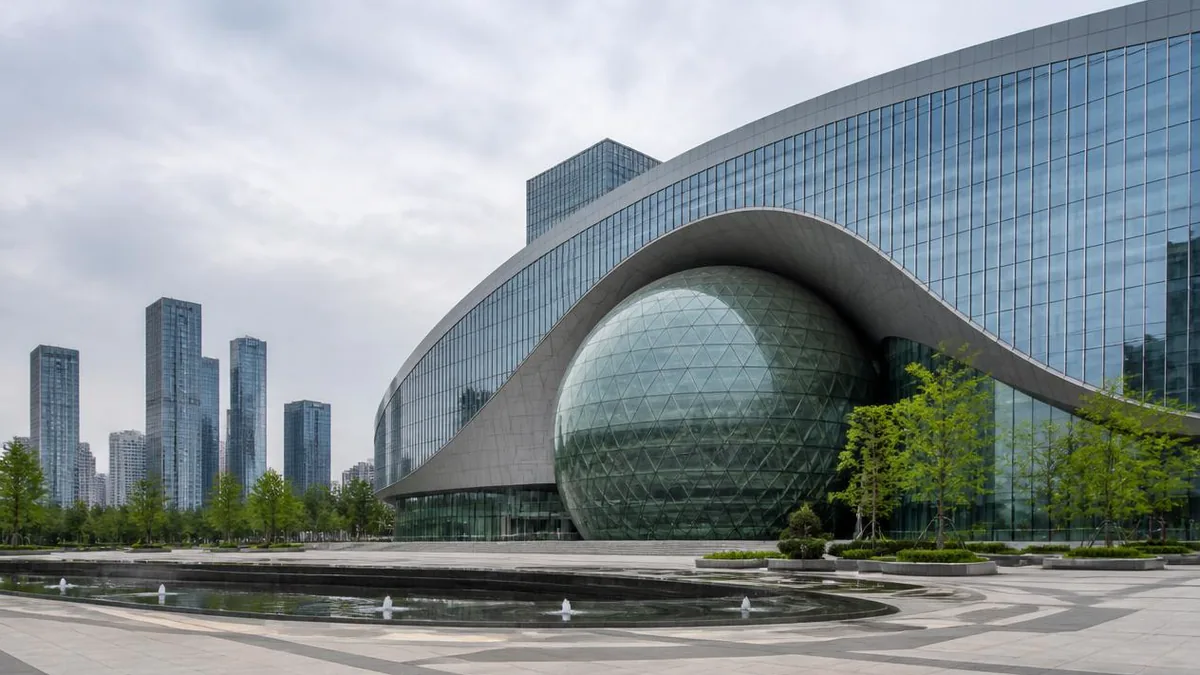
The Shanghai Science and Technology Museum stands at 2000 Century Avenue, in the administrative and cultural district of Huamu in Pudong. It has been open, in one form or another, since December 2001. In that time the first people to use the building were not visitors but heads of government; the exhibits have been stripped out and replaced wholesale once; and the institution’s name has spread to cover two more buildings elsewhere in the city, one shaped like a nautilus and one with no straight lines in it.
So the useful things to know here are not gallery names. They are the building, the group and the schedule.
The first people in were not visitors
The ninth APEC Economic Leaders’ Meeting was held in Shanghai on 20 and 21 October 2001, part of a year-long series of APEC meetings that had moved through Beijing, Tianjin, Shenzhen, Yantai, Dalian and Suzhou. It was the first high-level large international conference the People’s Republic had hosted.
The main venue was the Shanghai International Convention Centre at Lujiazui, where the first day’s sessions and the main banquet took place. An international media centre for 3,179 reporters from 517 organisations was set up next door in the Oriental Pearl Tower. The CEO summit ran in a hotel ballroom in Pudong.
The second day’s work took place here, in a museum that had not opened. Jiang Zemin left a commemorative signature in the building. The public was admitted on 18 December 2001, about two months later.
That sequence is the interesting fact, and it is worth separating from the version usually told. Guides frequently say the museum was built for APEC. No source I could open supports that: what is documented is that the summit used a nearly finished science museum for one day’s sessions, not that the museum exists because of the summit. The weaker claim is strange enough. Twenty-one leaders, meeting six weeks after the September 11 attacks, worked in a room that had never held a school group.
The surrounding effort was on a scale that explains why a half-finished museum could be pressed into service. Shanghai renovated its four- and five-star hotels, cleaned lanes that had been notorious for eighty years, expanded a Pudong airport then two years old, spent a reported 320 million yuan on telecommunications, and briefly opened access to foreign news sites for the duration. Over ten thousand security personnel were deployed. Leaders moved in nearly 800 Buick sedans built by the local joint venture.
A licence that says museum, a floor plan that says otherwise
On paper this is a museum of the top national grade: the State Administration of Cultural Heritage listed it in the second batch of National First-Grade Museums in December 2012. It keeps collections, including a specimen building at 1102 Longwu Road that has never been a public gallery.
In practice the floor plan is a science centre. The stated theme is nature, humanity and technology, and the galleries are built around apparatus you operate rather than objects you file past. Before the closure there were thirteen exhibition zones over a basement and three floors, with titles that describe activities rather than collections.
It is often said that this was among the first science-centre-type venues in mainland China, emphasising hands-on interaction over cabinet display. I could not verify that ranking from a source I could open, so it is not an assertion in this article. What is verifiable is the combination: a first-grade museum licence, a specimen store, and a building whose public face is interactive. Those pull in different directions, and the institution has been resolving the tension by expansion rather than by choosing.
The numbers on the building itself
The physical facts are the stable ones, so they are worth having.
The site is about 68,000 square metres and the floor area about 98,000, with total investment given as 1.5 billion yuan. The design was a collaboration between the American firm RTKL International and the Shanghai Institute of Architectural Design and Research. Completion is dated to 2001.
Its address is also an argument. Century Avenue runs about 5.5 kilometres from the Oriental Pearl Tower at Lujiazui east to Century Park, and it is 100 metres wide with only 31 metres of that given to traffic lanes—footway and planting take 69 metres, in an asymmetric layout by a French practice. Sculptures on the theme of time are set along it. The museum sits at the eastern end of that axis, beside Century Square and across from Century Park, in a district assembled in the 1990s to hold Pudong’s civic institutions. This is not a building that ended up somewhere; it was placed at the end of a designed sequence.
Three museums, three districts, three tickets
The most common practical mistake visitors make here has nothing to do with the galleries. It is assuming one institution means one building.
The Shanghai Natural History Museum is a branch. It sits in Jing’an Sculpture Park at 510 West Beijing Road, on the other side of the river, with its own metro station on Line 13. It opened on 18 April 2015 and admitted the public the next day. The building is about 45,257 square metres, cost a reported 1.3 billion yuan, was designed by an American practice with Tongji University’s design institute, and is shaped like a spiral shell—locally nicknamed the green snail.
The Shanghai Astronomy Museum is also a branch, and it is a long way out: Nanhui New City, roughly 800 metres from Dishui Lake station at the outer end of Metro Line 16. It was approved in January 2014, broke ground in November 2016, was completed in June 2020, ran trial days on 5 and 10 July 2021, and opened on 17 July 2021. Floor area is about 38,164 square metres on a site of about 58,602; at completion it was described as the largest planetarium in the world by floor area. Its architects say the design contains no straight lines and no right angles, with a spiralling geometry organised around three celestial objects—an oculus, an inverted dome and the sphere of the planetarium theatre.
Three buildings, then, in Pudong’s Huamu, in Jing’an, and beside a lake near the coast. They share an institution, a booking system and a mini-programme whose name lists all three. They do not share a ticket, a location or an opening pattern.
Nearly three years dark
On 31 March 2023 the main museum closed, in its own words for the largest systematic overhaul since opening.
The projected return moved. Reporting in March 2023 gave two and a half years, or a 2025 reopening. What actually happened is that the museum reopened for trial operation on 17 February 2026—the first day of the lunar new year—after what coverage called nearly three years. A three-year gap in a city museum’s life is long enough that a child who last visited on a school trip finished primary school in the interval.
The re-entry was staged. A first stress test ran on 27 January 2026, followed by public tests on 29 January and 4 February, scaling attendance from 5,000 to 20,000 visitors a day. The director reported that each test generated over a hundred written comments and that a rectification meeting was held the same evening, with entry arrangements adjusted for galleries that produced long queues.
Two dates from that window are worth keeping. The rebuilt giant-screen cinema held a film premiere on 9 January 2026, before the museum itself reopened. And a special exhibition mounted with the Palace Museum—reported as the institution’s first collaboration with it—opened to the public on the first trial day, in the basement gallery.
That exhibition is a fair sample of how this place now works. It was built in four sections around the horse, combining objects and apparatus: reported at more than twenty Palace Museum pieces dating from the Han to the Qing, shown in Shanghai for the first time, alongside eleven mounted specimens of rare breeds, a bionic mechanical horse assembled from over five hundred metal components by industrial 3D printing, a device recreating a horse’s near-350-degree field of view and two-colour vision, and glasses-free 3D. A first-grade museum licence, borrowed antiquities and a radar-triggered robot in the same four rooms is the institution’s whole character in one show.
Why any gallery list you read has already expired
This is the practical consequence of the rebuild, and it deserves stating as a rule rather than a caveat.
The thirteen zones on record before the closure ran from earth and crust galleries to robots, information technology, spaceflight, human health and a children’s rainbow playground. After reopening, a lower-level zone for young makers appeared, and a section presented as robotics and artificial intelligence.
Then, six weeks after reopening, the ground-floor biology gallery was replaced. From 1 April 2026 the same footprint reopened as a rainforest gallery, billed as the museum’s largest exhibition area. That is one substitution inside two months of trading.
Draw the obvious conclusion. Do not plan a visit around a named gallery you read about, here or anywhere. Plan around the building, the cinemas and the booking window, and treat gallery names as current until the app says otherwise.
Four cinemas, and a screen two millimetres thick
The cinemas are the part of the institution that behaves least like a museum, and after the rebuild they are the headline.
Before the closure there were four—a giant-screen IMAX hall, a dome theatre, a 4D theatre and a space theatre—with a stated capacity of up to 8,000 screenings a year. The rebuild kept the count and changed the technology.
The giant-screen hall is described as the first cinema in any science museum to use an LED cinema screen system rather than projection onto fabric. The panel is reported as a new-generation sound-transmissive LED screen, 2 millimetres thick, with frame rates up to 120 per second, bundled with several projection technologies including 4K, 3D and high brightness. The museum’s director has called it the largest LED giant screen in the world; that is his claim rather than an independently verified measurement, and it should be read as such. The dome theatre, described as the largest in China, was also converted to a sound-transmissive screen, with plans that include broadcasting football. The 4D theatre moved from ordinary to laser projection. Two further show spaces—a wind-tunnel venue and a sound venue—are also part of the offer.
The premiere film on 9 January 2026 was billed as the world’s first giant-screen film built around a zodiac animal, directed by a British documentary maker with credits including a major BBC natural-history series, and routed to a network of more than 200 science venues internationally, with an Americas premiere in Texas about a week later.
Underground spaces—the dome, the giant screen, the temporary exhibition hall and the plaza—are planned for regular opening on a longer schedule than the galleries, with hours discussed as running towards midnight.
Booking is the gate
Nothing about arriving here is spontaneous, and that is by design.
Entry is online-only, capacity-capped, date-specific and registered to a real name and identity number. Tickets are released about seven days ahead through the official mini-programme covering all three museums and the museum’s WeChat account. Visitors in free-admission categories, reported as including those aged 70 and over and children aged 6 and under, must still reserve. There are per-account and per-identity purchase caps. Cinema and theatre tickets are sold one per person, carry no free admission, and require a visit ticket first.
Hours reported for the reopening ran 9:00 to 18:00 through the first days of the new year and then settled to 9:00–17:00, Tuesday to Sunday. From February 2026 the branch museums extended Saturday and public-holiday closing to 20:00. From 3 March 2026 the Natural History Museum’s weekly closing day moved from Monday to Tuesday—a change that will catch people for years.
Every figure in this section is the category that moves fastest. Take it as a description of how the system works, not as this week’s timetable.
Getting there, and what is next door
Access is the easiest part of the whole visit.
Metro Line 2 has a station named after the museum, at the Century Avenue and Yingchun Road junction, and several bus routes stop nearby. The station is also the city end of two long-distance coach lines from Chongming Island, which means a passenger arriving from the Yangtze estuary steps off a coach outside the science museum—a useful thing to know if you are combining a city day with the island.
Beyond the doors, the district is the attraction: Century Park to the southeast, Century Square immediately outside, and the western end of Century Avenue at Lujiazui with the Oriental Pearl Tower, which served as APEC’s media centre in 2001. Line 2 links the two ends of that axis in a few minutes.
What could not be swapped out
Everything in the main building has now been replaced at least once. It is worth ending with the exception, which is in the branch.
In December 2021 the Natural History Museum finished mounting a 24-metre fin whale skeleton, described as the longest whale specimen in China. The animal was found dead in March 2017 on the water where the Yangtze mouth meets Hangzhou Bay—an hour or two north of the gallery it now hangs in.
That is the one object here that no rebuild could revise. It came out of the estuary that made the ground the city stands on, and it will be in the same room in twenty years, when the interactive galleries have been changed twice more. The building at 2000 Century Avenue works the same way. Its contents are a rolling argument about what science exhibition should be; the building is what stays, and it was finished in time for twenty-one governments before it was finished in time for anyone else.
The LoreLens app can help you identify specimens, instruments and architectural forms in Shanghai’s museum district while explaining the science behind them.
Location profile
Where it is

Frequently asked questions
Was the museum built for the 2001 APEC summit?
It was used by the summit before it was used by the public, which is not the same claim. What the record supports: the ninth APEC Economic Leaders' Meeting was held in Shanghai on 20 and 21 October 2001; the main venue was the Shanghai International Convention Centre at Lujiazui, where the first day's sessions and the main banquet took place; and the second day's work took place in what English-language accounts describe as the as-yet-unopened Shanghai Science and Technology Museum. Jiang Zemin left a commemorative signature there. The museum opened to the public on 18 December 2001, roughly two months later. What no source I could open supports is the stronger version—that the building existed because of the summit, or that its construction schedule was set by it. It was a science museum that a summit borrowed. Treat any guide who says otherwise as compressing the story.
Is the museum actually open? I have read that it closed.
Both are true at different dates, and this is the thing to check before travelling. The museum closed on 31 March 2023 for what it called the largest systematic overhaul since it opened. Reporting at the time gave a return in 2025 or after about two and a half years; the actual reopening was a trial opening on 17 February 2026, the first day of the lunar new year, after nearly three years dark. Public stress tests were run on 29 January and 4 February 2026, scaling from 5,000 to 20,000 visitors a day. Since then a further change has landed: the ground-floor biology hall was replaced by a rainforest gallery billed as the museum's largest exhibition area, opening 1 April 2026. In other words the institution is open, and its contents are still moving. Verify hours and gallery status on the day.
Are the Natural History Museum and the Astronomy Museum part of the same ticket?
Same institution, separate buildings, separate tickets, three different parts of Shanghai. The Shanghai Science and Technology Museum is the parent; the Shanghai Natural History Museum is its branch in Jing'an Sculpture Park on West Beijing Road, opened to the public on 19 April 2015 with a nautilus-shaped building of about 45,257 square metres; the Shanghai Astronomy Museum is its branch at Nanhui New City, opened 17 July 2021 with about 38,164 square metres, described at completion as the largest planetarium in the world by floor area. The two branches are not walkable from the main museum or from each other—one is in the inner city on Metro Line 13, the other is near Dishui Lake at the far end of Line 16. Book each separately, and note that from March 2026 the Natural History Museum's weekly closing day moved from Monday to Tuesday.
How do I book, and what is worth the extra money?
Booking is the real gate. Entry is online-only, capped, date-specific and registered to a name and ID number, with tickets released about seven days ahead through the museums' official mini-programme and WeChat account. Even visitors who pay nothing—reported as including those aged 70 and over and children aged 6 and under—have to reserve. Cinema and theatre tickets are sold separately, one per person, and require a visit ticket first. On the paid extras, the reopened museum leads with cinemas: a giant-screen hall described as the first science-museum cinema anywhere to use an LED cinema screen system, on a sound-transmissive panel reported at 2 millimetres thick running up to 120 frames a second; a dome theatre described as the largest in China; and a 4D theatre upgraded to laser projection. Two show venues were half price at 15 yuan per person during the trial period. All of this is exactly the category that changes, so confirm at the gate or in the app.
Sources and further reading
Background references for the history and place names in this guide. Opening hours, ticketing and access change often — always confirm with official local information before travelling.