Henan · Pingdingshan
Mount Yao and the Central Plains Buddha: Ridge and Monument
Choose between Mount Yao's steep Funiu ridges and Foquan Temple's modern Vairocana, then read mountain weather, Buddhist scale and two separate visitor systems without mixing them.
5A View location, maps and nearby scenic areasAt Mount Yao, look up before deciding how far to climb. Granite towers interrupt a forested ridge, and the summit can vanish into cloud while the lower path remains clear. At the Central Plains Buddha, look up for a different reason: the standing figure rises so far above the approach axis that distance, stairs and pedestal merge into one vertical impression.
These sights share the official name Mount Yao–Central Plains Buddha Scenic Area, but not one continuous visitor route. Both are in Lushan County, administered from Pingdingshan, yet Mount Yao is a weather-dependent mountain park and the Buddha belongs to the Foquan Temple complex reached by road.
Plan two gates, not one attraction: give Mount Yao a route chosen by weather and stamina; give Foquan Temple a separate block for the ceremonial approach, the 128-metre statue and Buddhist etiquette. Tickets, shuttles, ropeways and last entry should be checked for each site.
One 5A designation joins two spatially separate experiences
The combined rating can hide the most important practical fact: you cannot hike from a Mount Yao summit trail directly into the Buddha’s forecourt as part of a signed park circuit. A road transfer separates the mountain entrance from the Foquan Temple visitor system. One listing or marketing package does not guarantee a common ticket or timed connection.
Mount Yao rewards a long outdoor day. Its value lies in forest, exposed rock, changing height, viewpoints and the effort of moving among them. The Central Plains Buddha rewards axial looking: gate, plaza, temple space, stairs, lotus throne, statue and mountain backdrop are arranged to build scale.
They also represent different human relationships with stone. At the mountain, weathering reveals an inherited landscape and visitors adapt their route. At Foquan Temple, late-twentieth- and early-twenty-first-century engineering created a new sacred monument and adapted the site around it. Neither should be made secondary merely because the 5A name puts them in one line.
Before setting out, save the Chinese names 尧山 and 中原大佛/佛泉寺 separately. Drivers, ticket desks and navigation apps need the destination, not just the combined scenic-area title.
Mount Yao rises through the eastern Funiu Mountains
Mount Yao, once widely promoted as Shiren Mountain, occupies the eastern part of the Funiu Mountains. Its principal summit, Yuhuangding, is commonly measured at about 2,153 metres above sea level. Sources differ by a few tenths of a metre, a difference with no practical meaning for a visitor.
The mountain’s drama comes from contrast: vegetation fills lower gullies while rock walls and isolated forms rise above them. Granite crystallised below ground and was later exposed through uplift and erosion. Weathering exploited joints and fractures, separating blocks, cliffs and tower-like peaks. Tourism names may compare a formation to a person or animal; these are useful visual prompts, not geological identities.
The name Yao is connected in local historical tradition with the culture hero Emperor Yao and a story that his descendant Liu Lei established a shrine in this region. Written traditions give the name cultural depth, but they do not turn every summit feature into archaeological proof that Yao stood there. “Local tradition connects” is more responsible than “Yao visited.”
Forests, water and exposed summits form one system. The volume of a waterfall depends on recent rainfall and management; blossom, autumn colour, rime, snow, sunrise and a cloud sea depend on season and weather. Do not let promotional photographs convert possibilities into a fixed itinerary.
A mountain route is a series of trade-offs
For a summit-oriented visit, use currently operating scenic transport or ropeways to remove part of the lower ascent, then conserve energy for upper stairs, ridge paths and Yuhuangding. This gives the strongest high-mountain sequence, but it also concentrates exposure to wind, fog, queueing and closures.
For a forest-and-water route, remain longer in lower valleys and waterfall zones. It can offer shade and a more gradual pace, but water volume is not guaranteed and lower paths can still be slick. A full hiking ascent is a separate commitment: obtain current trail distance, accumulated ascent, daylight and emergency information rather than estimating from a flat map.
Ropeways can stop for strong wind, lightning, ice, maintenance or crowd control. A lift reduces vertical gain; it does not remove transfer walks, final staircases or the need to descend. Never schedule the last possible cabin as if it were a reserved private departure.
Fog changes more than the photograph. It can hide route markers, wet rock and remove the long view that justified an exposed detour. Follow barriers and staff directions rather than leaving the path to find a “clearer” ledge. Carry a layer for rapid temperature change and footwear with grip even when the entrance feels warm.
The Buddha’s scale begins with the measurement boundary
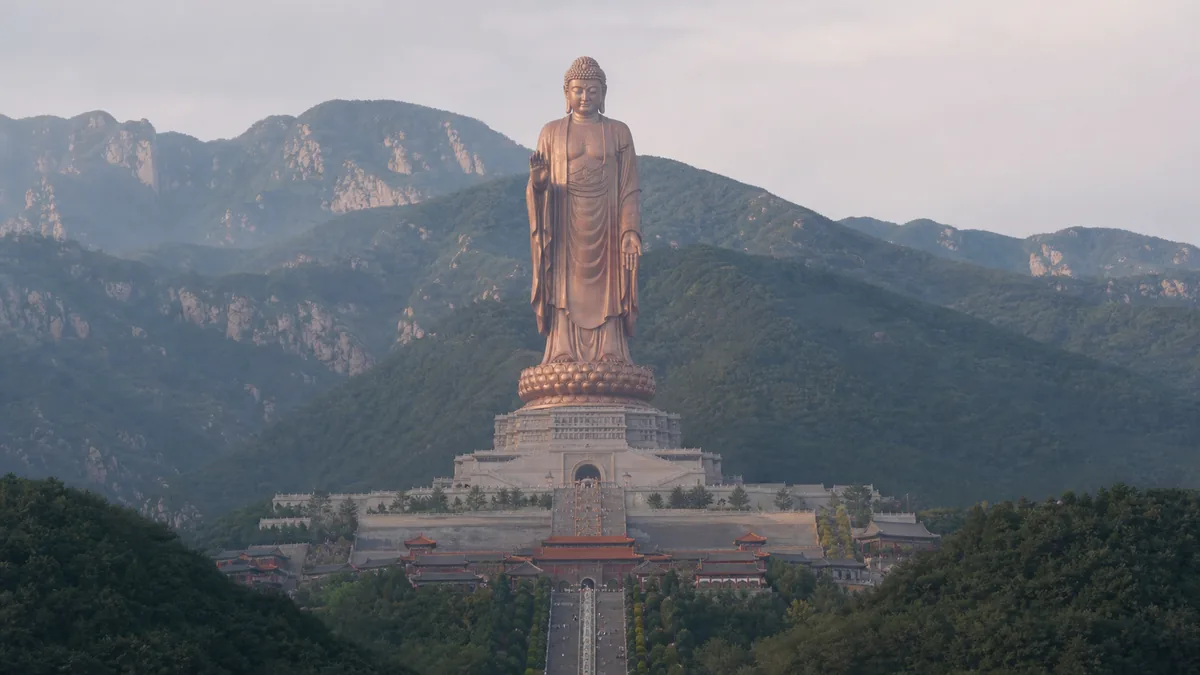
The Central Plains Buddha is a monumental image of Vairocana at Foquan Temple. Its widely quoted statue height is 128 metres. Published breakdowns commonly distinguish a standing Buddha body of about 108 metres and a 20-metre lotus seat, which together make that statue-level figure.
Other sources give totals such as 153 metres or 208 metres. Those numbers add different combinations of the diamond throne, Sumeru-style pedestal, building, terraces or remodelled base. They answer another question: “How high is the entire monument or vertical complex?” They must not be compared directly with a statue measured only from feet to head.
Superlatives become unstable for the same reason. Rankings may include or exclude seats, compare standing with seated figures, use sculpted height or entire structures, and change when a new statue opens. It is enough to say that the Central Plains Buddha is among the world’s most monumental standing Buddhist images. “World’s largest” without a category and date teaches less than the 108-plus-20 breakdown.
On site, use people, stair landings and lotus petals for scale. A low-angle phone photograph exaggerates height by merging base and body; a side view from farther back reveals which parts are statue, throne and architecture.
A modern monument carries an older Buddhist idea
Construction of the present giant Buddha began in the late 1990s, and a major consecration took place in 2008. It is a contemporary religious and engineering project, not a medieval image that survived at this size. Its metal skin, internal support, assembled components, ceremonial terraces and visitor circulation belong to modern construction.
The figure represents Vairocana, the cosmic Buddha especially important in the Huayan, or Flower Garland, tradition. A line associated with that scriptural world says, “The mind, the Buddha and living beings—these three are no different.” It points toward an interrelated cosmos rather than the biography of one historical teacher.
Huayan thought became highly influential in medieval China, and monumental Vairocana images appeared long before this one—most famously for Henan visitors at the Tang ensemble of Longmen. Foquan Temple’s modern echo enlarges the same cosmic name through contemporary casting, structural engineering and mass pilgrimage. Continuity lies in the icon and devotion, not in claiming ancient fabric.
Avoid inventing a single motive for the statue. Large religious monuments emerge from patronage, institutional ambition, local development, engineering, devotion and public symbolism. Unless a dated project source documents one cause, do not reduce the whole undertaking to a reaction to a world event or a bid for a record.
Foquan Temple is a religious place, not only a scale exhibit
The long approach turns looking into bodily effort. Gates and open courts establish an axis; stairs slow the visitor; the lotus and lower structures enter view before the face becomes readable. This sequence is part of the designed experience, not empty distance before the “real” attraction.
Move as you would in an active Buddhist precinct. Keep entrances and central worship paths open, lower your voice around ceremonies, and do not photograph worshippers closely without consent. Follow current signs on interiors, incense, drones, commercial filming and access to the statue base. A giant image is not permission to make comic poses at an altar.
Visible buildings may combine older temple associations with recent reconstruction and expansion. Date each structure by evidence rather than assuming every tiled roof is ancient or every modern hall lacks religious value. New fabric can support living practice; historical styling does not supply an automatic dynasty.
The ceremonial ascent can involve many steps and long exposed plazas. Vehicles, lifts or alternate approaches may operate for some visitors, but availability and coverage change. Ask where a step-free route begins and ends; “accessible to the complex” may not mean access to every terrace or interior.
Combining mountain and monument requires a selective day
If you have one day, choose the mountain or the Buddha complex according to your priority. Mount Yao is the stronger choice for hiking, geology and forest; Foquan Temple suits visitors interested in contemporary Buddhist culture, monumental engineering or a less weather-exposed—but not effortless—visit.
If you must combine them, select a short mountain route, start early and confirm the road transfer and both last-entry times before boarding any ropeway. A delay on the ridge can remove the temple visit; an extended temple stop can leave no safe mountain margin. Do not treat either site as a quick roadside photograph.
With a day and a half, give the better weather window to Mount Yao and the other block to Foquan Temple. This arrangement also prevents two monumental experiences from cancelling each other: after hours of exposed ridge walking, the Buddha’s processional axis deserves more attention than tired legs may allow.
Tickets, identity checks, parking, internal buses, ropeways and joint packages are operational products. Verify dated notices from each scenic area and ask accommodation staff to confirm what is current. Travel time changes with traffic, road work, weekends and mountain weather.
Accessibility and safety differ at the two sites
Mount Yao’s main barriers are steepness, repeated steps, exposed rock, weather and distance. Ropeways can help without making the summit circuit step-free. Visitors with limited mobility should ask for the highest currently reachable viewpoint with continuous accessible access, not only whether “a cable car exists.”
Foquan Temple’s broad paved areas may appear easier, but the processional design deliberately changes level. Heat, glare, wind and long stairs can be tiring. Confirm accessible toilets, rest points, shade, vehicle drop-off, lift coverage and companion procedures. Large festival or ceremony days can alter barriers and reserved areas.
At either site, rain can make stone slick. On the mountain it can also bring lightning or falling hazards; at the Buddha plaza it can cancel outdoor activity without closing every temple space. Winter ice, summer heat and crowd density require different pacing. Current staff instructions outrank an old travel post.
Respect ecological and religious limits alike. Do not feed wildlife or leave the path on Mount Yao; do not touch images, offerings or ritual objects at Foquan Temple. The combined scenic designation does not make either landscape disposable after the photograph.
Photograph the boundary between nature and making
On Mount Yao, photograph from an offset ridge so people and forest show the height of exposed rock. Mist can simplify layers but also erase the summit entirely; a clear horizon is a possibility, not an entitlement. Never cross a barrier for an unobstructed pinnacle, and do not block a stair landing while waiting for cloud to move.
At the Buddha, make three frames: a wide axial view that includes plaza and mountain, a middle view separating lower structures from the 128-metre statue, and a detail made only where religious etiquette and photography rules allow. This sequence tells more truth than one extreme low angle labelled “208-metre Buddha.”
Before leaving, compare the two acts of looking up. Mount Yao makes your eye follow rock that no patron designed; Foquan Temple makes it follow a precisely commissioned body toward a cosmic idea. One route teaches adaptation to weather, the other reveals how modern devotion, finance and engineering organise attention.
Take the photograph that conditions permit, then stop measuring. At the ridge, listen for wind moving through forest below the stone. At the temple, leave space for someone who has come to bow rather than sightsee. The shared 5A name becomes useful only when mountain and monument remain fully themselves.
Continue to Mount Chaya for another Henan rock landscape shaped by interpretation, to Mount Song and Shaolin for a living Buddhist mountain with older architectural layers, or to the Funiu Mountains guide for highland ecology paired with a separate fossil site.
Location profile
Where it is

Frequently asked questions
Are Mount Yao and the Central Plains Buddha one walkable park?
No. They are separate attractions in Lushan County grouped under one 5A designation. Mount Yao is a mountain scenic area, while the Buddha stands in the Foquan Temple complex and requires a road transfer. Confirm each entrance, ticket, shuttle and last-entry arrangement separately.
How tall is the Central Plains Buddha?
The widely cited statue-level height is 128 metres. Published breakdowns commonly describe a 108-metre standing figure plus a 20-metre lotus seat. Larger totals add structural pedestals, buildings or the terraced base, so they should not be compared directly with the height of another statue figure.
Can I visit Mount Yao and the Buddha on the same day?
It can be possible with private transport and a selective mountain route, but a full ridge visit can occupy a day by itself. Ropeway queues, road transfers, weather and separate closing times make a tight combination fragile. Split them across a day and a half when possible.
How accessible are Mount Yao and the Foquan Temple complex?
Mount Yao has steep paths, stairs and exposed high sections even when ropeways operate. The Buddha complex uses broad plazas but also a long ceremonial ascent and changes in level. Ask both visitor centres about currently operating step-free routes, vehicles, lifts, rest points and companion assistance.