Henan · Nanyang and Xixia
Funiu Mountains: Old Boundary Ridge and Xixia Dinosaur Eggs
Plan Old Boundary Ridge as a protected mountain day and Xixia's dinosaur park as a separate fossil visit, learning what an egg can prove without turning replicas into evidence.
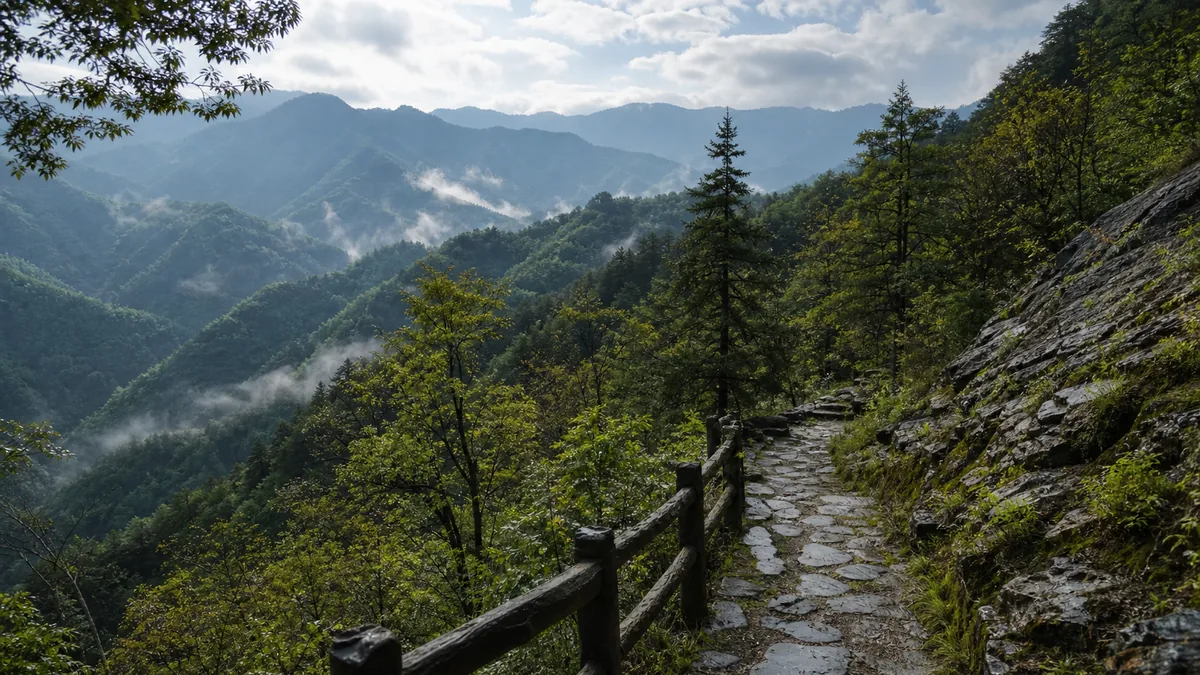
5A View location, maps and nearby scenic areasAt Old Boundary Ridge, put one hand near the rough bark of a tree without touching moss or lichen, then look through its branches toward successive blue ridges. At Xixia Dinosaur Relics Park, make the opposite adjustment: move close enough to a protected eggshell surface to notice pores and fractures, but keep your hands away. One view expands across a living mountain; the other compresses deep time into a few centimetres of mineralised shell.
These experiences share the name Funiu Mountains, or Funiushan, and one national 5A tourism designation. They do not share a gate. Old Boundary Ridge is a high forest and watershed landscape; Xixia’s dinosaur park interprets Late Cretaceous fossil-egg deposits in a different part of the county. A transfer separates them, and each deserves a different pace.
Choose the evidence before the itinerary: give Old Boundary Ridge a weather-dependent mountain day; give the dinosaur park a slower half or full day for labels, shell texture and display context. Do not let a package ticket turn distance into an imaginary footpath.
One destination name contains two different field trips
The Funiu Mountains 5A profile marks a useful location, but the designation joins separate visitor areas. Old Boundary Ridge, or Laojieling, lies in the higher Funiu landscape north of Xixia’s main urban area. Visitors normally combine a road approach, scenic shuttle, walking routes and—when operating—a cableway. It is an outdoor mountain visit whose outcome depends on cloud, wind, heat, ice and trail management.
Xixia Dinosaur Relics Park is reached through a different road corridor. Its experience combines museum galleries, protected fossil context and modern interpretive or entertainment structures. It is physically easier for many visitors, though large grounds, steps, dim galleries and hot outdoor sections still matter.
Plan around two days if both are important. A one-day combination is sometimes sold or driven, but it can reduce the mountain to a lift-and-photo stop and the fossils to a room of objects without context. If weather closes upper mountain transport, the fossil park can be an alternative only if tickets, opening and road conditions are confirmed; it is not a guaranteed automatic substitute.
The county name Xixia is pronounced roughly “shee-shyah.” Do not confuse it with the Western Xia dynasty, whose name is romanised the same way in English. Here, Xixia is a place in southwestern Henan.
At Old Boundary Ridge, let altitude organise the view
The Funiu Mountains form the eastern extension of the broader Qinling mountain system and a transition between central China’s northern and southern environments. Tourist descriptions often call a single ridge the exact climatic division between north and south. The more accurate picture is a broad transition zone shaped by elevation, slope direction, monsoon exposure, soil and human land use—not a climate switch hidden under one paving stone.
Old Boundary Ridge rises above surrounding valleys, with visitor materials commonly placing major viewpoints and high crests above 2,000 metres. Peak names and elevations vary because sources may count a scenic summit, a boundary point or the highest mountain in a larger reserve. Use current mapped elevations for navigation; do not use a tourism superlative as proof that one platform is “the roof of Henan.”
Start low and look for vertical change. Broadleaf forest, mixed stands, conifers and wind-shaped vegetation can occupy different bands. A shuttle or cableway compresses this ecological ascent, but does not erase it. Temperature and visibility at an upper station can differ sharply from the entrance.
On a clear day, layered ridges explain why the mountain was difficult to cross and useful as a boundary. In cloud, foreground trees, wet bark and sound become the landscape. Neither sunrise nor a “sea of clouds” is owed to the ticket holder.
A protected mountain is more than a scenic balcony
The wider Funiu range supports high biodiversity and protected habitats. Different labels may refer to a national nature reserve, a UNESCO biosphere-reserve context, a geopark, or a modern scenic operating zone. Their boundaries and purposes are not identical. A cableway inside a tourist zone does not make every protected slope open for wandering.
Forest cover regulates water, stabilises thin mountain soils and provides habitat across elevation bands. It also records human use. Communities gathered fuel, herbs and timber, grazed animals and travelled between valleys long before a scenic gate appeared. Protection can reduce damaging extraction while also changing how residents reach traditional resources. Avoid the easy fiction that conservation began only when tourists arrived, or that all restrictions have been socially cost-free.
Stay on open paths. Do not pick flowers, feed animals, remove fungi or enter a closed “shortcut.” A rare plant does not become educational when moved into a hand. If macaques or other wildlife appear, give them space and secure food; habituation harms animals and can make encounters dangerous.
Read an old tree as a participant rather than a prop. Bark damage, compacted soil and tied ribbons can outlast a visitor’s photograph. Current reserve and scenic-area rules take priority over an online route that once crossed a closed zone.
The fossil story begins with a landscape, not a model dinosaur
Xixia is internationally noted for abundant dinosaur egg fossils, many from Late Cretaceous sediments, broadly tens of millions of years before the end-Cretaceous extinction about 66 million years ago. A fossil egg is not the original shell filled with its original contents. Minerals enter or replace material during burial, while compression, groundwater and tectonic change fracture and deform it.
Large-scale local attention grew in the 1990s, when construction, farming and excavation exposed egg-bearing layers and reports reached researchers and authorities. Simplified stories sometimes credit one discovery moment or one person. In reality, local residents, road crews, collectors, geologists, preparators and museums all affected what was noticed, removed, protected or lost.
That last verb matters. Dinosaur eggs became valuable commodities, and unrecorded digging or trading stripped specimens from their geological context. An egg on a shelf can be visually impressive, but without an exact layer, orientation and association, much of its scientific information disappears. Protection is therefore not bureaucracy added after discovery; it preserves the relationships that make an object evidence.
The park belongs to a broader Funiu geological story, but “geopark,” “fossil site,” “museum collection” and “5A tourist attraction” describe different functions. Check the label before transferring authority from one to another.
Learn what an egg can—and cannot—tell you
Begin with the shell surface. Scientists study thickness, pore pattern, curvature and microscopic layers. They also map how eggs sit together, which sediment surrounds them and whether repeated horizons indicate nesting behaviour, transport by water or separate events. Cracks can come from hatching, burial pressure, excavation or conservation; a broken top is not automatically proof that a baby dinosaur emerged.
Many fossil eggs receive ootaxonomic names—classification based on the egg itself—because an embryo or an adult skeleton directly linked to the clutch is rare. Shape alone does not securely identify a familiar dinosaur species. A long egg may suggest one group and a round egg another, but confident labels require shell microstructure and stronger association.
The most scientifically useful specimen may look less complete than the dramatic one. A cluster still in its sediment can preserve spacing and orientation. A thin eggshell section under magnification may reveal more than a polished “perfect egg.” Ask whether a display is original, excavated and reassembled, a cast, or a reconstructed scene.
Do not touch even when a fragment appears loose. Skin oils, pressure and small movements can damage surfaces or destroy positional evidence. Collecting from a protected site is inappropriate and may violate Chinese law. Note the location, step back and tell staff.
Separate original material, reconstruction and spectacle
A modern dinosaur park must help non-specialists imagine animals that are absent. Skeleton casts, murals, animated figures and life-size models can explain body scale or make family visits engaging. They are interpretation, not fraud—provided their status is clear. Trouble begins when a model is photographed or described as a dinosaur excavated exactly where it stands.
Use a simple three-part test. Original material should have provenance, catalogue or geological context. A cast or reconstruction should identify the source and the choices used to complete missing parts. Entertainment can be inventive but should not be asked to prove colour, sound or behaviour.
Museum displays change through conservation, loans and renovation. A famous specimen seen in an older review may be off display; a hall may contain material from elsewhere for comparison. Confirm current galleries rather than promising one object. Photography, flash and close access can also vary by case.
The human story continues behind the glass. Fossil preparators remove matrix grain by grain; conservators stabilise cracked shell; researchers compare sections; guards and local residents protect exposed ground. Science is not one dramatic discovery but a chain of documentation and care.
Use two days to protect attention and energy
For an Old Boundary Ridge day, check weather and transport before leaving Xixia. At the entrance, choose between a lower forest walk, a cableway-assisted upper route and a longer stair-and-ridge combination. A cableway can reduce ascent but normally leaves steps, gradients and distance. Confirm the last descent and whether a one-way route returns to the same gate.
Cloud, lightning, high wind, ice and maintenance can suspend cableways or close exposed paths. Carry a warm or waterproof layer even when town is mild. Turn around for deteriorating weather; reaching one summit sign is not worth losing a safe descent.
For a dinosaur day, start with the museum before the largest outdoor models. First learn shell structure, age and discovery context; then judge reconstructions with better questions. Families can alternate galleries with outdoor spaces, but heat and walking distance still accumulate. If labels have limited translation, photograph permitted captions for later study rather than guessing.
Road transfer between the two areas can consume a meaningful part of a day, and estimates change with mountain traffic and entrance controls. Accommodation location matters. For nearby comparisons, Baiyun Mountain offers another protected Funiu forest and summit system, while Mount Laojun and Jiguan Cave pair a ridge with a separate underground karst experience.
Photograph evidence, then protect the path back
At Old Boundary Ridge, use a foreground tree or railing to give distant ridges depth without stepping outside a barrier. Mist can simplify the layers; midday haze can reveal atmospheric distance. Stop on a wide platform before using a phone. Never turn a narrow stair into a tripod position, and treat drone permission as something to obtain, not assume.
The mountain is not fully accessible. Shuttles and a cableway may remove some climbing, but queues, vehicle steps, station stairs and upper gradients remain. Ask staff about the shortest step-reduced option and current toilet access. Visitors with heart, joint or balance concerns should choose a lower forest route without treating it as an inferior visit.
At the fossil park, photograph a whole labelled case before a close view so the specimen keeps its context. Avoid flash, reflections and contact with glass. A scale bar or authorised caption is more useful than placing a hand beside an egg. Keep children close in dim rooms and explain that not touching is part of doing science.
Replica nests can make lively photographs, but caption them honestly. “Reconstruction based on Xixia fossils” communicates more than “dinosaur nest found intact here.” Accuracy does not make wonder smaller; it gives wonder somewhere firm to stand.
Leave with two scales of care
Return mentally to the first two observations: the ridge seen through branches and the eggshell seen through glass. The mountain asks for care across a living, changing ecosystem. The fossil asks for care across deep time, where a few millimetres of shell and its position in sediment may preserve evidence that cannot be replaced.
The shared lesson is restraint. Cableways and models can help people understand places, but they do not remove mountain weather or turn interpretation into an original fossil. A 5A label can connect attractions, but it cannot erase the road between them. Protection is not simply keeping visitors away; it is teaching us which actions preserve meaning.
Before leaving Old Boundary Ridge, make one frame in which the path occupies less space than the forest. Before leaving the dinosaur park, read one specimen label all the way through without photographing it. Those two pauses—one wide, one close—are a better memory of the Funiu Mountains than forcing both sites into a single rushed panorama.
To compare another Henan mountain where elevation is paired with a distinct religious complex, continue to Mount Yao and the Central Plains Buddha, keeping its summit route and living Buddhist space separate too.
Location profile
Where it is

Frequently asked questions
Are Old Boundary Ridge and Xixia Dinosaur Relics Park in the same place?
No. They are separate attractions in Xixia County grouped under one 5A tourism designation. Old Boundary Ridge is a high, forested Funiu Mountain landscape with shuttles, trails and optional cableway travel; the dinosaur park is a museum-and-site experience near fossil-egg deposits in another area. Allow road-transfer time and normally plan them on separate days.
Are the dinosaur eggs displayed at Xixia all original and still in their nests?
Do not assume so. The park can combine protected in-situ or site-related material, excavated eggs and eggshell, museum specimens, reconstructed nests, skeleton casts and life-size models. Labels and barriers should identify context; if a display does not say clearly, treat it as interpretation rather than proof of an original nest.
Can a dinosaur species be identified from the shape of one egg?
Usually not with certainty. Palaeontologists classify many fossil eggs by shell structure and form using egg-based taxonomic names, because embryos or an associated adult skeleton are rarely preserved. An egg's shape can support a hypothesis, but it does not automatically name the dinosaur that laid it.
Can visitors collect fossils or rely on the cableway at Old Boundary Ridge?
Collecting, moving or touching protected fossils is inappropriate and may be illegal; leave even loose-looking shell fragments in place and alert staff. At Old Boundary Ridge, cableways and scenic shuttles depend on weather, maintenance and current operations. Confirm the last descent, open paths and a walking alternative before committing to a high route.