Henan · Luoyang
Mount Laojun and Jiguan Cave: Two Landscapes, One 5A
Climb from Funiu forest to Mount Laojun's rebuilt golden-roofed summit, then read dripping limestone underground at Jiguan Cave—two separate Luanchuan experiences sharing one designation.
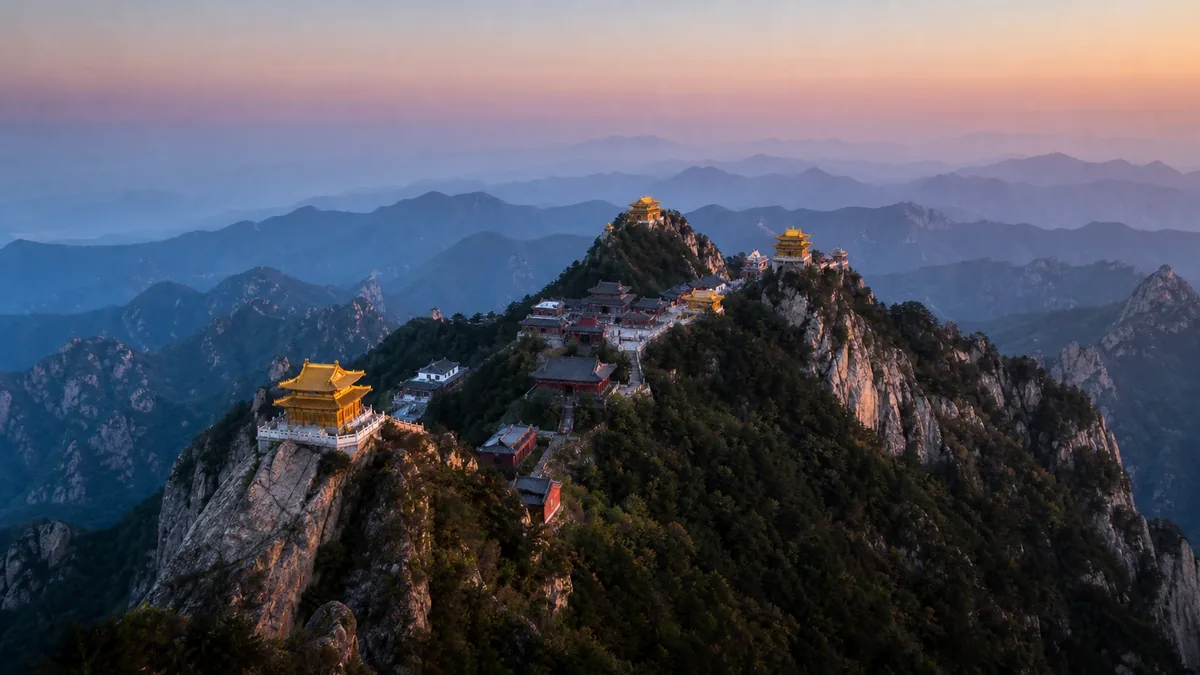
5A View location, maps and nearby scenic areasAt Mount Laojun, stand below a ridge pavilion and look past its shining roof. The drop beyond it opens into forest, jointed rock towers and receding folds of the Funiu Mountains. At Jiguan Cave, do the opposite: turn away from the horizon, enter the hill and watch a handrail disappear between pale curtains of calcite.
These views belong to one official name, Mount Laojun–Jiguan Cave Tourist Area, but not one continuous park. Both are in Luanchuan County southwest of Luoyang, yet they have different entrances, terrain, operating systems and rhythms. Laojun is pronounced roughly “laow-jwin”; the name means “Lord Lao,” a divine title associated with Laozi.
Choose the experience before the ticket: give Mount Laojun a mountain day built around weather, ropeways and ridge stamina; give Jiguan Cave a separate underground half-day when possible. Combining them requires a road transfer and current checks for both sites—it is not a trail from summit to cave.
One 5A title covers two separate places
China’s 5A rating can be granted to a combined tourist area. Here it joins a high mountain scenic area with a developed karst cave. That administrative pairing does not remove the distance between them. A map marker, a bundled promotion or a shared name can therefore mislead a visitor into planning a single gate-to-gate walk.
Mount Laojun is the longer, weather-dependent outing. Visitors ascend through a managed transport system and then follow high paths toward viewpoints and the Golden Summit complex. Jiguan Cave is an indoor route through lit limestone chambers. It is physically contained but has its own entry controls, stairs, climate and capacity.
Do not assume one ticket includes both attractions, one shuttle links them, or a late finish at the mountain leaves enough time for the cave. Products and traffic plans can change by season and crowd level. Check each operator’s dated notice, then confirm the road transfer with your driver or accommodation.
The pairing makes more sense as a geological contrast. At one site, uplift, fractures and weathering expose rock to sky. At the other, groundwater works through limestone from inside. The shared guide becomes useful when it preserves that difference.
Read Mount Laojun from forest to broken ridge
Mount Laojun rises in the Funiu Mountains, with high points commonly described at around 2,200 metres above sea level; 2,217 metres is widely quoted for the principal summit area. Named peaks and measurement points vary on visitor maps, so the figure is an orientation, not a promise that every golden-roofed platform occupies the exact highest point.
The ascent crosses ecological and visual zones. Lower slopes carry mixed forest and tourist infrastructure. Higher up, exposure increases: trees shorten, rock emerges and long views open when clouds permit. The ridge commonly marketed as the Ten-Mile Painted Screen is not a literal ten-mile canvas. It is a scenic name for a high route where jointed rock, gullies and forest repeatedly frame the view.
Granite is central to the mountain’s form. Rock deep in the crust crystallised and was later exposed as uplift and erosion removed overlying material. Weathering followed joints and fractures, helping isolate walls, blocks and towers. This explanation does not require assigning every pinnacle a precise age. Popular claims that reduce the entire landscape to one ancient event are tourism shorthand for a much longer geological history.
The high forest is also habitat, not scenery installed around a walkway. Remain on open paths, carry waste down and do not feed wildlife. Spring blossom, autumn colour, snow, rime and a “sea of clouds” all depend on season and weather; none is included with admission.
Laozi belongs to tradition, text and living religion
Local tradition says Laozi, the thinker linked to the Daodejing, withdrew to this mountain and practised self-cultivation here. “Laojun,” or Lord Lao, is Laozi in a deified Daoist form. The association gives the mountain its name and has supported temples, pilgrimage and storytelling for generations.
It is not an archaeologically verified travel record. Ancient accounts of Laozi differ, and modern scholarship treats the authorship and formation of the Daodejing as more complex than the biography of one fully documented man. No surviving structure on the summit proves that the historical Laozi lived inside it. Say “tradition holds” rather than “Laozi certainly retired here.”
The text traditionally attributed to him says, in one familiar translation, “A journey of a thousand miles begins beneath one’s feet.” In its chapter, the line follows images of a great tree beginning as a tiny shoot and a high terrace beginning with piled earth. It is about attending to beginnings before action grows difficult, not a caption written for this mountain.
Its modern echo is unavoidable on the ridge: thousands of visitors repeat the line while using ropeways, stairs and phones that belong to a very different age. That does not make the quotation false. It shifts the question from “Did Laozi stand here?” to “How does a living tradition keep making this mountain a place to think about effort, restraint and scale?”
Old sacred meaning, visibly recent roofs
The Golden Summit appears in photographs as a compact Daoist world suspended above cloud: halls with metallic or golden-coloured roofs, gates, terraces, incense and steep stairs joining separate knolls. Names such as Laojun Temple, Liangbaotai and Yuhuangding place the group inside a Daoist sacred geography.
Do not equate sacred continuity with untouched ancient fabric. Temples on Chinese mountains have repeatedly burned, decayed, been abandoned, repaired and rebuilt. Much of the conspicuous summit ensemble seen today reflects substantial modern reconstruction and twenty-first-century tourism investment. Materials, engineering, lighting and crowd infrastructure are readily visible when you look behind the postcard angle.
Recent construction does not make religious practice theatrical by definition. A new hall can house an old deity tradition, receive incense and support contemporary ritual. Conversely, religious vocabulary does not automatically turn every terrace, performance or night-lighting programme into ancient heritage. Read use and fabric separately.
When worship is taking place, keep doorways clear, do not aim a camera closely at a stranger and follow signs on incense or interior photography. Mountain wind can carry ash and sparks; use only designated burners. Programmes, illumination and ceremonial access change, so never plan a narrow descent around a video filmed on an unspecified date.
Let stamina, not social media, choose the ridge route
A common mountain visit uses one of the lower ropeway systems to reduce the long forest ascent, then adds a higher lift or a substantial walk toward the ridge and Golden Summit. Names, operating combinations and transfer points can change. A ropeway ticket is not a magic door to the last temple: stairs, sloping paths and high-level distance remain.
For a summit-focused route, spend less energy on lower detours and preserve it for the final temple circuit. This suits first-time visitors who want Daoist architecture and broad views, but it concentrates you where crowds and steps are heaviest. For a landscape route, prioritise the ridge and Painted Screen sections, treating the golden complex as one stop rather than the entire purpose. This takes longer and is more exposed to wind or closure.
A full hiking ascent is a different undertaking from a ropeway-assisted day. Do not estimate it from the horizontal map alone. Obtain current trail status, distance, ascent, last transport and daylight information from the scenic area. Descending on foot after missing a lift may be far more demanding than the morning plan anticipated.
Queues, lightning, high wind, ice, maintenance and crowd controls can stop or slow ropeways. Keep a return margin and download essential instructions in Chinese. At around 2,200 metres the ridge is not extremely high by global mountain standards, but a rapid mechanical ascent can still reveal temperature, wind and stamina differences that were invisible at the gate.
Jiguan Cave is limestone dissolved and rebuilt by water
Jiguan Cave lies in a different hill zone near Luanchuan’s urban area. Its name, “Rooster Crest Cave,” comes from the traditional resemblance of the hill above to a rooster’s comb. That resemblance is a place-name interpretation, not the process that made the cave.
The cave formed as slightly acidic groundwater moved through joints in soluble limestone and gradually enlarged them into passages and chambers. Later, when mineral-rich water entered air-filled spaces, carbon dioxide escaped and calcite was deposited. Stalactites grew downward, stalagmites upward; when they met, columns formed. Sheets of flowstone, curtains and rimmed pools record water moving in different ways.
This is not a frozen process with one reliable birthday. A large chamber may contain surfaces formed during different episodes, and growth rates respond to water supply and chemistry. Without a dated scientific study for one feature, labels such as “hundreds of millions of years old” should be treated as broad interpretation, not the measured age of the shape in front of you.
Installed coloured light makes forms easy to distinguish but changes how calcite appears. Look beyond resemblance names—dragon, waterfall, palace—and ask where water once dripped, flowed as a film or pooled. The geology is more durable than any imaginative label.
Cave length is a survey number, not your guaranteed walk
Published descriptions commonly cite a mapped cave system of about 5.6 kilometres and a developed visitor route of roughly 1.8 kilometres. Those numbers refer to different boundaries: surveyed passages are not the same as open public walkway, and the operating circuit can change with maintenance, monitoring, water or crowd management.
Follow the designated route rather than seeking side passages. Cave surfaces that look hard are vulnerable to touch, lint, mud and changes in airflow. Do not break, collect or lean on a formation. Some speleothems grow extremely slowly, but quoting one universal rate would be misleading because local conditions vary.
The interior is commonly cooler and damper than the outdoor summer air. Condensation can make steps slick, and lighting transitions can challenge depth perception. Keep a hand free for rails, avoid dark sunglasses once inside and do not stop a group in a narrow section for a photograph. Low ceilings and stairs may matter more than total distance.
Wheelchair access, companion assistance, route direction, photography and bag rules should be confirmed before entry. An elevator or short accessible segment, if operating, does not prove the whole public circuit is step-free. Cave tours may pause or close for safety even when outdoor weather seems harmless.
Combining both sites turns sightseeing into logistics
Visiting both in one day can be possible, but the mountain has several ways to consume the margin: road traffic, ticket checks, ropeway queues, slow ridge movement, weather holds and a careful descent. The cave has its own entry windows and controlled flow. A plan that allocates “two hours each” mistakes attractions for map pins.
If you have one day, choose Mount Laojun for open landscape and Daoist culture, or Jiguan Cave for a shorter, weather-sheltered geological visit. “Sheltered” does not mean unaffected by heavy rain; water management and access can still change. If you have a day and a half or two days, place the mountain in the best available weather window and use the cave for the other block.
If you must combine them, begin only after confirming both sites’ dated notices, transfer method and last admission. Carry the Chinese names 老君山 and 鸡冠洞 separately. Do not assume a driver hearing the combined 5A name will know which gate you mean.
Season also changes the choice. Summer heat at the foot may become wind and rain on the ridge, while the cave feels cool and humid. Winter can bring beautiful snow or rime to the mountain but also ice, closure and stopped lifts. A cave visit should never be treated as guaranteed backup until its operator confirms it is open.
Photograph two kinds of time without chasing a promise
On Mount Laojun, photograph the Golden Summit from an opposing path so that the ridge, stairs and visitors explain its scale. A close crop can make a modern complex look timeless; a wider frame honestly includes engineering and landscape. Cloud inversion, sunrise, snow, lights and a clear horizon are conditional. Never step beyond a barrier for a less crowded roofline.
In Jiguan Cave, steady the camera against your body rather than touching a formation. Respect current restrictions on flash, tripods and stopping. Coloured fixtures can push photographs toward orange, blue or magenta; a neutral white balance may better reveal limestone, but the lighting itself is part of today’s visitor design.
Accessibility is a choice between different obstacles, not a simple “mountain bad, cave easy.” Ropeways can remove vertical gain yet leave exposed paths and stairs. The cave avoids weather on its public route but adds damp steps, low light and confined space. Ask both sites specific questions about step-free distance, toilets, rest points and evacuation assistance.
At the end, hold the two rocks in mind. On the ridge, stone has been lifted, fractured, exposed and crowned by a modern sacred skyline. Underground, limestone has been dissolved and redeposited one drop at a time, then framed by rails and light. The combined title is most meaningful when it does not erase those differences. Take the summit photograph if conditions allow and one careful cave frame if rules permit—but leave each place without demanding cloud or colour to perform on schedule.
Continue to Baiyun Mountain for another Funiu highland where weather governs the route, to Longtan Grand Canyon for water working through exposed rock, or to the Longmen Grottoes to compare natural cavities with caves deliberately carved for Buddhist images.
Location profile
Where it is

Frequently asked questions
Are Mount Laojun and Jiguan Cave one walkable scenic area?
No. They are separate attractions in Luanchuan County, grouped under one national 5A designation but reached through different entrances and a road transfer. Treat admission, opening, transport and last-entry rules as separate unless a current official notice explicitly combines them.
Can I visit Mount Laojun and Jiguan Cave on the same day?
It can be possible with an early start, private transport and favourable operating conditions, but it compresses both experiences. Mount Laojun alone can fill a day once ropeway queues, ridge walking and weather are included; Jiguan Cave is better treated as a separate half-day when your schedule permits.
Are the Golden Summit temples ancient buildings from Laozi's lifetime?
No. The mountain's Daoist identity and the tradition linking it to Laozi are old, but the conspicuous golden-roofed summit complex visible today incorporates substantial modern reconstruction and tourism-era building. Its religious meaning and its recent physical fabric should be understood together.
How strenuous are Mount Laojun and Jiguan Cave?
Ropeways can remove much of Mount Laojun's vertical gain, but they do not eliminate ridge distance, stairs, wind or final climbs. Jiguan Cave has a managed route with steps, damp surfaces and occasional confined passages. Operations and accessible sections change, so confirm current assistance before visiting.