Anhui · Chuzhou
Mount Langya: Where a Pavilion Became a Proverb
Follow Rang Spring through forest to Zuiweng Pavilion and Langya Temple, reading Ouyang Xiu's famous essay without mistaking later buildings or legends for documented Song history.
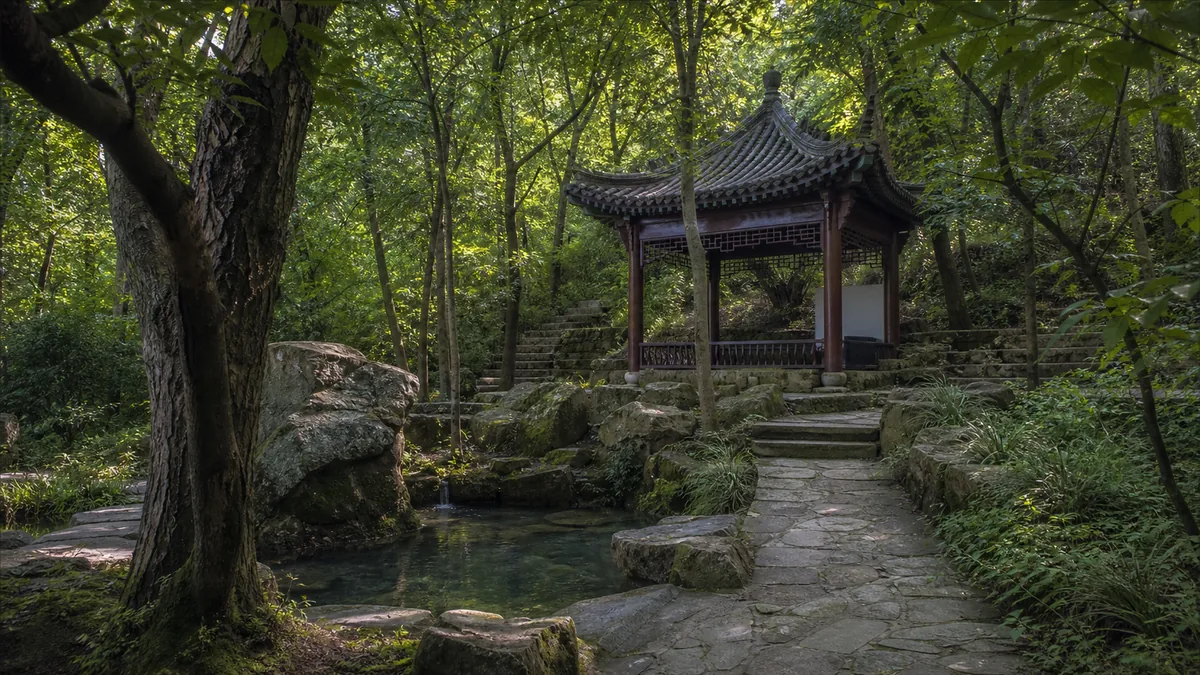
5A View location, maps and nearby scenic areasStand beside Rang Spring and listen before looking for the famous pavilion. Water moves under leaves and past stone; above it, roof corners appear between trunks. This is the sequence Ouyang Xiu made memorable almost a thousand years ago: mountain, sound, turning path, spring, then a pavilion suddenly revealed.
The scene feels composed, but it is not frozen in the Northern Song dynasty. Paths have been surfaced, inscriptions gathered, halls repaired and pavilions rebuilt. The useful question is not “Is every stone original?” It is “How did one short essay teach later generations to arrange, preserve and revisit this valley?”
Read from low to high: begin with the forested approach and Rang Spring, spend real time in the Zuiweng Pavilion precinct, continue toward Langya Temple if conditions allow, and add the upper ridge or Nantianmen only if your energy, weather and the current route map support it. The literary centre is low on the mountain; reaching the highest point is optional.
Follow water before climbing for a view
The Mount Langya 5A profile fixes the destination in Chuzhou, Anhui, but a map pin cannot explain its vertical logic. Mount Langya is best understood as a wooded valley route rising from city edge to spring, pavilion, lake and temple landscapes, with steeper paths continuing upward.
On a commonly used approach, the first important transition is from managed entrance space into denser shade. Follow the stream sound rather than rushing toward a summit sign. Rang Spring—written 酿泉, literally a “brewing spring”—and Zuiweng Pavilion form one visual and textual unit. The water introduces the pavilion just as it does in the essay.
Beyond the pavilion precinct, routes generally continue uphill through forest toward Shenxiu Lake and Langya Temple. Exact diversions, one-way controls and vehicle stops can change, so treat that as an orientation rather than a promise. The optional ascent toward Nantianmen or another open high point adds stairs, sun and time; it is a different physical experience from the shaded literary valley.
This order also protects attention. If you race uphill first, the pavilion becomes a box to tick on the descent. Starting with water lets you see why a modest shelter, rather than a grand peak, became the mountain’s cultural centre.
The pavilion is an old site with a rebuilt body
Ouyang Xiu’s text asks, “Who built the pavilion? The mountain monk Zhixian. Who named it? The prefect named it after himself.” That passage gives Zhixian, a Buddhist monk associated with the mountain, a clear role in the origin story: he made a pavilion by the spring, and the visiting official supplied the name and prose.
It does not authenticate every bracket, tile, wall or neighbouring courtyard now visible. Timber buildings are vulnerable to fire, moisture, insects and political upheaval. The pavilion complex has been repaired, reconstructed and enlarged in later periods. Inscriptions and subsidiary structures can commemorate the essay without having stood beside Ouyang Xiu.
Look for layers rather than hunting for a single “original.” The siting above water preserves the relationship described in the text. Rooflines and framed openings embody later ideas of what a celebrated literary pavilion should look like. Steles show how calligraphy carried prose into physical space. Wear on thresholds records modern visitation, not Song-dynasty footsteps.
The same caution applies to scenic labels. A line in an eleventh-century masterpiece can establish that the spring, path and pavilion mattered then; it cannot prove that every later-named pool, gate or garden is a Song survival. Literature is evidence, but it is not a construction inventory.
A demoted official turns Chuzhou into a moral landscape
Ouyang Xiu (1007–1072) was more than a travel writer. He was a Northern Song official, historian, essayist and advocate of a plainer, morally serious prose style. During the political struggles surrounding the Qingli reform movement, he defended reform-minded colleagues and was pushed out of the central court. He came to Chuzhou as its prefect, or zhizhou, around 1046.
That context changes the mood of The Record of Zuiweng Pavilion. The author is not a carefree retiree escaping public duty. He is an official after demotion, governing a relatively small prefecture and working out how private disappointment might coexist with public responsibility.
The essay is conventionally associated with the sixth year of Qingli, broadly 1046. Some modern summaries place the pavilion story or composition in 1047. Appointment dates, traditional calendars and later retellings do not always align neatly, so the honest formulation is “during Ouyang Xiu’s Chuzhou posting in the mid-1040s,” not a claim that every feature appeared on one precisely known day.
His prose moves from landscape to people: woodcutters, fishers, travellers, guests and the prefect share the scene. Food and drink come from the locality; feasting follows excursion; birds remain after humans depart. The political idea is quiet but substantial. A disgraced administrator imagines good rule not as ceremonial distance, but as being able to rejoice in the people’s rejoicing.
That is an aspiration expressed through literature, not an audited report proving every policy succeeded. Yet it explains why the essay endured as more than elegant nature writing.
“The Old Drunkard’s intent is not in the wine”
The line most visitors know appears early:
“醉翁之意不在酒,在乎山水之间也。” “The Old Drunkard’s intent is not in the wine; it lies among the mountains and waters.”
Ouyang Xiu called himself the “Old Drunkard” although he was only around forty; in the essay he jokes that he drank little, became tipsy quickly and was the oldest in his party. The self-mockery lowers official rank. Instead of entering as a stern prefect, he enters as a fallible companion whose pleasure depends on place and company.
The story has a cause, turn and consequence. Court conflict sent him away from the capital. In Chuzhou, monk Zhixian’s spring-side pavilion gave him a setting in which to recast loss as attention. The essay then turns private consolation outward: the deepest pleasure belongs not merely to the official enjoying scenery, but to his awareness that local people can enjoy it too.
The sentence became the modern idiom 醉翁之意不在酒. Today it means that someone’s real purpose lies beyond the stated action—sometimes playfully, sometimes with suspicion. A person may propose coffee while actually wanting to negotiate a contract. The phrase’s modern echo is sharper than its original setting, but the pavilion makes the metaphor visible: wine is the occasion; landscape, fellowship and an idea of public life are the point.
Pause after reading it. Listen for water and ask what you came for beyond collecting the same roof photograph as everyone else.
The mountain name belongs to tradition, not a proven itinerary
Mount Langya’s history did not begin with Ouyang Xiu, but its earlier narratives require careful labels. A traditional explanation, repeated in later geographical writing, links the name to Sima Rui, who held the title Prince of Langya before becoming the founding emperor of the Eastern Jin in the early fourth century. The story says he took refuge or passed through this mountain during disorder, and the name followed.
Treat that as a place-name tradition, not a verified travel log. A later text preserving the story proves that people told and valued the association; it does not by itself establish Sima Rui’s exact route, campsite or naming act. Nor should this Anhui mountain be confused with every ancient place called Langya farther east in Shandong.
The distinction adds rather than removes meaning. Place names often work as claims of memory, drawing a local landscape into larger histories of migration and dynastic change. Here the Sima Rui tradition connects flight and political rebirth; the Ouyang Xiu story connects demotion and ethical recovery. Both are narratives of setback, but they carry different levels of evidence.
When a sign uses “according to legend,” keep the qualifier when retelling it. Removing those two words turns cultural memory into false certainty.
Langya Temple is a living religious place
Accounts commonly trace the monastic history of Langya Temple to the Tang dynasty, while the buildings visible today reflect later destruction, rebuilding and repair. As with the pavilion, an early foundation tradition does not make every hall a Tang structure. Read plaques and conservation labels for the date of the particular building in front of you.
More importantly, the temple is not only a historical exhibit. Incense, chanting, offerings, bells and worship may be part of current religious life. A hall can be architecturally interesting and sacred at the same time. Stand aside from the central worship line, speak quietly, silence phone alerts and do not step over ritual objects.
Photography permission can differ by hall or occasion. A camera prohibition is not a missing attraction; it protects worship, images or crowd movement. Never pose with an offering table, touch statuary, direct a flash into a dark interior or photograph a monk or worshipper at close range without consent.
Temple thresholds and steps also mark an accessibility change. Someone comfortable on the broad lower road may find individual courtyards difficult. Companions should agree where to wait rather than pressuring everyone through each hall.
Zhixian’s role in the pavilion story is a reminder that the mountain’s literary fame grew through contact between monastic and official worlds. Do not reduce the monk to a supporting character who existed only to furnish Ouyang Xiu with a view.
Choose a route for your legs, not for completion
A short literary route focuses on the lower valley, Rang Spring and Zuiweng Pavilion precinct, then returns before sustained climbing. It gives the essay’s essential sequence and is the best choice in heat, light rain or limited time. “Short” does not mean step-free: check slopes, paving and entrances before committing.
A middle route continues from the pavilion toward Shenxiu Lake and Langya Temple, then descends by the currently approved path or transport option. It adds the living religious landscape and a clearer sense of forest depth. Allow time to enter quietly rather than arriving as a rushed final stop.
A full ascent adds Nantianmen or an upper ridge/viewpoint where open. Choose it for the contrast between enclosed valley and wider Chuzhou views, not because the lower visit is incomplete without a summit. Expect more stone steps, heat exposure and a harder descent. Keep enough time to return before route or vehicle service ends.
Families can make the spring the observation game: find where sound becomes visible, compare natural channel edges with masonry, and look for the “wing-like” pavilion profile described in the essay. Strong walkers should still resist collecting every side path. A ten-minute pause at the spring often teaches more than another hurried kilometre.
If scenic vehicles are operating, ask exactly where they board, where they stop and whether the last departure serves your chosen exit. Never assume a ticket includes every transfer or that a vehicle removes the final stair sections.
Wet stone, summer heat and access shape the day
Forest shade can make Mount Langya feel gentle, but it also keeps paving damp. Rain, spring splash, moss and fallen leaves make old stone unexpectedly slick. Wear shoes with grip, use handrails without leaning beyond them and shorten the upper route after heavy rain. Do not enter a closed path to recreate a literary view.
Chuzhou summers can be hot and humid. Start earlier when possible, carry drinking water and take breaks before the exposed upper climb. The spring name is poetic, not a safety certificate; do not drink untreated water unless current onsite guidance explicitly approves it. In storms, follow evacuation or closure notices even if the valley itself still looks calm.
Opening areas, admission boundaries, shuttle operation and temple access can change with maintenance, ceremonies, fire prevention, severe weather or crowd control. Check the scenic area’s current notice and confirm again at the visitor centre. Keep a lower-route plan that remains worthwhile if the temple or upper section is unavailable.
For limited mobility, ask about the complete chain: drop-off to entrance, gradients to the spring, pavilion thresholds, toilets, vehicle boarding and the return. A paved photograph at one point does not prove a continuous wheelchair route. Visitors with low vision may appreciate a companion on irregular steps; those sensitive to sound should allow distance from bells, amplified tour groups or festival crowds.
Photograph the relationship, then leave room for quiet
At Rang Spring, photograph water, path and pavilion in one frame. A slower shutter can show movement, but keep tripods out of narrow circulation unless permitted. After rain, reflections deepen while surfaces become dangerous; compose from a stable edge rather than stepping onto wet stones.
In the pavilion precinct, use a doorway or tree trunk to show that the building is embedded in a later memorial complex. Photograph inscriptions square-on if allowed, then read them with your eyes. Do not rub carved surfaces, climb railings or treat a crowded stele as a portrait backdrop for long periods.
At the temple, quiet is more important than coverage. At an upper viewpoint, include the forested approach or Chuzhou edge rather than using a tight lens that turns a modest mountain into a false precipice. Drone rules can reflect forest protection, religious space, crowds and local air controls; obtain explicit permission rather than relying on another visitor’s flight.
End where the essay begins: not at the highest stone, but with water heard between trees. The surviving truth is a relationship—spring below, shelter above, a path that turns revelation into rhythm. The timber may be later and the mountain-name story traditional, yet the act of looking beyond the obvious still works.
Continue through Anhui’s higher, more strenuous mountain country at Tiantangzhai. Compare Langya’s official-and-monastic landscape with the religious mountain traditions of Mount Song, or follow the afterlife of learned texts and public ritual at Qufu’s Confucius sites. Each makes a different claim about how words inhabit a place.
Location profile
Where it is

Frequently asked questions
How long should I allow for Mount Langya?
Allow roughly two to three unhurried hours for the lower literary circuit around Rang Spring and Zuiweng Pavilion. Continuing to Langya Temple and an upper viewpoint can make it a half-day or longer. Weather, closures, queues and any scenic transport can change the practical timing, so confirm the current map at the entrance.
Is today's Zuiweng Pavilion the one Ouyang Xiu saw?
No surviving pavilion should be treated as an untouched structure from Ouyang Xiu's lifetime. The site and literary association are old, but fire, decay, rebuilding and repair have changed the visible complex. Read the present pavilion as a memorial landscape layered around an eleventh-century text.
Is Mount Langya suitable for visitors with limited mobility?
Parts of the lower approach may be paved and scenic vehicles may sometimes reduce distance, but slopes, wet stone, thresholds, steps and uneven links remain. Ask the visitor centre about a step-light route to Rang Spring and the pavilion, vehicle operation, accessible toilets and the return path before setting out.
Can I photograph inside Langya Temple and drink from Rang Spring?
Temple photography rules can vary by hall and ceremony; follow posted signs, avoid flash and never photograph worshippers or monastics without permission. Do not assume spring water is treated drinking water. Use it only if current onsite guidance explicitly says it is safe.