Jilin · Dunhua
Liuding Mountain: Keep Balhae Tombs and a Modern Buddha in View
Move between early Balhae royal burials, a rebuilt living Buddhist complex, a monumental modern Buddha and wooded hills without compressing their different dates, purposes or evidence into one heritage story.
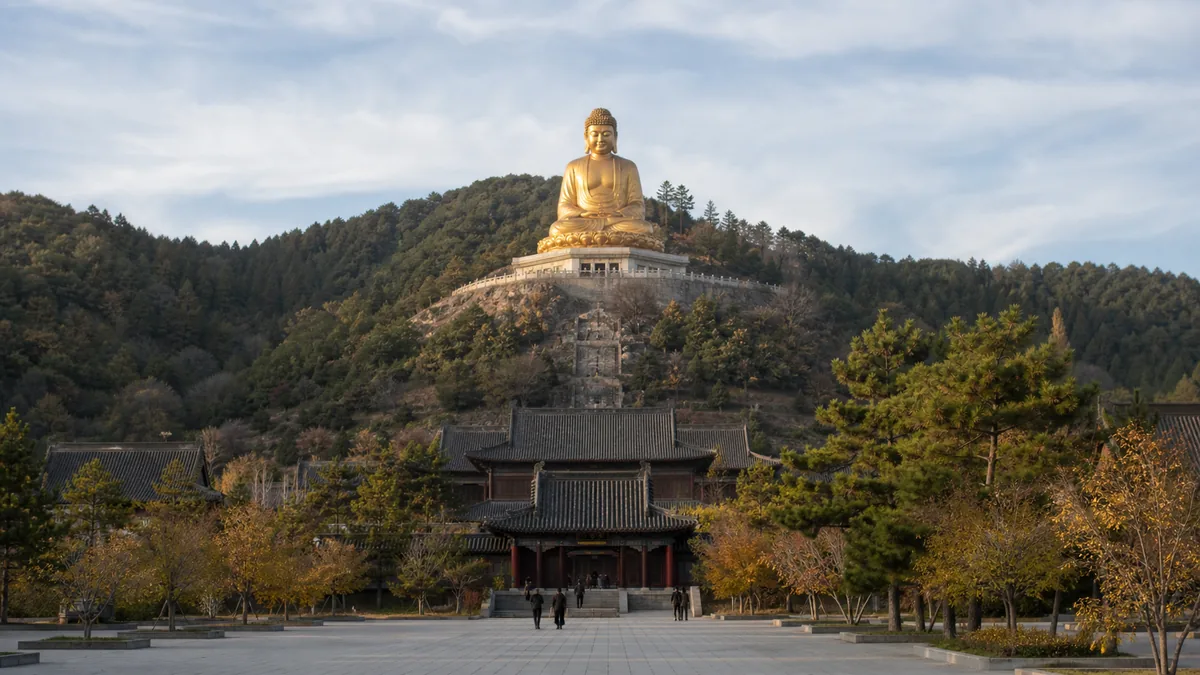
5A View location, maps and nearby scenic areasAt one stop, the earth rises into a low, grassed burial mound whose outline can disappear when the light turns flat. Elsewhere in the same tourism area, a modern golden Buddha dominates the skyline. Try to hold both scales in mind without forcing them into one photograph. The mound protects an early medieval grave; the gilded figure belongs to a living, contemporary religious complex. Their shared mountain address does not make them the same age.
Even the name carries a warning. The modern destination is usually written 六鼎山, Liuding Mountain, while the archaeological cemetery often appears as 六顶山古墓群, the Liudingshan Ancient Tombs. Romanisation hides the different middle character. The tourism identity now combines the Balhae cemetery, Zhengjue Temple, the Jinding or Golden Buddha, plazas, woodland and hill routes. A useful visit begins by separating those layers before reconnecting them.
Choose one main question before entering: archaeology asks what the mounds, epitaph and burial forms prove; a temple visit asks how to behave in an active ritual space; a woodland route asks what your time, footwear and weather allow. You can combine all three, but no single monument explains the whole mountain.
One scenic area contains three different kinds of place
The archaeological zone is a protected cemetery. Its value lies in mound positions, tomb construction, objects and inscriptions recovered in documented contexts. A low profile is not evidence of low importance. The original grave may now be covered precisely because exposure would damage it, and a visitor may encounter an exterior outline, protective building, replica or museum-style display rather than an open chamber.
The Buddhist zone serves a different function. Zhengjue Temple’s present buildings and the great gilded image are modern or reconstructed. They support worship, teaching, monastic life and contemporary pilgrimage as well as tourism. Their value does not depend on pretending that today’s halls survived intact from the Balhae kingdom.
The wooded slopes and open views make a third experience. Forest paths can provide distance from the plazas, but “natural” does not mean unregulated. Trails may cross steep or icy ground, sensitive vegetation and protected archaeological land. A mound-shaped rise beside a path is not an invitation to improvise a shortcut.
Read each sign for four pieces of information: the period being described, whether the fabric is original or reconstructed, where an object was found, and whether the space is archaeological, devotional or recreational. Decorative language about a unified “thousand-year culture” may be a tourism theme; it is not a construction date.
Balhae lasted from about 698 to 926, and its centre moved
The kingdom called Balhae, Bohai or Parhae in different romanisation traditions existed from about 698 to 926. It arose in northeast Asia after the fall of Goguryeo and developed through communities, institutions and cultural practices with multiple regional roots. Its political centres moved as the kingdom expanded. The Dunhua region is associated with its early royal landscape, not with one capital that remained unchanged for the entire period.
Archaeology around Dunhua connects settlement, fortification, burial and movement through valleys leading toward the wider Changbai mountain region. The Liudingshan cemetery is important because royal and high-status burials place the early court in a material landscape. Imported forms, local construction choices, Chinese-character inscriptions and Buddhist ideas can appear together without proving that the kingdom belonged exclusively to one modern people.
In 926, the Khitan Liao defeated Balhae. The court ended, but populations did not vanish on a single day. People moved, remained, entered new administrations and carried practices elsewhere. Later states and modern scholarship preserved different memories of Balhae.
Chinese, Korean, Russian and Japanese research traditions do not always use the same names or national frames. At the tombs, begin with evidence that travels across those debates: stratigraphy, masonry, pottery, epitaph language, burial dates and comparisons among sites. Balhae was an ancient multi-regional polity. A modern border or ethnic category cannot simply be projected backward as sole ownership.
Princess Zhenhui’s epitaph gives one mound a name
One of the cemetery’s strongest identifications comes from the tomb and epitaph of Princess Zhenhui. The text describes her as the “second daughter of our Great King”, court language that ties her to King Wen of Balhae. It also records biographical and burial information. Because the inscription was found in a tomb context, the name rests on much stronger evidence than a later nickname attached to a mound.
Zhenhui died in 777 and was buried in 780, according to the epitaph chronology. The delay between death and burial is not a romantic mystery to fill with invention; it is a documented interval that scholars place beside court practice, travel and preparation. Her tomb connects an individual royal woman with the early Balhae landscape around Dunhua.
The inscription is praise composed within elite conventions, not her private voice. It can reveal kinship, titles, literary choices and how the court wished a princess to be remembered, while saying far less about servants, builders and nearby communities. The cause is a royal death; the transformation is a life arranged into formal virtues; the consequence is that a stone text now gives historians one of the rare named women in Balhae history.
Do not assume the original epitaph is always displayed beside the mound. Conservation, loans and exhibition rotations can place an original object elsewhere while a facsimile explains its findspot. Check the label for “original,” “replica,” “rubbing” or “reconstruction.” Photograph the label with the text if permitted; an isolated slab image easily loses its archaeological context.
Princess Zhenxiao’s mural tomb is in Helong, not here
The most persistent location error concerns Princess Zhenxiao, another daughter of King Wen. Her tomb also produced an epitaph, and its wall paintings are among the best-known Balhae funerary images. But that tomb belongs to the Longtou Mountain cemetery in Helong, not to the Liudingshan cemetery in Dunhua.
The two princesses are easy to merge because both were royal daughters, both tombs are in present-day Jilin Province, and both are central to Balhae studies. The evidence keeps them apart: Zhenhui’s named burial belongs at Liudingshan; Zhenxiao’s epitaph and mural chamber belong at Longtou Mountain. If a Liuding Mountain display discusses Zhenxiao, it may be offering regional comparison or showing reproductions. It does not move her grave.
That distinction changes what a visitor should expect. A photo of attendants, musicians or architecture identified as coming from Zhenxiao’s tomb is not proof that original murals are visible in the Liuding Mountain archaeological zone. Read the caption all the way to the findspot. Museum graphics often place related sites side by side, while social-media captions erase the distance.
Other mounds require similar restraint. A royal cemetery can contain people of different rank and date, and a neighbouring tomb does not inherit the identity of the one with an epitaph. Use site numbers and cautious phrases such as “attributed to” where no naming inscription survives.
A closed tomb can be the most honestly preserved tomb
Burial chambers are unusually vulnerable visitor spaces. Opening changes humidity and temperature; breath adds carbon dioxide and moisture; light encourages biological growth; feet carry dust and salts. Painted plaster can detach before colour loss is obvious. Masonry can also become unstable after water, roots, frost and earlier disturbance enter a chamber.
For that reason, the most important thing on view may be the mound profile and protected setting, not an interior. A replica chamber can explain plan, brick or stone courses and image placement without exposing the original. Digital colour restoration should be labelled as interpretation, and vivid screens should not be mistaken for the present condition of ancient pigment.
Never climb a mound, sit on retaining stone, enter an opening without staff permission, touch masonry, make a rubbing or pick up a tile fragment. Do not clear leaves or snow to “improve” a photograph; the surface and anything on it belong to the protected context. If human remains or grave objects are displayed, avoid comic poses and close-up images of other visitors reacting.
Photography rules may differ between an outdoor mound, a protective shelter and an indoor display. Flash, tripod and video restrictions can change with conservation work. Ask before setting equipment down, keep bags away from fragile edges, and treat a “no entry” barrier as part of preservation rather than a challenge to find another angle.
The Golden Buddha is modern—and the temple is alive
Zhengjue Temple and the Jinding Buddha create the destination’s strongest contemporary image. Local promotional material commonly gives the gilded seated figure a total scale of roughly 48 metres and may use a “world’s tallest” or similar superlative for a bronze seated Shakyamuni. Such rankings depend on whether the body, lotus seat and plinth are counted, how material and posture categories are defined, and when comparisons were updated. Use the current on-site specification as a record of a modern project, not an eternal world rank.
The more important distinction is chronological. Balhae practised Buddhism and left Buddhist material culture, but that fact does not make the present temple halls or giant image surviving Balhae fabric. The current complex was built or rebuilt in modern times. Its architecture may quote older forms, yet reconstruction date and devotional use must stay visible in the description.
“Modern” does not mean spiritually empty. Worshippers may bow, offer incense, listen to chanting or sit quietly while tourists pass. Stand aside from the central approach, do not occupy kneeling cushions for photographs, and never imitate a ritual as comedy. You do not have to perform a bow; respectful stillness is enough.
Use incense only in designated areas and in the quantity staff permit. More smoke is not more devotion, and fire controls may tighten with wind, drought or crowds. Do not touch images or offerings. Modest clothing that covers the torso and shoulders is a considerate default; inside halls, follow current signs on hats, phones and photography. Ask before photographing monastics, ceremonies or people at prayer.
Let archaeology, worship or woodland set the route
For an archaeology-first visit, go to the tomb interpretation while attention and light are fresh. Establish where the princess’s tomb sits within the cemetery, then read any epitaph display and construction model. Add the temple later as a deliberately different period. This order prevents the giant Buddha from becoming a visual label for every earlier object.
For a temple-first visit, begin by learning the current hall sequence and whether a ceremony limits access. Move quietly through worship space before approaching the large image and viewpoint. Do not promise yourself a chanting session, incense ritual or open hall; religious schedules and visitor controls change.
For a woodland-first visit, select an officially open path by length and elevation rather than choosing a green line from an old map. Forest, plaza and archaeological protection zones may meet without sharing the same access rules. Stay on the trail, carry out litter, and do not use a burial mound as an overlook.
A short visit should choose one main theme and one contrast: tombs plus a brief exterior view of the Buddha, or the temple plus one archaeological orientation display. Combining every hall, mound and trail at speed produces photographs but little chronology. Internal buses, shuttles, tickets, reservations and last departures can change, so confirm them at the entrance before committing to a distant stop.
Steps, ice and ritual etiquette shape what is realistic
The complex includes broad plazas, long approaches, stairs, ramps, wooded inclines and exposed viewpoints. A map symbol does not show cumulative climbing. Visitors with limited mobility should ask which drop-off serves the archaeological interpretation, whether the principal worship spaces have a step-free route, how far the Buddha viewpoint lies from transport, and which toilets are accessible.
Dunhua winters can bring deep cold, packed snow and persistent ice. Shaded stairs may remain slippery after a road has been cleared. Wear insulated shoes with grip, keep hands free for railings and turn back before balance becomes uncertain. In warmer seasons, rain can make forest soil slick and heat or insects may change the comfortable route. Closures are safety decisions, not missing attractions.
At tombs, use low side light to reveal the mound’s curve and include a person only on the authorised path for scale. At the Buddha, step back far enough to show the lotus, plaza and human scale rather than cropping the figure into an unexplained gold surface. In the temple, photograph architecture only where signs permit; never use flash during worship or frame a stranger’s face without consent.
Drones, tripods, commercial shoots and interior video may require separate permission. Confirm current rules instead of assuming an outdoor scenic-area ticket is filming consent. For a wider Jilin itinerary, compare the mountain ecology of Changbai Mountain, the dispersed capital and tomb landscape at Ji’an’s Goguryeo sites, or the designed urban forest of Jingyuetan.
One mountain can hold different centuries without becoming one story
Before leaving, look once more for the two scales that opened the visit. The low mound works through concealment: earth protects a grave, and an epitaph names one person while leaving many others unknown. The golden Buddha works through visibility: modern engineering and devotion create a figure meant to be seen across a large space.
Both belong to Liuding Mountain today, but for different reasons. Between them stand archaeologists, conservators, temple builders, monastics, worshippers, forestry workers and visitors—people whose work continues to shape what survives and what can be seen. A tourism map can connect their locations without collapsing their dates.
Take a final photograph only if it preserves that difference. One frame cannot prove continuity from an eighth-century tomb to a modern temple, and visual resemblance is not historical evidence. Sometimes the honest record is two photographs with two captions.
Lower the camera and let the mountain remain layered: Balhae earth, reconstructed halls, living ritual and present forest. The achievement of the visit is not squeezing them into one grand image. It is leaving each period enough space to keep its own outline.
Location profile
Where it is

Frequently asked questions
Are the Balhae tombs, Zhengjue Temple and the Golden Buddha from the same period?
No. The Liudingshan tomb cemetery belongs to the Balhae period, roughly 698–926. The present Zhengjue Temple complex has been rebuilt in modern times, and the Jinding or Golden Buddha is a contemporary monument. They share one tourism area and a broader Buddhist frame, but the modern buildings are not surviving Balhae structures.
Which Balhae princess is buried at Liudingshan?
The tomb identified by its epitaph as that of Princess Zhenhui is at the Liudingshan cemetery near Dunhua. The mural tomb of Princess Zhenxiao, also identified by an epitaph, is at Longtou Mountain in Helong and must not be relocated to Liuding Mountain in an itinerary or caption. Surrounding unnamed tombs cannot be assigned to royal individuals merely by proximity.
Can visitors enter the ancient tombs or see original murals?
Do not assume entry. Tomb chambers may be closed, protected or represented by replicas and digital interpretation, and what is visible can change for conservation. Princess Zhenxiao's celebrated murals belong to her tomb at Longtou Mountain, not Liudingshan. Follow each zone's current rules on access, photography and flash.
How long should I allow for Liuding Mountain?
A selective visit focused on either the archaeological zone or the temple and Golden Buddha can fit into a half day, depending on transfers and current internal transport. Combining tomb interpretation, the religious complex and a woodland walk is more comfortable with most of a day. Check operating hours, last transport and winter trail conditions before fixing onward travel.