Henan · Xinyang
Jigong Mountain: Read a Summer Resort in the Mist
Walk from mixed mountain forest into a late-Qing and Republican-era villa district, reading cool-climate architecture, foreign and Chinese communities, local labour and the unequal history behind a celebrated summer resort.
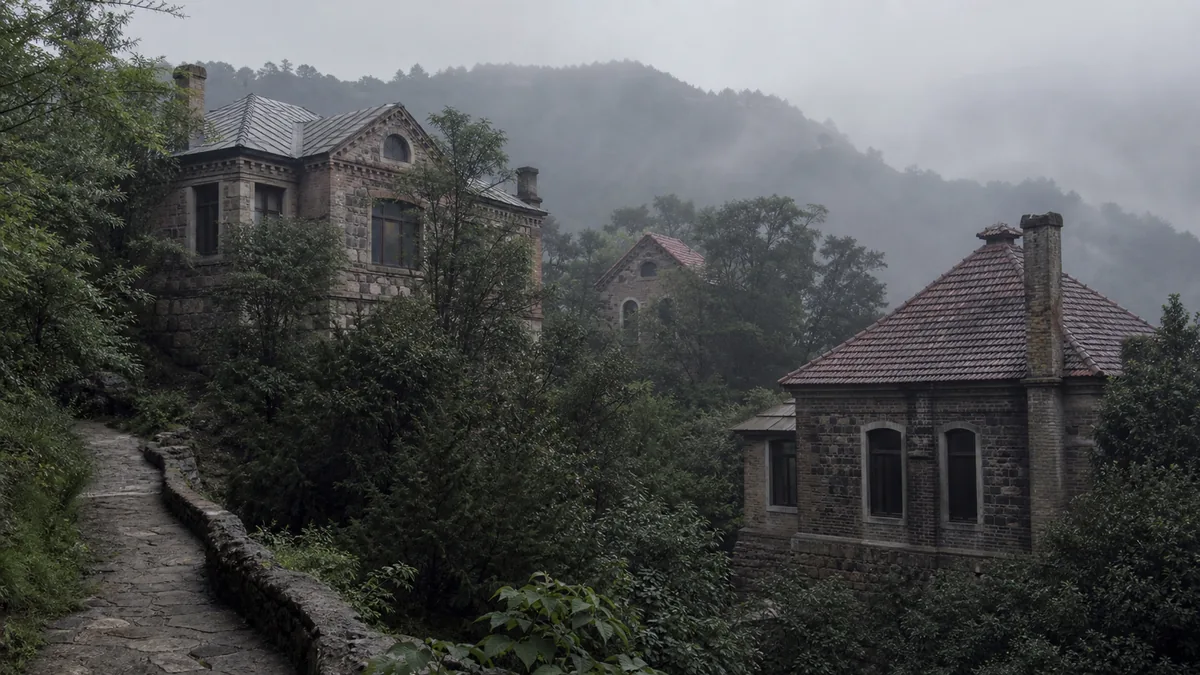
5A View location, maps and nearby scenic areasStand below an old villa after rain and look at the meeting of wall and mountain. Rough local stone holds the slope; a veranda projects into wet air; moss occupies a shaded joint. Beyond the roof, broadleaf forest dissolves into mist. Architecture and ecology do not sit in separate display cases here—the weather presses on both.
Jigong Mountain—roughly jee-gong-shahn—rises south of Xinyang near the Henan–Hubei boundary. It is known both as a protected mountain landscape and as an early twentieth-century summer resort where foreign missionaries, merchants and other residents built alongside later Chinese owners and institutions. That combination is the subject of the visit, not proof of a carefree international idyll.
Plan three layers, then let conditions decide: start with the old villa district for history; add a ridge or rooster-profile viewpoint for orientation; choose a forest walk only after checking mist, rain, trail closure and the last scenic vehicle. A ticket to the mountain does not mean every historic interior is open.
The forest grows across a climatic threshold
Jigong Mountain stands in the uplands where central China’s northern and southern landscapes meet. Warm, moisture-bearing monsoon air, varied slopes and elevation help support a mosaic of deciduous and evergreen broadleaf vegetation. The exact boundary is ecological and gradual, not a painted line across a trail. On the ground, it appears as overlapping leaf shapes, dense understorey, vines, ferns and seasonal changes in which species dominate the view.
Walk slowly enough to notice vertical layers. Leaf litter and fungi work at ground level; shrubs occupy filtered light; trunks carry mosses and climbers; crowns intercept wind and rain. A plantation, restored patch and older mixed stand can look equally green in a quick photograph but contain different structures. Labels beside a trail are more reliable than naming every tree from an app image.
Protection also limits how a visitor should move. Remain on open paths, do not collect flowers, fungi, insects or stones, and never feed wildlife to manufacture a close photograph. Fog muffles distance, but voices and portable speakers still travel. “Mountain resort” describes a human use of part of the landscape; it does not turn the surrounding forest into a garden without ecological consequences.
A rooster appears only from chosen angles
The name Jigongshan, literally “Rooster Mountain,” is commonly explained through a profile that resembles a cock lifting its head or spreading its wings. The association belongs to local tradition and scenic seeing. Change the angle, let cloud cover the ridge, or crop the slope tightly and the bird can disappear. That does not make the name false; it shows how place-names teach people to look.
At a signed overlook, trace the silhouette before reaching for the camera. Identify the supposed head, neck, back and tail, then compare them with the actual ridge. A named summit or viewpoint may carry the rooster-crowing image, but names and mapped routes should follow the current onsite plan. Tourism maps sometimes simplify several ridges into one emblem.
The mountain is substantial enough to produce steep approaches and sudden weather, but its importance should not be reduced to a single elevation figure. Published heights can refer to different peaks, survey points or scenic landmarks. Use the altitude marked at the exact viewpoint, and use your legs and the cloud line to understand the more relevant scale: how far the villa district sits below a ridge and how quickly visibility can collapse between them.
A summer resort grew through late-Qing foreign networks
Jigong Mountain’s modern resort history took shape around the turn of the twentieth century, during the final years of the Qing dynasty. Foreign missionaries and other residents connected to treaty-port cities in central China sought cooler summer conditions away from humid lowland heat. Improved rail access near Xinyang helped make seasonal travel, materials and supplies more practical. Villas, churches, clubs and service buildings gradually formed a mountain settlement rather than one planned palace complex.
This history must be located inside unequal late-Qing relations. Foreign residence, missionary institutions and commercial networks operated through privileges created by treaties, consular power and uneven access to land and law. Jigong Mountain was not simply a colony transplanted whole onto an empty ridge, but neither was it a neutral design exchange among equal participants.
Chinese landholders, intermediaries, builders, porters, servants and suppliers were essential to the resort’s operation. Some benefited from new employment or commerce; others faced bargaining power very different from that of well-funded organisations and seasonal residents. Surviving walls rarely record those negotiations. Read plaques for property history, but also ask whose work made clean water, food, transport and repair possible through each summer.
Local builders made outside ideas mountain-ready
The villa district is often introduced by the variety of its roofs, verandas, gables, towers and plans. Some buildings drew on architectural habits familiar to their foreign patrons; others were commissioned or later adapted by Chinese owners. Yet style did not travel as a sealed package. Local masons, carpenters and material suppliers translated drawings and requests into structures that could stand on wet, sloping ground.
Look for thick stone bases, retaining walls, raised floors, deep eaves, covered porches and openings arranged for ventilation. These details answer rain, damp, heat and terrain as much as they advertise identity. Locally available stone may anchor a building whose silhouette looks European; Chinese tiles or construction skills may appear within a plan described by a foreign name. Repairs from later decades add another layer.
Do not identify a building’s nationality from one pointed arch or red roof. A villa’s patron, designer, builder, occupants and stylistic references can all come from different places. The strongest reading combines a dated plaque, archival attribution and visible fabric. When those disagree, preserve the uncertainty rather than turning resemblance into biography.
The cool air carried privilege as well as relief
Summer heat was a serious health and comfort problem before modern air-conditioning. Moving to a higher, wooded site could reduce exposure to the lowland’s oppressive weather and create space for rest, worship, schooling or medical recovery. Children, families and institutional workers experienced the mountain as more than architecture.
But retreat depended on resources. Rail fares, seasonal houses, paid labour and access to reserved social spaces divided those who could escape the heat from those who carried luggage, prepared food, maintained roads or remained below. Foreign residents themselves differed by nationality, occupation, denomination, gender and income; “the foreigners” were not one household. Chinese residents and visitors likewise ranged from workers to merchants, officials and later villa owners.
This tension is visible in the resort plan. A generous veranda opens a household to breeze and landscape, but service paths and support rooms reveal the labour behind leisure. A church or club may document community life while also marking boundaries of belonging. Admiring craftsmanship does not require romanticising the social order that paid for it.
Republican-era summers changed owners and meanings
After the Qing fell in 1912, Jigong Mountain continued to develop during the Republic of China. Chinese officials, businesspeople, organisations and institutions became increasingly visible in the resort landscape. Buildings changed hands or use; political figures and public events entered local memory; a seasonal foreign enclave became a more mixed and contested Chinese mountain destination.
War and political upheaval interrupted that trajectory. Occupation, military use, abandonment, institutional reuse and repeated repairs affected different properties in different ways. A neat “built in one year, preserved ever since” story rarely fits the fabric. A villa may carry an early name, a Republican association, a later government function and a contemporary museum label at the same time.
That layered afterlife matters to conservation. Restoring only an imagined first appearance can erase later evidence; preserving every alteration can obscure the early plan. Current work may stabilise roofs and drainage, adapt interiors or close buildings while research continues. Treat scaffolding and locked doors as part of responsible stewardship, not as a failure to deliver every room to a ticket holder.
“A museum of many nations” is a clue, not a catalogue
Jigong Mountain is often called a “museum of architecture from many nations”—wanguo jianzhu bowuguan in the familiar Chinese phrase. The label captures the surprise of meeting varied historic villas inside a Henan forest. It is memorable, and it helped make the district legible to broad audiences.
It is not, however, an architectural inventory. Promotional accounts give different numbers of countries, villas or surviving buildings depending on period and boundary. One structure may mix references, local materials and later alteration. A national label can also hide the Chinese workers who built it and the unequal system through which some patrons acquired mountain property.
Use the phrase as a question: what does this façade quote, who commissioned it, who constructed it, and which part is original or restored? Likewise, Jigong Mountain is frequently included among China’s “four great summer resorts.” That received list is a useful history of tourism branding, not evidence that Jigong Mountain, Lushan, Moganshan and Beidaihe developed under identical conditions. The buildings and documents should lead; the slogan should follow.
Read villas, ridge and forest as separate layers
For a history-first visit, begin with the visitor overview or any open interpretation space, then walk a compact loop through the principal villa area. Select a few buildings with clear plaques and compare foundations, verandas, roof forms and later uses. Enter only the interiors explicitly open that day. Depth in four buildings is more useful than collecting forty façades without names.
For a landscape-first route, use permitted scenic transport to save energy if it is operating, then walk to a signed ridge or rooster-profile viewpoint. Add a forest section on the descent only if surfaces are dry enough and the exit remains open. The celebrated silhouette and broad views depend on cloud; a misty day is better used for nearby stonework, moss and porch details.
For families or visitors with limited stamina, combine the most accessible villa cluster with one nearby overlook rather than crossing every ridge. Historic doors, steps and uneven interiors may remain inaccessible even when a shuttle reaches the district. Ask which ground-floor exhibits and paved approaches are step-free, and confirm where an accessible vehicle can actually stop.
Mist and transport rewrite the day’s plan
Jigong Mountain’s cool, cloudy reputation is part of its resort history, but weather is not a scheduled performance. Mist may rise, thin, return or hide the named view all day. Rain makes stone stairs, roots and painted decking slippery; wind and thunderstorms can close exposed sections. Carry a layer even in warm seasons, protect electronics and choose shoes for wet gradients rather than city pavements.
Road access, private-car controls, scenic buses and transfer points can change with season, crowd level, maintenance and weather. Do not assume a navigation app will take a taxi to the door of a chosen villa. At the entrance, photograph the current map and last-vehicle notice, then ask whether your route finishes at the same gate where it began. Leave margin for queues and a slow descent.
Accessibility also changes with operations. A vehicle can bypass a climb but still require a high step or crowded boarding point. Fog reduces visual orientation for everyone, and wet paving can be difficult for canes or wheels. Visitors with limited mobility should confirm companion rules, accessible toilets, rest areas and emergency return options before committing to a one-way trail.
Photograph weathered details and respect closed doors
For a villa portrait, step back far enough to include the retaining wall and forest. The relationship between slope, drainage, porch and roof explains more than a tight shot of decorative trim. In mist, use a nearer building or tree as an anchor; on a clear day, place the ridge behind the villa without claiming that weather is typical.
Inside an open building, follow current rules for flash, tripods and room access. Historic floors can be fragile and passages narrow. Do not move furniture, lean over a barrier, press a lens to old glass or photograph staff and other visitors at close range without consent. An unlocked window, side door or broken fence does not make a closed property public.
Return at the end to the wall where stone meets wet soil. The moss now belongs to a larger story: a climatic threshold, local craft, foreign privilege, Chinese labour, Republican change and present conservation. If cloud has erased the rooster-shaped ridge, let it. Make the last frame about the building holding its place in the weather, then leave enough time to descend before the mountain decides the route for you.
Continue to the Red Flag Canal to compare twentieth-century landscape engineering and collective labour, to Mount Song for a much longer religious and mountain history, or to the Taihao Fuxi Mausoleum to see how historic architecture supports living ritual rather than seasonal retreat.
Location profile
Where it is

Frequently asked questions
Why is Jigong Mountain named after a rooster?
Local tradition and scenic interpretation compare the mountain profile to a rooster raising its head or spreading its wings. The resemblance depends on viewpoint, weather and imagination; it is not a geological classification. Ask which current overlook gives the intended silhouette rather than expecting it from every trail.
Can visitors enter the historic villas?
Only some buildings may be open as displays, visitor facilities or adapted spaces. Others can be under conservation, in institutional use or unsafe to enter. Open interiors, tickets and photography rules change, so read the sign at each building and never use an unlocked side door as permission.
Is Jigong Mountain one of China's four great summer resorts?
It is commonly grouped under that long-used tourism label, often with Lushan, Moganshan and Beidaihe. Such lists vary and do not prove that the four places share one origin, climate or social history. At Jigong Mountain, the villas and records provide stronger evidence than the ranking.
Is Jigong Mountain easy to visit with limited mobility?
Scenic transport can reduce some climbing when operating, but it does not remove steep roads, stone steps, damp surfaces or thresholds in historic buildings. Ask the visitor centre about the day's step-free stops, vehicle boarding, accessible toilets and open ground-floor exhibits before choosing a route.