Shandong · Linyi
Firefly Water Cave & Underground Grand Canyon: Two Worlds Below
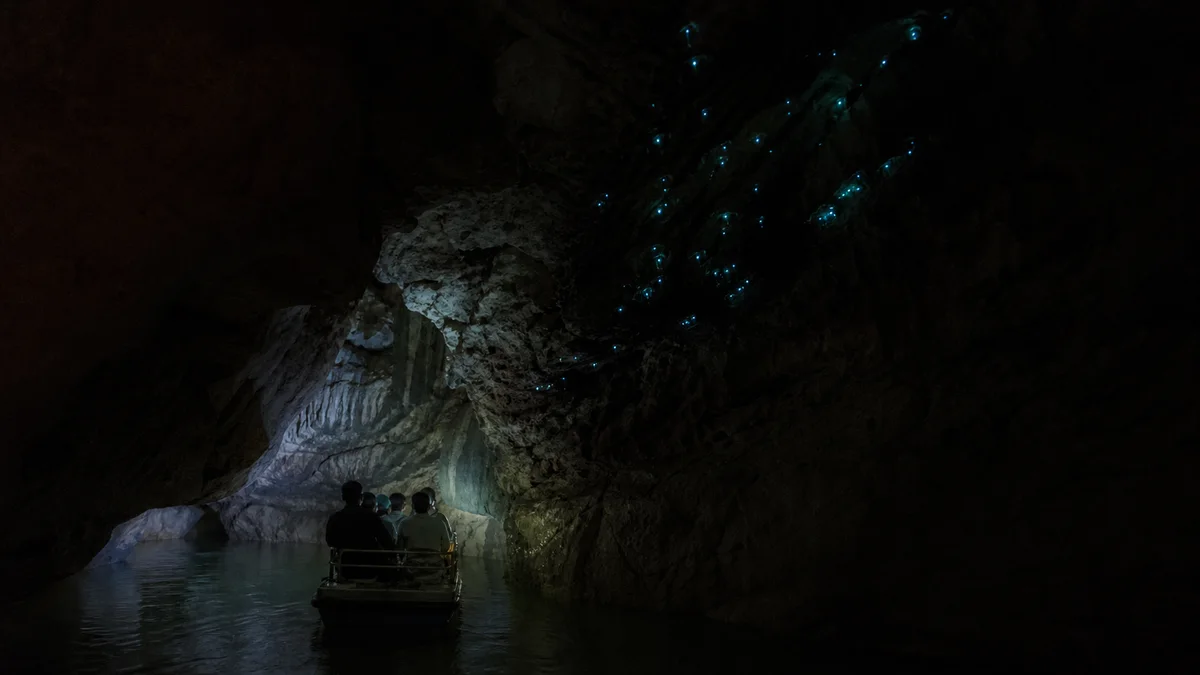
Treat Yishui's paired attraction as two separate cave visits: one centred on fragile points of living light, the other on water-shaped karst chambers and an optional adventure route.
5A View location, maps and nearby scenic areasBefore entering, put your phone away for one minute. Let your eyes adjust instead of forcing the cave to brighten. In Firefly Water Cave, the reward is not a floodlit wall but the possibility of tiny lights becoming visible only after darkness settles around you. At Underground Grand Canyon, do the opposite: use railings, stairs and people to measure passages that artificial colour can otherwise flatten.
These experiences share one long tourism name, but not one underground route. They are separate scenic areas in Yishui County, with different entrances, circulation systems and operational limits. A combined ticket is a commercial link, not a geological tunnel.
Plan two visits, not one cave: Firefly Water Cave centres on a dark, commonly boat-based observation section and its sensitive luminous organisms; Underground Grand Canyon centres on larger karst passages, engineered walkways and, when operating, an adventure water ride. Travel between them is above ground and must be included in your timetable.
Two attractions share a name, not a passage
The most important orientation happens before geology. Firefly Water Cave and Underground Grand Canyon are physically separate. Their gates, queues, safety briefings and exits are not interchangeable. Road conditions, parking control, a scenic shuttle or a self-arranged transfer can determine how much of a combined visit is realistic.
This separation also clarifies the contrast. Firefly Water Cave asks visitors to become quiet and accept limited visibility. Its signature section depends on darkness, water access and biological conditions. Underground Grand Canyon is a more architectural experience: chambers, narrowings, drops and decorated surfaces are made legible by paths, handrails and display lighting. An optional rafting-style route, when offered, adds speed and splash rather than more geological certainty.
Do not use a promotional “total cave length” as your walking distance. Surveyed passages, developed visitor routes, boat sections and separate caves can be counted differently. The most useful number is today’s open route, which the attraction should confirm at the entrance.
Karst begins with water finding weaknesses in rock
Both sites belong to a landscape shaped in soluble carbonate rock. Rainwater absorbs carbon dioxide from air and soil, becoming mildly acidic. As it moves through joints and fractures, it can dissolve tiny amounts of rock. Repeated over long periods, narrow cracks may widen into channels, chambers and underground drainage routes.
That explanation is a process, not a stopwatch. It does not establish a precise age for a particular chamber, and a cave system rarely forms in one uninterrupted episode. Rock uplift, fracture patterns, changing water tables, sediment, collapse and renewed flow can each alter the interior. Without a site-specific published dating study, a confident claim that the caves are an exact number of millions of years old is advertising, not evidence.
Look for relationships instead of records. A passage aligned like a corridor may follow a fracture. Rounded scallops or smoothed surfaces can indicate moving water, while angular blocks below a high roof suggest collapse. Current trickles show where water works now, but not necessarily where the strongest flow travelled in the past.
Read the “canyon” as shape, not a world ranking
The name Underground Grand Canyon describes the visitor’s impression of steep walls, height changes and a long, enclosed route. It should not be converted into an unsupported global rank. Cave measurements depend on what has been surveyed and whether length, depth, chamber height or developed route is being compared.
Inside, separate bedrock form from mineral decoration. Water carrying dissolved calcium can release carbon dioxide and deposit calcium carbonate. Over time this builds stalactites from ceilings, stalagmites from floors, columns where they join and flowstone across walls. A broken tip does not quickly regrow; even active dripping produces change on a timescale far slower than a visit.
Coloured lamps help visitors see relief but alter the apparent colour of the rock. Look once under the dominant display light, then find a neutral-lit edge if permitted. Wet calcite reflects brightly; muddy or iron-stained surfaces may appear brown or red. Do not identify every fantastic silhouette as a separate “natural sculpture.” Named formations are interpretation layered onto geology.
The cave’s living lights deserve taxonomic caution
“Firefly Water Cave” is an evocative visitor name, not by itself a scientific identification. Around the world, common terms such as firefly and glowworm are used for unrelated light-producing organisms, including different insect groups and life stages. Unless a current site study gives diagnostic evidence, visitors should not assign the points of light to a particular species from appearance alone.
What can be said safely is that bioluminescence is light produced by biochemical reactions within a living organism. Chemical energy is converted into visible light; it is not merely the cave lamps reflecting from an insect. The molecules and ecological purpose differ among organisms, so familiar explanations about mating signals or prey-catching threads should not be imported without confirming which organism lives here.
Scale is easy to misread in darkness. A bright point does not mean a large animal, and apparent clusters can be shaped by distance, moisture and where the boat turns. Let the site’s qualified biological interpretation supply the identification; let your eyes supply only the observation.
Darkness is habitat, not an empty backdrop
The viewing environment works because darkness increases contrast. Flash photography, a phone torch or a bright screen can spoil other visitors’ adaptation immediately. More importantly, repeated light, heat, noise and physical disturbance can change a cave habitat. The exact response varies by organism, but precaution is simple: do not add light unless staff direct you to an emergency exit.
Remain seated if the observation section uses a boat. Keep hands inside, do not reach towards walls or water, and never try to collect an organism. Follow instructions about silence. Quiet is not only theatrical; it helps boat staff communicate and reduces disturbance in an enclosed space.
Visible light may vary from one circuit to another. Organism activity, maintenance, visitor flow, water conditions and temporary section closures can all matter. A ticket cannot guarantee a particular density or photograph. If few lights appear, do not pressure staff to illuminate them—the darkness is part of what is being protected.
“Fireflies in a bag” becomes an ecological warning
The Chinese idiom 囊萤映雪, “bagged fireflies and reflected snow,” joins two traditional stories about studying despite poverty. In the best-known firefly story, the Jin-era scholar Che Yin is said to have gathered luminous insects in a gauze bag so he could read at night. The phrase now praises persistence in difficult conditions.
It is cultural memory, not a field guide. The story does not identify the organisms in this cave, and collecting light-producing wildlife would be the wrong modern echo. Habitat loss, pesticides, artificial night lighting and collection can threaten firefly populations in many places; cave organisms may face still more specialised limits.
The more responsible update to the idiom is to learn without taking. Allow a light to remain where its lifecycle depends on moisture and darkness. The photograph you fail to obtain may be the clearest evidence that you treated the cave as habitat rather than a box of visual effects.
Walkways and boats reveal the cave—and change it
Neither visit is an untouched expedition. Entrances may be enlarged, floors levelled, drains added, routes lit and dangerous areas bypassed. Boat operators, guides, safety staff, maintenance crews and conservation workers make public access possible. Their work is part of the contemporary cave landscape.
Infrastructure reduces some risks while creating management choices. Lamps can support unwanted surface growth if poorly controlled; visitors add heat, moisture, carbon dioxide and accidental contact; concrete and railings alter drainage or views. This does not mean caves should never be visited. It means capacity, route closures, low lighting and no-touch rules have practical conservation reasons.
Use the built route as evidence. A bridge shows a void that could not safely be crossed. A low protective roof may mark falling-water or rock risk. A barrier may protect an active formation rather than conceal a better photograph. Respect closures even when another group seems to have crossed earlier.
Choose one quiet half day or a carefully linked full day
For a half day, choose one site. Pick Firefly Water Cave if your priority is dark adaptation, a restrained boat experience and biological observation. Pick Underground Grand Canyon if you prefer a longer physical route, large-scale cave form and the option—subject to operation and eligibility—of a water ride. One complete experience is better than arriving after last admission at the second gate.
For a full day, an effective sequence often begins with the quieter experience while attention is fresh, then moves to the more active canyon route. But ticketing, crowd controls, shuttle direction or suspended boat sections may dictate the reverse. Confirm both sites’ actual entrances, the transfer method, last entry, open sections and whether combined admission still applies on the date of your visit.
Allow road and queue buffers. The sites do not connect underground, and a map pin cannot predict holiday traffic or parking. Carry a dry layer and water outside the caves; food and drink may be restricted inside. Do not schedule a fixed onward train immediately after a final rafting slot.
Let damp floors, darkness and confined space set the limits
Caves are commonly cooler and more humid than the surface. Wear closed shoes with good grip and keep one hand free for rails. Smooth wet paving, irregular steps, dripping ceilings and changing light can challenge balance. A thin layer is useful even in summer; loose ponchos or dangling straps can be awkward on boats or rides.
Visitors with claustrophobia, vertigo, limited mobility, poor low-light vision or sensitivity to boat motion should ask for the shortest current route and the location of exits before entering. “Scenic walkway” does not mean step-free. Wheelchairs and strollers may not pass high thresholds, narrow turns or boat transfers. Do not assume staff can lift a mobility device safely without advance arrangement.
Boat and rafting operations can change with water level, maintenance, crowding and safety inspections. Age, height, health and loose-item rules may apply. Use required flotation or protective equipment, remain seated when told, secure glasses and phones, and keep hands away from walls. Declining an optional ride is a sensible route choice, not a failed visit.
Photograph geology; experience living light with your eyes
In Underground Grand Canyon, include a railing, bridge or distant person to show scale. Hold the camera steady against your body rather than stepping outside the marked path. Mixed coloured lighting can confuse automatic white balance, so accept that the photograph records visitor presentation as well as stone. Never touch a formation to “show scale.”
In the luminous section, the best photography advice is often do not photograph. Flash destroys dark adaptation, and a bright focusing screen affects everyone nearby. Long exposures from a moving boat usually fail while increasing disturbance. Follow any complete photography ban without bargaining; a few minutes of careful seeing will be more accurate than a noisy black frame.
When you return to daylight, recall the first minute without your phone. The two sites now differ clearly: one asked you to perceive a living signal at the edge of vision; the other used paths and lights to expose water-shaped rock at human scale. Both depend on management, and neither needs a length record or a guessed species to matter. Their deepest lesson is that underground attention must be slower than underground tourism.
The LoreLens app helps separate visible cave evidence, cautious karst interpretation, living-light ecology and visitor infrastructure across Yishui’s two cave sites.
Location profile
Where it is
Frequently asked questions
Are Firefly Water Cave and Underground Grand Canyon one connected cave?
No. They are separate scenic areas with different entrances and require an above-ground road transfer. They are commonly promoted or ticketed together, but do not plan them as one continuous underground walk. Confirm the current transfer and ticket arrangement before visiting.
Will I definitely see fireflies in Firefly Water Cave?
No biological sighting should be guaranteed. The attraction markets the cave around firefly-like points of living light, but visibility can depend on darkness, organism activity, visitor management and which sections are operating. The common name is also not enough to assign a precise species.
How much time should I allow for the two Yishui cave sites?
Allow most of a day for both sites because they require separate admission sequences, a road transfer and possible queues. A focused half day is better spent at one site. Check current last entry, shuttle or transfer timing and any rafting or boat suspension before setting out.
Are the caves suitable for children or visitors with limited mobility?
Expect dim light, damp paving, steps, confined passages and boat movement; the Grand Canyon may also include an optional water ride with changing restrictions. Ask the official service desk about age, height, health and accessibility rules, and choose the shortest available route if darkness or enclosed spaces are difficult.