Chongqing · Wushan and Daning River
Chongqing Lesser Three Gorges: Read the River in Layers
Transfer from the Yangtze into the Daning River, distinguish three named gorges from the optional Mini Mini Gorges, and watch cliffs, coffins and managed water without treating a boat schedule as a promise.
5A View location, maps and nearby scenic areasWhen the boat leaves Wushan, watch the water before the cliffs. At first it still feels like the broad, managed Yangtze corridor. Then the bow turns into the Daning River, the walls draw closer and the wake begins to bounce between them. That change in sound is the real entrance to the Lesser Three Gorges.
The name can mislead. These are not shortened copies of Qutang, Wu and Xiling, and the optional Mini Mini Three Gorges are not simply a fourth stop. You are moving through nested river systems, boat sizes and management zones. Understanding the transfers makes the scenery easier to read and the return easier to protect.
Keep the river chain clear: Wushan and the Yangtze lead into the Daning River’s Longmen, Bawu and Dicui gorges. A further Madu River excursion, when included and operating, normally requires a smaller boat. Confirm each link before treating the advertised itinerary as today’s route.
Three river corridors sit behind one familiar name
The Lesser Three Gorges 5A profile gives a map anchor in Wushan County, northeastern Chongqing. Onsite, orientation depends less on a pin than on confluences. The Daning enters the Yangtze at Wushan; the Madu is a smaller tributary reached farther inside the Daning system.
Tourism descriptions usually group Longmen Gorge, Bawu Gorge and Dicui Gorge as the Lesser Three Gorges, often giving a combined scenic length of about 50 kilometres. Published segment lengths and start points vary, so use that figure as a route-scale description rather than a measurement you can verify from one seat.
The Mini Mini Three Gorges, or Xiaoxiao Sanxia, form a narrower side excursion on the Madu River. They are marketed together because a visitor can sometimes experience both in one outing. Geographically and operationally, however, they are another branch. Water level, vessel permission or crowd control can remove that branch without closing the main Daning cruise.
Save the Chinese names of your boarding pier, main vessel and optional transfer. A return described only as “back to Wushan” may still involve a small boat, a main boat and a pier connection. Follow crew instructions rather than assuming you can change vessels whenever you choose.
Limestone, water and engineering share the same frame
The most useful observation is the contact between rock and water. Pale or grey carbonate rock has been fractured, dissolved and cut by drainage over long periods. Harder masses remain as towers and walls; joints guide narrow clefts; caves and recesses mark places where water has exploited weakness.
Do not assign every shape to one process. Regional uplift gave streams energy to cut downward, while dissolution enlarged openings and rockfall widened some faces. Vegetation hides parts of that structure in warm, wet months. A bare winter wall can reveal bedding and fractures that disappear behind summer green.
The present waterline is also managed. Filling of the Three Gorges Reservoir raised water levels through connected tributaries, changing rapids, banks, landing places and the apparent height of lower cliff sections. Navigation became calmer in some reaches, while former paths and features were submerged or transformed.
That does not make the canyon artificial, and it does not leave it untouched. Reservoir operation, tributary inflow, rainfall, sediment and local construction all contribute to what you see. Photograph a landing stage or water mark along with the cliff: it records the current relationship between ancient rock and modern infrastructure.
Longmen, Bawu and Dicui work as a sequence
Longmen, “Dragon Gate,” is the threshold. The name invites a dramatic single doorway, but the better clue is how quickly the river changes scale after the confluence. Look backward as well as forward: the opening often becomes clearer once the boat has passed through it.
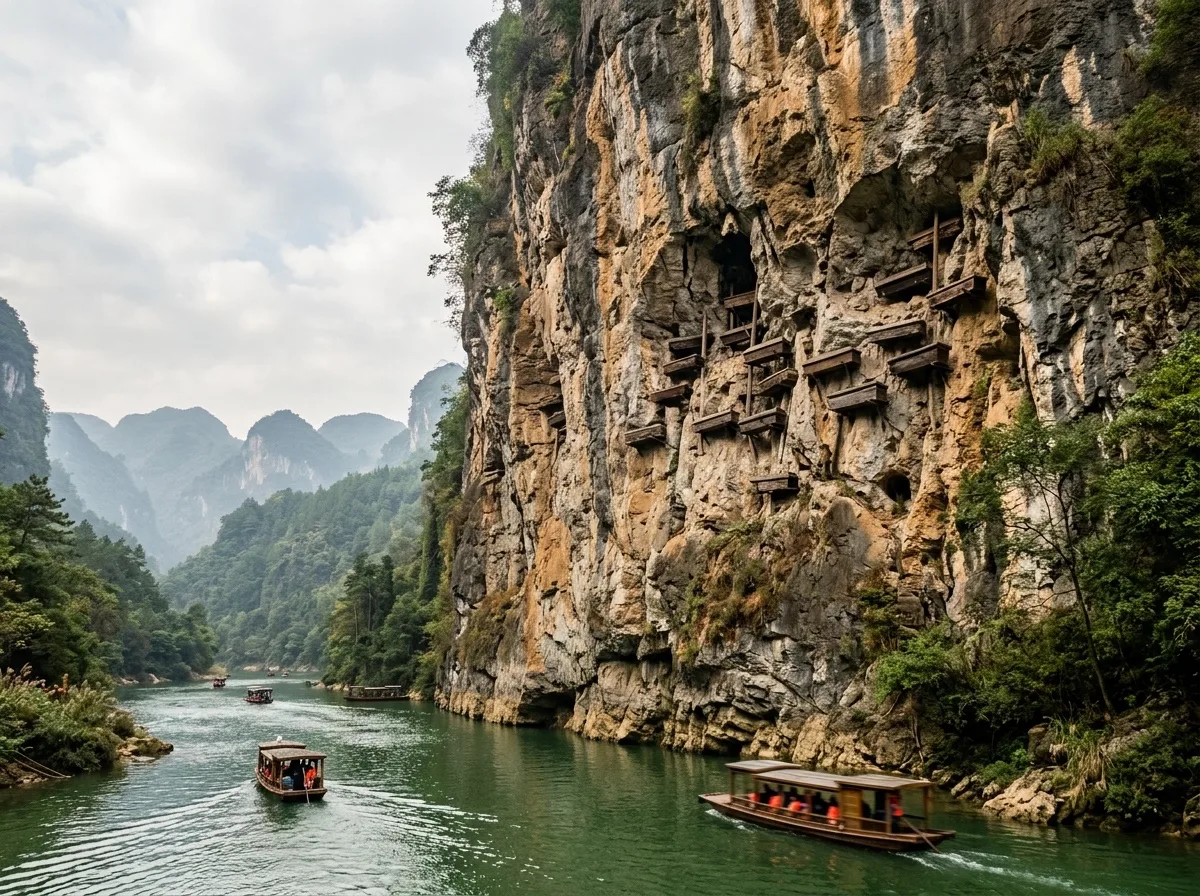
Bawu Gorge is commonly associated in tour narratives with cliff remains and hanging-coffin viewpoints. The vessel may not slow at every feature, and names announced from a loudspeaker can arrive before your eyes find the object. Use the guide’s direction as a starting point, then compare straight timber lines with irregular rock shadow.
Dicui, often translated as “Dripping Emerald,” foregrounds vegetation and moisture. The colour is conditional. Sun angle, cloud, recent rain, seasonal leaves, suspended sediment and phone processing all change green water and green walls. The name describes an aesthetic tradition, not a guarantee of emerald light.
The sequence is more valuable than a checklist. Longmen teaches enclosure, Bawu asks how people used a difficult cliff, and Dicui shows how water and vegetation soften stone. Exact stopping points and narration vary, but that progression can still organize your attention.
Hanging coffins are evidence, not a solved mystery
High recesses in the Three Gorges region preserve genuine cliff-burial remains, including wooden coffins placed in caves, crevices or on supports. Their elevation protected some timber and burial material, but it also encouraged exaggerated stories. Not every dark rectangle called out from a boat belongs to the same date, people or lifting method.
Accounts often connect the practice with ancient Ba communities and other river peoples of southwest China. “Ba” covers changing political and cultural worlds across long periods; it is not a simple label for every burial. Modern Tujia communities have deep regional ties, but they should not be reduced to a direct, unbroken museum display of one ancient group.
Researchers have proposed lowering coffins from above, raising them with timber scaffolds, or combining ropes and temporary structures. Different cliff sites may have used different solutions. The surviving beam holes, terrain, wood and burial objects matter more than a legend that one flood floated a coffin into place.
Treat the remains as graves. Do not cheer for a closer boat manoeuvre, fly a drone toward the opening or turn uncertain human remains into a horror story. The separate guide to the Yangtze hanging coffins goes deeper into the archaeology and ethical questions.
The smaller boat changes both scale and risk
When the Madu River extension operates, visitors commonly transfer to a smaller vessel for the Mini Mini Three Gorges. The narrower channel can bring rock, vegetation and water sound much closer. It can also make boarding gaps, low branches, wake and sudden weather more consequential.
Keep hands, phones and camera straps inside the boat. A low branch or passing hull can catch an object held beyond the side. Wear a life jacket as instructed even when the water looks calm, and do not stand merely because a photograph appears for a few seconds.
The transfer is a decision point for accessibility. A large sightseeing vessel may have fixed seating and better shelter, while the smaller boat may require steps, a narrow gangway or staff-assisted boarding. Travellers who cannot transfer safely can remain with an approved alternative only if the operator confirms one; never assume the main vessel will wait independently.
If the extension is cancelled, the visit is not incomplete. The main Daning gorges contain the central landscape and cultural evidence. An itinerary is a set of operating possibilities, not a contract with the river.
Wushan’s most famous clouds belong first to poetry
Tang poet Yuan Zhen (779–831) wrote a line now repeated across China: “曾经沧海难为水,除却巫山不是云”—“After seeing the vast sea, other waters are hard to call water; apart from Wushan, other clouds are not clouds.” It comes from the fourth of his Poems on Parting Thoughts, not from a Daning River timetable.
The poem is traditionally read through the poet’s grief for his wife, Wei Cong. Instead of listing her virtues, Yuan Zhen chooses comparisons so absolute that later water and clouds cannot match what has been lost. Wushan already carried literary associations of clouds, rain and longing, so the place-name condensed a much older cultural memory.
The couplet became a modern expression of unmatched love or experience. It appears in conversation, fiction and even advertising far from Chongqing. That afterlife explains why “Wushan clouds” can sound familiar to a Chinese visitor before the physical mountain comes into view.
Keep the layers separate. The verse gives the region emotional depth; it does not prove Yuan Zhen sailed this exact excursion or promise a sea of cloud. If mist arrives, watch it erase scale. If the sky stays clear, use shadow and cliff overlap instead.
A scenic cruise depends on river labour and river restraint
Captains, deck crews, ticket staff, guides, mechanics, cleaners and rescue teams turn a tributary into a public route. Residents have also adapted to changed shorelines, tourism income and transport patterns. The quiet frame from a passenger seat can hide constant work and the social costs of large water projects.
The Three Gorges project changed settlement and ecology across a vast region. Relocation, flooded heritage, improved navigation, flood-control goals, power generation and new economic opportunities belong to the same history. Do not reduce every local outcome to one slogan, positive or negative, and do not treat picturesque boats as proof that river life stayed unchanged.
Wildlife needs distance. Macaques may be promoted along some routes, but sightings and feeding rules vary. Never throw packaged food or plastic toward an animal, and do not demand that crew lure wildlife closer. Keep noise low near cliff nesting areas and carry all waste back to a managed bin.
Choose a licensed current service. An informal small craft that ignores weather, loading or life-jacket rules is not a more “authentic” encounter with the gorge.
Weather, transfers and mobility should set the plan
Build the day backward from the confirmed final return. Ask whether the ticket includes the Madu extension, how many transfers are required, which pier receives you, and what happens if weather cancels one segment. A cruise-ship shore excursion and an independently purchased Wushan tour may use different meeting points.
Rain can deepen colour and strengthen side streams, but heavy rain upstream can bring debris, reduced visibility or suspension. Fog can make the cliffs atmospheric while hiding hanging coffins and landmarks. Heat reflects from water; wind on an open deck can feel colder than the town. Carry layers, rain protection and medication you may need before the next landing.
A seated boat day is not automatically step-free. Floating piers move, ramps change angle and small vessels sit at different heights. Ask about wheelchair handling, accessible toilets, shaded seating and whether every stage accepts a mobility aid. Travellers sensitive to motion should choose a stable seat and follow medical advice; calm reservoir water can still carry wake.
Keep your passport or required booking document available, but confirm current rules rather than relying on an old review. Schedules, identity checks and boarding gates are operational facts that can change.
Photograph the narrowing, then put the camera down
For scale, frame a small licensed vessel against one full cliff face. A wide lens from the centre of the boat can show enclosure, but avoid leaning over the rail to gain another degree. A telephoto lens is more useful for a possible coffin recess and safer than trying to approach it.
Expose for the pale rock or sky so mist retains detail. Reflections and green colour shift minute by minute; do not force every frame into the saturated look of a poster. Include a current water mark, pier or protective structure when it explains how the gorge is used today.
On the return, look back at the point where the Daning opens toward the Yangtze. The walls that felt complete begin to separate, and nested corridors become a confluence again. Make one final frame with wake, cliff and open water together—then lower the camera long enough to hear the echo widen.
Use the Lesser Three Gorges 5A profile to locate the route. Continue to Qutang Gorge for the Yangtze’s compressed stone gateway, read the hanging-coffin guide before judging a distant burial, or compare the changed water system at the Three Gorges Dam. The Yangtze cruise guide helps connect tickets and transfers.
Location profile
Where it is

Frequently asked questions
Are the Lesser Three Gorges the same as the Yangtze Three Gorges?
No. The famous Yangtze sequence is Qutang, Wu and Xiling gorges. Wushan's Lesser Three Gorges lie on the Daning River, a tributary that meets the Yangtze at Wushan, and are commonly named Longmen, Bawu and Dicui. Tickets and tours may combine the two river systems, but they are distinct landscapes.
Are the Mini Mini Three Gorges included in every visit?
Do not assume so. The Mini Mini Gorges are a narrower Madu River extension that normally requires a transfer to a smaller boat. Inclusion depends on the product, water, weather, maintenance and current navigation controls. Confirm the complete route and return time before boarding.
Will I definitely see the hanging coffins?
No. Genuine cliff-burial remains exist in the region, but visibility varies with route, light, water level, vegetation and the guide's timing. A distant dark shape is easy to confuse with timber or shadow. Listen for the viewing cue and use binoculars or a modest telephoto lens rather than demanding a closer approach.
Is the boat trip accessible for travellers with limited mobility?
A seated cruise can reduce walking, but piers may have ramps, floating steps, narrow gangways and level changes as water moves. The optional smaller-boat transfer can be harder. Ask the operator about step-free boarding, an accessible toilet, wheelchair storage and whether assistance is available on every transfer.