Henan · Xinxiang and Huixian
Baoquan Tourist Area: A Taihang Canyon Rebuilt for Leisure
Separate Baoquan's cliffs and water-shaped valley from its managed reservoir, lifts, glass structures and changing entertainment zones, then choose a low or high route.
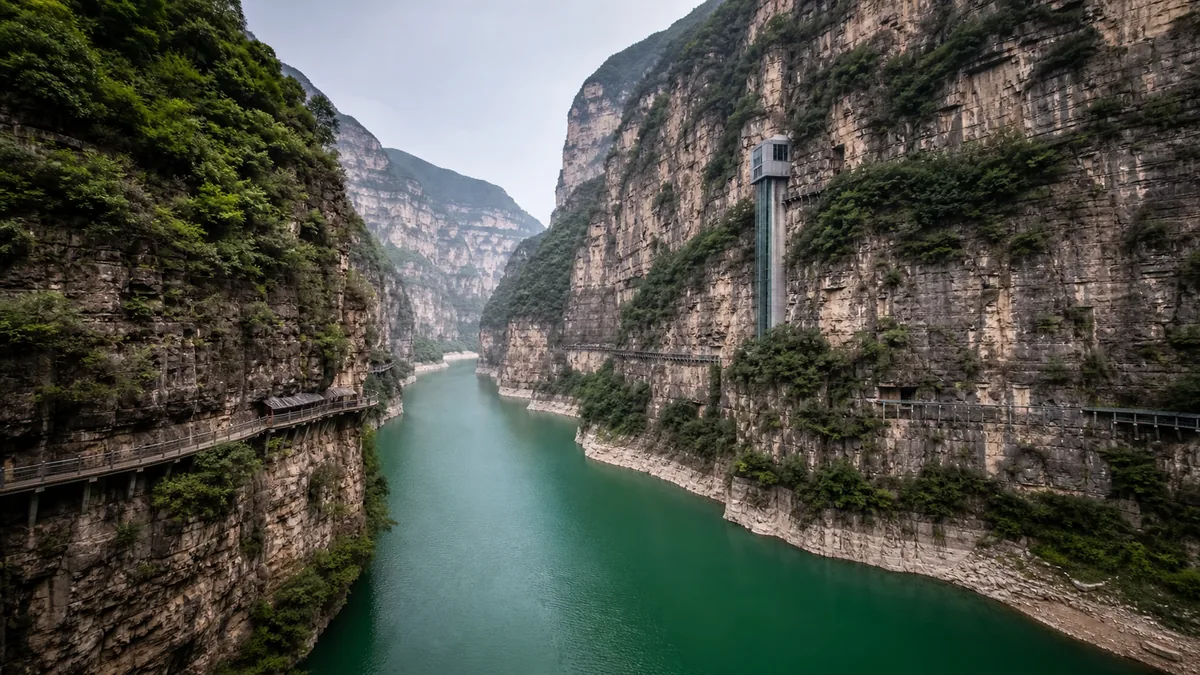
5A View location, maps and nearby scenic areasAt Baoquan, begin by finding the seam between mountain and resort. A vertical Taihang cliff may carry bedding and fractures formed long before people arrived. At its foot, a remarkably smooth path, controlled pool edge or carefully positioned viewing deck shows recent design. Both belong in the photograph. Hiding the infrastructure does not make the geology more authentic; calling the infrastructure ancient does not make the visit deeper.
Baoquan Tourist Area, near Huixian in northern Henan, is a contemporary canyon-and-reservoir resort. Its natural setting is real: high rock walls, ravines and water moving through the southern Taihang landscape. Its present visitor experience is extensively managed through roads, shuttles, lifts, railings, glass structures, landscaped water and entertainment zones.
Choose height before buying a package: a lower canyon-and-water day and a high cliff-and-engineering day have different effort, exposure and transport dependencies. Use the current official map; branded zones and included rides can change faster than the mountain.
Read the current map, not a permanent ancient plan
The Baoquan 5A profile gives a map anchor, but the dot cannot show multiple gates, parking transfers or vertical routes. Baoquan is marketed through named subareas and experience packages. Labels can refer to the original water-focused scenic sector, a newer cliff-world sector, particular valleys, shows or seasonal activities. These are operating brands, not historical districts fixed for centuries.
For orientation, reduce the options to two questions. Do you want to stay closer to the canyon floor and water, accepting a long linear walk and possibly wet surfaces? Or do you want the upper cliff experience, accepting height, modern lifting systems, queues and weather exposure? Some current tickets may combine both; physical distance and the last operating ride still remain.
Entrances, scenic vehicles and exit logic can differ. A route described online as a loop may now be one-way or included in another package. Ask where your final transport returns, whether a lift is essential or optional, and which attractions close first. Do this before joining the first shuttle.
Baoquan is pronounced approximately “baow-chwen,” with quan meaning “spring.” The name encourages visitors to imagine naturally emerging water everywhere. Onsite, distinguish springs and streams from impounded, diverted or recirculated water rather than using one poetic name as a hydrology report.
The Taihang cliffs are old; the visitor surface is new
Baoquan sits on the southern Taihang margin, where uplift, fractures, weathering and running water have cut into thick rock sequences over geological time. Horizontal-looking bedding can record ancient sediment deposition; vertical joints guide falling water and rock breakage. A narrow ravine concentrates sound and shade, while a wide cliff face makes people and structures appear small.
Do not reduce every red or pale wall to one rock type from a promotional caption. The broader Taihang has varied stratigraphy, and colour changes with mineral content, wetness, lichen and light. Use interpretation boards tied to a particular exposure when naming a formation.
Water exploits weakness. It enlarges cracks, carries sediment and undercuts steps, while freeze-thaw and plant roots help loosen blocks. These processes work unevenly over long periods. A dramatic waterfall did not carve the entire canyon in one event, and a dry wall has not stopped being part of a water-shaped landscape.
Modern construction adds another visible layer. Cut road benches, anchored railings, concrete channels, elevators and glazed platforms redistribute movement and sometimes water. They should be assessed for safety and environmental impact, not disguised as timeless features.
A reservoir landscape is nature managed through infrastructure
Baoquan’s present water scenery is linked to reservoir and water-management history as well as rainfall. Impoundment can create calm turquoise-looking reaches and reliable visual axes, but it alters flow timing, sediment, aquatic habitat and the relationship between upstream and downstream communities. “Natural water” and “artificial lake” are not the only two choices; a real river system can be heavily managed.
The area’s transformation from local mountain-water landscape and infrastructure corridor into a large visitor resort accelerated in recent decades. Roads, dams or waterworks can precede the newest entertainment branding. The exact opening year of one platform does not date the canyon, and the age of the canyon does not make a recent platform heritage.
Residents, construction workers, reservoir operators, cleaners, drivers and performers make the resort function. Development can create jobs and new access while increasing land pressure, traffic, waste and dependence on seasonal tourism. Reservoir and scenic management can also limit older uses of water or paths. A balanced visit notices both public convenience and who maintains it.
Water level and colour are operational and optical. Deep water can absorb light differently; sky reflection, shade, algae, suspended sediment and phone processing alter blue and green tones. Do not treat a saturated social-media image as a fixed natural property.
Lifts and glass structures are contemporary engineering
Baoquan’s high sectors use engineering to turn vertical terrain into an accessible spectacle. Depending on the current package, visitors may encounter cliff lifts, escalator-like transport, glass decks or bridges, cantilevered viewpoints and staged high-altitude activities. They can reveal scale and reduce some climbing. They are not evidence of an ancient cliff civilisation.
Before entering, study load signs, weather notices and exit direction. A lift removes elevation but can add boarding steps, queues and a dependency: if wind, lightning, inspection or power conditions stop it, the planned route may no longer work. Staff instructions take priority over a prepaid checklist.
Glass changes the experience more than the mountain. Looking through a transparent floor can provoke fear even when the structure is engineered and monitored. Visitors should never be pressured into it as the price of “really seeing” Baoquan. An opaque overlook can give a clearer geological view because attention moves from feet to rock layers.
Shows, rides and themed installations belong to a leisure economy. Enjoying them is compatible with serious observation, but describe them honestly. Schedules, performer access, age or height limits and separate charges can change. Confirm onsite rather than building a day around one advertised production.
Let the route match the question, not the package price
A lower water route suits visitors interested in canyon walls, managed pools, streams and reflections. It commonly involves sustained walking even when gradients are modest. Wet stone, splash, narrow sections and crowd flow matter. Walk away from the busiest frame and compare a natural rock edge with a constructed bank.
A high cliff route prioritises panoramas, vertical relationships and modern access engineering. It may use lifts or scenic vehicles, but upper walking, stairs, sun and height exposure remain. Wind and thunderstorms can close exposed facilities before lower paths.
A comparison route uses one lower sector and one high viewpoint. It can be satisfying if the current transport link is clear; it becomes exhausting when visitors repeatedly transfer between branded attractions to recover the value of an expensive bundle. More inclusions do not create more attention.
Families should choose two or three meaningful stops rather than every ride. Strong walkers can extend a canyon route but still need the last shuttle time. Visitors focused on photography often gain more from waiting for changing light at one pool than from racing through several glass structures.
For a less resort-engineered South Taihang canyon comparison, Bali Gou emphasises long valley and waterfall routes. The Yuntai Mountain group adds three separate areas and an even larger transport-planning problem.
“Delighting in mountains and water” has modern consequences
The Analects contains a famous line often translated, “The wise delight in water; the humane delight in mountains.” It is a moral analogy, not an ancient review of Baoquan. Yet it helps explain a durable Chinese habit of reading water as responsive movement and mountains as stable character.
Baoquan’s modern echo is unusually literal: a commercial resort packages water below and mountain height above into selectable experiences. The pairing can sharpen observation. It can also turn “mountain and water” into visual commodities expected to be bright, full and instantly accessible.
Pause at a service corridor or reservoir edge and notice the hidden labour behind ease. Someone checks a lift, clears wet paving, monitors water, directs traffic and performs for a timed audience. Their work belongs to the landscape visitors actually encounter.
Environmental care is not fulfilled by calling the water beautiful. Carry waste out of crowded resting areas, use refill points where permitted, avoid feeding fish or wildlife and never add stones to decorative stacks. Respect closures around water infrastructure even if they interrupt a preferred photograph.
Water, weather and names are all conditional
Waterfall power depends on recent rain, catchment conditions and management. Reservoir operation can raise one reach and reduce another. Pumps or recirculation may support particular visitor scenes. Without a site-specific sign, do not claim that every cascade is either completely natural or completely artificial.
Heavy rain presents the opposite problem from low water. Narrow valleys can concentrate runoff; falling rock, slippery paths and sudden closure can follow storms upstream even if the entrance is dry. Leave when staff direct evacuation. Summer heat and crowding bring dehydration; winter shade can preserve ice.
Cliff lifts, glass decks, boats, shows and shuttles are operational systems. Check current notices on arrival and again before committing to a one-way section. Keep a lower-route alternative that remains worthwhile if high facilities close.
Names and packages change as the resort expands. Save a screenshot of the current official map for navigation, but defer to physical signs. An old review may use a former gate name or bundle several paid experiences under “Baoquan.” Avoid arguing with staff using a map from another season.
Photograph relationships and make accessibility specific
For the most informative canyon image, include a natural cliff joint, managed water edge and a human-scale element. This frame shows geology, hydrology and resort design together. A polarising filter can change reflections, but extreme colour editing turns water conditions into a claim that may not be true.
From a high viewpoint, use a solid foreground edge rather than leaning a body or phone beyond the rail. Secure hats and loose objects in wind. Drones may conflict with crowds, infrastructure, performances and protected airspace; obtain explicit permission.
“There is a lift” does not mean “the attraction is accessible.” Ask about the entire chain: parking-to-shuttle boarding, lift entrance, station steps, surface gradients, toilets and the exit return. Wheelchair users may find one lower paved segment practical while a glass or cliff route remains inaccessible. Staff can identify current barriers better than a generic icon.
People with vertigo can avoid transparent floors and exposed cantilevers. Visitors with hearing or sensory needs should ask about loud shows, amplified music, lighting and crowded transfer halls. A quiet water-side visit can be complete without the newest high-altitude attraction.
End at the seam between canyon and resort
Return to the first seam. The cliff contains bedding, fractures, weather and long erosion. The path at its foot contains design, capital, regulation and daily maintenance. Baoquan is most interesting when both layers remain visible.
Calling the whole place untouched nature erases reservoir history and contemporary labour. Calling it only an amusement park erases the Taihang landform that makes every lift and pool legible. The honest description is a modern resort built intensively around a real canyon-and-water system, with benefits, dependencies and environmental costs.
For a final photograph, let one modern railing lead the eye toward an old rock wall rather than cropping it out. Then put the camera away and listen: flowing or pumped water, wind against a lift tower, footsteps on smooth paving. That mixed sound is Baoquan’s present tense.
To see a very different way people engineered the Taihang landscape for water, continue to the Red Flag Canal. There, infrastructure was built to distribute scarce water to communities; at Baoquan, much of the visible infrastructure distributes visitors through water scenery. The comparison makes both places clearer.
Location profile
Where it is

Frequently asked questions
Is Baoquan an ancient scenic site or a modern resort?
Its Taihang cliffs, valleys and erosion processes are natural and far older than tourism, while the reservoir landscape, paths, lifts, glass structures, performance spaces and branded zones are modern infrastructure. Baoquan is best understood as a contemporary resort built around a real mountain-water setting, not as an untouched ancient park.
Which Baoquan route is better: the canyon floor or the cliff area?
The lower canyon route usually prioritises water, pools and easier gradients, though walking and wet surfaces remain. Higher cliff packages emphasise vertical views and engineered access, but can involve height exposure, stairs and more dependence on lifts or scenic vehicles. Names and combinations change, so choose from the current map rather than an old blog.
Are the blue water and large waterfalls guaranteed?
No. Colour changes with light, depth, algae, sediment and image processing; waterfall and channel flow depend on rainfall, reservoir operations and maintenance. Some water scenes are managed. Check current conditions and value the cliff form and visitor engineering even when water is lower.
Is Baoquan accessible for visitors with limited mobility or fear of heights?
Shuttles, paved sections and lifts can reduce effort, but they do not create a fully step-free visit. Boarding gaps, queues, slopes, wet paving and stairs remain, while glass or cliff routes may be unsuitable for vertigo. Ask the visitor centre for the shortest low-level route, current lift status and accessible toilets before buying a package.